
Hey Parra fans, welcome to this week’s issue of TCT Golden Point. This week I am taking an evidence based, but ultimately subjective look at the resignation of NRL CEO Andrew Abdo: the fall-out, the next steps and the volatile corporate landscape that awaits his replacement. As always, I hope you find it insightful and engaging.

THE EXECUTIVE EXIT, THE POWER SHIFT, AND THE CORPORATE MINEFIELD
Andrew Abdo (AA) has announced his resignation as NRL CEO, to take up a new position as Tennis Australia CEO. His departure reflects careful timing from a corporate perspective. The NRL has confirmed that AA will remain until 15 July, to support current broadcast negotiations. Peter V’landys (PVL) will then act as interim CEO, and ARLC Chairman until a permanent successor is appointed.
AA leaves the NRL in a strong commercial position: annual revenue is approaching one billion dollars, attendance figures have increased significantly, Las Vegas has provided the sport international exposure, expansion plans are progressing, and negotiations for the next broadcast deal are underway.
As a result, AA concludes his tenure with a reputation as a growth-oriented CEO who was not afraid to disrupt the status quo in the name of commercial gain. The timing of his departure is notable, as he steps down prior to several challenging negotiation and implementation phases for the game and its administration. This transition is important, as the incoming CEO will not only assume responsibility for commercial achievements, they will also need to address the resulting challenges.
The Power Shift
With AA departing, attention immediately turns to the ARLC Chairman, PVL: who has confirmed that in early July he will commence four months’ long-service leave from his role at Racing NSW, to enable him to assume the interim dual responsibility of NRL CEO and ARLC Chairman. While making clear he will not formally seek to make the arrangement permanent at present, he has not ruled out the possibility.
This is not a standard caretaker CEO arrangement, it is closer to an executive chairperson model, and that changes the power dynamic inside the game. AA and PVL appear to have served different informal functions as a duo, PVL has been the transformative force: commercially ambitious, combative, media-savvy, and willing to challenge convention. Whereas AA has been the ultimate corporate operator: detail-focused, diplomatic, and more measured in his dealings with clubs, executives, and stakeholders. Together, they created something of a good-cop-bad-cop balance, but without AA, that balance changes.
The next phase of negotiations for: broadcast rights, expansion execution, club funding, salary-cap pressure and player relations, may now unfold with stakeholders dealing more directly with the game’s ultimate powerbroker. That could be effective for the NRL/ARLC’s bottom line, but it could also be combustible for other stakeholders, particularly players and fans. The issue is not that PVL is incapable, the issue is that statistically, concentration in decision making across business areas naturally creates a significant governance risk, regardless of who is at the helm. An executive chairperson model brings strategy, oversight, and day-to-day executive influence closer together at exactly the moment the NRL needs to build trust through robust checks and balances.
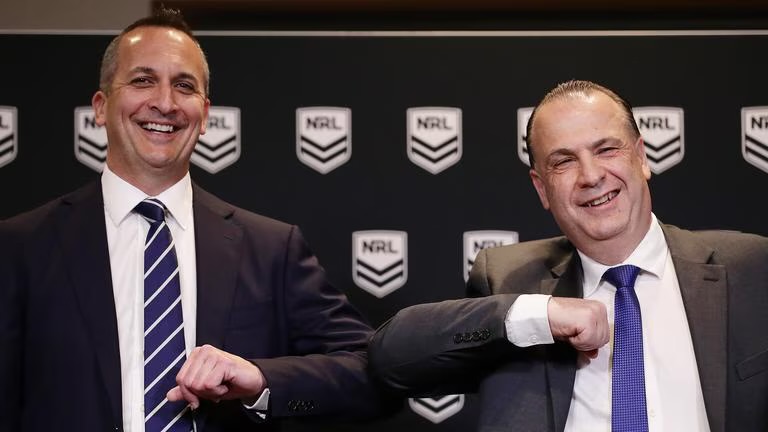
The bromance is over. But who will take AA’s place? Will anyone? Source: NRL
The ASX Corporate Governance Principles prescribe that the role of chairperson and the role of CEO, should not be conducted by the same person, because it weakens the relevant board’s ability to challenge management and hold it accountable. The NRL is not an ASX-listed company, but the governance principle still applies. The chairman’s role is to lead the board, test executive advice, oversee management, and protect governance standards; whereas the CEO’s role is to run the organisation. When the chair moves into executive control, that separation becomes blurred and commonly creates three clear business risks:
- If one person is both shaping direction and leading its execution, the rest of the Commission must work harder to scrutinise decisions rather than simply endorsing them. Otherwise, it raises huge questions around the ongoing integrity of existing governance and accountability frameworks;
- If major business decisions and strategic positions are established during the interim authority period, the permanent CEO may inherit a narrower role than expected; and then be limited in their ability to effectively govern, repair, and mould the game to the extent they would otherwise.
- These two things in-turn could further damage public-fan belief, and club-player trust in the administration. Even if decisions are in-fact sound, if the game is being run by one dominant figure rather than through a balanced executive and board structure, stakeholders may still lose trust in the system.
The timing makes the issue more plausible; this is not happening during a quiet period. The NRL is dealing with unprecedented media negotiations, expansion tensions, player welfare and RLPA trust issues, salary-cap and tax-concession concerns, club funding pressure, officiating scrutiny, and rule-change controversy. That is exactly the kind of volatile business environment where clean separation between board oversight and executive management is imperative.
An executive chairperson would obviously remain accountable to the ARLC board, the organisation’s constitution, and broader governance rules. The concern is that executive models can by default create an overly deferential immediate governance environment, blurring the lines between oversight and control. If one figure normalises setting the agenda, driving execution, and shaping the public narrative, any incumbent CEO may be limited in their ability to challenge, redirect, negotiate or advocate in their role.
The current administration seems focused on the game’s universal growth in their measurement of strong leadership; but what the game needs more than anything is stronger governance. This requires more than a strong leader capable of growth, it requires a formal separation of powers, broad scrutiny, and proportionate accountability.
That is why the next appointment matters so much. Not to worry though, the ARLC have stated they are using the next three months to conduct a formal recruitment process, right? This is just an interim arrangement? It’s temporary, there is nothing to see here.
The Constitutional Elephant in the Room: Could the Interim Arrangement Become Permanent? (An explanation of the process – not an entertainment of actualisation)
I have been trying to ignore the growing online discourse and formal reporting around this issue, largely because I suspect much of it is politically and commercially driven by the looming broadcast deal. That being said, some mainstream pundits are now promoting the idea as possible, probable, and plausible; and some fans are understandably starting to worry.
While the possibility does concern me, I am not yet convinced it is achievable at present. Because when the urgency of the NRL’s immediate operational demands is weighed against the formal process, stakeholder control and highly regulated constitutional change required to make it happen, it would be difficult to execute, at least for now.
In that context, it is worth briefly visiting how the current ARLC constitution came about, how ARLC constitutional change occurs, and what that means in practical governance terms.
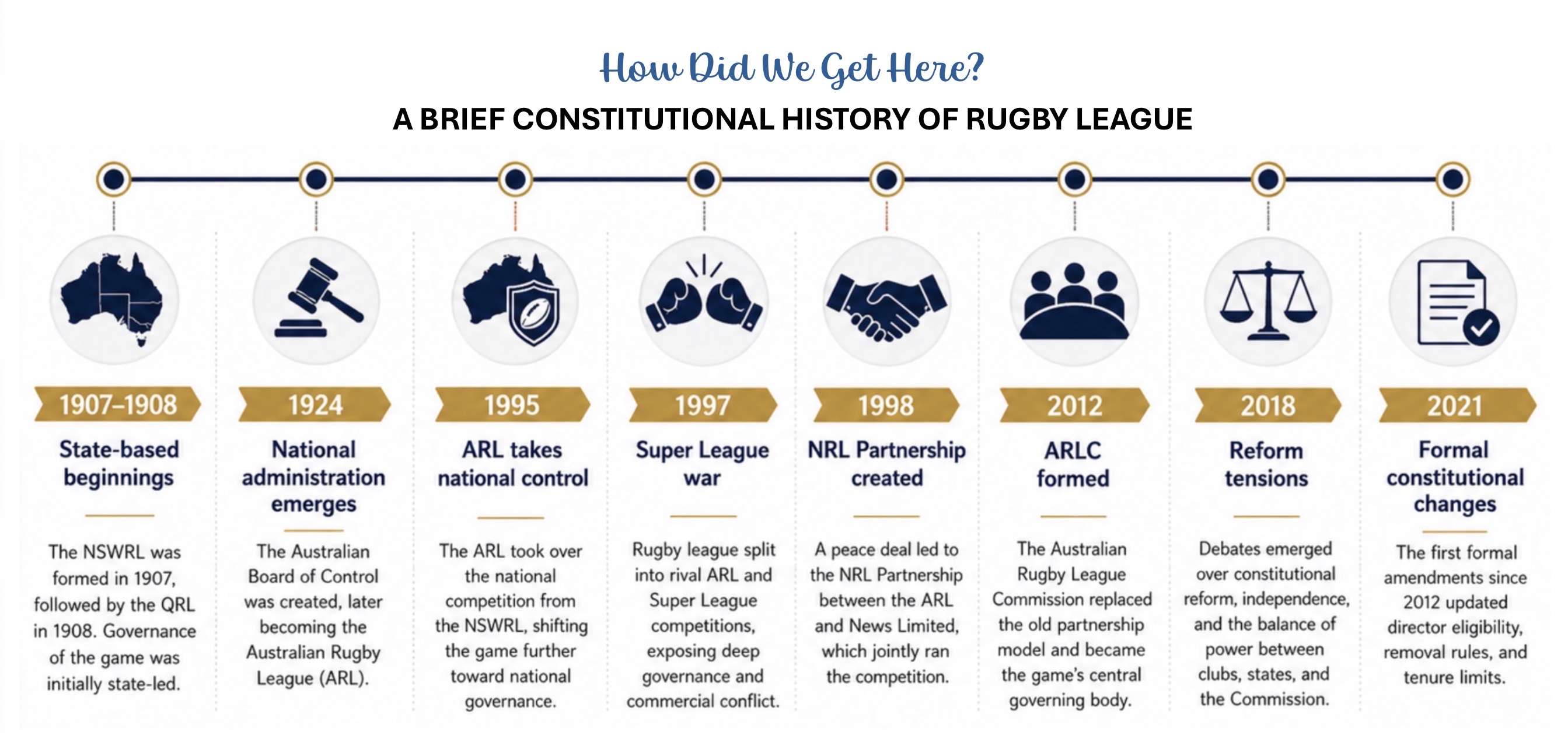
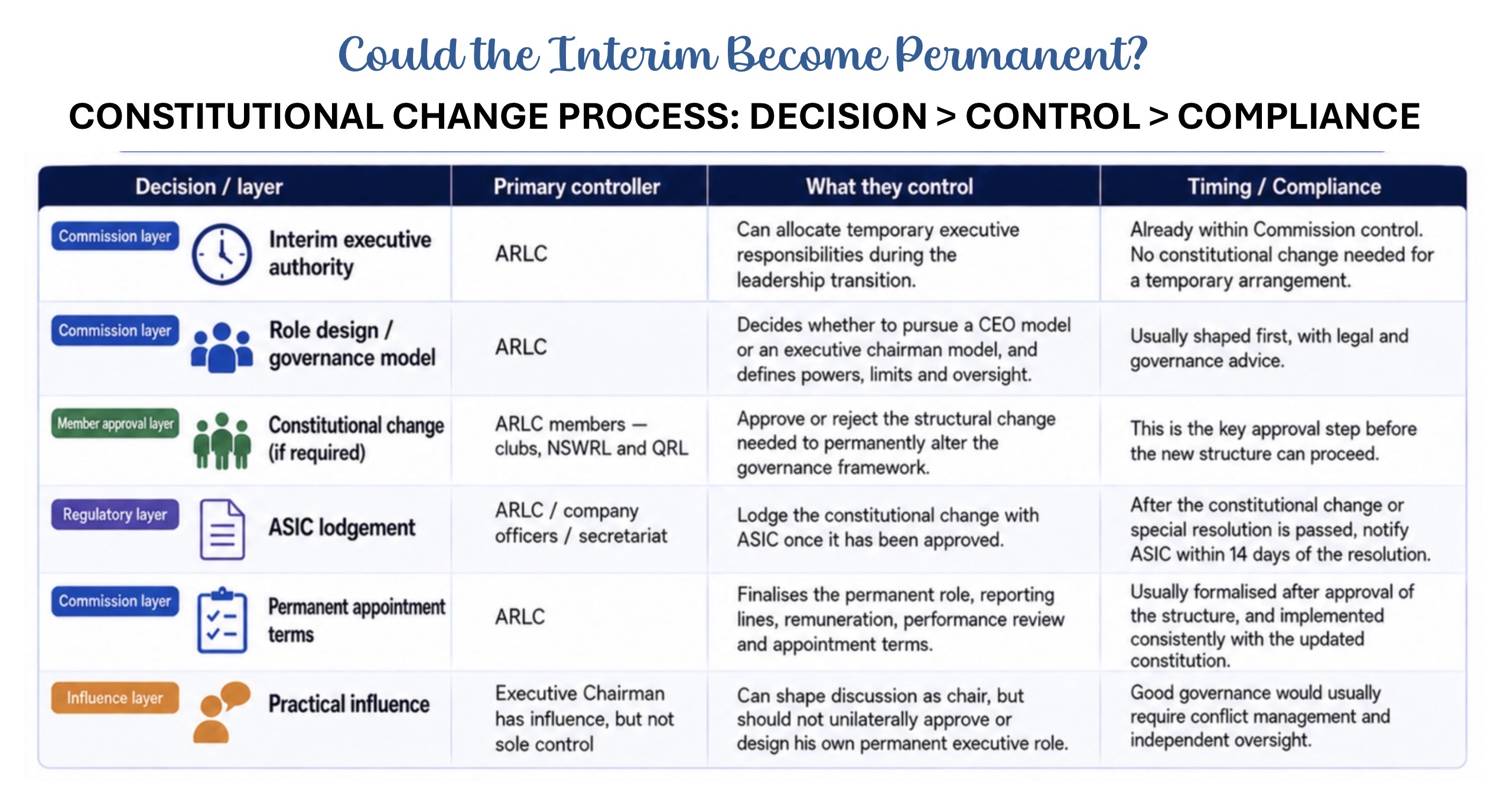
Infographics created by the Author using Canva & MS PP. Information Sources: NRL, ASIC, ARLC, AFR, Corporations Act 2001 (Cth).
Okay, with all that in mind, I think it’s time to trust the process on this one for now. But before we move on, there are a couple of important points that are being consistently misrepresented in pro-administration media reporting that I wanted to assert:
- A chairperson acting as an interim ‘executive chairperson’ cannot simply declare themselves permanent off their own bat. They can want it, lobby for it, and use the interim period to build support, and normalise the behaviours that define it; but the formal power to make this interim change permanent sits with the relevant Commission, its members, and the highly regulated process they must follow to change the current ARLC constitution.
- This potential scenario could only become a permanent reality if the ARLC back the move, the clubs and state bodies approve the necessary constitutional change, and the NRL-ARL formally restructure the CEO/chairman position and their business relationship. Though as acknowledged in the business risks towards the start of this section, statistically there are ways that an interim arrangement of this type might allow similar behaviours to be informally applied without appropriate oversight, effectively allowing broader control in the absence of formal approval.
Once again, that is why the next appointment matters so much. Now, let’s try and put that disturbing scenario aside and take a broad look at the discussions happening around AA’s replacement. After all, this is an interim arrangement. It’s temporary, there is nothing to see here.
The Formal Search for the Next CEO
AA was a growth-and-delivery CEO: commercially sharp, operationally reliable, composed, and trusted by the chair. While AA and PVL are professionally considered a successful duo, it is unlikely that the ARLC will be looking for another visionary CEO in the traditional sense this time around. I am hopeful they will be looking for a CEO who is a high-level commercial operator, with football credibility and stakeholder maturity: someone capable of executing the chairman’s agenda, managing club relationships, calming stakeholders and keeping the commercial machine operating smoothly.
That makes the appointment delicate. If they choose someone too siloed in experience and/or overly independent in nature, internal tensions may arise, if they choose someone whose experience is too generalised and/or overly agreeable in nature, the role risks becoming little more than administrative cover for the centralised power. In my humble opinion, the latter is a big possibility-risk, though I believe the game really needs something in between. Someone with stoicism, humility and business acumen, who can work productively alongside the current administration, while possessing the ability and Emotional Intelligence (EQ) to challenge the status quo professionally and proportionately when and where it is required.
While it’s only been a few days since AA’s announcement, several potential candidates have already been floated across mainstream and independent media circles as potential successors to AA. Early frontrunners range from current ARL Commissioners, NRL Executives and rugby league administrators; to broader sports, media, and business executives. Although no-one has really gone beyond names and current position summaries at this stage, most have listed the same names. What I find most interesting/amusing, is that while the candidate names and summaries are almost identical across publications, the overall comparative assessment shifts focus to different ideal candidates that coincidentally correlate with the publication’s best interests.
As someone with considerable experience overseeing end-to-end legislative compliance throughout high-stakes recruitments, I am hesitant to name a potential candidate publicly before formal expressions of interest have been confirmed. The internet is a fickle thing, and in 2026, even speculation can cause AI algorithms to influence public perceptions of a candidates suitability or where their professional/personal interests and intentions lie. While I intend to conduct a subjective comparative analysis on each potential candidate’s suitability down the track, it is too soon to do that effectively, and in a manner that would be of great value.
One thing I did notice about the speculative candidate pool, is that there are no international candidates. I suspect the ARLC will at the very least conduct a preliminary scan for suitability across the Global Executive Market as part of their procurement/recruitment process. Even if the eventual preferred candidate is an Australian, if they genuinely want the NRL to become a larger international product with greater reach and influence, it should at least test the global market. The strongest international options might be sport or general corporate executives, with experience in global broadcasting rights, expansion, player health & welfare, governance & accountability frameworks, and sustainable commercial growth. Executive leaders from international rugby league circles or cross-code environments may also have value.
It is important to note, that while AA himself has just been poached by Tennis Australia, it was only after a global search relevant to Tennis Australia’s business needs. Hence my suggestion to ensure the next NRL CEO is the best candidate for Rugby League, they should also scan the global market for potential outliers.
But the strategic question is bigger than the names and resumes. The real question for mine is: what kind of CEO the ARLC wants after AA? Whether the ARLC wants a commercial force, or continuity with current strategic objectives, the preferred candidate will need governance, stakeholder management, and industry credibility; with an equal balance of club, commercial, legal and operational understanding. The next NRL CEO will be walking into an impending corporate minefield of high-stakes commercial negotiations and unprecedented expansion implementation. That means the next CEO cannot simply be a passenger, a spokesperson, or an administrative executor, they need to be a stabiliser. Watch this space.
What type of Leader are the ARLC looking for in their next NRL CEO?
The Impending Corporate Minefield
The next NRL CEO does not simply assume responsibility for a billion-dollar business experiencing unprecedented momentum, they will inherit the associated pressure, conflict, and consequences at every level of the game.
- At the macro level, the broadcast-rights battle looms large. With the current deal expiring after the 2027 season, the next agreement will shape the NRL’s revenue, accessibility, commercial strategy and long-term direction.
- At the meso level, player relations remain fragile. The current CBA also runs to the end of 2027, meaning the next CEO will inherit early positioning for another potentially difficult negotiation cycle with the RLPA after a bruising and public breakdown in trust.
- At the micro level, expansion brings major delivery risks for new and existing clubs. The Perth Bears and PNG Chiefs may represent growth, but their survival will depend on the implementation of that growth and whether it translates into supporter engagement, and competitive credibility.
Then there is the need for the reparation of the public’s trust in the administration, the public perception impacts, which cut across all three levels. It is the consumer warning light the NRL/ARLC have ignored for too long. When commercial ambition, poor governance and inconsistent communication are concurrently prevalent, public trust naturally begins to erode. For a game that is experiencing unprecedented growth, why is it that it also feels increasingly expensive and out of touch with its core consumer? Public perception can be as valuable as profit, particularly with reference to long-term sustainability, it is a whole-of-system legitimacy risk.
AA leaves his role as NRL CEO with the label growth orientated leadership success story, but his successor shall only inherit high level delivery, compliance and reputational risks, and consequences of the growth that’s been created.
MACRO LEVEL: Broadcast Negotiations and the Fragmentation Risk
The broadcast negotiations may become one of the first major tests of the NRL’s next era. The NRL clearly wants to maximise the value of its next rights package. That is understandable as broadcast revenue remains one of the game’s most important financial engines, and live sport is still one of the few products that can reliably attract large audiences in real time. As the game expands into Perth, PNG, Las Vegas and the broader Pacific, the NRL should absolutely seek fair market value for its growth.
But leverage only works if it is handled carefully. The risk is not ambition itself, the risk is what happens if the pursuit of maximum value creates a product that is harder, more expensive, or more frustrating for supporters to follow.
Reports have already suggested the NRL may explore a more fragmented, US-style broadcast model, where different parts of the product are sold separately. Thursday night football, Monday night football, streaming exclusives, representative fixtures, international content and digital-only products could all be packaged in different ways. Commercially, that may make sense, splitting rights can create competitive tension between broadcasters and streamers. It can bring more bidders to the table and allow the NRL to extract more value from different parts of the calendar.
But from a fan perspective, fragmentation creates real danger. If the game becomes spread across too many platforms, supporters may be forced to pay for multiple subscriptions just to follow the sport properly. One service for weekly club games, another for streaming exclusives, another for representative fixtures, another for international content, and another for marquee events.
I am not confident that kind of business model is viable or practical for Rugby League’s core demographic in Australia. Growth matters but so do the needs and resources of existing fanbases. It may look impressive on paper from a projected profits perspective; however, it’s far less impressive to a family already juggling general cost-of-living pressures, club memberships, merchandise, and junior sport fees. This is where commercial ambition can start colliding with community accessibility.
Rugby league is not just content; it is community infrastructure, routine and tribal identity. It is Thursday night frustration, Friday night release, Saturday family viewing and Sunday afternoon habit. If supporters have to ask, “what app is this game on?” before every round, the product may technically be worth more to the administrative bottom line, while at the same time becoming out of reach to the very people that have kept it alive for over a century.
That is why free-to-air exposure still matters. It is not just a legacy arrangement or commercial compromise; it is a recruitment resource that keeps rugby league accessible, culturally present and relevant to all Australians. If the next broadcast deal delivers record revenue but leaves supporters frustrated, priced out or confused, the game may win financially while losing something more important: accessibility, trust and cultural reach.
The same principle applies to scheduling. Reviving Monday night football may create another sellable broadcast asset, but it also raises questions about crowd attendance, player welfare and fan fatigue. A Monday night product may work commercially, but it cannot simply be treated as another inventory line if it weakens the live atmosphere or stretches supporter engagement too thin.
None of this means the NRL should undersell itself. Clubs need funding, players deserve investment, and sustainability requires robust finances that support pathways, regional development, integrity systems, officiating technology, and player welfare. But the best broadcast deal is not simply the biggest number, the best deal is the one that balances revenue, reach and supporter trust.
Fans should still be able to follow their club without needing several paid platforms. Key matches should remain accessible on free-to-air television. Streaming should improve the product, not scatter it. Additional content, documentaries, archive access, lower-grade coverage and enhanced digital features can be monetised without turning the main competition into a subscription scavenger hunt.
An effective option for fair access to subscription matches (in my opinion), would be to offer access to their club’s televised games as a bundled incentive included in all club memberships. Which is a model that would give the administration and the clubs a concurrent major financial uplift while maintaining accessibility. If a fan is willing to become a member, they deserve access to at least watch their team play each week. In simple terms, the NRL can monetise growth, while acknowledging loyalty.
Commercial ambition is necessary, but fragmenting the fan experience is optional, and chasing commercial ambition at the expense of fan experience is just bad business. The next CEO needs to acknowledge, own and address this as a significant and fundamental consideration throughout the remainder of the broadcast negotiation process.
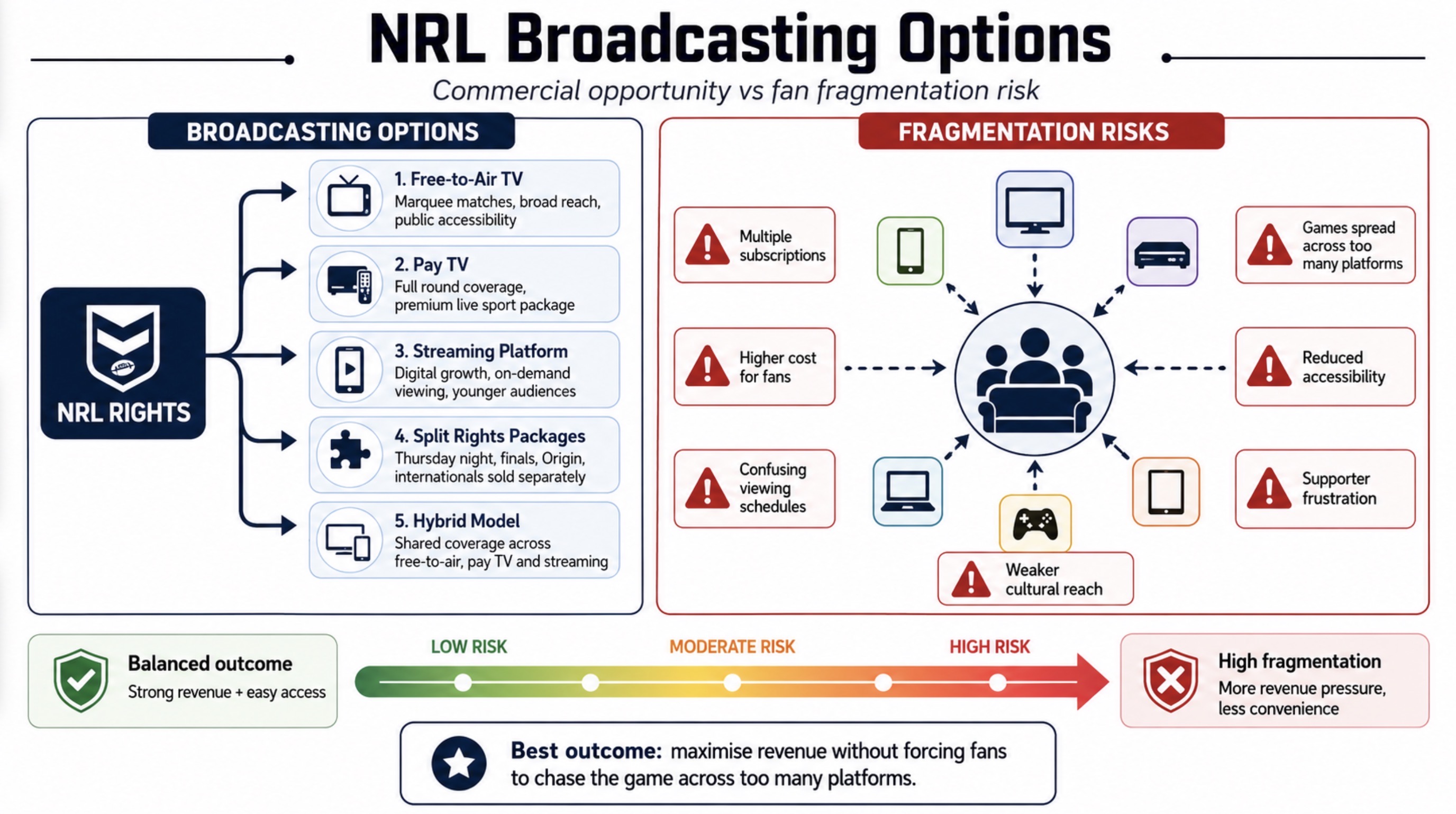
Broadcasting Negotiations: Commercial opportunity vs fan fragmentation risk. Created by the Author using Canva & MS PP. Information Source: NRL & AFR.
MESO: The RLPA Factor
The next NRL CEO will also need to prioritise rebuilding and maintaining trust within the player groups; this cannot be treated as a secondary issue.
The modern NRL is faster, more demanding and more commercially valuable than ever. The players are the products greatest value, but they are also employees operating in a high-risk environment. Workload, fatigue, concussion management, travel, scheduling, representative commitments, and rule changes are not just football matters, they are workplace matters.
That point has become sharper following the RLPA’s latest player survey on the impact of the 2026 rule changes. Released on 26 May 2026, the survey captured the views of 57 player leaders, mostly RLPA delegates from every NRL club, after Round 10 of the season. The results will be difficult for the next CEO to ignore.
According to the RLPA, 96.5% of respondents believed overall match speed had increased or significantly increased, 74% said physical match intensity had increased, and 77.5% said the amount of continuous play had increased. Most strikingly, 94.5% said fatigue during matches had increased, while 73.5% said they were always or often more fatigued in the later stages of matches compared with 2025.
That is not simply players complaining that rugby league is hard. Rugby league is supposed to be hard. The issue is whether the game’s administrators are properly listening when the people absorbing the collisions say the workload profile has changed.
The same survey found that two-thirds of respondents said fatigue always or often impacts their tackling or skill technique, while 61.5% said their level of concern about injury during matches was higher than in 2025. Almost half said their ability to recover between matches was worse, and 65% said their physical soreness in the 48 hours after a match was worse than last season.
These results should matter at every level of the game. At executive level, addressing them should be treated as a priority, not a public relations problem. Yet in AA’s final period as CEO, concerns from players, fans and commentators were too often framed by head office as issues of adjustment, interpretation or misunderstanding. While the NRL pointed to its own data and rule rationale, the RLPA’s response shows players were still seeking a more rigorous explanation of how rule changes were affecting speed, fatigue, injury risk, welfare and career longevity.
Once fatigue begins affecting tackling technique, recovery, soreness and injury concern, the conversation moves beyond entertainment value. It becomes a governance issue, a workplace health and safety issue and a question of whether the NRL is designing the game in a way that protects the players as well as the product.
The RLPA has already shown it is willing to challenge the NRL publicly when it believes players have been sidelined. In April 2026, The latest Players’ Pulse Report release added another layer. You can read more about the results of this report and their implications here: TCT Golden Point – 1 May 2026 – Due Diligence by Design: Balancing Safety, Sustainability and Spectacle
That analysis in conjunction with the latest report is the context and responsibility the next NRL CEO will inherit. Player relations cannot be managed by a press release. They cannot be reduced to optics, spin, or carefully worded statements about consultation. If players believe decisions are being made around them rather than with them, trust will continue to erode.
Rugby league already knows what happens when that trust breaks down. The 2023 CBA dispute escalated into a player media boycott, with players refusing game-day media commitments as part of their industrial response. At the time, the RLPA did not rule out further action. That should remain a warning to the next CEO: the players are organised, informed and increasingly prepared to use their collective voice.
A more combative head-office style may play well in headlines, particularly with fans who enjoy a strongman administrative approach. But headlines do not build stable labour relations. Trust does. Transparency does. Early consultation does. Data-led decision-making does. Respecting the RLPA as a legitimate stakeholder does.
The next CEO does not need to hand the RLPA control of the game, but they do need to recognise that player voice is now part of the game’s governance architecture. Ignore it, and the NRL risks turning every rule change, scheduling decision, and workload debate into a flashpoint.
Respect it, and the game has a chance to build something more sustainable: a product that remains fast, physical and commercially powerful, that is designed with respect to the safety of the people who make it possible and making it accessible to the people that keep it relevant.
MICRO: Expansion = Growth or imbalanced Competition?
Expansion is another major test for the next CEO. But I won’t discuss that in this piece as it’s been covered at-length over the past two weeks. You can read them via the links below:
TCT Golden Point – 23 May 2026 – Expansion Equity, Competitive Balance and Fan Fatigue
Final Thoughts
At the end of the day, AA leaves with the NRL’s commercial story looking stronger than ever. Though the next CEO will not simply inherit that success story, they will also inherit the consequences of it.
The developments across the game over the past week only sharpen that sentiment. AA’s exit is not just a leadership change; it is a stress test for the administration’s governance model and accountability framework.
With PVL moving closer to the executive controls in the interim, his next moves will tell us a lot about what the ARLC thinks the new NRL CEO should be. Will they be a genuine leader? A corporate operator? A carbon copy asked to make the chairman’s vision work? Or the Chairman himself?
All I know is the next NRL CEO does not need to be another headline-maker. They need to be the person capable of turning AA’s planning for PVL’s ambition, into a stable, credible, and sustainable competition.
Thanks for reading and supporting The Cumberland Throw.
Until next week…
Roly-Poly


PVL’s proposed “executive chairman” role is actually the default model that professional sports around the world use, with the notable exception of Australia.
Hi Brett,
Thanks for your thoughts.
I think we may be looking at this issue through different lenses.
I understand an executive chairman (EC) structure is the predominant model in international team sport (USA NBA, NHL, MLB, IPL etc). However, these professional leagues are all privately owned companies.
The ARLC is a Not-For-Profit Company Limited by Guarantee (NFPCLG); and it is best practice for this operational type to have a governance structure that separates the chairperson role from the CEO role. Whether they are based in Australia or not (e.g. US Soccer, FA Cup are two examples).
Privately owned leagues, clubs and franchise-based competitions operate under vastly different commercial and governance structures to NFPCLG leagues.
I am not saying the EC model is universally bad. I am saying it is not recommended and is considered very risky business when it comes to Not-For-Profit companies Limited by Guarantee.
I respect your alternative view all the same.
Thanks,
Roly-Poly
Hi RP,
My first post was a quickie, I was just making the observation that the centralised executive role was the most common in the world, particularly the Anglosphere. I understand the different corporate structures, just making the observation.
That being said, I still think the most transparent structure is a single individual, CEO or Commissioner as in the US, answering to a board of the member clubs representatives. It gives the games fans in particular clear understanding of who is making the decisions, ie, who’s to blame !!!
Right now the question, who is making these decisions ?, and is the ARLC actually holding that decision maker accountable, particularly around football questions ? Who in the commission is actually equipped to make sound decisions on football matters, and yes obviously Wayne Pearce is on the commission ? I’ve never been wholly convinced that the ARLC is fit for purpose in this matter. The constant reflexive rule changes are testament to that.
As for the commercial side, the next round of broadcast rights are going to be interesting. I used to be a vocal proponent of maximum atomisation of the rights, however I’m now more measured in that. I think that the league should definitely be looking to split the FTA packages up between the three commercial networks, eg 9 has TNF, FNF & Sunday afternoon, Origin & Finals, 7 could have new slots on Sunday night and the return of MNF as well as international footy, and 10 could have Saturday nights, but the league would be well advised to not spurn News Ltd as its universal broadcaster via Kayo, that’s where the money is. Nine entertainment have apparently offered $4bn for the total exclusive rights for FTA & streaming, I think that would be a mistake.
In any event, there’s no question PVL will want another Abdo clone.
Brett are you saying that PVL will replace Abdo with someone who will work hard and do as he is told and also someone who does not know a lot about Rugby League.
I hear what you’re saying. I am a business woman with a business education but I find it hard to look at the broadcast packages through a business lens as it’s just so greedy. It will make the working class game unaffordable to many of its most loyal. Rugby league is so much about community. At some point community needs to come first. No community = no money too eventually.
Agreed, hence why I think the best solution is to spread the FTA rights across the seperate commercial broadcasters, no extra cost obviously, and keep the subscription rights to a single default broadcaster. You can optimise financial return without making the game too expensive to support.
I personally dont want to see the CEO and Chairman role combined, the result would be a PVL fiefdom. There are enough “bully boy” signals when he speaks, please give us a professional CEO who becomes the spokesperson and the Chairman sinks into the background, just like the Commission.
Roly Poly, thank you for your very detailed articles. Look forward to them.
Hi Lady Eel, Thanks so much for the support with my articles. Writing for TCT means a lot to me and it’s great to hear from listeners and readers and chat about our thoughts and views together. I have the same concerns about the combined role and PVL’s intentions. Looking at that constitution it’s going to be tough for PVL to make it happen but I feel like it’s what he is aiming for and the fact it’s possible is worrying. I am hopeful the new CEO is able to conduct his responsibilities in a way that mends the culture and power imbalances that are currently present professionally and ethically. Thanks again.
Well you wouldn’t combine the roles. Typically in US sports, and they are the gold standard for governance IMO, the clubs are the oversight, after all they actually own the league, the chairperson of each club, or their alternate if unavailable, would form the game’s “board”, with the chairmanship rotating equitably between each club in an agreed order and timeframe. The CEO would then answer directly to the clubs as a body. I fail to see why we needed an independent commission anymore. I don’t believe it’s fit for purpose anymore.
Brett,
I get what you are driving at and US sport seems to thrive. I just always have this thought in the back of my head that that model can lead to club self interest overriding the games self interest if they are in conflict. Most of the time the interests should be aligned but when they’re not where is the independent view coming from?
I may be wrong because I don’t follow it close enough but isn’t that sort of what has happened in Australia with the A-League football? Clubs wanted more say and control, forced the Lowy’s etc out and took greater control. Hasn’t exactly worked because self interest took over. I may have oversimplified or even got that totally wrong because, as I said, I don’t follow it too closely but that seems to be what happened.
Either way we seem to be in agreeance that perhaps the current NRL structure could be vastly improved.
Cheers and thanks for putting your ideas out for us to think about.
Yeah, I don’t believe the A-Leagues issues are governance related, more that the league itself will never be the powerhouse they were led to believe it would be. That obviously is not a problem for the NRL. In the past I would not have trusted the clubs to take the wheel, and we still somewhat lack a “whole-of-game” mentality in rugby league, it’s very tribalism that makes it great is also what can cause it to eat its own young from time to time still, but I do believe the clubs still have a better idea what the actual sport itself should look like, not the business, the actual between the lines game, the product, than anybody on the commission or in the administration do, or could ever do. I just don’t see how someone like John McGrath or Peter Beattie or Kate Jones can offer any kind of wise counsel on the sport. Why do they need to be on the commission ? Now you might say we can use their influence to get money from governments or in the case of McGrath advice on property investment, but why do they need to be on the games governing body for that ? If you need government relations advice, hire a lobby group. If you need property investment advice, hire an investment advisor. Why do they need to be on your sports governing body for non core reasons ? Property investment & government relations aren’t the ARL’s core business, rugby league is. The commission should be filled with rugby league people if you insist on having one. Just my thoughts.
I agree with these thoughts Brett. PVL as part of that commission has done a good job commercially. During Covid, TV deals and even the season opening in Vegas has been good.
However some of his moves on the rules and referees selection, those aspects need to be left to more experienced and informed football people.
Thanks Brett,
Interesting thoughts on using advisors as opposed to those people being on the board. I actually feel that a more hybrid mix would work better. So majority Commission members are rugby league people with just one or two with the commercial background. That would be cheaper than getting the advisors in too – they charge an arm and a leg compared to a stipend.
I understand your point around the actual game versus the business side and it’s very valid. Ex-players etc just have a greater feel for the game and what will and won’t work. While the NRL needs both they can be separated a bit more than is currently the case.
Thanks for the chat, been good to get other ideas.
Tks Roly. I know it’s been done to death, but the recent Lomax situation is a living breathing indication of governance quality. Fortunately, in the end, reasonable checks and balances prevailed but it did take legal proceedings to have everyone gather around a proper outcome.
Full disclosure under legal procedure would have given us a look at how governance can get fatigued (like after 3 six agains) and a ‘what not to do’ case study written. Even the RLPA were served an important question..’how do you represent a member who is messing around with the core method of protecting player entitlements?’
Hi BDon, One hundred percent! The Lomax situation was a perfect example of “the application of rules interpreted correctly under legislation”. In a way is a shame it had to get to the Supreme Court to make it happen as all they really did was apply the laws correctly and enforce them. However I think governance and culture around compliance in some clubs and across the administration has become so poor that many clubs act as if they are above the law.
I think I said something to this affect at the time, but I genuinely believe that over time, the Lomax case will become retrospectively viewed as a wider lesson for all clubs, players, the RLPA and the administration.
Players: contract compliance and consequences of not complying
Clubs: administrative conduct in negotiations
ARL-NRL: inconsistent application of their own rules & unethical stakeholder relationships
AA specifically: don’t do favours for club administrators
PVL specifically: your conduct in other previous/current cases can impact your credibility
Storm: if rules are broken deliberately then there are consequences. Melbourne are actually quite lucky. The $250k plus legal fees in the consent orders were reflective of the potential damages payable had mediations failed and if Parra sought damages.
RLPA: Exactly what you said BDon. They were faced with needing to support someone who had done something difficult to adovocate for. I was disappointed in their stance at the time but retrospectively can see how difficult of a situation it was for them.
There is a part of me that wishes it had have gone further as I think it would have exposed a lot of the governance flaws and while negative at first made a difference in the long run to the game and the administration.
Thanks Roly and everyone who has replied with their thoughts. Another interesting topic and, while pretty dry, is so important for rugby league.
I’ve always wondered if the NRL governance structure is the best possible. It was born of a negotiated compromise to end the Super League war which, of itself, suggests it is not the perfect structure. I’ve also often wondered if as Chair PVL actually consults with the rest of the Commission members. I also think there should be a few more recent players, with appropriate qualifications, on the Commission as well as people with relevant business and commercial experience. Who they could be I don’t know.
The concept of Executive Chair doesn’t sit well. Seems to remove one of the checks and balances to me. Sport in general plays a strong cultural role in Australia, so the relevant governance bodies need to be not only appropriate but seen to be appropriate. It also shouldn’t be dictatorial which is how the AFL administration often comes across as.
Anyway, my two cents for what it’s worth post-tax.
Hey Namrebo,
Tax free two cents or lump sum; I think that’s a very fair way to look at it.
The current structure was ultimately born out of compromise, so it is reasonable to question whether it remains the best model for the modern game.
The issue is not just whether decisions are technically lawful, but whether the governance model is transparent, balanced and trusted by the public. Rugby league has a major cultural role, so the Commission needs the right mix of independence, commercial skill, football knowledge and lived experience from recent players.
I believe this is why the executive chair concept feels uncomfortable for many of us. It risks weakening the separation between oversight and management, which is one of the key checks and balances in any strong governance structure. The last thing the game needs right now is a dictatorial model.
Under the constitution, i can’t see how PVL can appoint himself as interem executive chair. For him to become EC he needs 75% of the 17 clubs, plus the RLPA to vote in favour. Then he requires both the NRL and QRL to vote yes, if either one says no, PVL misses out. This is going to be the making or breaking of the game as we once knew it. There are too many current and former players venting their frustrations as to where the game is heading now. Too many changes are being made without the consultation of the players and clubs, and I’m afraid if PVL gets the control he wants, God help us.
Don’t underestimate the clubs. He convinced them that the PNG chiefs was a good idea.
Hi Mick, Thanks for your thoughts.
He was appointed interim EC on the basis that they need time to recruit for a suitable replacement. The ARLC Board have the power to do that but I agree the constitution makes it very difficult for this to become permanent.
On paper it feels like an almost impossible outcome which is comforting. But with media support and PVL’s history of getting what he wants I am worried. His LSL from racing NSW heightens that worry. They’ve been questioning his ability to conduct both roles for years. I don’t think PVL does anything when there is nothing in it for him.
I agree the ramifications could be catastrophic for the game as we know it,
He is also facing a lot of heat from his support for the sell off of Rosehill racecourse for a property development. Owners and trainers not happy with him.
If they get their way he won’t be coming back after LSL.
Pingback: TCT Golden Point – 10 July 2026 – The Deal is Done, What’s in it for us? And The Great Governance Goose Chase – The Cumberland Throw