
Hey Parra Fans, what a week it’s been! My multi-generational inherited disdain has been positively bolstered by Sundays upset; the State of Origin left us gasping for air regardless of what side you’re on, and the recruitment discussions at Parramatta and across the NRL have gone from intense to enticing.

This weeks TCT Golden Point takes a closer look at the recent broadcasting deal while revisiting the NRL/ARLC Leadership/governance subplot debate from a different angle and perspective. Because this is rugby league and no good news is allowed to exist without a political sub-plot. A few weeks ago, I insinuated the incumbent interim executive chairs intentions of becoming a permanent EC and can now confirm: it’s probably not temporary and there is something to see here.
The timing is opportune, but we can’t pretend the planning ahead with this wasn’t intricate and calculated. And it’s not just because the DT reported that NRL employees were consulted on structural change in March 2026; a change that transferred their employment from the NRL to the ARLC, and which took effect 1 May 2026. Because that aside, nothing says “please hand me the skeleton key” quite like announcing the biggest broadcast deal in Australian sporting history.
You may notice my subjective take this week is slightly more satirical than usual. As someone who has built a career championing organisational integrity and complying to it’s correlating legislation in practice; satire is just my way of coping with acts of poor governance that make my moral compass spin into reverse polarity. As always, I hope you find it insightful and engaging and I look forward to your views and perspectives whether they are similar, dissimilar, or indifferent.
Congratulations, You’re Rich! Now, What’s in It for Us?
The NRL has announced the richest broadcast deal in Australian sporting history, a seven-year, $5.3 billion agreement with Nine, Foxtel and Sky NZ from 2028 to 2034. That sound you heard was not just champagne corks popping at Rugby League Central, but the collective thud of every administrator in the game patting themselves on the back with considerable vigour.
The deal reportedly eclipses the AFL’s $4.5 billion agreement, which will no doubt please the incumbent interim executive chairperson (IEC) immensely. For years, rugby league has carried the insecurity of a code that dominates in its heartlands yet still feels compelled to measure itself against the neighbours. Now, at least on the broadcast scoreboard, rugby league gets to put its feet up, polish the trophy and declare itself officially bigger, richer and definitely not still thinking about the AFL at all.
The numbers are admittedly extraordinary. Nine will reportedly pay $145 million in cash each year for the free-to-air rights, with Foxtel expected to pay around $520 million annually for the pay-TV component. In plain English, broadcasters have once again confirmed what fans already knew: rugby league is incredibly valuable.
For fans, the access model remains largely familiar. Nine keeps three weekly free-to-air games, State of Origin and the NRL Grand Final. Foxtel and Kayo remain the home of everything else, which is wonderful news for those of us who enjoy paying subscriptions in order to watch our team make or break our weekend live and in high definition. Sky NZ is also part of the agreement, while Foxtel’s connection to British entertainment platform DAZN gives the NRL a broader international platform. The game is going global, which is exciting news for international audiences who may now also experience the unique spiritual journey of watching a forward pass ignored in 14 camera angles.
One of the most important parts of the deal is that control of the draw and scheduling is said to return to the NRL. In theory, this means the game can finally prioritise fairness, player welfare, proper turnarounds, sensible travel and club balance over the ancient broadcast science of “let’s wing it and see what happens”. Of course, rugby league fans have heard the phrase “in theory” all too many times before; it usually arrives just before a rule interpretation, judiciary decision or expansion promise that makes everyone slightly worse off.
That being said, now that the NRL controls the draw, it also must own the excuses. No more quietly blaming broadcasters for awkward time slots, five-day turnarounds, lopsided travel or fixtures that look like they were assembled during a fire drill. With control comes responsibility, and with responsibility comes the terrifying prospect that fans might expect competence.
State of Origin will also remain on Wednesday night, which is one tradition the game has wisely chosen not to turn into an innovation project. Origin belongs midweek in my view; it is tribal, disruptive, culturally oversized and completely unreasonable, which is exactly why it works. However, I don’t want to promote/encourage over-optimisation and risk killing what’s great about it in the process. The last thing the game needs is making its biggest asset completely beyond reach for everyday fans.
That affordability and accessibility concern is where my overwrought fan cynicism starts to feel more like reasonable behavioural pattern recognition. Foxtel has paid a very large amount of money for these rights, and very large amounts of money usually like to be recovered. While the public language is all about growth, scale, affordability and protecting the price point, fans can be forgiven for wondering whether “we are aligned on affordability” is corporate for “please do not check your subscription renewal too closely”.
The IEC has said he wants to protect affordability, and that is the right thing to say, but supporters will not judge affordability from a press conference. They will judge it from their bank accounts: Kayo bills, membership inclusions, singular game surge pricing, merchandise costs, and the general financial ambush that already comes with taking themselves and/or their family to the footy. A record broadcast deal should make the game more secure; but it should not become another reason the fans are expected to pay more for the privilege of watching club-level rugby league, a basic human right in-terms of Australian subculture.
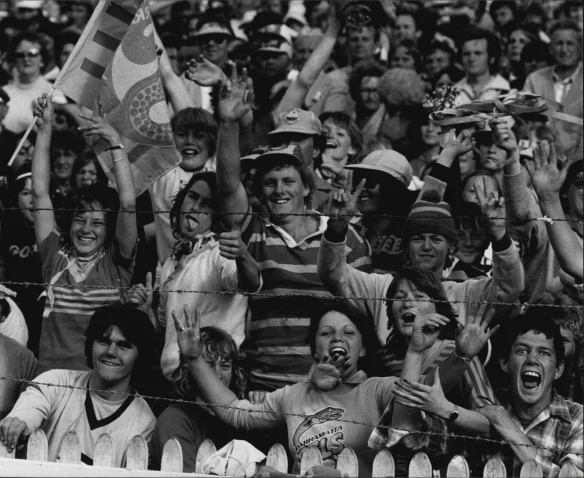
The power and the glory of our fans cannot be dismissed. Source: SMH Public Archives
So yes, this is a monster deal, that’s historic, lucrative and strategically important. It gives the NRL certainty, leverage and a platform to grow the game in Australia, New Zealand and beyond. It also strengthens the competition at a critical time, with expansion, the women’s game, player welfare, grassroots investment and future scheduling all demanding serious funding.
But from a fan’s perspective, the question is not whether the NRL sealed a solid deal, the question is: What happens next? And, what’s in it for us? After all, we are the ultimate lifeblood of our game, despite having minimal voice, power, and control.
More money should mean the game becomes better, not just richer; because fans do not support profit margins, they support clubs, players, communities, colours, rivalries, rituals; and in the case of this die-hard Eels fan, unwavering hope.
The NRL has won the broadcast war, Congratulations to our IEC and the Team. Now comes the harder part: proving the fans get something out of the peace treaty.
The Great Governance Goose Chase
There are few things rugby league does better in 2026 than turning a smooth working ruleset into a convoluted black hole of confusion. In this week’s macro-level narrative: the incumbent interim executive chairman (IEC) may or may not be set to become the permanent all-powerful executive chairman. Though that does depend on which constitutional clause, club chairman, State body, legal opinion, media outlet or racing administrator happens to be speaking on the topic. It’s a simple change really, just like the six-again or obstruction rules.
To his credit, the commercial record is significant. Expansion, Vegas, rising revenue, record broadcast money and a stronger national footprint are all real achievements. But the game should be careful not to confuse commercial success with automatic governance sainthood. A big deal is not a blank cheque; strong leadership still needs accountability; growth still needs consultation; and power still needs safeguards. Even in rugby league, the response to “we made lots of money” should not always be “great, please centralise more authority”.
So yes, commercially the IEC has admittedly earned himself a victory lap. The question is whether the victory provides genuine justification for redeveloping Rugby League Central into a sole power palace complete with an on-call red carpet roller, a blow-torch retardant throne room, and a trapdoor that opens up under anyone who says “checks and balances” too loudly.
This is where the whole situation becomes humorously convoluted. Publicly, we are being told that nothing has been decided. The IEC has not yet confirmed whether he will leave Racing NSW to run rugby league full-time. Instead, he is sticking with the four months’ of long service leave from Racing NSW narrative purely to Act as IEC. Yet Racing NSW reportedly expects clarity within two months; which in my view raises the question: Are Racing NSW quietly trying to get rid of someone they have openly despised for years, or are they just politely holding the door open while pretending not to whistle?
Then there is the mainstream media angle, where depending on the day and the publication, the story seems to shift. There’s the yes to clause 30 angle: “Clubs are ready to back constitutional change”, the no to clause 30 angle: “Clubs are nervous about it”, the plight of the leader angle: “IEC needs constitutional change to enact his vision”, and lastly the screw clause 35 and insult the intelligence of our readers using the clause 53 angle: “lets try and make these idiots believe a broad positional clause can be used to override a specific executive governance clause in order to avoid the inconvenience of democracy.”
TCTGP 31 May The Executive Exit and the Power Shift broadly outlined what steps an ARLC constitutional amendment would ordinarily require to be successful in getting constitutional changes approved. However, it didn’t go into what specific constitutional changes would be needed in order for the constitution to support an Executive Chairperson Model (ECM). In the authors humble subjective opinion, this is the only lawful and ethical way the ARLC enact this type of change; and while there is a part of me that lives in hope this is all just a bad governance dream; it’s pretty obvious this is where the game is headed.
The first step in gaining a greater understanding of this ball of confusion is to define the relevant clauses simply and transparently.
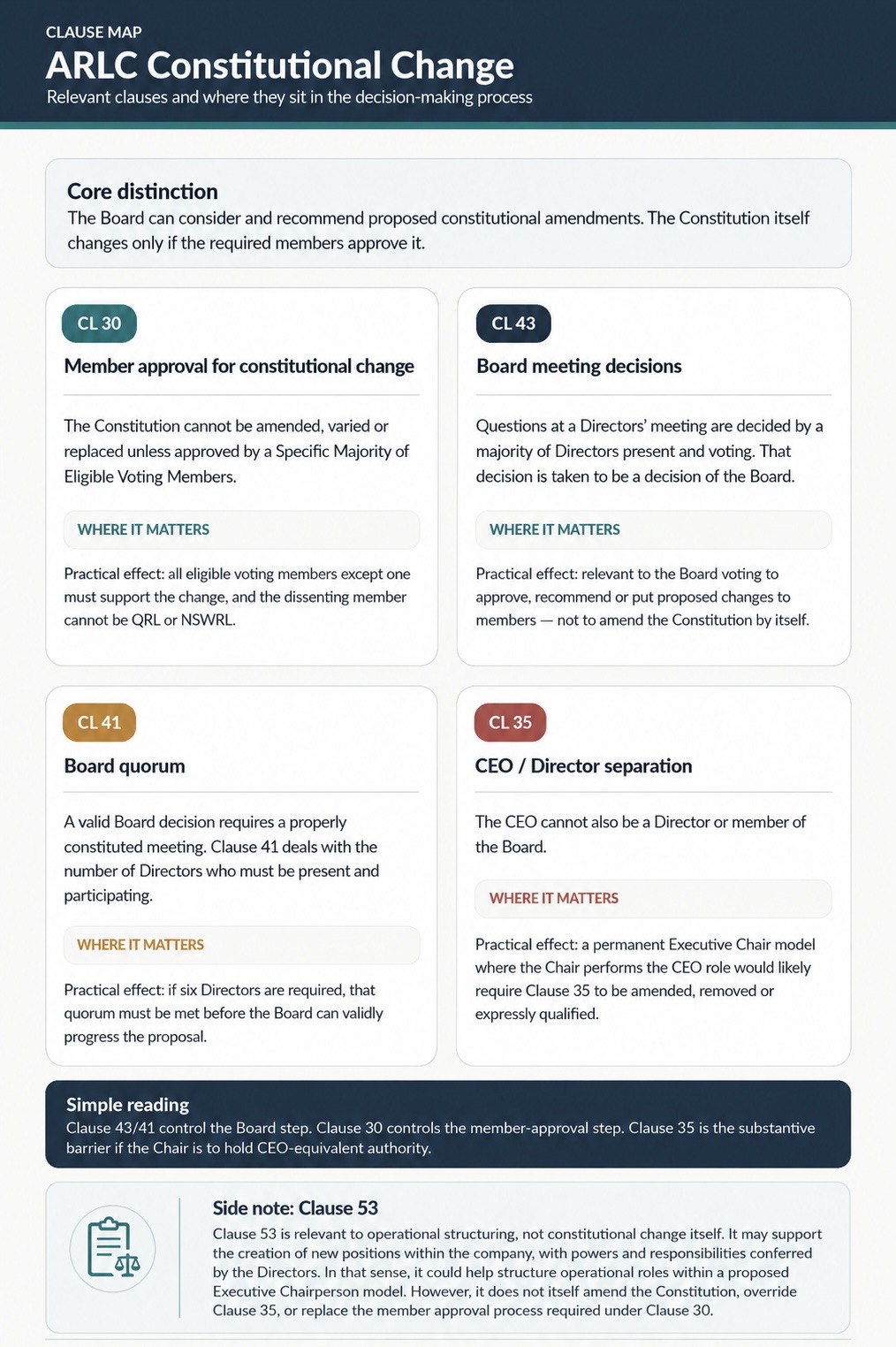
Constitutional Clause Breakdown – General Information – Not Legal Advice – information obtained from the Public record of the original ARLC document
The next step is to take this information and hypothesise what specific constitutional changes may be required: planning actions, clause additions/amendments/removals. Then prepare a change proposal to be voted on by ARLC members by way of special resolution under clause 30 of the ARLC Constitution. As you can see, while I am acknowledging the existence of Clause 53 I am not entertaining the media beat-up around it that has seen it being floated as a potential primary workaround to diminish the power of clause 35 and the need to action clause 30; because it allows directors to create other positions.
This is not just because it’s a ridiculously overwrought suggestion/narrative; it’s because legally the Corporations Act 2001 (Cth) prohibits broad constitutional clauses from being manipulated in order to override more explicit clauses. Specifically, section 198A prescribes that: directors may exercise company powers except powers that the Act or the company constitution requires to be exercised in a general meeting. Furthermore, section 198D allows directors to delegate powers, but expressly begins with “unless the company’s constitution provides otherwise.”
That’s the great thing about Federal Statutes that Govern specific industries/activities, they’re less flexible than common laws and in addition they’re reviewed regularly to adapt to the current climate. When interpreted correctly, they protect the application of stupidity and silence propaganda in print as just that. The Corporations Act gives the ARLC constitution binding contractual force, requires proper member approval to amend it, and recognises that directors’ powers are subject to the constitution. Therefore, a broad board-power clause (clause 53), cannot be used to defeat a specific constitutional restriction (Clause 35). Under Federal Law, general provisions are usually interpreted as overridden by more specific provisions, because it is highly unlikely the general wording was intended to nullify a specific clause dealing with the exact issue.
In all honesty, all this EC stuff may well just be speculation dressed up as a serious proposal, or possibly a faction in disguise testing the waters of public opinion. It may be clubs trying to look grateful after the broadcast windfall without accidentally handing over the entire kingdom, or NSWRL & QRL ‘quietly’ wondering whether the ARLC “independent commission” still embodies the separation of power it was created to protect; and that is the core issue.
The ARLC was created to streamline rugby league governance and provide central strategic direction. The NRL itself says the Commission works with its administrative executive and acts as trustee of the game. In theoretical governance terms, that means the board governs and management manages. In rugby leagues current landscape, it apparently means the chair may also become the executive, the strategist, the negotiator, the salesman, the media performer and quite possibly the bloke who decides what sandwiches are served at the next club briefing.
No one can deny the IEC is an affective administrator, one might say annoyingly effective, depending on where you sit. But good governance is not built around whether one person is currently getting results. Good governance is built for the day that person leaves, fails, overreaches, or simply becomes too powerful for anyone else in the room to challenge.
A short-term executive role while the incumbent Sir Tennis’s replacement is sourced is one thing, a permanent executive-chairman model is a completely different kettle of fish. If the game wants to go down that path, then it needs to do it properly: with constitutional clarity, club and state body approval where required, a defined term, reviewed mechanisms, conflict protections, and a governance framework that is not reduced to a decorative office plant with a corporate lanyard. Because otherwise, this starts to look less like rugby league leadership reform and more like fat pockets celebrating a commercial win by immediately creating a transparency headache. The author is not suggesting one person is pulling all the strings; maybe the strings are simply very impressed by him and have decided to pull themselves.
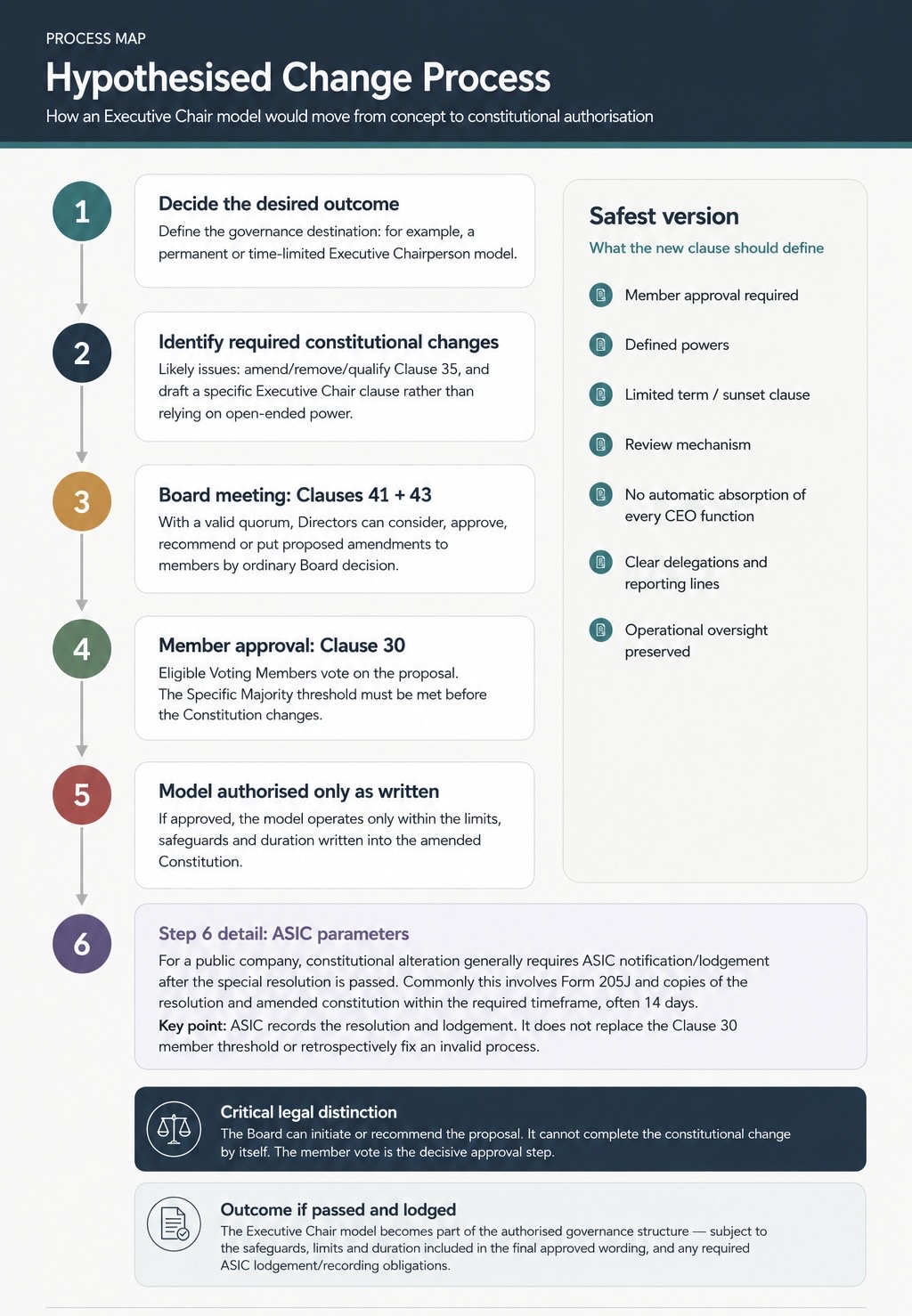
Hypothesised Change Process Breakdown – General Information – Not Legal Advice –information obtained from the Public record of the original ARLC document
Anyway, as the above hypothesised “if we must” process suggests, and while I have reluctantly accepted that my “temporary/nothing to see here” hopes are dead and buried; I am now hoping that common sense and best practice prevail at least within the process of moving our game from its current model to the proposed one; while quietly hoping the ARLC Board throw a spanner in the works if things start to smell too much. Afterall, before the special resolution under clause 30 can be actualised, it’s the ARLC Board who ultimately decide whether to pursue a CEO model or an executive chairman model in the first instance. Remembering of course that the IEC ‘should’ be excluded from the vote, because the proposed constitutional amendments will expand his own executive authority, eligibility for appointment, remuneration and control; giving him an actual conflict and material personal interest in that decision. He should therefore disclose the conflict, have it recorded, and take no part in the board’s discussion, recommendation or vote on whether to initiate or advance the proposed constitutional amendments. So getting this off the ground relies on the majority yes vote between the remaining seven board members, excluding the IEC himself.
Then there is the ASIC roadblock, because even if the strings somehow get the first two steps (ARLC Board vote and special resolution under Clause 35) across the line; if the changes to the constitution are submitted to ASIC and found to be directly inconsistent with the relevant legislation, or not commensurate with acceptable standards for NFP operations; any constitutional changes could be deemed legally invalid and unenforceable, which may result in ASIC refusing its registration of the amended constitution.
As Sir Walter Scott’s 1808 poetic masterpiece Marmion: A Tale of Flodden Field first transcribed: “Oh, what a tangled web we weave, when first we practice to deceive”. Especially when the law potentially stands in the way of a good and unfortunately achievable money driven spectacle. I guess all we can do is watch this space and hope some governance measures survive the show.
See you at the game on Saturday; Go Parra; and thank you for supporting The Cumberland Throw.
Roly-Poly


Brilliant and tragicomic at the same time. Thank you Roly-Poly Eel.
Thanks so much Gaby, I appreciate the support. I also love the term tragicomic. It’s exactly the angle I was aiming for. Thanks again
The interesting part is the decision to move all the NRL employees to the ARLC, I’m interested to know the purpose of such a move. They wouldn’t be doing it just for kicks, there has to be a reason for it.
Hi Brett, I reckon it was a preemptive strategic move in anticipation for the EC model / constitutional change being supported by the board and voted on by the members. There are probably new positions that were already created to that support the EC model. The application of 53 is not something that requires a constitutional change or a vote for that matter. Its a green flag that allows the ARLC Director/IEC to create new positions as he sees fit. So in short. The structural change is a subjective sign that the EC model has been in the works for some time….allegedly.
Thanks for showing up rain hail or shine. As Sixties often says, football is a welcome relief and distraction.
I’ve been absent but I’ve listened and watched every episode.
I lost my dear mum recently, she had no interest in football but she always watched Parra games because she knew how much I loved the Eels.
She knitted my kids and I countless blue and gold blankets and beanies which I will treasure forever.
She made me the giant flag I took the Belmore Oval that was confiscated by security. The flag made it on TV and Ray Warren mentioned the flag throughout the first half.
This was the game Price Cumberland threw Kelly on the first tackle of the game and knocked him out. Price was sent off but we won the game.
Joseph,
Always enjoy reading your posts here, except today. Sincere sympathies to you and your family on your Mum’s passing. Like you I have little mementos from close family who have passed away. Whenever I look at them now they bring back fond memories. Hopefully those beanies and blankets will do the same for you in the future.
Here’s to hoping the Eels can bring some more joy over the next few weeks.
Hi Joseph, thank you for sharing and for continuing to support TCT by listening and watching, even while you’ve been going through such a difficult time.
I’m so sorry for the loss of your mum. These wonderful memories you’ve shared will become lasting reminders of her that are so special. I know this because my late father was an integral part of my love of Rugby League and the Eels. It’s never been the same without him but I always feel like he is close by when I am at games, especially Commbank. I hope you can find a similar solace that helps manage the immeasurable grief I know comes from losing a parent
Thanks again for supporting TCT. I am just an intermittent contributor but I know Sixties and Forty20 appreciate every single one of their supporters whether they are watching, listening or reading; as do I.
Take care of yourself,
Roly
Those are some amazing memories to share with us Joseph. Having been there with my mum not so long ago, I know words can only do so much for the gaping hole in the heart but I am truly sorry for your loss. I am glad that you have those beautiful hand-made blankets and beanies to help carry forward the memories of all the wonderful things she did for you.