
Hey Parra fans, Welcome to this weeks edition of TCT Golden Point, where I broadly explore rugby league expansion over-time and whether the current system is fair, balanced and sustainable. As always I hope you find it insightful and engaging.

Expansion Equity in the NRL: Growth Without Losing Fairness
Expansion has always been sold as progress. More teams, bigger markets, broader reach, stronger broadcasting opportunities and greater national relevance. On paper, it sounds like an unquestionable positive for the game. But beneath the excitement lies some complicated governance questions:
- How does the NRL determine what supports each new club receives? And;
- Are they doing enough to balance supporting new clubs without unfairly disadvantaging the clubs already competing under the existing system?
Like many things in rugby league; (i.e. the PNG Government funding breakdown, the Dally M voting system, officiating accountability, adjudication consistency, untested rule changes, and one leaders curious business case for paying people to roll out a red carpet for them on demand); the mystery of expansion concessions sits somewhere between unclear, unexplained and mildly absurd. But mystery should not be mistaken for irrelevance. In fact, it is often exactly why the discussion is worth having.
These questions form the basis of this analysis into NRL expansion support. Drawing on what we know; and what remains frustratingly unclear about salary-cap concessions, tax advantages, recruitment support, government funding, historical precedent and lessons learned, this piece considers whether the current mechanisms are being designed and distributed fairly.
At its core, this is not just a question of whether new clubs should receive help. It is a question of whether that help protects holistic competitive integrity across the game: for expansion teams, existing clubs, players, pathways, fans, and the long-term sustainability of rugby league itself.
Previous Expansions: Tales of Triumph & Lessons from Flops
Historically, new clubs have almost always received some form of additional assistance in the first instance, though that assistance has never been standardised in type, volume or timeframe. Some expansions have received almost nothing, others no explicit financial support but included various combinations of game, Government, and corporate funding and infrastructure support.
The following section provides a subjective comparative analysis of rugby league expansions since 1980. I have looked both inside and outside the formal NRL era because the 80’s and 90’s were imperative to how the NRL was formed and shaped the game we have today in many aspects; and because that era provides invaluable lessons for assessing expansion into geographic markets where rugby league has not historically been the dominant code.
To maximise integrity, I have only used information from reputable rugby league & Government sources. I have also chosen to omit the Super League-only clubs (Hunter Mariners and Adelaide Rams) from this comparison. While they were technically expansion teams, they were fully funded by News Ltd and operated within a breakaway competition, rather than through the NSWRL/ARL/NRL expansion framework. Their creation was largely politically and commercially driven during the Super League war, rather than the product of a strategically stabilised and sustainable expansion model. For that reason, they are not directly relevant to this comparative analysis, which focuses on how macro-level expansion decisions have evolved within the main governing competition structure.
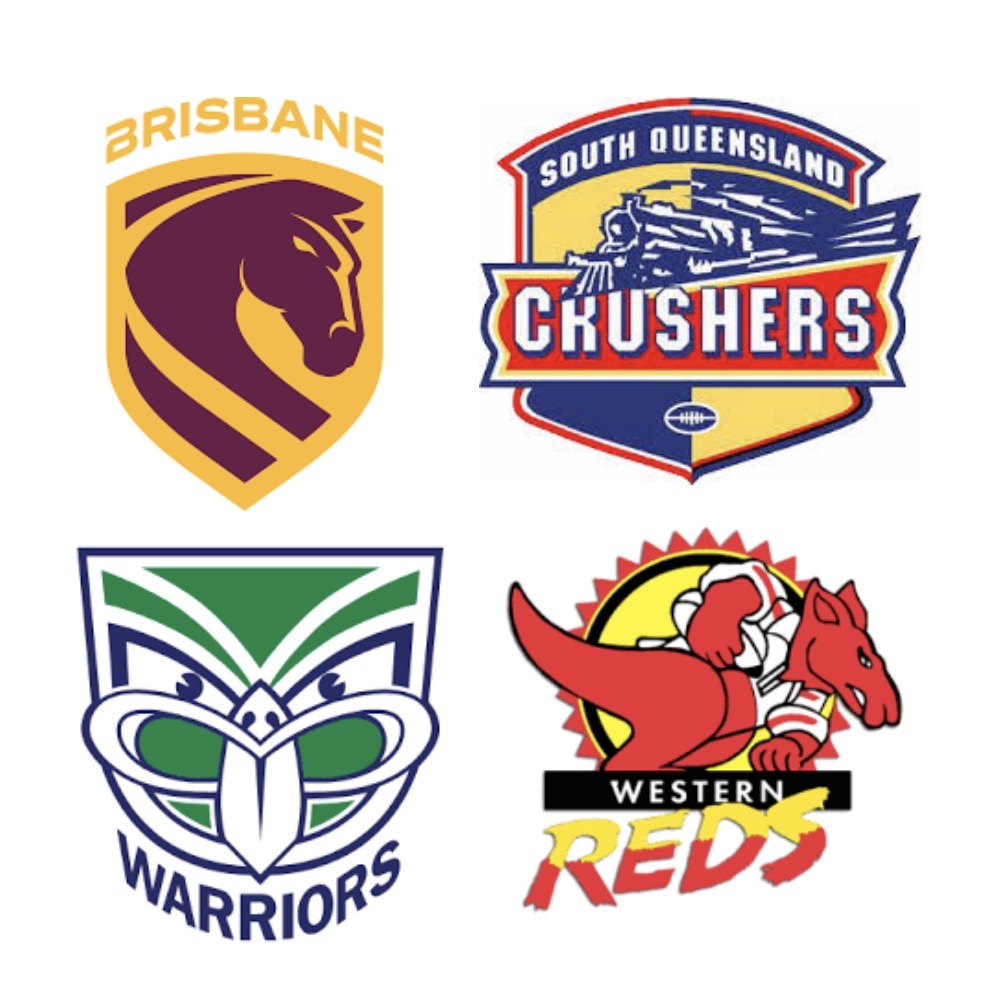
Expansion Successes and failures – Source: NRL-ARLC – made by the author with Collageable
| ELITE RUGBY LEAGUE EXPANSION OVER TIME – NSWRL/ARL/NRL | |
|
1982 NSWRL Expansion The 1982 admission of Illawarra and Canberra reflected a very different expansion environment. The salary cap did not yet exist, and the modern language of concessions, pathway funding and competitive equalisation had not really developed. Both clubs showed that early expansion was less about competitive protection and more about whether a region could justify a place in the competition. |
|
| Illawarra Steelers | Illawarra entered after decades of attempts to join the premiership. The Steelers had a strong rugby league nursery, a clear regional identity, and an established home base in Wollongong.
Their support was not built around salary-cap relief or player allocation. It was based on admission, local legitimacy, community backing and the strength of the Illawarra rugby league region. Source: St George Illawarra Dragons & NSWRL |
| Canberra Raiders | Canberra’s entry followed a similar pattern, although with one major difference. The Raiders helped make the NSWRL’s expansion problem easier by becoming the 14th team and reportedly accepting the burden of travel-related costs for visiting clubs.
In that sense, Canberra did not receive expansion assistance so much as absorb part of the financial inconvenience its entry created. Source: Canberra Raiders, The Canberra Times |
|
1988 NSWRL Expansion The 1988 expansion introduced Brisbane, Newcastle, and the Gold Coast. On paper, this looked like a major strategic broadening of the competition. In practice, the three clubs entered with very different levels of stability. |
|
| Brisbane Broncos | The Brisbane Broncos were the strongest model. They entered with major private and corporate backing worth $3M, a powerful rugby league market, elite recruitment capacity and immediate credibility.
Their advantage was not formal salary-cap assistance. It was money, profile, geography and access to a deep Queensland talent base. Brisbane did not need to be heavily protected by the league because it entered with the kind of commercial strength most expansion clubs could only dream of. Source: Brisbane Broncos, Courier Mail |
| Newcastle Knights | Newcastle entered in 1988 as a rugby league heartland club with strong community backing, Newcastle International Sports Centre as its home ground, and a squad built around local players plus experienced recruits.
No obvious special concessions were received. Newcastle’s main support was its existing rugby league culture, one-team-town identity and major home crowds, including average home crowds of around 21,000 in its first season. Newcastle was a community/heartland expansion model: strong local legitimacy, but not a heavily protected start-up model. Source: Newcastle Knights, NRL, Newcastle Herald |
| Gold Coast-Tweed Giants (1988-1989) NSWRL*
Gold Coast Seagulls (1990-1995) NSWRL/ARL* Gold Coast Gladiators (Name Only) 1995 to 1996 off season. Gold Coast Chargers (1996-1998) ARL* *Same Licence/Lineage with different hierarchical structures |
From 1988 to 1998, the Gold Coast was less a series of completely separate ventures and more a fragile expansion licence repeatedly reshaped under different names, owners, backers and survival strategies.
The Giants began as a privately backed venture, supported by a consortium of former players and businessmen, but had little structural protection and struggled to compete commercially. The Seagulls brought stronger financial and operational backing through Seagulls Leagues Club yet still found it difficult to gain stability in a crowded Queensland rugby league market. The Gladiators were essentially a short-lived rebrand between the 1995 and 1996 seasons, after entrepreneur Jeff Muller purchased the licence. Despite winning the pre-season World Sevens, the ARL revoked Muller’s licence before the season began and took control of the club. The club was then rebranded as the Chargers, after Muller’s removal and Seagulls Leagues Club subsequent withdrawing of support. ARL backing was limited, and the club survived largely on unstable sponsorship arrangements with Chandlers Electrical, Home Hardware and WIN TV. Their eventual demise in 1998 showed how vulnerable expansion clubs could be, when admission into the competition was not matched by sustained structural support, strong governance and long-term strategic protection. Source: Gold Coast Titans, Gold Coast Bulletin |
|
1995 ARL Expansion The 1995 ARL expansion period was bold, but uneven. Auckland, North Queensland, South Queensland and Western Australia, all represented different strategic goals and exposed a different type of risk. |
|
| Auckland Warriors
1995-2000 (SL 1997)*
NZ Warriors 2001 onwards*
*Same Licence
|
The Warriors entered as a strategically valuable expansion club, opening the competition to a national New Zealand market and a large rugby league talent base. Backed initially by Auckland Rugby League, they had strong commercial backing, but also faced unique cross-border challenges, including travel demands, logistics and ownership instability.
Auckland Rugby League sold the club to Tainui Group Holdings in 1998, before Eric Watson’s Cullen Investments took control in late 2000. That ownership reset was followed by the club’s rebrand from the Auckland Warriors to the New Zealand Warriors in 2001. Ownership later moved from Watson, to Watson and Owen Glenn, then back to Watson, before passing to Carlaw Heritage Trust and Autex, with Autex becoming sole owner in 2019. Overall, the Warriors have been sustained largely by private enterprise rather than obvious special NRL concessions, aside from possible but unclear COVID-era relocation support. Source: New Zealand Herald & New Zealand Warriors |
| North Queensland Cowboys | North Queensland entered the competition with a strong regional identity, deep grassroots support and genuine community backing. Townsville embraced the Cowboys quickly, helping establish strong local engagement and attendance from the outset. However, recruitment was difficult, particularly as the club entered during a crowded expansion period and tight player market.
Across their lifespan, the Cowboys have had limited formal competitive concessions. Their long-term success has been built less on league-funded advantages and more on regional loyalty, pathway development, persistence and the strength of their supporter base. Source: NQ Cowboys, QLD Government |
| South Queensland Crushers | The South Queensland Crushers exposed the risk of entering a saturated market without clear differentiation or sustained structural support.
Strategically, the club made sense as an ARL counterweight to the Broncos and had access to rugby league territory, local juniors, and a Brisbane-based market. Practically, the Broncos already dominated that space, leaving the Crushers with limited identity, weak commercial footing, and little competitive relevance. Without meaningful concessions or long-term protection, they were quickly overwhelmed competitively and financially and folded at the conclusion of the 1997 season. Source: Australian Broadcasting Corporation, NRL |
| Western Reds | The Western Reds were one of the clearest examples of national ambition being undermined by insufficient protection. Their admission gave rugby league a genuine national footprint in Western Australia, with early local enthusiasm and sponsorship support.
However, distance, travel costs and logistical pressures quickly became major disadvantages, with the club carrying costs such as subsidising visiting teams’ travel and accommodation. The Reds folded after the 1997 Super League season, showing how difficult non-heartland expansion can become when a club is asked to carry the burden of national growth without substantial long-term support. Source: The Western Australian, WA Government |
|
1998 NRL Era Formation The 1998 NRL season was the inaugural year of the National Rugby League, formed to reunite the sport after the bitter Super League war which resulted in two separate parallel competitions in 1997. |
|
| Melbourne Storm | Melbourne Storm remains the most successful example of modern non-heartland expansion, but not because Melbourne was an easy rugby league market. Its success came because strategic ambition was matched by serious structural backing.
News Limited ownership, strong administrative support, access to players during post-war rationalisation, and the NRL’s desire to retain a Victorian presence, gave Melbourne a level of financial and organisational protection that Perth, Adelaide and the Gold Coast did not receive in the same way. That does not diminish Melbourne’s achievements. It reinforces the broader point: expansion into difficult markets can work when the game is prepared to support the club beyond the announcement. Source: Melbourne Storm, NRL-ARLC, Herald Sun |
|
1999-2000 NRL Era Rationalisation The rationalisation period created another type of structural change support: competition survival through merger. The lesson learned from the Rationalisation era has reared its head intermittently time-and-time again and is still relevant in today’s NRL: financial survival does not automatically create cultural viability. |
|
| St George-Illawarra Dragons
St George Dragons + Illawarra Steelers |
The joint venture helped secure continued NRL participation after both St George and Illawarra were identified as non-viable under the emerging NRL structure.
The newly formed St George Illawarra Dragons received a five-year licence and guaranteed funding for that period, with additional ongoing support from its respective leagues clubs in Kogarah and Wollongong. There is no clear evidence of additional NRL support beyond the initial five-year period that was not otherwise available to all NRL clubs. The merger also benefited from established supporter bases and St Georges historical legitimacy. Source: St George Illawarra Dragons, Illawarra Mercury |
| Wests Tigers
Western Suburbs Magpies + Balmain Tigers |
The joint venture helped secure continued NRL participation after both Balmain and Western Suburbs were identified as non-viable under the emerging NRL structure.
The newly formed Wests Tigers received a five-year licence and guaranteed funding for that period, supported further by the existing leagues club structures in Ashfield and Campbelltown. There is no clear evidence of additional NRL support beyond the initial five-year period that was not otherwise available to all NRL clubs. The merger also benefited from established supporter bases, historical legitimacy and the legacy of two foundation NSWRL clubs across inner & outer Western Sydney Heartland. Source: Wests Tigers, NRL-ARLC, Camden/Macarthur Chronicle |
| Northern Eagles
North Sydney Bears + Manly-Warringah Sea Eagles |
The Northern Eagles were rugby league’s most uncomfortable compromise: two arch-rivals, Manly and North Sydney, forcibly merged into one confused joint venture and expected to magically become a united franchise.
In reality, the merger was less a strategic expansion model and more a convoluted survival mechanism designed to preserve both clubs without properly considering identity, geography, culture or supporter loyalty. Shock-horror, combining two administrations and fan bases that largely despised one another did not produce instant harmony nor did it nurture consistent on-field performance and boardroom unity. The venture struggled from the outset. After only three seasons, the arrangement collapsed, with Manly effectively reclaiming the licence and most of the joint assets before continuing as the Sea Eagles. Source: North Shore Times, Australian Broadcasting Corporation. |
|
2007 Enter the Titan’s: a re-set, not a continuation |
|
| Gold Coast Titans*
*Different Licence to earlier ventures |
The Gold Coast Titans’ entry in 2007 was a new licence, separate from the earlier Giants-Seagulls-Gladiators-Chargers lineage. This time, the model was stronger: with government-backed stadium infrastructure, a regional pathway base, commercial recruitment and additional establishment assistance.
There was no stated salary-cap concession, but the Titans did benefit from early recruitment access and support designed to give rugby league on the Gold Coast a more stable footing after previous failures. The Titans showed that revisiting a failed market is not necessarily wrong, but that doing so requires acknowledging why the earlier attempts failed and the building of better foundations. Source: Gold Coast Titans, NRL-ARLC, QLD Government |
|
2023 Expansion with infrastructure already in place |
|
| Dolphins | The Dolphins entered in 2023 with one major advantage many expansion clubs lack: they already existed as a strong rugby league institution.
Backed by the Redcliffe Dolphins’ established QRL infrastructure, the club received a subsidised licence, significant lead-in time to build its roster and NRL-funded pathways investment. There was no stated salary-cap relief, but the Dolphins were not starting from scratch. They had history, facilities, pathways, identity and administrative capability already in place. That made them a lower-risk expansion option. The Dolphins were not simply invented; they were elevated.Source: QRL, NRL-ARLC, QLD Government, The Courier Mail |
|
2027 When the governing bodies national expansion strategy becomes a fairness debate. |
|
| Perth Bears | The Perth Bears, proposed for 2027, bring rugby league back to Western Australia and revive the Bears brand in the process. Strategically, that has appeal. Perth gives the NRL national reach, a major broadcast market and a chance to repair the damage left by the Reds’ collapse.
But Perth also raises the same question the Reds exposed decades earlier: what level of support is required to make non-heartland expansion genuinely viable? The WA Government has reportedly committed major support, including no licence fee, $60 million over seven years and additional match-day and marketing assistance. The ARLC will also cover further unspecified costs to guarantee financial viability. However, salary-cap concessions appear to have been resisted. That creates an important fairness question. If Perth is expected to compete for players from a non-heartland market, with relocation challenges, travel demands and limited local elite pathways, should it receive targeted recruitment assistance? Or would that unfairly disadvantage existing clubs? This is the tension at the heart of expansion policy: support may be necessary for viability, but if poorly designed, it can look like preferential treatment. Source: WA Government, NRL-ARLC, The Western Australian |
|
2028 The most unusual expansion package in rugby league history |
|
| PNG Chiefs | The proposed PNG Chiefs represent something far bigger than a normal expansion licence.
PNG is not just a rugby league decision. It is also a government-funded, diplomatic, regional development and strategic security project. Reported support includes Australian Government funding, Pacific rugby league programs, infrastructure, accommodation and security arrangements, plus significant tax advantages for eligible players and staff. The reported package is extraordinary: approximately $600 million, including around $290 million for the franchise, $250 million for broader regional programs and $60 million for the licence fee. Players are also reportedly set to pay no tax on club-specific income in both PNG and Australia. That makes PNG fundamentally different from traditional expansion support. PNG may be inspiring, ambitious and culturally powerful. But for the competition, it also presents the biggest fairness test the NRL has faced. Further insights on this and the franchises overall viability/volatility can be found in last weeks TCT Golden Point: The PNG Paradox Source: AUS Government, NRL-ARLC |
|
2029-2030 (Speculative) |
|
| 2029–2030: possible 20th-team discussion | The NRL has continued discussing future expansion options, including a second New Zealand team, another Queensland team, and broader international growth. NRL CEO Andrew Abdo has publicly said New Zealand could sustain a second team if the competition expands to 20.
Source: Australian Broadcasting Corporation |
What the Analysis Shows
Across four decades, rugby league expansion has relied on a number of different types of support:
- Some clubs were admitted into strong rugby league regions
- Some relied on private wealth
- Some were backed by leagues clubs or corporate ownership
- Some benefited from government infrastructure
- Some were protected through merger funding
- Some carried heavy travel and market-development burdens without fair and adequate assistance
What that history shows is that expansion support has rarely been consistent. Some clubs received political or corporate backing, others were handed little more than a licence, a dream and a financial headache. Earlier expansion attempts were often exposed by weak safeguards, uneven funding and chaotic competition politics.
Evidently, the model has improved over time in that no expansion club has failed this century, and with the exception of the Northern Eagles (which was doomed from the start politically and culturally, if not financially), no merger venture has collapsed (yet) either. This does not prove the current system is fair, complete or beyond criticism, but it does suggest the game has learned at least some lessons from the more chaotic and under-supported expansion attempts of the 1990s.
The pattern is clear: expansion support has always existed. What has not always existed is transparency, consistency or a clear competitive fairness framework.
Now, the game is preparing to implement expansion models unlike anything previously seen, that are unashamedly inconsistent, opaque, and on face value unfair. That is the real issue and the short and long term risks outlined in the visual below are real and significant.
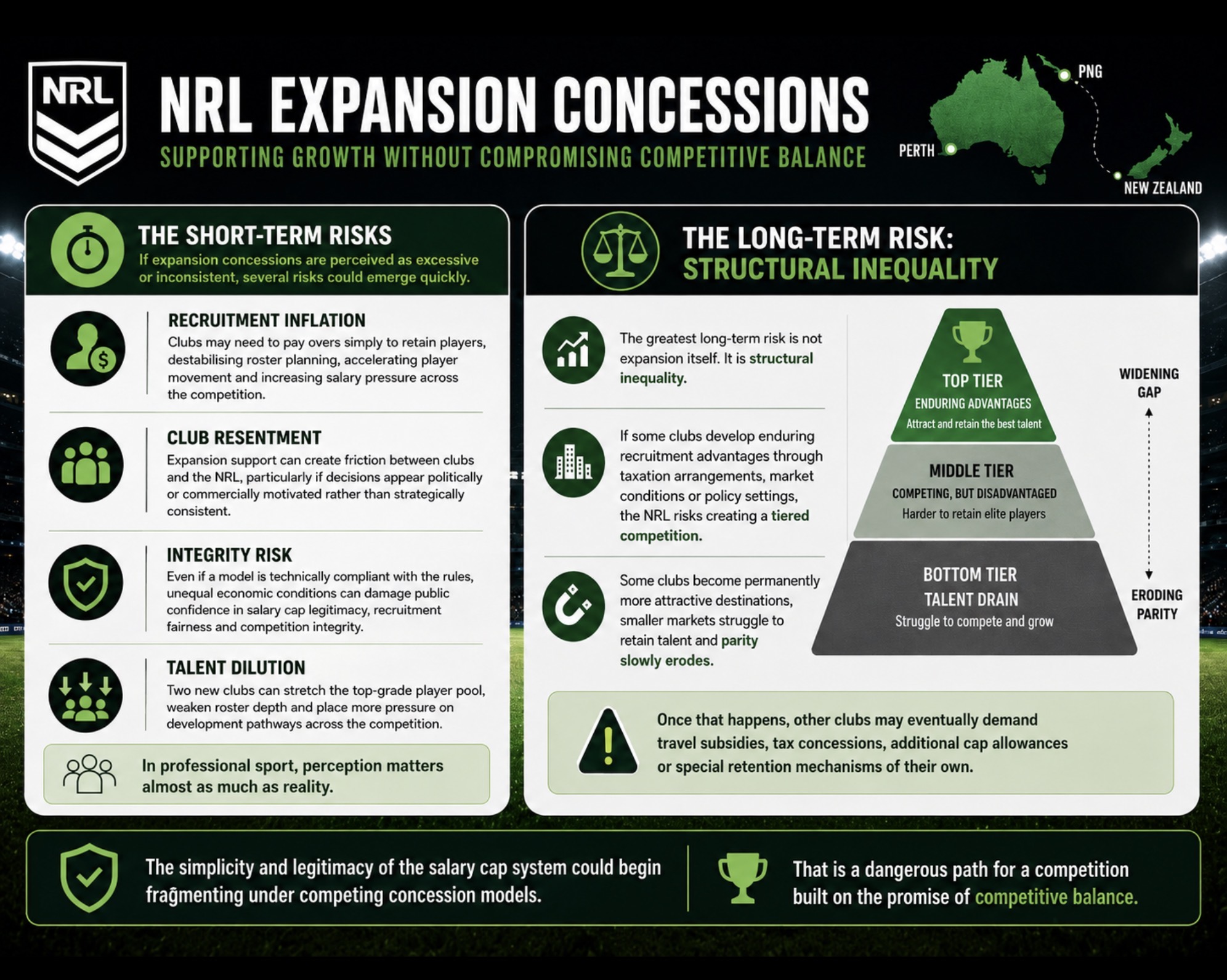
Expansion Concessions Short & Long-Term Risks – Created by the Author using Canva
The PNG Tax Concession Debate: Fairness, Viability and Cap Integrity
The proposed PNG Chiefs tax concessions are particularly sensitive because they are viewed by many critics as potentially creating an ongoing recruitment advantage, rather than temporary establishment assistance.
The concern is not that PNG receives support. Most stakeholders accept that expansion clubs need help. New franchises often require assistance with infrastructure, pathways, relocation, recruitment, administration and commercial establishment. That is not unusual, and in reality, without some form of support, expansion teams will inevitably struggle to become competitive or sustainable.
The issue is whether government-backed tax arrangements effectively create a shadow salary cap concession by allowing players to retain significantly more take-home pay than they could elsewhere under the same official contract value.
If two clubs can offer the same salary on paper, but one club’s player keeps substantially more after tax, the practical value of that contract is no longer the same. That matters because the salary cap is designed to regulate competitive balance, not simply accounting figures.
From a fairness perspective, this creates a difficult question: Is it still a level playing field if one club can offer the same salary, but deliver a better financial outcome?
That question becomes even more important if the concession is not short-term. Temporary establishment assistance can be justified as a bridge into the competition; it helps a new club build systems, attract staff, establish pathways and become viable. But if the advantage continues long after establishment, it risks shifting from expansion support into structural inequality and that is where the overarching viability of the broader code comes into play.
The NRL’s long-term strength depends on more than adding new markets, it depends on maintaining trust in the competitions model. Clubs, players, sponsors and supporters need to believe success is determined by recruitment strategy, development, coaching, culture and performance; not by different economic rules applying to different teams.
If existing clubs believe they are competing against a government-subsidised recruitment model, resentment will build. If supporters believe certain clubs can stretch the practical value of the salary cap beyond what others can match, confidence in competition parity weakens. If players begin treating one franchise as financially superior because of tax treatment rather than football opportunity, the player market itself may become distorted.
Expansion must be viable for the new club, but it must also be viable across the existing competition. A model that helps the PNG Chiefs survive cannot simultaneously make other clubs feel structurally disadvantaged. Growth that damages trust in the salary cap is not sustainable growth. It simply shifts risk from the expansion club to the integrity of the competition.
The central issue is therefore not whether PNG should receive additional assistance, it is whether that assistance is designed as a bridge into the competition; or whether it becomes a permanent advantage within it.
Because once clubs and supporters begin believing some teams are operating under different economic rules, the credibility of competition parity starts to weaken; and in a salary-capped competition, credibility is not a minor issue, it is the foundation that the whole system relies on.
The Perth Bears: Viability v Competitive Advantage
Ironically, there is also a compelling argument that Perth deserves more meaningful assistance too. Geographically it is further away from the bulk of the competition than PNG and New Zealand. The expansion also faces genuine structural challenges: extreme travel demands, AFL market dominance, smaller rugby league pathways, reduced media saturation and significant relocation barriers for players. Perth is not just geographically farther from rugby league’s heartland than most existing clubs, it also lacks the generational rugby league infrastructure many eastern states take for granted.
From a competitive balance perspective, the need for some level of consistent transitional support seems obvious. If one expansion club receives major long-term economic advantages while another receives only standard establishment support, perceptions of fairness become difficult to maintain. A sensible expansion model should not pretend every new club is the same; because a one-size-fits-all model would ignore geography, market maturity, pathways, recruitment difficulty, travel burden and economic context.
But different support should not translate to competitive advantage. The NRL needs to distinguish between assistance that helps a club become viable and assistance that permanently alters competitive balance. Clubs need viability supports to help them stay afloat, not competitive advantage supports that enable them to stand above others.
For Perth, the question is whether support is enough to overcome non-heartland disadvantages without unfairly weakening existing clubs.
For PNG, the question is whether tax and government-backed arrangements create a recruitment advantage the salary cap cannot properly control.
For future expansion, the question is whether the NRL has learned from history, and whether it is still making major decisions first and explaining the logic later.
The Game needs a balanced Expansion Framework that supports the viability of all clubs. Source: Parramatta’s Eels, Perth Bears and NRL-ARLC
Expansion Through Sustainable Equalisation, Not Permanent Advantage
Expansion without transparent planning is risky. Done properly, expansion can broaden the NRL’s national footprint, deepen Pacific engagement, create new pathways, increase participation, strengthen broadcast value and grow rugby league beyond its traditional borders.
The issue is not growth itself. The issue is whether growth is being managed fairly, transparently and sustainably.
Rugby league expansion has produced some of the game’s greatest success stories. Brisbane, Melbourne, Newcastle, North Queensland and the Warriors have all added enormous value to the code in different ways. But expansion has also produced collapsed ventures, failed mergers, unstable licences and markets that were asked to carry too much without enough structural support.
I believe the NRL needs a formal expansion framework that balances three things:
- New club viability;
- Fairness to existing clubs; and
- Long-term competition integrity.
That framework should include:
- Transparent concession rules,
- Independent competitive impact reviews,
- Time-limited establishment support,
- Pathway and infrastructure investment, and
- Progressive sunset clauses on any recruitment assistance
Most importantly, the focus should shift away from permanent roster advantages and toward long-term player development. Because the NRL’s biggest strategic problem at player level is not simply talent distribution, it’s talent production to avoid talent dilution.
A smarter long-term model would invest more into regional pathways and feeder systems in expansion regions rather than relying heavily on recruitment concessions. The NRL could:
- Incentivise interstate development,
- Strengthen WA and Pacific pathways,
- Expand academies,
- Reward clubs for homegrown talent and support sustainable grassroots growth.
That grows the overall talent pool instead of simply redistributing the same elite players between more clubs. It also creates stronger regional identity, deeper community connection, and greater long-term sustainability.
This stuff isn’t rocket science, it’s common sense. To be completely honest, in forming this section, I just actualised what I have learned in my studies and employment and said to myself: if the nrl is the business, the clubs are the product, and the players are the value (what makes the product valuable); then it makes sense to build a framework that enables the product to sustainably produce more value.
Final Thought: Growth Only Works When it is Fair
Expansion is not the problem, rugby league should want to grow. It should want new markets, stronger pathways, broader national reach and deeper Pacific engagement. But growth only strengthens the game if it is planned transparently, applied consistently and managed with the whole competition in mind.
The history of rugby league expansion shows one clear pattern: new clubs often need support, but poorly designed support can create long-term problems. Some clubs were built on strong local identity. Some relied on private wealth, government backing or merger funding. Others were left to carry the cost of expansion without enough structural protection. The lesson is not that assistance is wrong. The lesson is that assistance without a clear fairness framework creates risk.
That is why Perth and PNG matter so much. Both may be valuable expansion projects, but they raise very different questions. Perth highlights the challenge of making non-heartland expansion viable. PNG highlights the risk of support becoming a structural recruitment advantage. In both cases, the issue is not whether new clubs should be helped. The issue is whether that help protects the integrity of the salary cap, existing clubs, player pathways and public confidence in the competition.
If the NRL wants expansion to succeed, it needs more than ambition. It needs a transparent model built around sustainable equalisation, not permanent advantage. That means clear concession rules, time limits, independent competitive impact reviews, pathway investment and sunset clauses on any recruitment assistance.
The future of the NRL should not be built by simply stretching the same talent pool across more clubs and hoping the market sorts itself out. It should be built by growing the talent pool, strengthening regional pathways and ensuring every club (new or old) can compete under rules supporters understand and trust.
Because expansion is only progress if it grows the game without weakening the fairness that makes the competition worth watching.
Enjoy the rest of Parra’s much needed Bye Round.
Roly-Poly

PS: It’s been a tough season/decade/quarter century; to say the least. I wanted to share this Parra fan fatigue recalibration rubric I created for myself and my family. I have found it helpful, as have they. I hope you do too. – RP
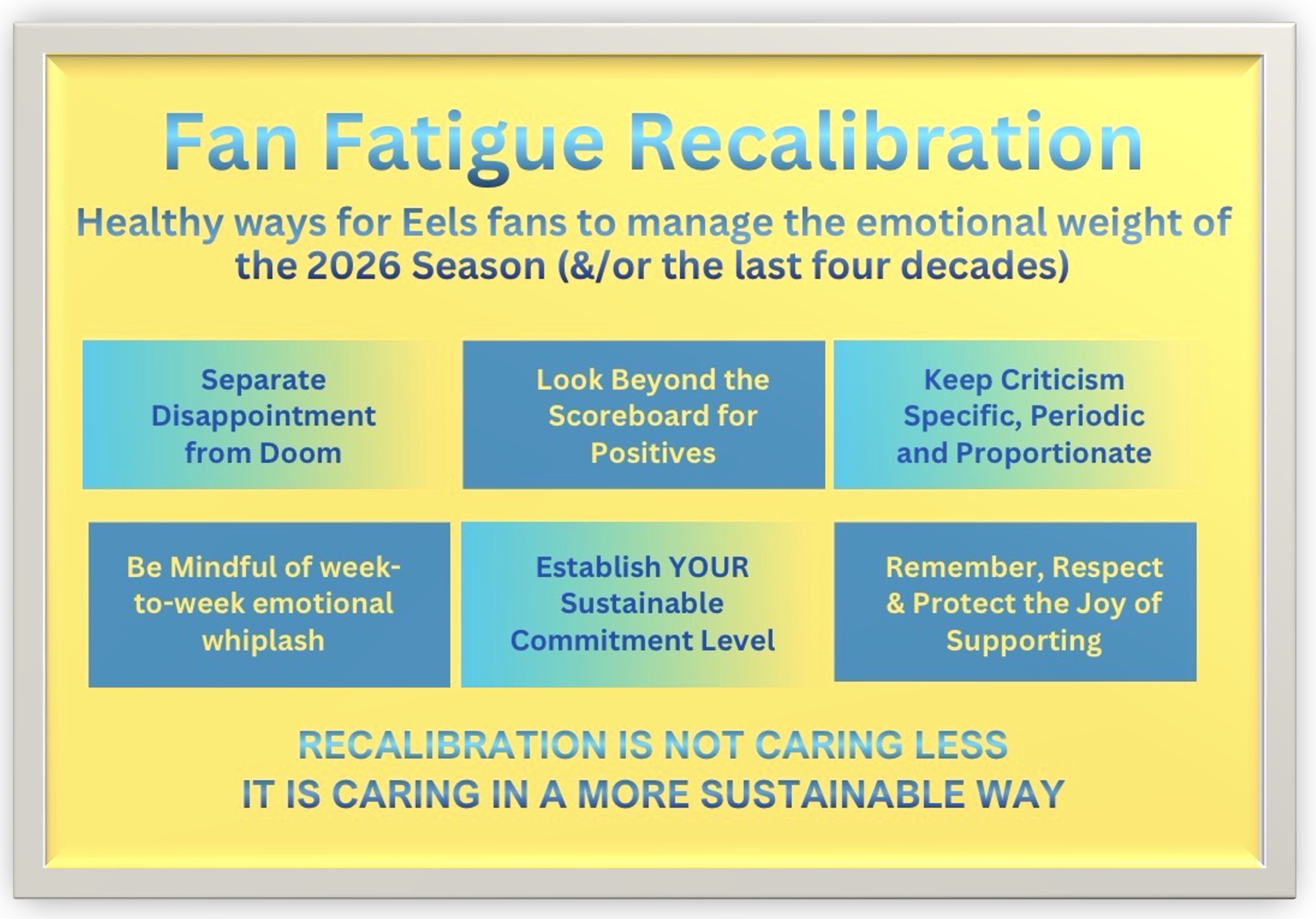
Created by the Author using Canva

Tks Roly. You wonder what is the process of analysis, planning, recording, decision making, execution, monitoring and review. And there’s two big lumps here..the government’s investment on behalf of taxpayers and the NRL’s taking of that $600million and turning it into part of its business. As Mike Tyson said, everybody has a plan until they get punched in the mouth. Your informative summation confirms Mike’s opinion perfectly.
BDon,
Your second sentence is so on the money. For transparency’s sake you think it would be easy to find out wouldn’t you.
So well said BDon. You pretty much summed up my novel in a couple of sentences. I wasn’t familiar with that particular Mike quote but I love it. Hopefully today’s Abdo news is a sign that punches are on their way for other similar stakeholders in the near future.
Thanks Roly,
Insightful as always. It would be interesting to see how this compares to the AFL expansion teams over the same period. I know the Eddie McQuires of the world always complain about concessions the Swans have (and that was a relocation rather than expansion).
It is interesting though, one persons equalisation is another’s unfair set of rules. PNG will be intriguing, the favourable treatment is only meant to last ten years I think. If the team is struggling and the geostrategic issues are still unfavourable will the federal government of the day be willing to pump more money in? How would that manifest itself and how would other teams perceive that?
I think the Storm also had to be almost guaranteed a spot under the SuperLeague/ ARL peace agreement. While they have always been strong, having News Limited as owners for a long time certainly didn’t hurt, along with the fact NRL needs a successful team in Melbourne to compete with/counter AFL.
In this whole context it really is striking to see how differently the NRL is treating the Chiefs and Bears. Is it justified due to the different circumstances? Will it create tension between the two clubs that becomes a long term rivalry? I don’t really know the right answer.
I used to think the only true fair way for expansion teams entering the competition was to receive no form of favourable treatment. But then I thought the existing teams will give nothing away due to self interest (understandably), so maybe new teams do need some form of assistance. What that is and how it is implemented I don’t know.
Thanks again Roly.
Hi Namrebo,
I think you’ve captured the core tension perfectly: one person’s equalisation measure can easily look like another club’s unfair advantage.
I agree on Melbourne too. The Storm are a great expansion success story, but their success did not happen in a vacuum. News Limited ownership, strategic backing and the NRL’s need for a strong Melbourne presence all mattered. But the Storm will never acknowledge that.
I had a good look at the AFL models over the last couple of weeks. The AFL players are significantly better paid than the NRL players across almost every financial metric, including average salary, total team salary caps, and the number of million-dollar players. Though the AFL administration are extremely strict on Total Player payments and third party agreements; and their soft cap on football club spending is much stricter too.
Eddies sadness is somewhat warranted I guess on face value, but I spent eight years living an working in Melbourne between 2014 and 2021 and our mate Eddie and his many different pies (mind the pun) get more perks than most would like to admit.
The Swans received structural assistance over time, most notably a controversial cost-of-living allowance, which allowed them to pay players an extra 9.8% above the standard salary cap until 2017. GWS received a more direct expansion package, including draft concessions, access to young talent, expanded list sizes, uncontracted player access and academy/pathway support.
The AFL have a new team (Tassie Devils) entering in 2028. They will receive multiple supports including but not limited to: an expanded overall list size, additional high level draft picks (for two years), player sign on bonuses ($5M allowance over two seasons), junior/pathways supports and slightly odd family concessions for children of some parents in the TAS league.
Noteably, existing clubs that lose players to Tasmania will receive compensation through flexible draft picks. While our code doesn’t have a draft the NRL could easily offer something similar to clubs who are impacted by PNG or Perth. Perhaps the option to speak to off contract players in the relevant position sooner or some form of NRL financial concession to replace the loss for their team that will ultimately bolster the game.
If it isn’t already obvious I have so many concerns regarding PNG and the Bears. Financially, politically, environmentally. I hope it works out but it’s all a bit too volatile and vague for my liking and I worry (mostly for png’s people and Perth’s wider stakeholder group.
Thanks again for your insights. They are always appreciated.
Thanks Roly,
The difference between NRL and AFL is quite stark.
I notice that the chaps on NRL360 have recently mentioned the Bears and NRL are in discussions about more assistance as the Bears prepare to enter the comp.