
Hey Parra fans, welcome to this week’s edition of TCT Golden Point where I fly down ridiculously overcomplicated Rugby League related rabbit holes, so you don’t have to. Tax concessions, cap exemptions and player safety concerns for the PNG Chief’s franchise have dominated mainstream discussions and online discourse in recent weeks. This week I am conducting my own subjective analysis on the NRL’s 2028 expansion into Papua New Guinea (PNG) that acknowledges these contentious issues in context, while shifting focus towards the overarching ethical dilemmas that are being largely overlooked. As always, I hope you find it insightful and engaging.

THE PNG PARADOX: SELLING THE DREAM – CORPORATE SOCIAL RESPONSIBILITY AND BENEFIT BEYOND SYMBOLISM
The core focus for any multi-million-dollar entity (NFP or Commercial), conducting primary operations in a developing nation, should be whether its activities will safely and sustainably improve the day-to-day lives of the domestic community. This subjective analysis examines the NRL’s expansion into PNG from a Corporate Social Responsibility perspective.
Selling the Dream
Rugby league holds significant importance for the people of PNG, serving not only as a sport but also as an integral aspect of national identity that promotes unity across the country’s diverse regions, multiple languages, and complex culture. A PNG NRL franchise therefore carries enormous symbolic power in its potential to create fair employment opportunities, and improve educational retention, domestic player pathways, health outcomes, and the overall quality of life for the citizens of a vulnerable developing nation.
The NRL/ARLC and both the Australian and PNG Governments is promising that the PNG Chiefs NRL expansion will benefit PNG citizens primarily in the form of economic and social development, rugby league pathways, and regional partnerships; creating people-to-people and economic opportunities that deliver economic benefits through infrastructure, sport and tourism investment.
The Australian Government has committed to a $600M funding package that broadly includes:
- $290 million: PNG Chiefs franchise – establishment and operational support;
- $60 million: NRL licensing arrangements and integration costs; and
- $250 million: broader development initiatives within the Pacific Partnership Program
Tuesdays Federal Budget quietly confirmed legislative changes that will allow players and staff that sign with the Chiefs to pay no Australian income tax on salary and third-party arrangements earned through the franchise until 2036. Australians generally still pay tax on overseas earnings if they remain Australian residents, but the new arrangement is intended to create a specific exemption for employment income linked to the PNG club. In simple terms, it is a government-backed financial incentive designed to make signing with the franchise more attractive to prospective players and staff.
The ARLC has announced a new partnership with the PNG based commercial conglomerate Constantinou Group, to construct the PNG Chiefs player and staff accommodation base. As part of the arrangement, new world-class residential quarters will be developed at an existing accommodation site and will include 67 fully furnished units allocated to the franchise to house players, staff and their families. Residents will also have access to broader external resort style facilities, including gyms, pools, medical services, cafes, bars, and a range of self-care services and amenities.
The NRL has confirmed that the franchise has secured its first marquee signing, with Jarome Luai officially announced as Player number 001 for the PNG Chiefs, on a reported three-year deal, worth more than $3.6 million collectively. When announcing his decision, Luai emphasised the move as an opportunity to represent and inspire Pacific Nations, describing the move as something bigger than football and a chance to help build a legacy for PNG and the wider Pacific community.
On the surface, the PNG Chiefs franchise/NRL expansion can be confidently framed as a positive development story for rugby league and PNG. An opportunity to create jobs, inspire young people, strengthen national identity, support regional relationships, and give a developing nation a meaningful presence on the NRL stage. The central concern is whether PNG citizens will be genuine beneficiaries, or merely the cultural, emotional, and labour foundation for a project whose greatest rewards flow elsewhere.
Corporate Social Responsibility in Developing Countries
Corporate Social Responsibility (CSR) requires businesses to look beyond profitability and assess whether their commercial decisions produce equitable, ethical, and sustainable outcomes by considering the environmental, social, ethical, and community impacts of their operations. CSR is particularly important when large enterprises expand into developing nations, as it helps ensure financial objectives remain aligned with broader social and community responsibilities.
The NRL/ARLC stand to benefit significantly from this venture, gaining access to a passionate rugby league market that is quantitively larger than the NRL’s Australian supporter base, while generating income through expanded broadcasting opportunities, new sponsorship and content markets, greater international exposure and stronger political relevance in the Pacific region. Yet, despite these projected commercial and strategic gains, the bulk of the expansions funding is projected to come solely from the Australian Government, while the NRL and ARLC contribution has largely centred on rugby league-specific functions such as governance, competition integration, administration, pathway development, scheduling, program delivery; and activities that primarily align with and support the growth of rugby league as a product and competition.
From a CSR perspective, if the overwhelming financial burden sits with the Aus Government, while the NRL and ARLC primarily contribute services that also directly strengthen their own competition, brand and long-term commercial position; it raises legitimate questions about proportionate responsibility, ethical investment, and whether enough direct non-rugby league benefit is flowing back into the day-to-day lives of PNG citizens. CSR outcomes aren’t measured by profits or the strength of an announcement full of material promises; they’re measured by what the corporation that stands to benefit most contributes independently, how their contributions improve quality of life and whether the benefits for ordinary citizens are sustainable after the cameras leave.
Given the ARLC & NRL’s record breaking 2025 revenue and operating surplus, their $1 Billion revenue projection for the Chief’s inaugural season (2028), and the understanding that the NRL operates as an NFP; I am hopeful that by the time the Chief’s franchise launches, there will be NRL/ARLC lead initiatives separate from football operations that support quality of life for PNG Citizens.
If my opinion mattered, I would recommend they partner with an existing active initiative that focuses on a core social issue like clean drinking water; a ‘luxury’ only available to one third of PNG residents. One viable option would be for the NRL/ARLC to provide CSR contributions through construction partner Constantinou Group; who have existing philanthropic social initiatives that support health, education, domestic violence, community policing and cultural inclusion.
The contribution does not have to be expensive or excessive, but it does need to be intentional, measurable, fair and balanced against what they stand to gain in profit and exposure; especially given the overwhelming direct financial burden is carried by the Australian Government/Taxpayer, and a developing nations public resources.
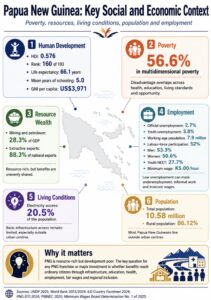
Created by the author using Canva and data endorsed by the United Nations & International Labour Organisation.
Benefits Beyond Symbolism
If the Chiefs are to represent PNG in more than name, the franchise’s symbolism must be backed by tangible social impact: improved opportunity, community participation and quality of life for the people the franchise claims to represent: a developing nation of 10M people, where poverty is prevalent and basic amenities such as electricity and safe drinking water are difficult to come by.
The real test of success for this type of venture within a developing nation is whether the franchise delivers measurable, practical and lasting improvements for the day-to-day lives of ordinary PNG citizens. Particularly those who live regionally (85%), experience multi-dimensional poverty (56.6%), rely on subsistence agriculture to feed their families (75%), have no access to electricity (79.5%) and limited access to safe drinking water (66%). Together, these statistics show why any PNG NRL franchise or major investment should be measured by the outcomes it delivers, not just the optics surrounding it. This would require the stated assurances and development goals within the $600M Government Funding Package to be fairly distributed, independently monitored, and proportionately accessible.
The NRL/ARLC have framed their PNG delivery commitments around two main promises funded by the Aus Government:
- Establishing and operating the PNG Chiefs franchise for NRL entry in 2028 ($290M); and
- Supporting broader rugby league and community development across PNG and the Pacific ($250M)
The stated delivery areas with reference to the Chief’s franchise include limited but relevant community development components in developing high-performance pathways and player welfare systems.
The broader community development promises will be facilitated through the existing Pacific Rugby League Partnership initiative and include: grassroots participation, junior/elite pathways, women’s rugby league, coaching/referee education, school-based programs, and unspecified community initiatives. These have also been linked to wider social outcome goals: including improved school attendance, health and nutrition, youth leadership, gender equality, social cohesion, tourism, infrastructure, and employment.
Established in 2024, The Pacific Rugby League Partnership is a 10-year agreement between the Australian Government, the ARLC and Pacific nations aimed at expanding rugby league development across the Pacific, particularly in PNG, Fiji, Tonga and Samoa. The partnership is fully funded by the Aus Government and combines rugby league development with broader regional diplomacy and social investment objectives.
Unfortunately, there is nothing publicly available that details: how the funding will be allocated and distributed, what measurable social targets exist, whether funding is independently audited, how much reaches rural and provincial communities; or whether there are explicit commitments tied to poverty reduction, education, healthcare or employment outcomes. I virtually gutted the Aus Government public databases and official federal budget published documentation trying to find it and kept hitting the same delightful brick wall represented in the image below.
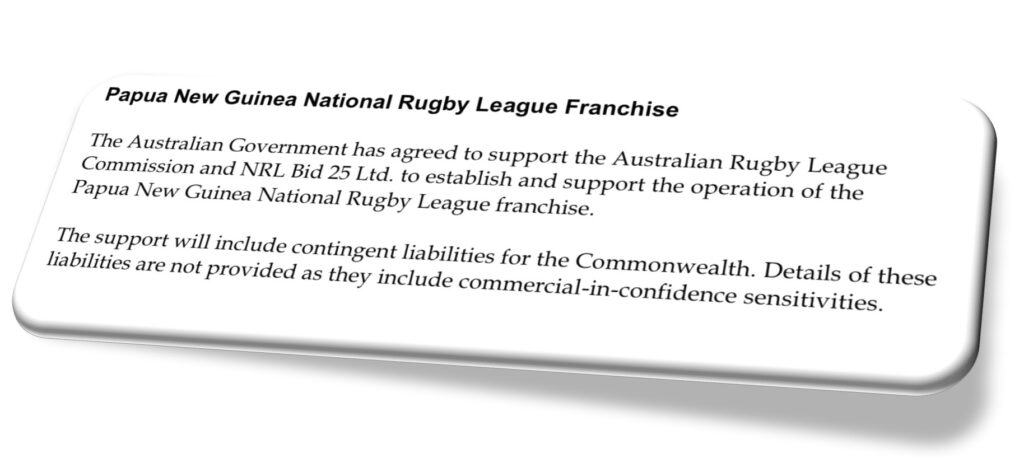
The quote that became the bane of my research/existence this week – Source: Aus Gov 26/27 Federal Budget
This is ultimately not surprising, but it is concerning, because statistically the greatest environmental and social risks of this type of venture lie in potential misplaced priority. Any project involving significant government funding in conjunction with commercial opportunity automatically carries a significant governance risk. Opaque project delivery in developing countries often follows a familiar pattern. A project is presented as economic and social development, but the practical benefits are captured mostly by wealthy foreign partners, politically connected contractors or corporate interests, while local communities absorb the disruption, risks and long-term cost. Other issues that could inhibit the delivery of commitments and beneficial outcomes include unintended social consequences:
- If communities invest emotionally in the project while broader living conditions remain unchanged, frustration can eventually replace optimism. That is why social responsibility must focus on substance over narrative. Cultural and socially an NRL team could potentially unite the nation, but it could also intensify already serious social crises (Alcohol abuse, unregulated gambling and correlating Domestic Violence rates) adding financial pressure and reducing safety for already under resourced and vulnerable fans;
- If professional sport is romanticised as the primary pathway out of hardship, it could place unrealistic expectations on aspiring athletes, which could unintentionally narrow aspiration and rates of domestic success rather than improve it. The message to young people should not be that rugby league is the only way forward. It should be that rugby league can improve their quality of life, connect them to education, health, employment, leadership and community pathways, whether or not they ever play professionally.
The Gated Team Compound Conundrum
One of the more uncomfortable issues for mine is the assessed need for players and staff to live in secure accommodation. There are obviously practical safety reasons for that decision, and those concerns should not be dismissed given the club has a duty of care obligation to protect players, staff and their families.
But socially, it creates an awkward and essentially unethical classist divide if the the people outside of the highly secure fenced and gated five-star compound are comparatively living a 1-star existence in the country that is meant to be their home.
I am hopeful that the undisclosed wider social outcome goals in the Pacific Partnership funding stream are measurably implemented by 2034 and that this translates into a safer community that requires less segregation. A secure accommodation model might be essential at present, but it must be balanced by initiatives that sustainably support improved community living conditions, community access to electricity, technology, food and resources. In the long term if PNG is safe enough to host the team, sell the dream, and justify the expansion, but not safe enough for players and tourists to integrate within the community, then PNG risks becoming the collateral backdrop for an elite professional football bubble rather than the beneficiary of meaningful change initiatives.
It is understood that the projected $90M cost of the accommodation base will be bankrolled by the Constantinou Group with construction being managed by their own PNG based subsidiaries Hebou Constructions, Monier Limited, and Lamana Developments. The NRL have confirmed that the Constantinou Group is building the facility, and the ARLC has signed a long-term lease agreement for at least a decade. While the cost of this agreement remains confidential, based on the current Port Moresby rental market it is likely a significant portion of the $290M operational budget in the Government funding package will be expended by this agreement.

Player benefit is guaranteed, but will the people of PNG benefit too? – Source: National Rugby League
Domestic Tax – Contribution and Benefit
There has been significant debate about the amendments to Australian taxation laws that allow eligible Chiefs players and staff to receive tax exemptions and third party concessions on income earned through the PNG franchise. However, far less attention has been paid to the other side of the arrangement: that those same players and staff will also avoid being taxed domestically by the PNG Government.
That raises a broader fairness and CSR issue. If the franchise is being promoted as a development opportunity for PNG and if players and staff are benefiting from tax exemptions to make the franchise viable, then what replaces that public contribution and how will PNG citizens benefit?
In simple terms, the concern is this: the project is being justified partly through its supposed benefit to PNG, yet the tax structure may reduce one of the most direct ways PNG could benefit from high-income earners working there – domestic tax revenue. If PNG is not receiving meaningful tax revenue from marquee players and senior staff, then the social return must be intentionally demonstrated elsewhere.
Tax concessions should not weaken the project’s social licence. For any exemptions granted, best practice CSR principles suggest there should at the very least be a visible alternative contribution made by the exempted party (individual or entity), such as a community benefit levy or independently audited social impact fund. If the franchise is being built in the name of PNG community development, there must be a guaranteed return to PNG’s people.
Politics and Power in the Pacific
Have you heard the one about the sporting arrangement that is ultimately a strategic regional partnership linked to international security relationships and Australia’s broader geopolitical interests in the Pacific? It was scarcely and very briefly covered a couple of years ago when the Chief’s venture was first announced.
You may or may not have heard this narrative, it’s primarily based on hearsay; but the security agreement was referenced and dare I say it emphasised by both countries Prime Minister’s (Marape & Albanese) at the time of the Chief’s announcement. Plus, based on what I have learned about media and its relationship with politics and law in my professional travels; if the BBC & SBS are all over it with credible sources but the Murdoch’s & Stokes’s are largely ignoring it, then it probably holds some weight.
I won’t go into it too much as this piece is already blurring the lines between Rugby League blog post and Four Corners investigation. But I will say, that from a CSR perspective it raises a contentious ethical debate around whether sport and international aide are being used as an instrument for political leverage. From a governance perspective, the central question becomes:
Is the PNG franchise primarily a community-development initiative that also produces strategic benefits for Australia, or is it primarily a strategic initiative that uses rugby league as the sweetener?
The answer probably sits somewhere in the middle.
Enough Said but More to Say
Well, I think it’s safe to say I have expended all the energy I have on this never-ending rabbit hole. Though there is much more to explore and discuss in next week’s column, particularly around the tax exemptions and other related concessions with reference to their fairness to Australian based teams and other proposed expansions. I decided about halfway through this one that the two issues required separation to ensure the key topics and their implications are given appropriate attention, analysis and review.
So I will close this one out by saying: At its best, I believe the PNG franchise could build pride, pathways, employment, education links, health engagement, women’s participation, regional inclusion and community infrastructure. It could treat PNG’s people as stakeholders with agency, representation and a long-term share in the project’s success. At its worst, PNG risks becoming the backdrop of a good story, while corporate, political and commercial stakeholders reap the tangible benefits.
Once again, the answer probably sits somewhere in the middle, and only time will tell how it plays out.
Until next week,
Roly-Poly Parra
#PARRAProud


Another excellent piece, thanks Roly.
I live in optimistic hope that eventually this will be an outstanding initiative for the people of PNG, youth and women as well as elite male athletes and eventually the bulk of the side will be made up of pathways players with the odd smattering of internationals to round out there team.
The cynic in me thinks that the wealthy will receive the most benefit. Sadly when money floods into a poor and corrupt country it doesn’t really end well for those who are poor/”lower class” but fingers crossed I’m wrong this time!
Hi Mike, the cynic in me thinks so too. The vicious circle of when money & greed/power meet vulnerability & poverty on land that is rich in “extractive resources” Is a scenario we’ve seen time and time again throughout history. The lack of transparency almost feels like an insult to fans intelligence. I would rather not know anything about the funding than be fed 3 lines of buzz words and be expected to treat it as gospel. Though it won’t be easy, I will try and give the powers that be the benefit of the doubt for the moment; as the information around where the money will be spent is so vague, it’s hard to know what they do and don’t have planned.
Tks Roly. Food for thought there, perhaps make that a banquet. Maybe this is a hypothetical given your search of government records came up with not much, but what is the governance structure (for the $600 million commitment)…the bit of ‘overview’ from the government to the principal actors ( from what I can see these are the ARL/NRL and the PNG government).
Hi BDon, Governance is the biggest concern for me too. Hypothesising seems to be the only option at present. There has not yet been any public transparency around: where the money sits; who signs off expenditure; what auditing mechanisms exist; how independent oversight works; how outcomes will be measured; and what proportion directly reaches PNG communities versus rugby league operations.
From what I can see there is no single publicly identified stakeholder/s or independent body confirmed as responsible for the funding pool. Instead, the money appears to flow through multiple layers depending on the purpose of the funding.
I think a half $Billion taxpayer investment should automatically require: independent auditing, transparent reporting, and measurable outcome tracking at the very least.
One would hope the funds are to be distributed through direct government-controlled programs that include milestone-based agreements, transparent infrastructure arrangements; and robust partnership delivery mechanisms. Though in trying to establish/confirm this I kept hitting the quote: “The support will include contingent liabilities for the Commonwealth. Details of these liabilities are not provided as they include commercial-in-confidence sensitivities”.
Disappointing, frustrating and intriguing all at once.
Thanks Roly,
Another enjoyable, thought provoking piece. I appreciate the time and research effort you put into all of your posts here.
The PNG franchise could be a wonderful thing or an absolute disaster, only time will tell. The main players in kickstarting it will have all moved well on before we find out.
The CSR angle is an interesting one. Is it the role of the NRL to contribute in that way more broadly or is its main function to ensure the good running of the rugby league competition that remains financially secure. There seems to be a little winding back by some companies on CSR. I think one of the new bank CEOs was quoted as pulling back a bit and saying the focus should be on the shareholders. When my son was at university over the last few years there was some debate over how CSR should be viewed. Of course good CSR can contribute to a company’s, or the NRL’s success if done well.
The political angle is intriguing. I’m not surprised you kept on hitting your head against the proverbial brick wall while researching this part. All governments have become increasingly opaque in providing adequate details on spending and outcomes. I would love to be able one day to see the actual details in that item called “off budget spending”.
A few years back a chap called into the ABC Grandstand commentary team to discuss the national/regional security angle of the Federal Government involvement in funding some of the PNG franchise. He was shut down immediately with the commentators saying it was a nonsense they’d never heard about. I was disappointed at the naivety. I may be cynical but governments do not provide funding for this sort of project out of pure altruism. It is definitely a form of soft power being used to try and influence other outcomes. Will it work? Depends if the money really gets used for its intended purpose.
The PNG concept has the real potential to be good in so many ways. I just worry that it won’t. At a bare minimum there has to be a competitive, self sufficient footy franchise at the end of it.
I haven’t really expressed my thoughts as well as I would like here, especially around the political, regional security aspect. I am so out of practice writing my thoughts out in a logical, succinct manner.
Thanks again for the post. Really, really enjoyable.
Hi Namrebo, I appreciate the support, you raise really good points as always.
It is interesting looking at the shift in CSR and also KPI objectives. I remember when doing my Masters so much had changed from when I did my Bachelor; and they were only 5 years apart. There has been a definitive shift in so many aspects of corporate functionality (in theory and practice) since COVID in particular. Having moved to the public sector in recent years after 20 years in private this has also been an eye opener.
I think the NRL/ARLC could do a lot for the community by simply doing their job in the structure efficiently. I.e. I would assume any decent pathways program would have specific budget for safe drinking water and adequate nutrition; but the lack of information makes me worry.
Being disappointed in the naivety of the media is one of my biggest first world pain-points. When I see them ignore big stories or dismiss clear issues I feel so conflicted. Is it a lack of intelligence? Is it ignorance? Are they under the direction of a greater power? Are there anterior business motives at play? And I think it’s a combination of all of them.
There is so much potential for good to come out of this. I remain hopeful despite all my concerns. I agree with you sentiment that at the very least a self sufficient footy side would be the bare minimum measure of success. I think for me more broadly I would add that whatever happens, I would just like PNG and its people end up being measurably better off from a human development perspective than they were at the start. It doesn’t have to be massive. Maybe a few years of improvement in life expectancy and 10% less multidimensional poverty. Measurable doesn’t have to mean massive.
Let’s face it – the real reason is to beat back China. In other words it’s about national security. I pity the players who travel there to play. It will be much worse than Darwin. Another mistake by our administration.
Love your honesty Zero,
The limited but well sourced reporting that suggests the funding can potentially be withdrawn in the event that certain geopolitical/security conditions change is concerning from a political, economic and human rights perspective. While I can’t see PNG shifting its weight behind the big C; it does concern me that this is being framed as good will that will be pulled away if the poor people don’t do what they’re told. Not very democratic in values.
Pingback: TCT Golden Point – 17 October 2026 – What’s in a Name? The Chiefs, the Courts and the Question of Coexistence – The Cumberland Throw