
Hey Parra fans, welcome to Part 2 of the TCT Golden Point Beyond the Blame Game Series: Challenge the System. Otherwise known as the summarised version of pages 21-40 of the original 2am novella. Let’s get straight into it.

ACKNOWLEDGEMENT AND PREFACE
Since Part One was published, the Eels have announced that CEO Jim Sarantinos will step down at the conclusion of the 2026 season.
It is important to me that I acknowledge Jim’s significant contribution to the Parramatta Eels as a Board Member, COO and CEO over a 10-year period. Beyond the more commonly cited achievements of revenue growth, the Centre of Excellence and record membership; for mine, Jim’s legacy sits firmly in governance and administrative reform; improvements in corporate integrity and operational stability; the establishment of community-focused initiatives including the Eels Foundation and Eels Education Institute; and the expansion of Junior Pathways Programs.
Whatever anyone’s individual assessment of particular decisions or football outcomes during his tenure, these are substantial contributions to both the Parramatta Eels of today and the foundations of its future, and they deserve to be recognised.
Recognition aside, Jim’s departure does not materially change the direction of this series. Beyond the Blame Game is deliberately not personified where possible. While names are inevitably attached to the analysis because individuals currently occupy the roles being examined, the focus is primarily on the roles themselves and the systems, processes, responsibilities and accountabilities surrounding them.
I like to say: faces change, but the work of the heart remains; which is a much softer version of my late fathers “everyone’s expendable and everyone’s replaceable”; both have served me well. Better still, I am of the belief that a strong organisation should be capable of retaining what works, identifying what does not, and continuing to improve regardless of who occupies a particular position. Because changing the person within a system does not necessarily change the system itself.
As I acknowledged throughout Part One, I am not sitting inside Parramatta’s Boardroom meetings, football department or coaching reviews. I cannot analyse what I do not know, nor can I reasonably conclude that any particular systemic weakness actually exists. I do not profess to have specialist sporting-club expertise, nor do I believe I know better than those currently responsible for overseeing these areas.
What I can confidently analyse, both theoretically and practically, drawing on my studies and three decades of professional experience, are the kinds of questions an organisation seeking sustained success should be capable of continually asking itself.
As always, I hope you find this insightful and engaging. More importantly, I look forward to hearing your own views and perspectives in the comments; whether they are similar, dissimilar, or indifferent.
BEYOND THE BLAME GAME SERIES – PART 2: CHALLENGE THE SYSTEM
In Part One, Ask Why?, I attempted to move beyond some of the more convenient explanations for Parramatta’s ongoing inconsistencies. Using RASCI to clarify accountability and the Five Whys to dig beneath visible problems, the aim was not to find somebody to blame; it was to better understand what might actually be causing those problems in the first place. But identifying a possible cause is only the beginning:
- An organisation can correctly identify a problem, assign responsibility for addressing it and still find itself confronting essentially the same problem twelve months later.
- A team can identify poor completion rates and practise ball control.
- A football department can identify a roster gap and recruit a player.
- An executive can identify an underperforming function and change the person leading it.
- A Board can review poor results and request an improvement plan.
Each response may be entirely reasonable on its own, and even effective in the short term. But when the same types of problems continue to reappear, asking “why did this happen?” may no longer be sufficient. At some point, the organisation must critically reflect on whether something within the system itself is allowing the problem to persist. Without that reflection, it risks becoming very efficient at responding to problems it never actually solves.
If they do not critically reflect, the organisation risks repeatedly treating symptoms rather than causes. Individual responses may solve the immediate problem, but the underlying assumptions, structures or processes remain unchanged, allowing the same failures to reappear in slightly different forms. Over time, this can normalise underperformance, reinforce ineffective practices and create a cycle in which considerable effort is spent fixing recurring problems without ever addressing why they continue to exist.
DOUBLE-LOOP LEARNING: CHALLENGING THE SYSTEM
Double-Loop Learning (DLL), was originally developed by organisational theorist Chris Argyris in 1977, and examines why organisations can continue experiencing the same problems despite appearing to learn from them. The concept remains influential today, with contemporary research continuing to apply it’s methods across organisational change, leadership, education and healthcare initiatives in both the public and private sector. DLL helps organisations and the individuals within them, to understand how they can move beyond correcting immediate errors and instead question the assumptions and systems that allow problems to persist.
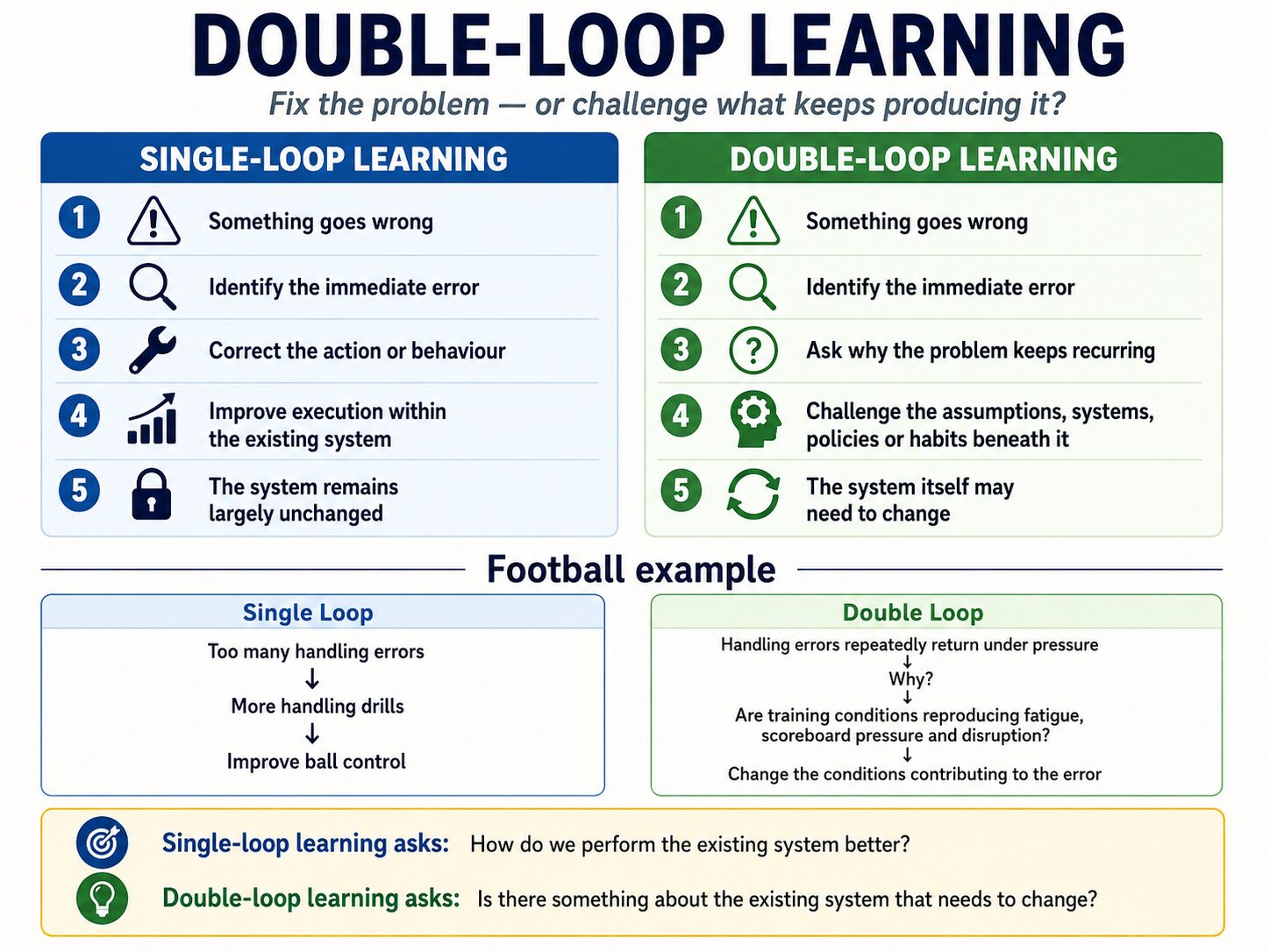
SL & DLL Differentiation – Concept: Chris Argyris for Harvard Business Review – created by the author using Canva Premium
At its simplest, single-loop learning corrects an immediate error within the existing system. That is often entirely appropriate. The limitation arises when the same problem keeps returning and repeated corrections fail to produce lasting improvement.
Double-loop learning goes further by examining not only how the existing system can perform better, but whether something within the system itself needs to change. The second loop challenges the assumptions, policies, behaviours and habits sitting beneath the problem identified in the first loop. In football terms, it moves beyond simply correcting execution and asks whether the game plan, training environment, recruitment philosophy, leadership structures or accountability systems are themselves contributing to the recurring outcome.
Argyris’s broader message is that genuine organisational learning requires more than correcting errors. It requires an environment capable of questioning established practices when repeated evidence suggests that simply improving execution within the existing system is no longer enough.
For The Eels, Double-Loop Learning (DLL), therefore means looking beyond individual mistakes and isolated decisions to examine whether the systems and assumptions surrounding them are helping the club learn; or simply allowing familiar problems to return in slightly different forms.
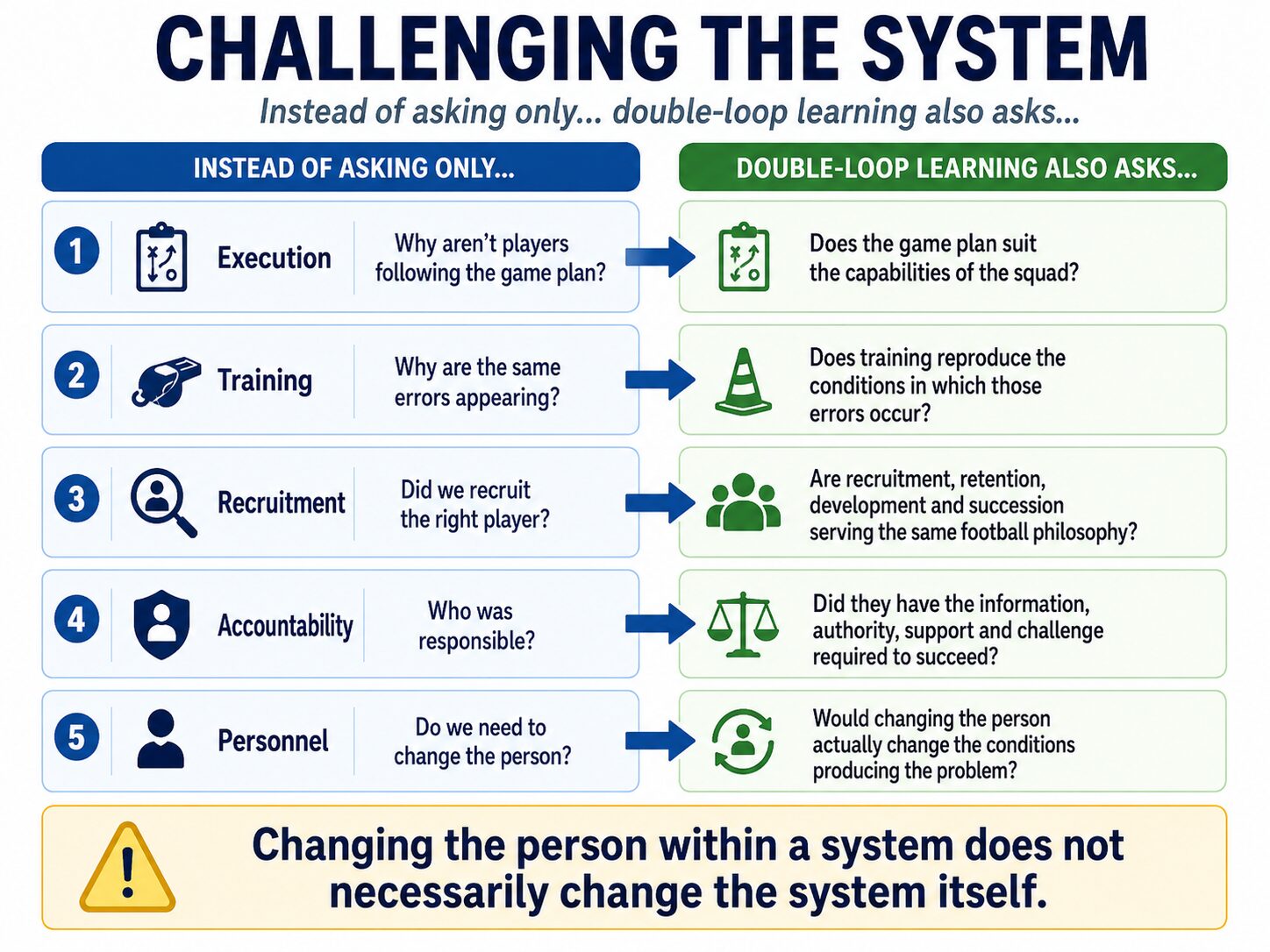
Challenging the System – Concept: Chris Argyris for Harvard Business Review – created by the author using Canva Premium
DLL For the Board: From Oversight to Effective Governance
Part One Summary: The Board must look beyond delegation and ensure its governance framework can detect underperformance early, challenge ineffective decisions and hold the right people accountable before problems become entrenched (5 Whys Assessment). The Board is Accountable for the overall governance environment, including whether appropriate structures, information, oversight and accountability mechanisms are in place and functioning effectively (RASCI Implication).
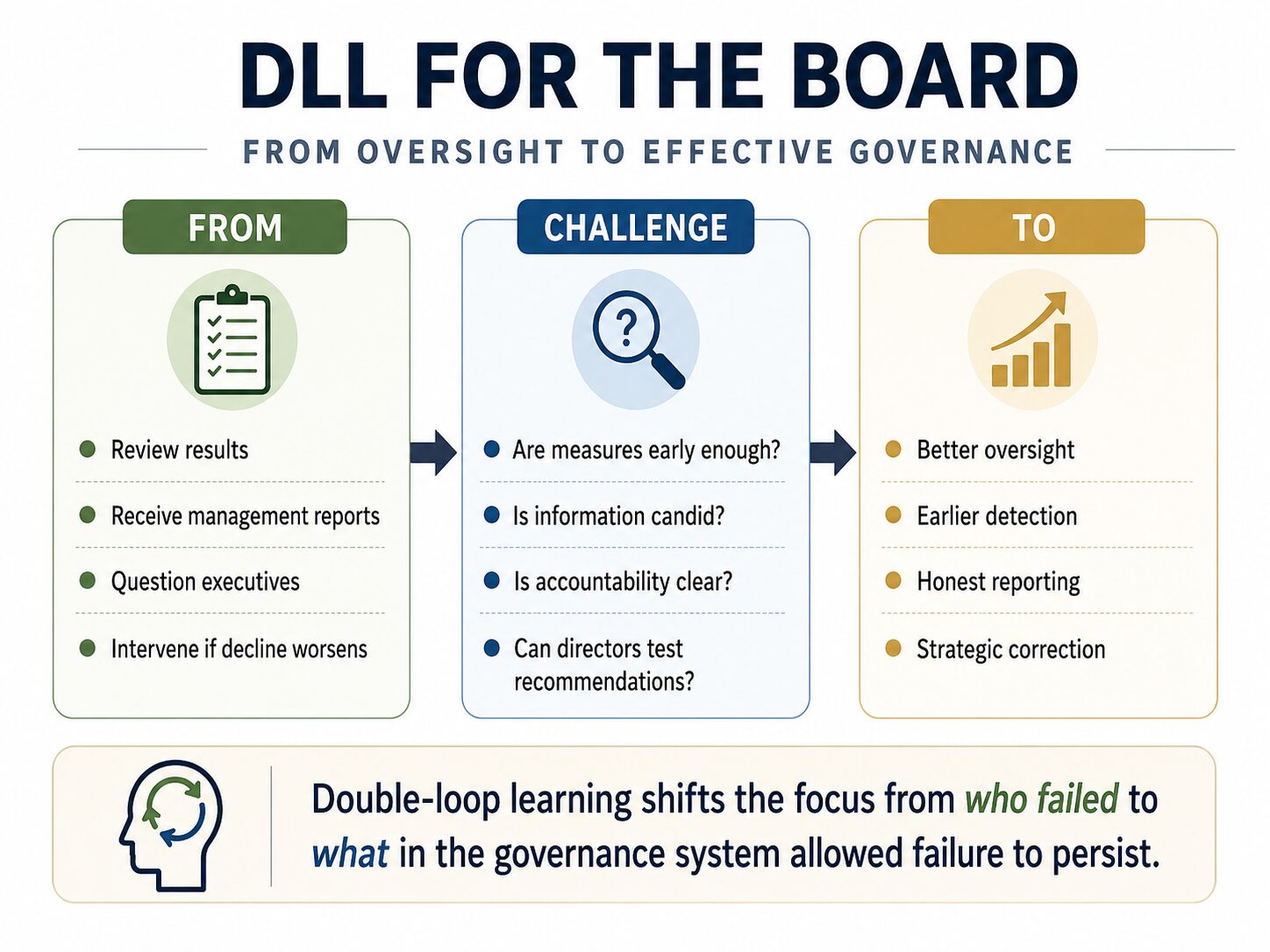
DLL for the Board – Concept: Chris Argyris for Harvard Concept: Chris Argyris for Harvard Business Review – created by the author using Canva Premium
The Board’s role is to govern, not manage. Its responsibility is to provide strategic oversight, set expectations, monitor performance and hold management accountable—not to make day-to-day operational or football decisions. The double-loop challenge is whether the governance system allows the Board to recognise problems early enough for that oversight to be meaningful.
If similar issues continually reappear under different coaches, executives or football staff, repeatedly placing the onus on the individual occupying the role becomes increasingly difficult to justify. Changing personnel may address one part of the problem, but if the weakness survives successive appointments, the Board must also examine whether reporting structures, strategic assumptions, measures of success or governance expectations are enabling it to endure.
For the Eels Board, double-loop learning is therefore not about intervening in decisions appropriately delegated to management. It is about ensuring the governance environment can identify poor performance early, receive honest information, challenge ineffective decisions and adjust strategic direction before another cycle of underachievement takes hold.
DLL for the CEO: From Individual Functions to Collective Accountability
Part One Summary: The CEO must create an organisation where accountability is clear, performance is measurable and ineffective decisions are identified and corrected early, while ensuring the club learns from problems rather than repeatedly reacting to them (5 Whys Assessment). The CEO is Accountable for effective organisational accountability and performance systems, with functional leaders Responsible or Supporting and the Board providing appropriate oversight (RASCI Implication).
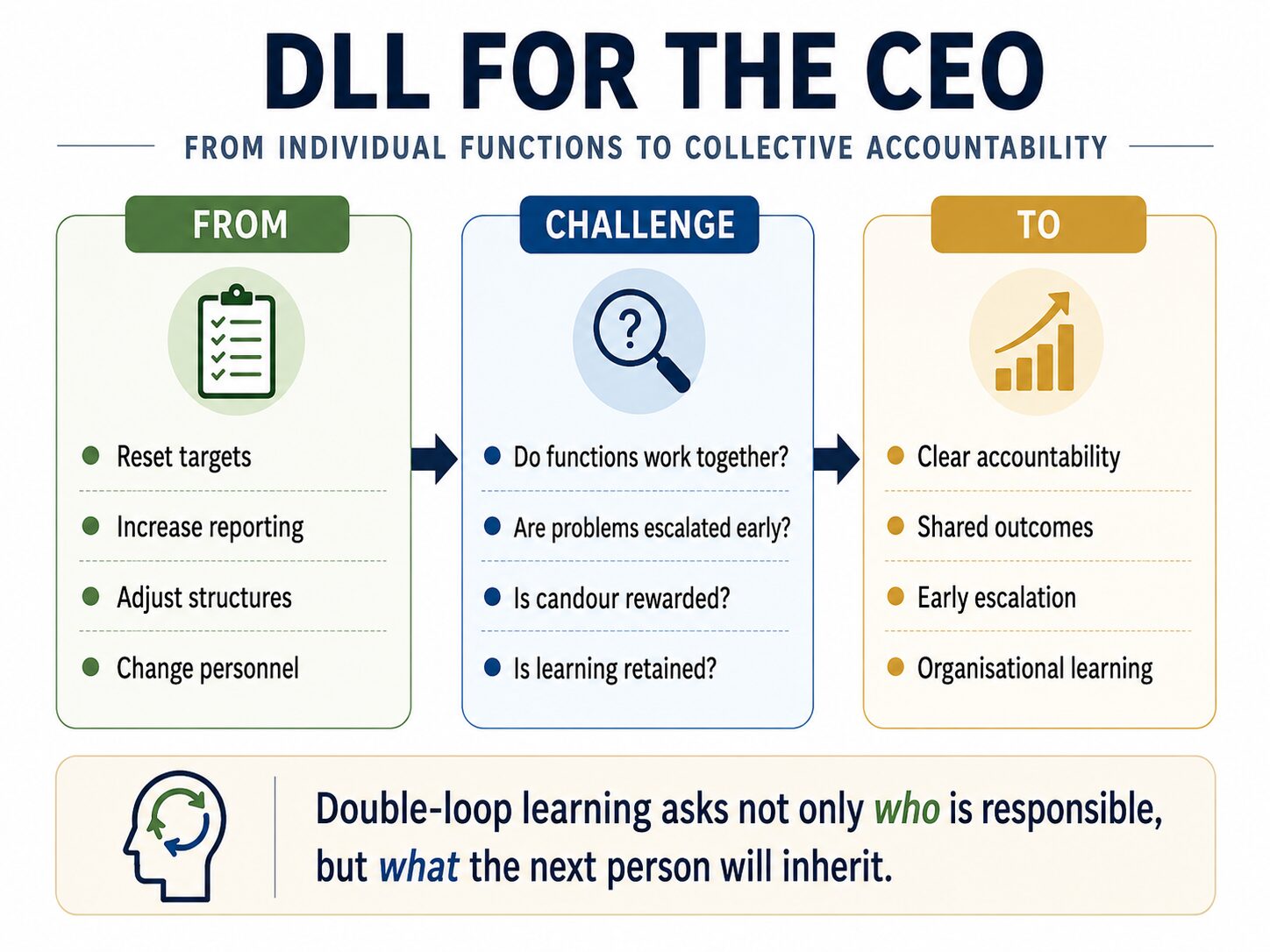
DLL for the CEO – Concept: Chris Argyris for Harvard Business Review – created by the author using Canva Premium
The CEO sits at the critical junction between governance and execution: translating the Board’s strategic direction into an organisation capable of delivering it.
That becomes particularly important where responsibility for an outcome crosses several functions, as it inevitably does within a multifaceted sporting organisation such as the Parramatta Eels. Even where individual business functions are operating effectively within their respective areas, the combined system can still fail to produce the required overall outcome. Double-loop learning therefore requires the CEO to examine not only the performance of its individual parts, but also how effectively those parts interact as a whole.
That is where the CEO’s accountability becomes broader than the performance of any single function. Responsibilities must be clear, performance measurable, information able to reach the people who need it, interdependencies understood, and ineffective decisions capable of being challenged before their consequences become entrenched.
Changing a person may sometimes be the appropriate response. Double-loop learning simply requires the organisation to ask one further question: What will the next person inherit?
If the structures, assumptions and processes surrounding the role remain unchanged, changing the person may change who is accountable for the problem without changing what continues to produce it.
DLL for the GM of Football: From Reactive Recruitment to Roster Coherence
Part One Summary: The GM of Football must take an integrated approach to recruitment and roster management, balancing elite talent, reliable core players and emerging pathways to build sustainable depth and resilience across the squad (5 Whys Assessment). The GM of Football is Accountable and Responsible for an integrated roster strategy, supported by Football Operations and informed by the Consulted expertise of the Head Coach and Coaching Team (RASCI Implication).
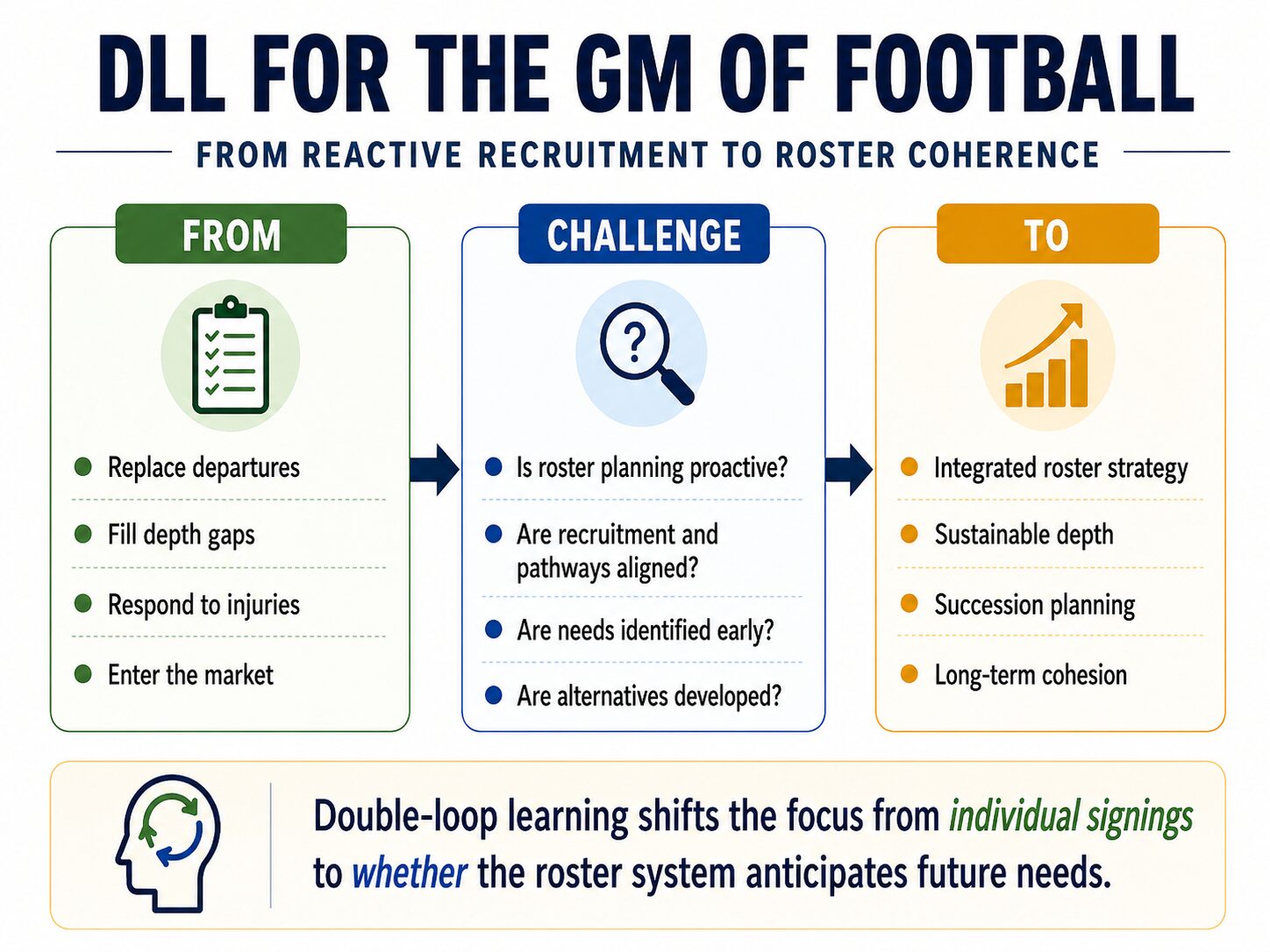
DLL for the GM – Concept: Chris Argyris for Harvard Business Review – created by the author using Canva Premium
The deeper question for the GM of Football is whether individual recruitment, retention and development decisions form part of a coherent, proactive roster strategy capable of anticipating what the squad will require several seasons from now.
No recruitment system can eliminate uncertainty. Players reject offers for many reasons; rival clubs may provide more attractive opportunities; young players develop at different rates; family and environmental circumstances matter; and salary-cap constraints inevitably remove otherwise attractive options from consideration.
Double-loop learning does not pretend those variables can be controlled. It asks whether the club is learning effectively from the variables it can influence. One unsuccessful recruitment pursuit may tell us very little, but when the same positional weakness, succession problem or lack of depth repeatedly reappears, the pattern itself becomes worthy of examination.
The focus then shifts from the individual player who was or was not signed, to whether the need was identified early enough, whether sufficient alternatives were developed and pathways, recruitment and retention decisions were aligned with the club’s longer-term roster requirements.
Premiership rosters are not built through a collection of isolated transactions. They are the cumulative product of recruitment, retention and development decisions made across several seasons.
DLL for Football Program Operations: From Fixing Problems To Preventing Them
Part One Summary: Football Operations must continually review and improve the systems supporting the team to reduce uncertainty, anticipate problems and allow coaches and players to focus on performance (Five Whys Assessment). Football Operations is Responsible for those systems, while the GM of Football remains Accountable for ensuring they collectively enable performance (RASCI Implication).
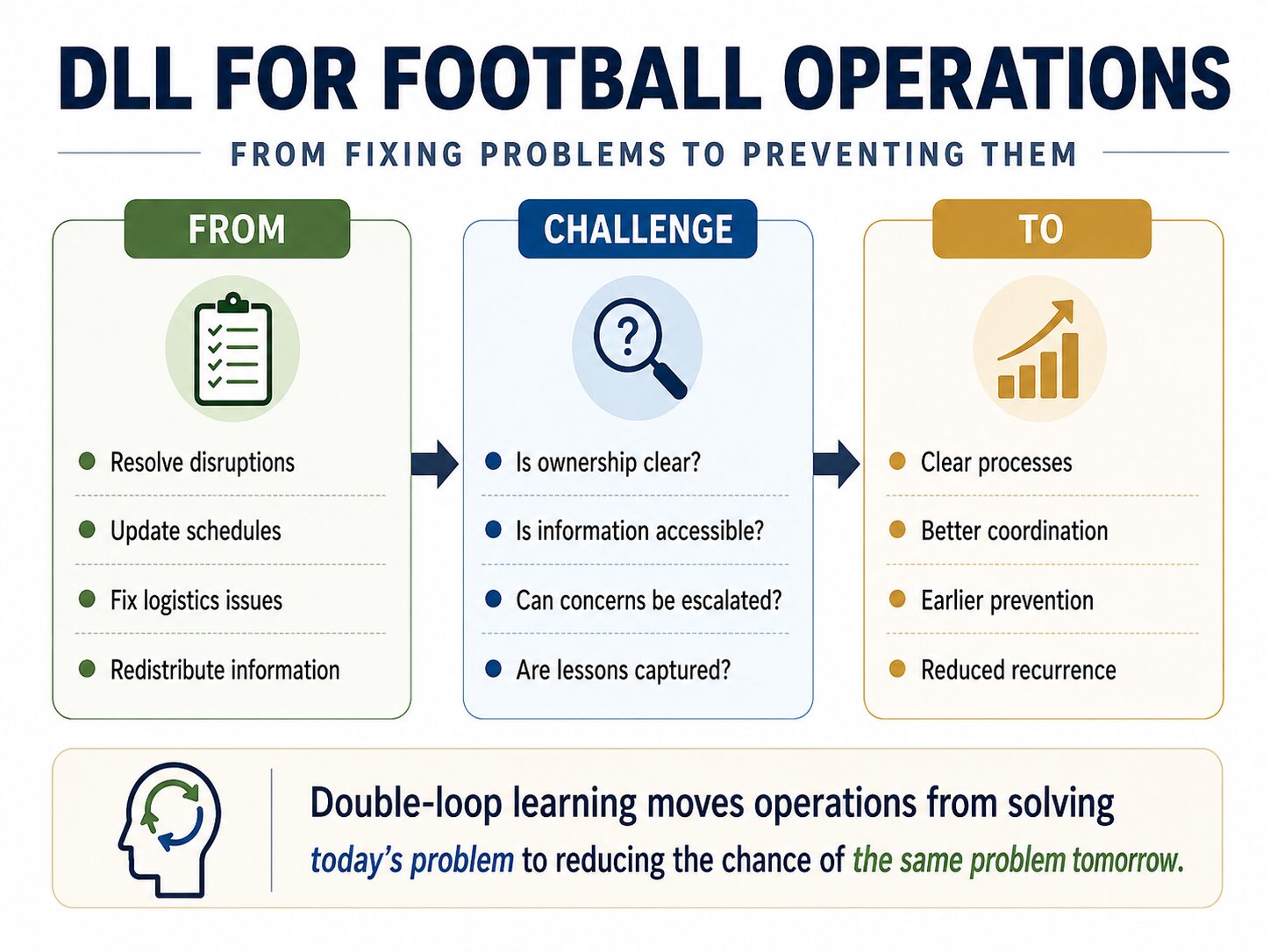
DLL for Football Operations – Concept: Chris Argyris for Harvard Business Review – created by the author using Canva Premium
Operational work is often most visible when something goes wrong and almost invisible when everything works as intended. Resolving immediate problems is therefore an essential part of the role. The risk is that becoming very good at solving them can unintentionally disguise weaknesses in the processes producing them.
Operational weaknesses rarely announce themselves as major organisational failures. One communication breakdown may simply be human error; repeated communication failures may instead indicate fragmented information, unclear responsibility or a process overly dependent on individuals compensating for its weaknesses. Likewise, one unavoidable late change may mean very little; a pattern of late changes may suggest that something further upstream requires attention.
Double-loop learning does not require a Royal Commission every time somebody forgets the witches’ hats. It requires an organisation capable of distinguishing an isolated mistake from a recurring pattern; one that is willing to examine the system when that pattern emerges.
For Football Operations, the objective is therefore not merely to resolve problems efficiently, but to learn from them, reduce their recurrence and progressively remove the conditions that created the need for intervention in the first place.
DLL for The Head Coach: Training for the Response, Not Just the Plan
Part One Summary: The Head Coach must ensure the coaching system converts preparation, strategy and expectations into increasingly reliable match-day performance through clear standards, aligned priorities, meaningful accountability and selection decisions that reinforce the required behaviours (Five Whys Assessment). The Head Coach is Accountable for the overall coaching response, with the Coaching Team Responsible for delivery, Football Operations providing Support, and the Captain and Squad Responsible for translating preparation into match-day behaviour (RASCI Implication).
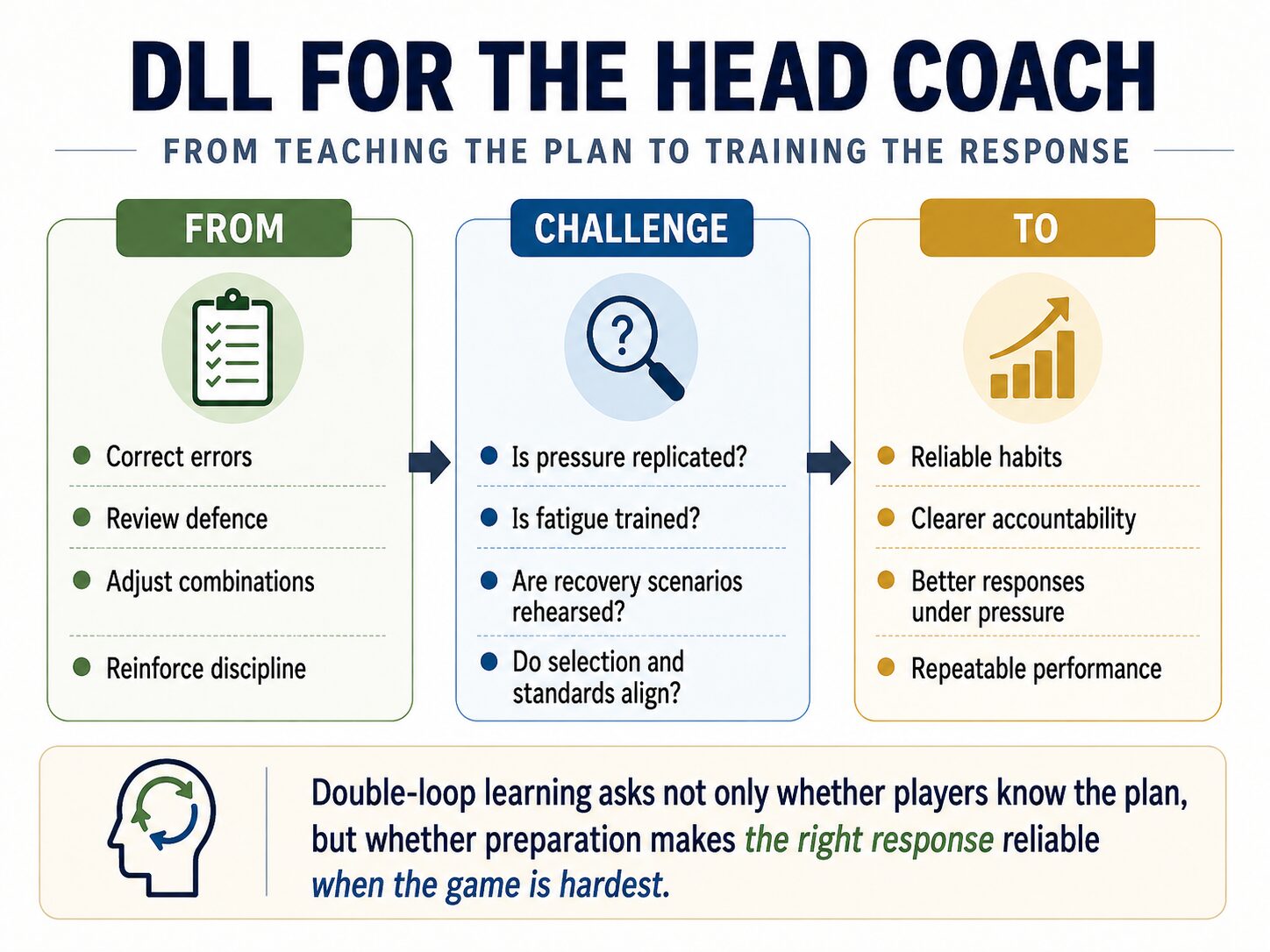
DLL for the Coach – Concept: Chris Argyris for Harvard Business Review – created by the author using Canva Premium
Correcting errors, reviewing execution and reinforcing expectations are legitimate and necessary coaching responses. But when the same performance failures continue to reappear despite repeated correction, the focus must extend beyond whether players understand what they are expected to do; and towards whether the broader coaching environment is preparing them to reproduce those behaviours when they become hardest to execute.
This does not dilute player responsibility, players remain accountable for making the tackle, catching the football and choosing the correct option in the moment. Double-loop learning asks whether the coaching system surrounding those responsibilities is making the desired behaviours increasingly reliable—particularly when fatigue, pressure and momentum make them most difficult to reproduce.
The Head Coach’s challenge therefore extends beyond identifying what went wrong and prescribing the correct response. It is to create an environment in which preparation, standards, selection and accountability progressively reduce the likelihood that the same failures will continue to return.
The ultimate measure is not simply whether the team has been told what the correct response should be, or whether they can reproduce it successfully in a controlled training environment. It is whether that response has been embedded deeply enough to be executed reliably on the field, where fatigue, pressure, disruption and momentum make it most difficult to execute.
DLL for The Coaching Team: From Correcting Errors to Embedding Behaviour
Part One Summary: The Coaching Team must translate identified performance problems into coordinated, measurable responses that align with the Head Coach’s strategy and progressively build stronger habits, decision-making and reliable execution under match pressure (Five Whys Assessment). The Head Coach remains Accountable for the broader coaching program, while the Coaching Team is Responsible for coordinated delivery, supported by relevant football staff and informed by player feedback (RASCI Implication).
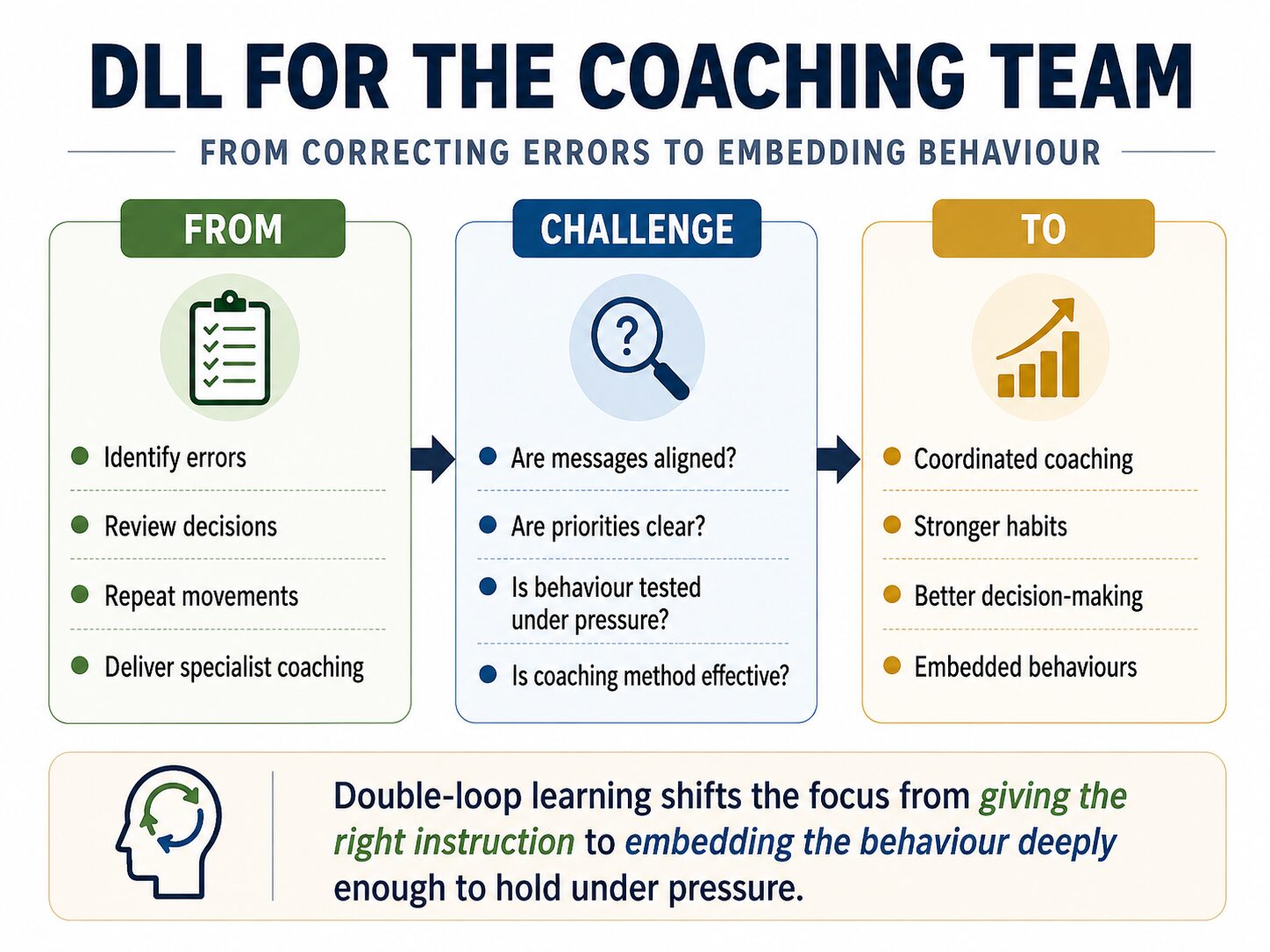
DLL for the Coaching Team – Concept: Chris Argyris for Harvard Business Review – created by the author using Canva Premium
Modern coaching programs distribute considerable technical and tactical responsibility across assistant coaches, positional coaches, development staff, analysts and other specialists. That expertise is essential, but it creates its own systems challenge: every specialist intervention must ultimately reinforce the same broader football strategy and contribute to improvement in the same team.
A player can understand precisely what they did wrong, demonstrate the correct response at training and still repeat the same mistake the following week. That is where coaching has to move beyond correction.
The Coaching Team’s challenge is to convert information into habit: through targeted interventions, consistently reinforced across coaching areas, repeated under relevant conditions and ultimately measured by what players reproduce in competition.
Knowing what is required is not the same as having those behaviours embedded deeply enough to reproduce them consistently and automatically under fatigue, pressure and disruption.
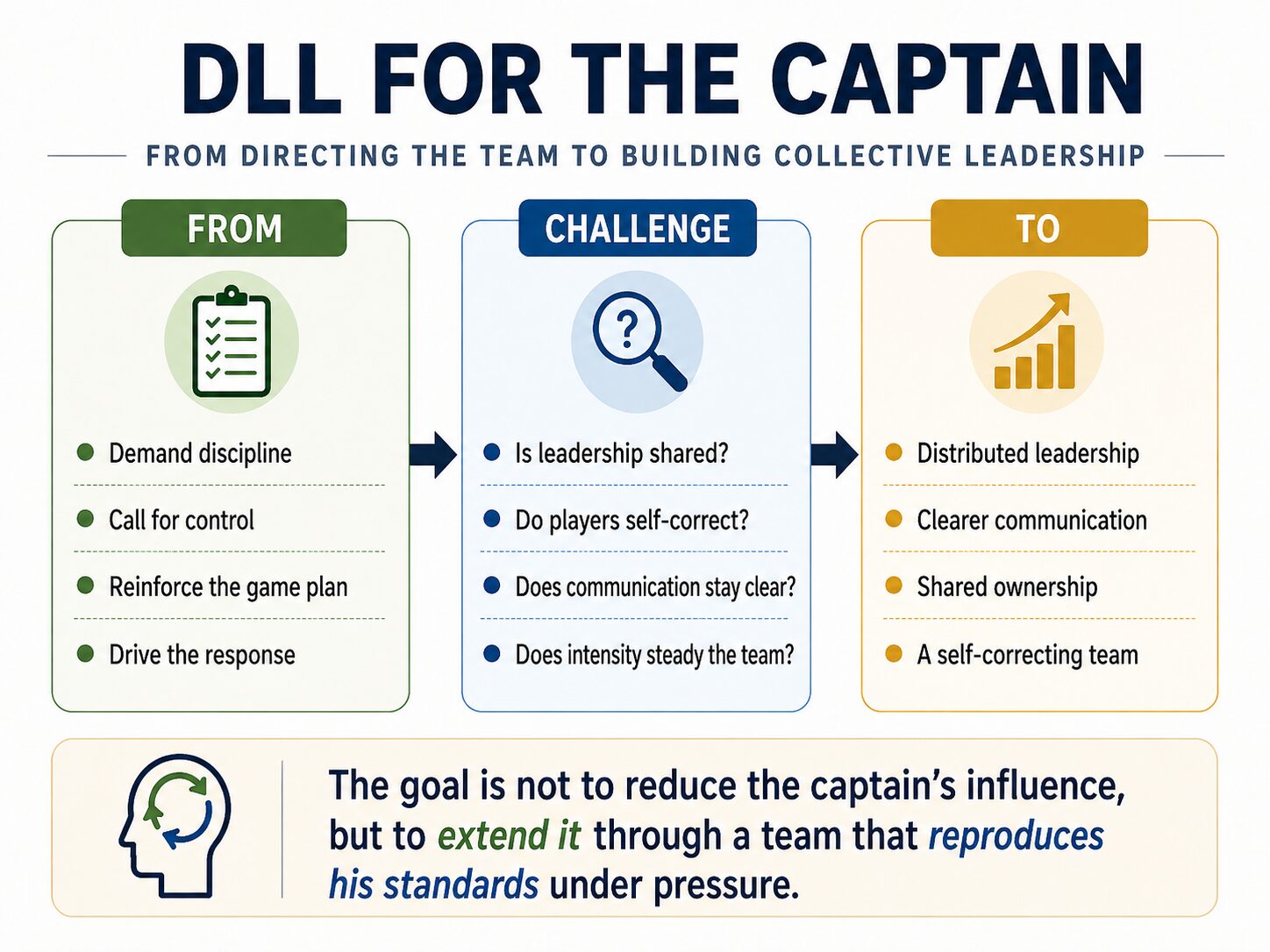
DLL for The Captain: From Directing the Team to Building Collective Leadership
Part One Summary: The Captain must translate competitiveness, football intelligence and responsibility into calm, clear and adaptable leadership, particularly under pressure (Five Whys Assessment). The Captain is Responsible for reinforcing standards, communication and collective on-field responses, while the Head Coach remains Accountable for the leadership environment and the wider Squad provides Support through shared ownership (RASCI Implication).
DLL for The Captain – Concept: Chris Argyris for Harvard Business Review – created by the author using Canva Premium
Captaincy presents a slightly different double-loop challenge because leadership itself forms part of the system. The Captain; and in this instance chief playmaker; already carries substantial responsibility. He directs the attack, manages the kicking game, communicates tactical adjustments and helps control the tempo of the contest, while also being expected to influence the emotional and tactical response of those around him.
The deeper question is therefore not simply whether the Captain communicates enough, but whether the leadership environment allows that communication to remain effective when pressure increases and whether enough leadership exists around him that the team does not become dependent on one person to continually restore control.
There is also a more personal dimension to leadership that Double-Loop Learning allows us to examine without reducing it to criticism. The Captain’s competitiveness, passion and willingness to take responsibility are obvious strengths. The consideration is how those qualities translate into the behaviour of the people around him.
Effective leadership requires urgency to sharpen concentration, demands for a response to be accompanied by clarity about what that response should be, and visible emotion to galvanise rather than unsettle teammates. The challenge is ensuring the Captain’s intensity reinforces the sense that the team remains composed, connected and in control, particularly when momentum shifts.
The second-loop focus therefore moves beyond directing the team more effectively towards helping create a team capable of remaining organised, accountable and self-correcting, even when he cannot personally direct every moment. That may require greater distribution of leadership, clearer on-field responsibilities, and deliberate development of emerging leaders.
The objective is not to reduce his influence, but to extend it. One of the strongest measures of a captain’s leadership may ultimately be a team capable of reproducing his standards, football intelligence and accountability, even when he is not the person providing every instruction.
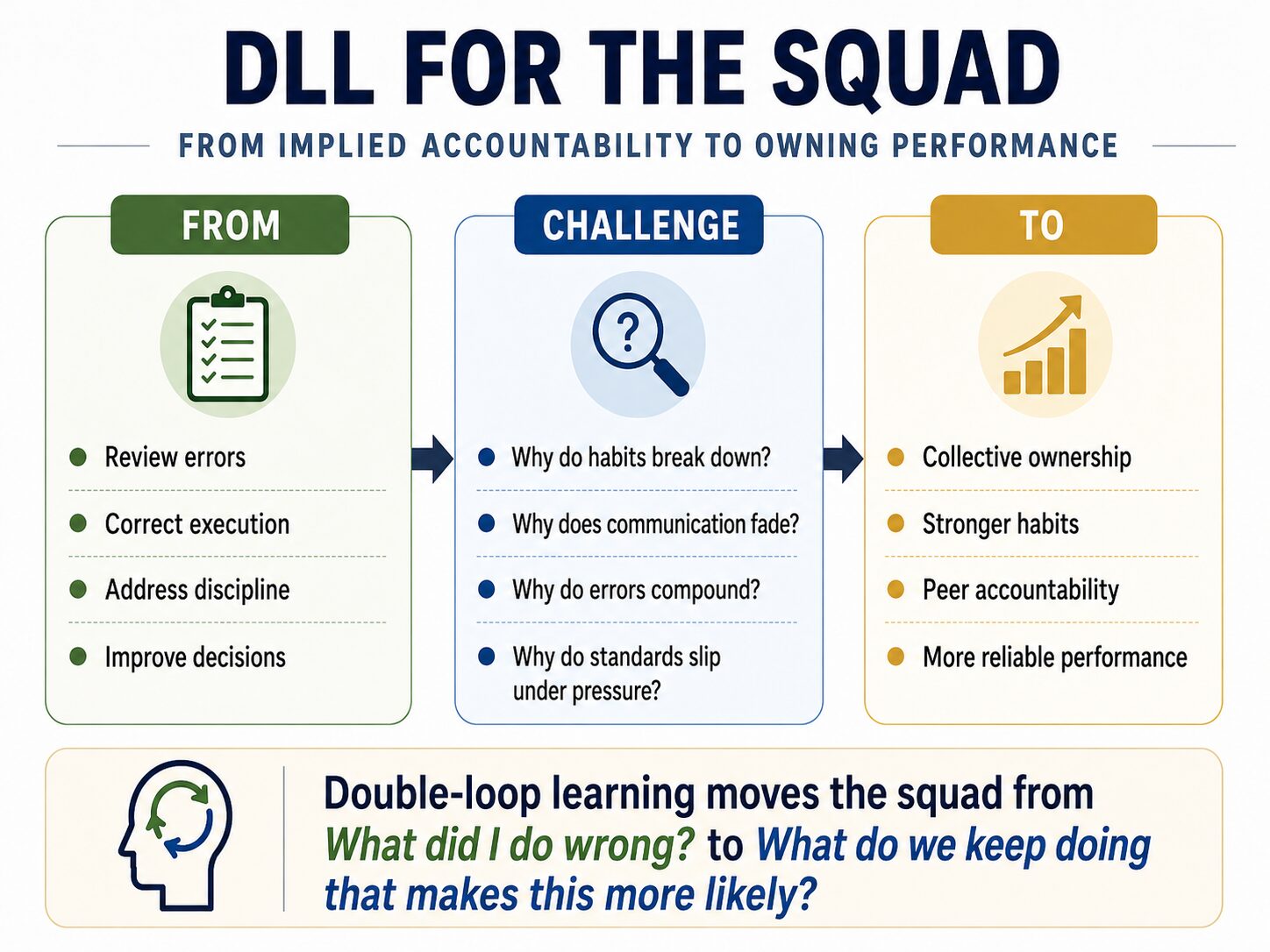
DLL for The Top Squad: From Implied Accountability to Owning Performance
Part One Summary: The Top Squad must convert preparation and development into reliable match-day habits, maintaining execution, discipline and decision-making under pressure through collective ownership and consistently reinforced standards (Five Whys Assessment). Individual players are Accountable and Responsible for their own execution, while the wider Squad Supports collective standards and the Captain and Coaching Team reinforce the behaviours required under pressure (RASCI Implication).
DLL for the Squad – Concept: Chris Argyris for Harvard Business Review – created by the author using Canva Premium
Eventually, every organisational system reaches the field. Coaches can prepare, Analysts can identify patterns, Football staff can construct the roster, and Leaders can establish expectations; but none of them can catch the football, make the tackle or choose the option for a player in the moment.
That is why Part One ultimately returned a significant amount of responsibility to the Top Squad. Double-loop learning does not dilute that responsibility. It deepens it by asking players to look beyond isolated mistakes and examine the habits and collective behaviours that make those mistakes more likely to recur.
Accountability must also operate horizontally across the team rather than flowing only downward from coach to player. Senior players need to reinforce standards, teammates need to be able to challenge one another constructively, and all players must try to recognise and respond to emerging problems before the coaching staff can intervene from the sideline. The behaviours required to regain control ultimately need to become collective expectations rather than instructions dependent on continual external reinforcement.
That does not mean creating an environment where every mistake attracts blame. A learning team must distinguish between making an error and accepting the behaviours that repeatedly produce avoidable errors. Mistakes are inevitable in rugby league. Allowing poor habits, lapses in communication or declining standards to become normal is something different.
For the Top Squad, the objective is not perfection. It is to become a playing group that is increasingly capable of recognising problems, reinforcing its own standards and correcting itself under pressure.
ONE CLUB, MULTIPLE LOOPS, ONE CONNECTED SYSTEM
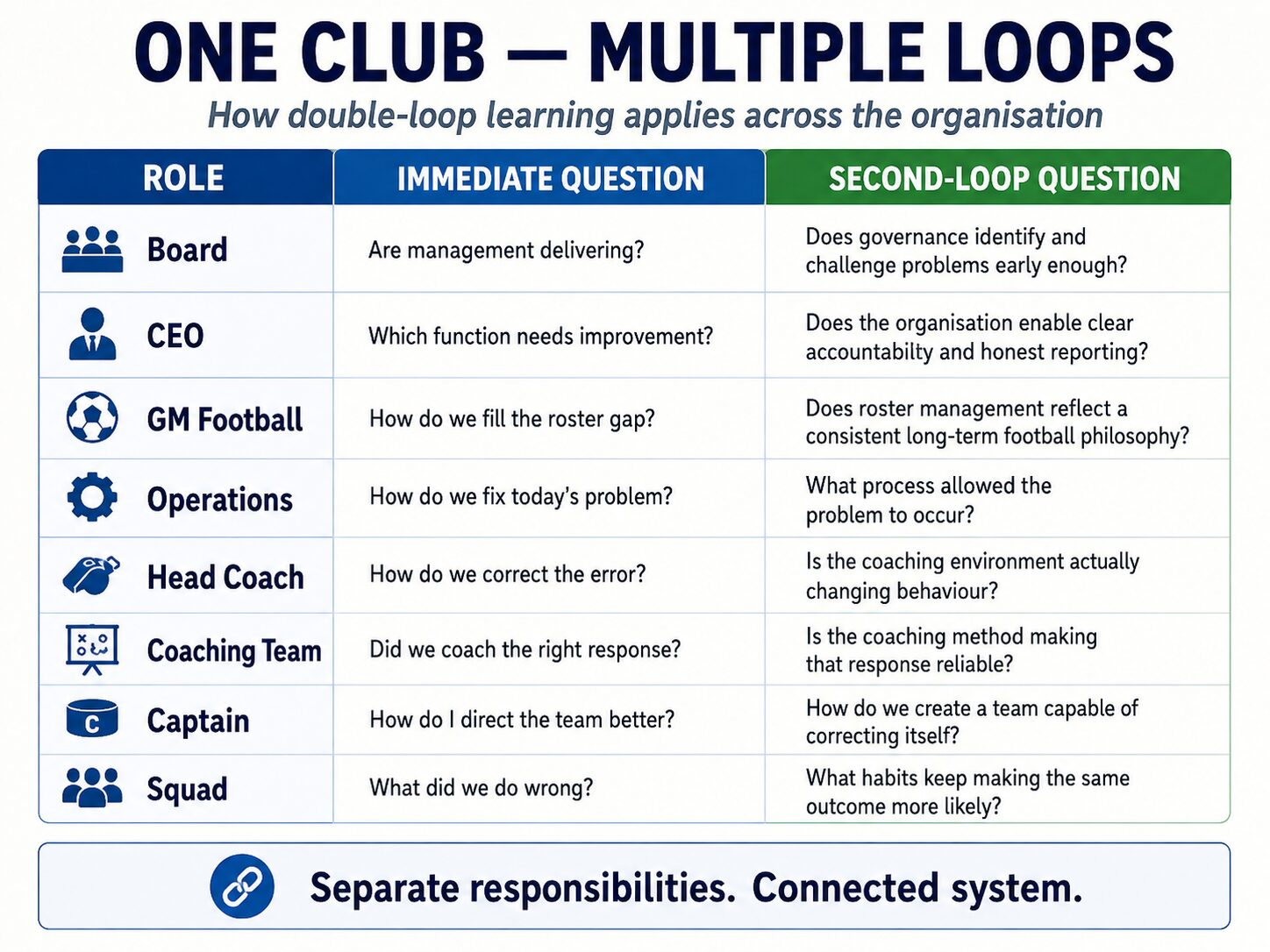
There is an obvious risk in separating this analysis across the Board, CEO, GM of Football, Football Operations, Head Coach, Coaching Team, Captain and Squad: a football club does not operate as eight independent systems, the loops overlap:
- The Board’s governance shapes the environment in which the CEO operates.
- The CEO’s structures influence the football department.
- Recruitment determines what the Head Coach has available.
- Coaching shapes what the Captain is expected to lead.
- Operational systems influence preparation.
- Leadership influences player behaviour. And,
- Player performance ultimately produces the results against which the organisation is judged.
That is precisely why accountability and systems thinking must coexist. If every outcome is described simply as a collective responsibility, accountability becomes so dispersed that nobody meaningfully owns it. But if every problem is examined only through the narrow responsibilities of a single role, the organisation risks overlooking the relationships and conditions that helped produce it.
One Club – Multiple Loops – Concept: Chris Argyris for Harvard Business Review – created by the author using Canva Premium
Part One used the Five Whys to look beyond the immediate problem and explore what might be causing it, while RASCI helped clarify where responsibility and accountability sit across the organisation. Together, they helped identify both potential causes and who has a role in addressing them. Double-loop learning added another layer by asking whether the systems connecting those responsibilities are themselves working as intended:
- A recruitment problem may also contain development, retention or succession issues.
- A recurring execution problem may involve individual player responsibility while also raising legitimate questions about preparation and coaching.
- A leadership problem may involve The Captain while revealing a broader dependence within the leadership system.
- An operational failure may occur in one function while originating from information, decisions or processes elsewhere.
Double-loop learning therefore does not remove individual accountability by declaring everything a systemic problem. Used properly, it strengthens accountability by asking not only who owned the immediate decision or behaviour, but whether the wider organisation created the structures, information, support and challenge necessary for that responsibility to be executed effectively.
THE GOLDEN POINT: CHALLENGE BEFORE CHANGE
Part One asked why. Part Two asked whether the answer to why exposes something deeper within the system that also needs to change. Together, they demonstrate that an organisation can with good intention make numerous changes in response to operational problems without necessarily changing the underlying behaviours, processes or systems that continue to produce them. They can hold reviews, change structures, recruit players, replace leaders, run additional training, rewrite procedures and introduce new performance measures. None of those actions, in isolation, demonstrate that organisational learning has occurred. The stronger evidence is whether the organisation becomes better at recognising recurring problems, challenging the assumptions beneath them and changing the behaviours, processes or systems that continue to reproduce them.
That is where I see the value of Double-Loop Learning for the Eels. It does not suggest that every existing assumption is wrong, every process requires reform or every unsuccessful outcome represents organisational failure. Sometimes the strategy is sound and simply needs better execution. Sometimes injuries are genuinely unfortunate, the opposition is simply better, or a player makes an error despite having been prepared perfectly well. The challenge is knowing when another correction within the existing system is appropriate; and when repeated evidence suggests the system itself deserves closer scrutiny.
But even identifying that something should change leaves an equally important problem. Challenging an assumption does not prove the alternative is better, and identifying a systemic weakness does not automatically identify the intervention that will fix it. Replacing one approach with another can simply create a different set of problems if the proposed solution is adopted without first being properly tested.
So, if Part One helped identify the possible cause and Part Two challenged the system surrounding it, the next step is determining whether the proposed solution actually works; this is where theory must meet practice.
In Part Three, Test the Solution, I will hypothetically and subjectively apply the Plan–Do–Study–Act cycle to a selection of the issues explored throughout this series. Rather than treating a proposed change as the answer, PDSA treats it as something to test: plan the intervention, put it into practice, study what actually happens and then act on what the evidence tells us. Because one of the greatest risks after finally asking the right question is assuming that the first answer must also be the right one.
Roly-Poly


You’ve got to wonder whether the board are on top of this. They should be, with their business pedigree. They have changed the coach and now the CEO. Time for some inward looking at themselves to ensure they have the right strategies in place to set up the next CEO for success. Additionally, they need to create space for the CEO to challenge the board from a strategic point of view. The type of reviews you have suggested are exactly what’s required.
I feel the club is not too far off course at the moment, but is in desperate need of clear strategy and accountability to fix the issues that have been ingrained for so long. You look at Melbourne and it’s clear why they have been successful for so long. They have strategies in place for continual success and churn out player after player who are capable of doing their job within the team.
Hi Longfin, I agree. I don’t think the club is fundamentally off course either, but this feels like an important opportunity for the Board to look inward as well as outward. Changing the coach and CEO can only achieve so much if the strategic settings, accountability structures and decision-making environment around them remain unchanged.
The next CEO needs both clarity about what success looks like and the authority to challenge the Board when necessary. I hate to admit it; but Melbourne is probably the clearest example of why that matters — their sustained success isn’t simply about continually finding better players; it’s about having a system, standards and development pathways that consistently produce players capable of fulfilling clearly understood roles. That sort of organisational consistency is exactly what Parra needs to build.
Cheers,
Roly
Another interesting read – made me think of this which I think you would enjoy –
https://www.jfa.jp/eng/japansway/ –
From the home page of Japans football association with a detailed plan and vision on how they will win a World Cup
Has clear philosophy and links everything together – the key is it is one united vision to win na world cup by 2050 – and everything is aimed to that
And that is where the leaders role is – what is the vision ? Now what do we do. But I think this message just needs to be repeated and repeated and repeated.
Also – away from the worlds biggest game – link to an article from 2017 with Gus when he lays out his vision for the Panthers – the 5, maybe 10 year plan – https://www.smh.com.au/sport/nrl/the-real-five-year-plan-why-phil-gould-is-proud-of-penrith-but-concerned-for-the-nrl-20170808-gxrktu.html
and back ito another one in 2012 – this was in an interview – from a SMH article – with Gus
“In early 2012 we did introduce a plan called “Project 2015 — built from within”. The architect of this program was a gentleman by the name of Matt Cameron, who is now our high performance manager. Matt is responsible for overseeing this entire operation.
When I first spoke to him about working for Panthers, I told him I wanted to review and reshape our entire development programs. I asked him if he could make it happen.
I gave Matt a blank canvas to create his own program and his own job description. Within a week he presented a brilliant model for Panthers. I simply said, “Build it.” Matt has done the rest. He has been a key acquisition. Our CUBS participation program begins with kids as young as 12. The best youngsters will then progress to our JETS (Junior Elite Training Systems) and junior representative teams. We also have COLTS programs for late developers”
The vision is the key – just need to be brave enough to say it
Thanks Greg — These are really interesting examples, and I think you’ve captured the critical point perfectly. The vision has to come first, because strategy, structures, recruitment and accountability only really become coherent when everyone understands what they are collectively trying to build.
Japan and Penrith are strong examples of that long-term thinking: establish the destination, build the system around it, and then reinforce the message relentlessly. The bravery is in articulating an ambitious vision clearly enough that the organisation can actually be held accountable for delivering it.
I am hopeful the current leadership changes provide an opportunity to establish a clear long-term vision and accountability framework that aligns the objectives, motivations and strategic direction of administrative functions across all levels of the club, wherever possible.
Thanks for your continued support of TCT
Roly
Thanks for keeping us thinking Roly. Before I retired, I used to work for many years as an engineer within the Australian Defence Force. I attended a in-house project management course many moons ago which focused on learning and development methods at NASA including something called APPEL knowledge sharing systems. I don’t remember too much specifically about the specific content because I am an old fart who loses his keys between the kitchen and the car. Though I do remember it was centred upon the theory and research of the same Argyris bloke that you talk about here; and that we built a whole knowledge management and project risk mitigation system around it. Very interesting to see it applied to a complex hierarchical entity so well.
Thanks FairGo, I think the NASA/ADF connection is a really useful one. It shows that Argyris’ ideas are not simply theoretical; they have been applied in complex, hierarchical and high-risk environments where learning from experience and preventing the recurrence of failure genuinely matters.
I hadn’t initially considered APPEL in this context, but the emphasis on capturing and sharing organisational knowledge rather than allowing lessons to disappear with individuals fits very closely with what I’m trying to explore here. And I’m glad at least some of the course survived the journey between the kitchen and the car! I can totally resonate with this and I am still about 20 years off retirement.
Thanks again,
Roly