
Hey Parra fans, Welcome to this week’s issue of TCT Golden Point: an “in the news” focused weekly column about all things Parramatta Eels and Rugby league in general. As always, I hope you find it insightful and engaging.

Round 6 In Theory – Role Ambiguity – The Simplest Explanation – Not an Excuse
In any team environment, talent only gets you so far. Clarity and confidence in the role you play are what drives individual and team performance. Role ambiguity occurs when a person is unsure of: what they’re responsible for, when they’re responsible for it and how success in that role is measured.
It’s a common hidden factor behind “underperformance” in both individuals and teams across codes and professions. In rugby league, this becomes most obvious under pressure—particularly when players are inexperienced, and/or fatigue is high. In theory there are four common components, represented below in an on field NRL context:
- Paralysis by Analysis: Hesitation in attack or defence, over/underestimating a play: a split-second of doubt can be the difference between a try and a try-saver.
- Emotional Contagion: Uncertainty erodes confidence and might contribute to higher levels of stress and lower self-confidence, which can quickly spread across teams.
- Fractured Cohesion: Ambiguity increases doubt, If a player is unclear about their own role they are unlikely to understand the role of others. This could lead to missed tackles, poor timing in attack and a visible and measurable disconnect in completion rates across the team.
- Diffusion of Responsibility: When roles aren’t clear, accountability blurs. Multiple players might assume “someone else has it”, when in fact, no one does.
Teams with clear roles play fast, connected, and instinctive football. Right now, we need to acknowledge the reality of our situation: Our squad is riddled with injuries and is both inexperienced and unsettled. Younger players are being fast-tracked into high-pressure roles, while senior players are adjusting to constantly shifting combinations around them.
That’s not an excuse, it’s context. Yes, players are accountable for performance, but they’re not responsible for decades of frustration. Directing all of that toward a group still trying to find cohesion under pressure doesn’t fix the problem, it amplifies it.
The Hidden Costs Of A Fast Game
The reality is, what a lot of us are feeling right now isn’t just about the big losses, inconsistent form or individual player performances. It’s about watching our team trying to compete while carrying a growing injury toll, with no genuine structural support available from the NRL to remedy the situation. It’s the frustration of seeing players sidelined for weeks or months through foul play, while the club absorbs the full cost—on the field and under the cap.
The emotions are real and intense, they’re not irrational. They’re a reflection of a bigger issue, one where effort, resilience, and depth are being tested against a system that hasn’t kept up with the demands of the modern game.
The opening six rounds of the 2026 NRL season have delivered a faster, more physical spectacle, but at a significant physiological cost. With an estimated 60–70 first-grade players sidelined, the concern is no longer just volume, but severity. The conversation is shifting away from ladder positions and contenders toward a more pressing question: is entertainment beginning to outweigh duty of care?
Rule changes designed to improve flow and reduce stoppages have achieved their aim, but not without consequence. Fewer penalties mean fewer natural breaks, forcing teams to defend more repeated sets with minimal recovery. The result is accumulated fatigue—a well-established Work Health and Safety hazard—now presenting in rugby league as poor technique, slower reaction times, and increased lower-body injury rates.
Much of the media narrative has supported the direction of the game, often attributing injury trends to club-level factors such as recruitment, conditioning, and squad management. While the impact of the six-again rule is acknowledged, broader structural solutions, such as salary cap concessions for long-term injuries caused by foul play, have gained little traction. Instead, discussion often defaults to the familiar “that’s just footy” mindset, prioritising opinion based debate over meaningful reform.
To its credit, the NRL has strengthened player welfare measures through concussion protocols, CMO oversight, and CBA-backed medical and financial safeguards. However, these responses remain largely reactive. At the same time, the game itself is evolving in ways that are increasing fatigue and, by extension, injury risk.
If fatigue is a known hazard, and the structure of the modern game is amplifying it, then legislatively the issue becomes less about how well injuries are managed, and more about whether enough is being done to prevent them. From a Work Health and Safety perspective, this shifts the conversation firmly into governance, where accountability must extend beyond reactive response and into policy design.
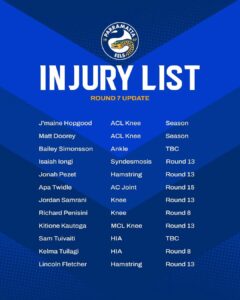
The Injury Toll. Source: Parramatta Eels
Paying the Price Twice: Why Parramatta Are Right to Push for Foul Play Salary Cap Relief
In previous pieces I’ve contended that the speed of the game is the main contributor of increased injuries and that the discourse around the eye for an eye approach while tempting, is not realistic because it can be very difficult to prove reckless intent due to the speed of the game.
That aside, with the number of Eels players sidelined due to proven adverse actions, the frustration around the lack of options for impacted clubs in general is real and relevant, and it’s not just about money, It’s about fairness.
A significant portion of the teams roster has been impacted by incidents that have resulted in judiciary action from dangerous tackles, high contact, and other adverse types of play that the game is actively trying to stamp out. And yet, while those incidents are punished in isolation, the broader impact isn’t being addressed.
The players responsible serve their suspensions, but there is no action against the offenders club and suspension periods are not often proportionate to the impact the injury has on the impacted club, their performance and their salary cap
The NRL salary cap is designed to create parity. In theory, every club operates on a level playing field. But in practice, that only holds if player availability is relatively even. When a club loses a player for a significant period, it impacts performance and flexibility. That injured player’s salary remains locked inside the cap, limiting the club’s ability to bring in meaningful replacements.
Meanwhile, the club responsible for the incident absorbs only a short-term loss. That’s not parity, that’s a structural imbalance. The argument Parramatta are making is simple—and hard to dispute. Across the early rounds of 2026: Their players have missed dozens of games due to foul play-related injuries, and the players responsible have served a fraction of that time in suspensions. The gap is obvious and it raises a question the NRL hasn’t adequately answered: Why is the long-term cost of foul play borne almost entirely by the injured player and their club?
This Isn’t about Excuses, it’s a call for alignment between: Actions, Consequences and Impact. The judiciary already acknowledges that certain actions are dangerous enough to warrant suspension. But if those same actions result in long-term injuries, shouldn’t the system also recognise the extended consequences that follow? The clubs push for adverse action salary cap concessions isn’t radical, it’s common sense. Because as the game evolves, so too must the systems that support it.
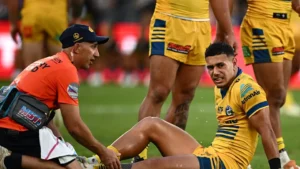
The hip drop strikes on Iongi
A Practical Solution
The concept of what Parramatta are proposing, is relatively simplistic, rational and not dissimilar to proven remedies in action across other sports
- If a player is injured in an incident that results in a suspension
AND
- that injury sidelines them long-term
THEN
- The affected club receives proportional salary cap relief
Not a free pass, not a blank cheque, just recognition that: the loss is real, the impact is measurable and the burden shouldn’t fall on one side alone.
There are several existing remedies already in use across a number of professional sporting codes in Australia and globally that could realistically be reviewed and tested for the development of a revised process model for cap concessions if the NRL are willing to accept change is needed.
English Super League clubs are eligible for salary cap dispensation in cases of long-term player injuries, provided that the affected individual is sidelined for at least eight weeks during the season and a certified injury report is submitted by the club’s medical staff. This provision permits clubs to secure replacement players without the entirety of the new salary being counted against the salary cap, typically facilitating “like-for-like” substitutions. More broadly:
- The NBA allows for replacement exceptions
- The NHL provides cap flexibility for long-term injuries
- The AFL offers structured cap relief for career-ending injuries
- FIFA’s Disciplinary Committee imposes sanctions on clubs for violations, whether they happen through negligence or intentional misconduct.
The reality is, what a lot of us are feeling right now isn’t just about the big losses, inconsistent form or individual player performances. It’s about watching our team trying to compete while carrying a growing injury toll, with no genuine structural support available from the NRL to remedy the situation. It’s the frustration of seeing players sidelined for weeks or months through foul play, while the club absorbs the full cost—on the field and under the cap.
The emotions are real and intense, they’re not irrational. They’re a reflection of a bigger issue, one where effort, resilience, and depth are being tested against a system that hasn’t kept up with the demands of the modern game.
Final Thought
For Parra this isn’t just about the current slate of injuries, it’s about protecting club longevity, roster integrity, maintaining competitiveness and fairness and ensuring they’re not penalised twice for the same incident: Once on the field and again on the books.
In a competition built on parity, the idea that one club can lose a player for months due to foul play—with no structural relief—while another absorbs only a short suspension is increasingly difficult to defend.
If the NRL is serious about fairness, accountability, and player welfare, this is the next step.
See you at the game on Sunday.
Roly-Poly Parra

PS: Eels Fan Check-In
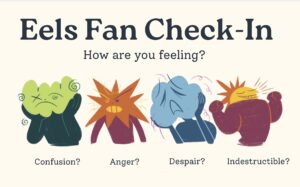
Source: Canva (via Katie)
The above image was one of the kinder messages I copped post-game on Sunday. That’s the deal when you’re a loud, die-hard supporter of any code. When they have a big loss, everyone—friend, family, foe—has something to say.
I started the day feeling indestructible. By halftime I was bouncing between confusion and anger, and by full-time I was firmly parked in despair—helped along by a relentless chorus of hecklers on the way home. Normally I shake it off pretty quickly, but this one stuck-around in the form of: Brain fog, poor sleep, and a deathly knot in the guts I couldn’t shift.
Thankfully a mid-week catch-up with a good friend and lifelong Chicago Cubs fan snapped me out of it. The Cubs went 108 years between titles (1908-2016), so we’ve always bonded over the shared experience of loving teams that test your patience more than they reward from a trophy perspective, but somehow consistently bring us great joy and satisfaction.
It wasn’t a deep conversation. It didn’t need to be. It just reset my perspective and priorities through humour and brought me back somewhere between realistic and indestructible now—and that’s probably about as good as it gets.
I acknowledge and respect that everyone processes setbacks at varying paces, and that’s okay. I hope you can all find your way back to “indestructible” in your own time. Because the club needs our support more than ever right now and we’re at our strongest when we support each other, not just the club.
RPP

Brilliant, insightful, great read, thank you, the image was exactly how most fans feel
Thanks Johnno, It was challenging finding the right balance of perspective, frustration and passion within a subjective data driven discussion on a sensitive topic. I am glad it resonated with you and I hope it does for other fans too.
Well said Roly. the club should really hold on to this argument and try to gain traction with other clubs. It’s such an important thing to keep employees safe whilst doing their work. In any other industry employers must ensure all reasonable steps are taken to prevent injury, but in rugby league even serious injury is considered part of the game.
I’m sure the NRL considers the 30 player squad as plenty to take into an NRL season, and that this should cover for any injury crisis. In reality, many spots are taken by players on a development path who are not always ready for the rigours of NRL. In an ideal world we would have a full reserve grade of experienced players ready to step up to NRL, but of course that has never been feasible. So we find ourselves having to throw in young players into the NRL before they have all the physical attributes and skills to play there. That is an accident waiting to happen in itself.
The current situation also opens the door to clubs taking the risk on players employing dangerous tackling techniques. Most of the time they get the results they are after with tackle efficiency etc, but the risk is that the player finds themselves sitting out a few weeks on suspension. That’s certainly better than being on the receiving end with serios injury and sitting out the rest of the season. I wonder how many clubs see this as a risk worth taking, considering the NRL are effectively making this a more desirable outcome?
Thanks Longfin, You raise excellent points regarding squad size and dangerous tacklers. The 30-man squad assumes a moderate injury toll. Clubs are managing both injury and readiness risks concurrently which isn’t safe of sustainable.
I am hopeful Parra push back on the NRL to drive the need for change, and that more clubs support their stance or follow suit. While it’s primarily impacting Parra and Broncos at the moment, it’s an every club/every player issue in the long run, as well as a competition integrity and player welfare problem that needs to be addressed at structural level by the games governing body.
Well presented Roly. The Duty of Care aspect will receive ongoing attention whilever the injury stats are screaming out ‘why is this happening?’. Risk of liability is not to be ignored in the modern world. The lack of relief for foul play serious (long term)injury, could also play into the Duty of Care obligation.
Absolutely BDon, Duty of Care is the missing piece at the core of every part of this piece, even role ambiguity and it should be applied at every level (player-club-system) routinely, not on a case by case subjective basis. The current frameworks do not reflect adequate duty of care at any level. Its a huge risk for players, clubs and the NRL from a WHS, financial and legislative perspective.
Also just in general: apologies that the original post had a double up paragraph and a couple of typos.
I write a lot of things down on the run throughout the week as ideas enter my mind at work, at home or in transit. Then try to summarise and tie several pages of scribble into a concise compelling and translatable piece. I had a lot of thoughts this week, seven Word doc pages in draft that I somehow shrunk to two without losing too much quality. I found this one particularly difficult to get right with respect to tone and placement of points, I did quite a bit of chopping and changing with the way it was structured, hence how I ended up with a couple of discrepancies that I fixed this morning with fresh eyes. It probably sounds a bit overcritical but I take my writing very seriously as it’s a reflection on the site as well as me.
I am both relieved and happy with how it all came together in the end and appreciate the support.
Our biggest problem is that we reward potential in the extreme.
The game is about the here and now.
How long did persist with Dunster ?
How many years are we going to think that Richie Penisini and Arthur Miller Stephens are ever going to become NRL players????
What about Sam Louzou ????
Im aware Miller Stephens played 1 game but both these players continue year after year to be ‘potenial’ but spend year after year on the sidelines.
Smart operators like Gus Gould would have packed them off long long ago.
There are plenty of fast poly boys in lower grades with other clubs that are just waiting for a chance
Do what the Bulldogs do.. rinse and release if not good enough.
That’s what they did with KitKat and Joash.
No sentiment. It’s a business.