
 Hey Parra Fans, Welcome to Part Three of The 47 Twenty-One; a TCT Golden Point Series exploring the lives of the 21 foundation players who represented Parramatta in its inaugural 1947 season, in recognition of the club’s approaching 80th anniversary celebrations.
In Part One, we explored Parramatta’s post-war beginnings along with the stories of our first four foundation members: Keith Gersbach (1), Lambert ‘Bert’ Bell (2), Robert ‘Bob’ Andrews (3) and George ‘Seaweed’ Cook (4). In Part Two we chronicled the lives and times of Eels 5-8: Edward ‘Barney’ Hearn (5), Fred ‘Snowy’ McKean (6), David ‘Darby’ Munro (7), and George ‘Togs’ Robertson (8). In Part Three we continue to ride the entertaining and unpredictable wave that is the Australian National Library and Archives, to explore the lives and times of our next four beloved local heroes: George ‘Sago’ Saywell (9) Colin ‘Schommy’ Schomberg (10), Arthur Slattery (11), John “Johnny” Smith (12).
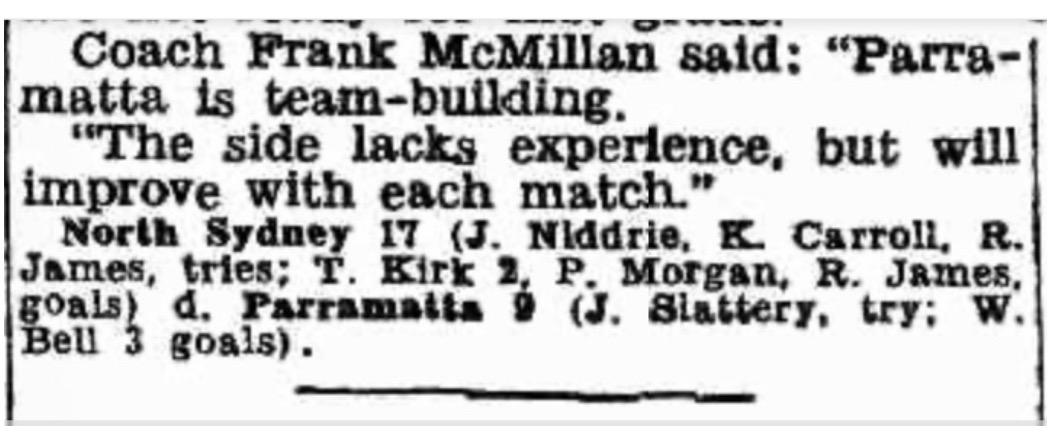
Frank said it first. Daily Telegraph, 6 April 1947. Link to full article in Reference List
Speaking of entertaining and unpredictable, On 6 April 1947 The Daily Telegraph reported on the challenges facing Parramatta’s inaugural side, which for mine prompted a rather relatable explanation from inaugural coach Frank McMillan. Following a pre-season trial defeat to North Sydney, McMillan reportedly acknowledged the team’s inexperience, explaining: “Parramatta is team-building. The side lacks experience, but will improve with each match.” Apparently, the building narrative is almost as old as the club itself! Although, to be fair, in 1947 they really were building from scratch. In that context our current build, or rebuild if you will, is more akin to a renovation, is it not?!
Personally, I am taking this find as a good omen; and I choose to believe that 2027 will be a year of final touches before the sold sign goes up and the lollies are finally ours again in 2028 (you heard it here first). Of course, in reality whether you believe 2027 will be a year of building, rebuilding, renovating or a complete knockdown, I am sure we are all in agreeance that it’s worth honouring the men who laid the original foundations. So, enough about the building works. Let’s get back to 1947 and honour four more of Parramatta’s foundation year legends.
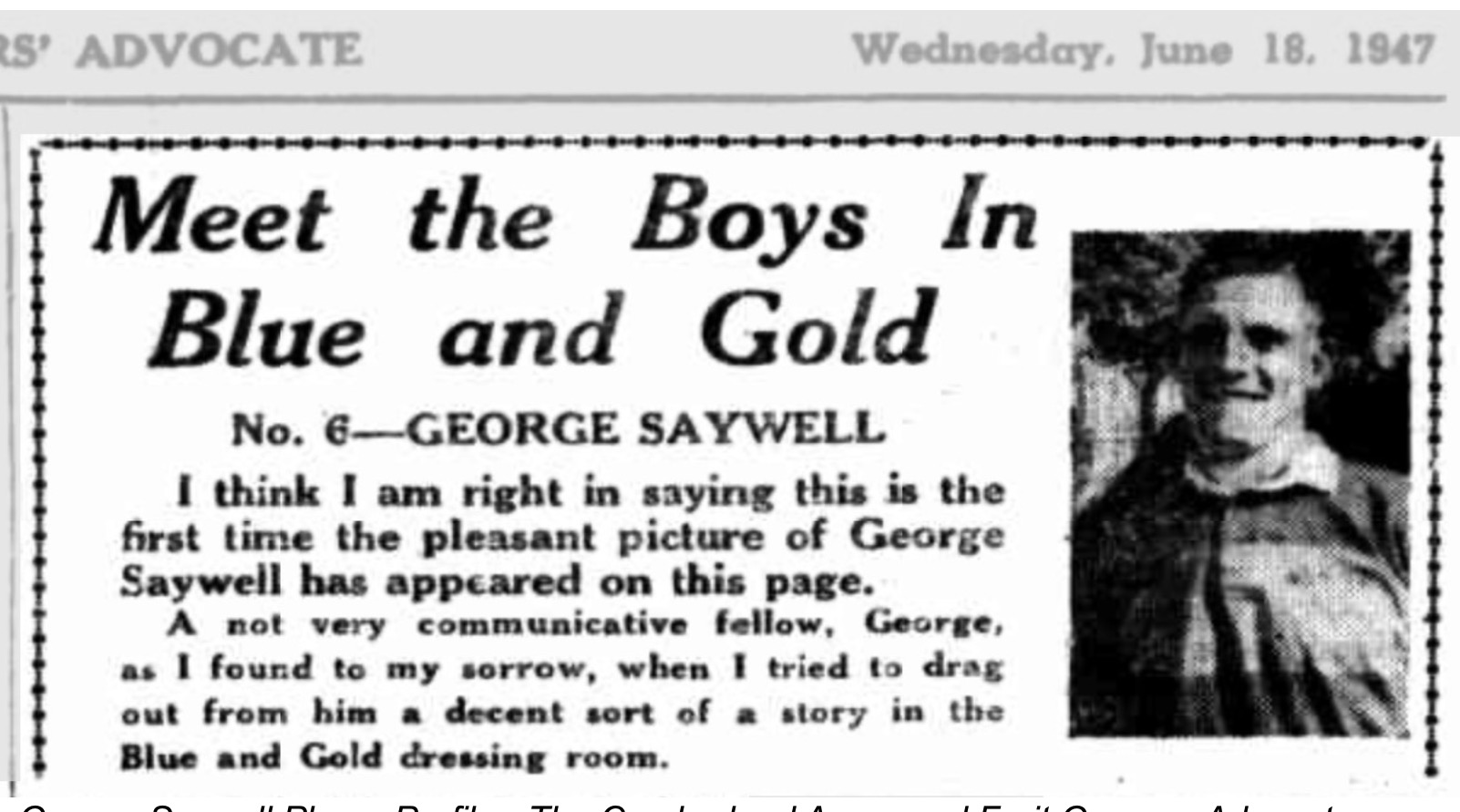
George Saywell Player Profile – The Cumberland Argus and Fruit Growers Advocate, published 18 June 1947. Link to full article in Reference List
EEL #9 – GEORGE ALFRED ‘SAGO’ SAYWELL
Electrical Labour Inspector | Galloping Second-Rower | South Coast Family Man
George Alfred “Sago” Saywell was born on 16 August 1924 in Bulli, NSW. According to his Cumberland Argus & Fruit Growers Advocate ‘Meet the Boys in Blue and Gold’ player profile, George’s football journey began at just ten years of age, playing for Scarborough Public School on the NSW South Coast. He later spent three seasons with the team at Wollongong Technical College before stepping into local first-grade football with Thirroul and Scarborough at the age of 18. The article also revealed the origins of George’s nickname, ‘Sago’, a simple playful combination of his Christian name and surname, bestowed upon him by his teammates.
In 1947, aged 22, Sago joined the newly established Parramatta Rugby League Club as a second row forward and competed in all trial matches leading up to the season. Sago quickly earned recognition for his defensive strength and determination during Parramatta’s pre-season trials. In March 1947, The Cumberland Argus identified Sago as one of the team’s most outstanding forwards against Manly-Warringah and a subsequent trial against Canterbury-Bankstown also drew praise for his defence. His trial performance against North Sydney attracted similar recognition, with match reports naming him among Parramatta’s most effective forwards.
On 12 April 1947, George ‘Sago’ Saywell took the field at Cumberland Oval as Eel number 9, securing his place in club history as one of Parramatta’s inaugural first-grade second-rowers. Despite an injury that sidelined him for two matches in May, Sago went on to make 11 first-grade appearances during the club’s foundation season, including Parramatta’s historic first premiership victory, defeating Western Suburbs 13–8 at Cumberland Oval on 21 June 1947. Although he never officially registered a premiership point, reports suggest he was a highly effective attacking forward. During that historic victory over Western Suburbs, The Cumberland Argus described an attacking movement involving Keith Gersbach and George Cook, which saw Sago gallop through an overlap before being tackled agonisingly close to the try line. His defensive capabilities were equally impressive. Following Parramatta’s 39–16 loss to Newtown later that month, The Daily Telegraph praised the tireless efforts of Sago and fellow second-rower Neville Brennan (Eel #14), crediting their defensive work with preventing several additional scoring opportunities.
Throughout Parramatta’s challenging inaugural season, Saywell distinguished himself through his work rate, determination and commitment at both ends of the field. While his contribution may not be reflected on the scoreboard, the National Archives paint a picture of a highly capable, dependable forward whose attacking enterprise and defensive resolve were valuable assets to Parramatta’s developing first-grade side.
Following his departure from Parramatta, he returned to the Illawarra football competition. Reports published in the Goulburn Evening Post in April 1948 identify him playing for Port Kembla, including selection for an inter-town fixture against Goulburn. The newspaper specifically acknowledged his previous season with Parramatta, while further reporting in the Illawarra Mercury confirms his continued involvement with Port Kembla in June 1948. His return to the South Coast brought George’s football journey back to the region where it had begun, although the available records have yet to establish how long he continued playing.
Away from football Sago’s 1947 player profile in The Cumberland Argus, described him as a pleasant but rather reserved young man, admitting that extracting information from George in the dressing room had proved something of a challenge. Nevertheless, the author managed to uncover a few interesting details about his life away from the football field. The reporter noted that the young footballer was single, unattached and apparently had no serious romantic intentions at the time. Unsurprisingly, that would eventually change with NSW marriage records showing that George married Raynor James in Bulli, NSW, in 1954; seven years after his foundation season with Parramatta. The 1947 profile also noted that George was employed as an inspector of labour at the Australian General Electric (AGE) Company’s works in Auburn, balancing his working life with the demands of first-grade rugby league.
For readers familiar with the Auburn–Lidcombe area, George’s former workplace has an interesting connection to the local sporting landscape. At the time that George worked at the Auburn plant, the factory represented an important part of the industrial backbone of a rapidly developing Western Sydney. According to Cumberland Council’s Historical Timeline, the AGE factory was established following the awarding of a NSW Government contract in 1924 to supply equipment for the electrification of Sydney’s suburban railways. Bordered by Church, Percy and Boorea Streets, the factory stood beside what would become Lidcombe Oval and Wyatt Park. During World War II, the factory’s operations were considered part of a protected industry, reflecting its importance to Australia’s wartime needs. Interestingly, AGE also had its own sporting traditions, with State Library records identifying an AGE Hotpoint Football Club in Auburn as early as 1936. Following a land exchange agreement with Auburn Council in 1974, the factory buildings were demolished in 1976, enabling the expansion of Wyatt Park and the establishment of additional sporting facilities, including the State Netball Centre. According to Cumberland Council, the former administration building opposite on Boorea Street survived and is now occupied by Kennards Self Storage Auburn.
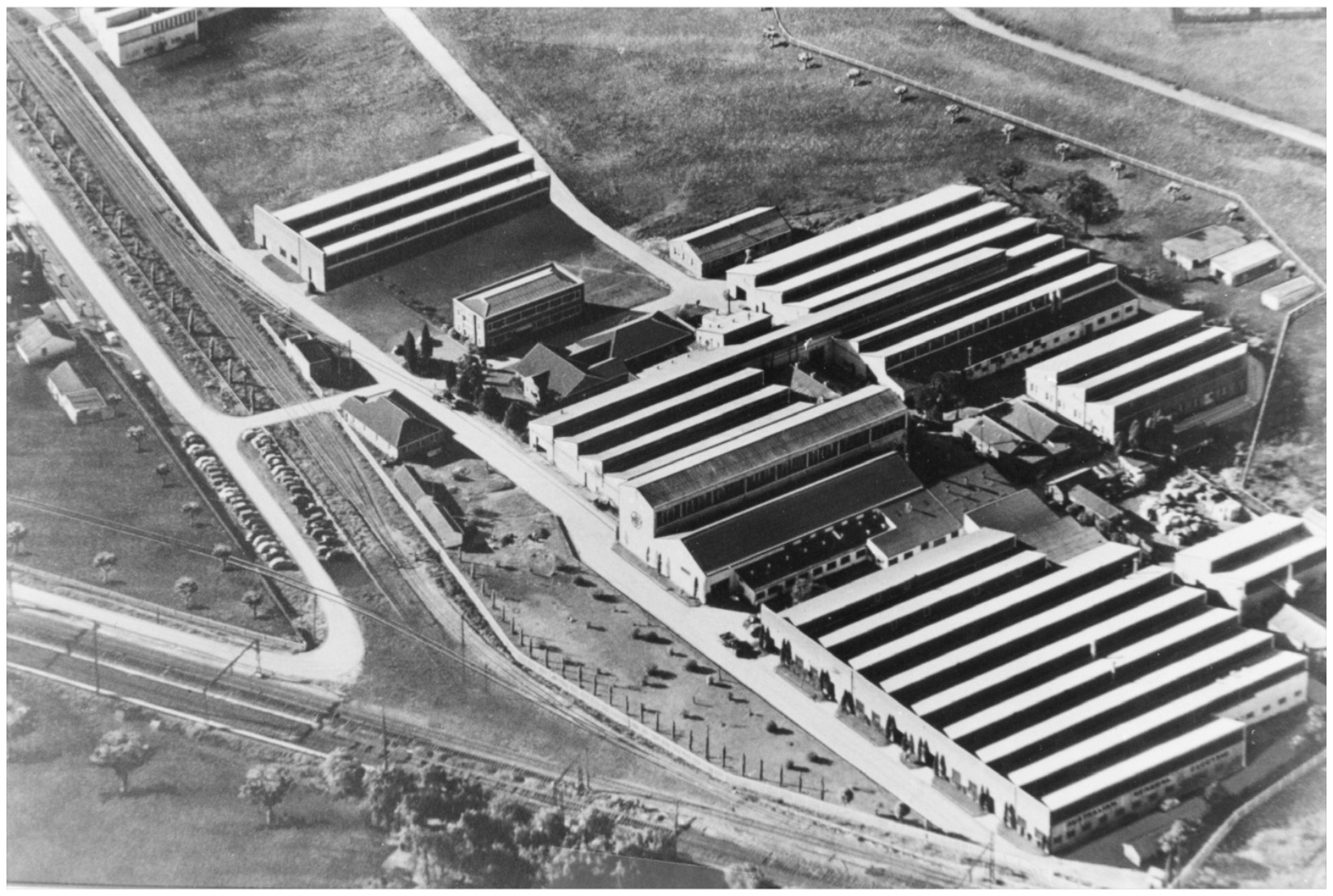
An aerial view of the Australian General Electric works at Auburn in 1952, where Parramatta foundation player George ‘Sago’ Saywell was employed in 1947. Source: Cumberland Library, Local Studies Collection.
Although the National Archives have helped establish where George’s football career took him immediately after Parramatta, much of his later life remains undocumented. During my research, I came across limited publicly available information beyond establishing that George and Raynor went on to have a family and remained in the Illawarra region. At the time of publication I have very recently been provided with a potential avenue for contact with George and Raynor’s family. Once established, I intend on sharing a draft of this story in the hope of connecting with them, entirely at their discretion. While it would be wonderful to hear from the family and learn more about George’s life beyond football; at the very least, I hope they have an opportunity to read this and know the special place their father holds in Parramatta’s history as a foundation team member and Parramatta Eel number nine.
George “Sago” Saywell passed away on 28 November 2009, in Bulli NSW, the same community where he was born 85 years earlier. From the school football fields of Scarborough to the second row of Parramatta’s inaugural first-grade side, George ‘Sago’ Saywell played his part in establishing the Blue and Gold tradition that continues today. His story reflects the experiences of a generation balancing work, family and football in an industrial community undergoing significant post-war change. While much of his life remains to be discovered, his contribution to Parramatta’s foundation season and his place in the club’s history are assured.
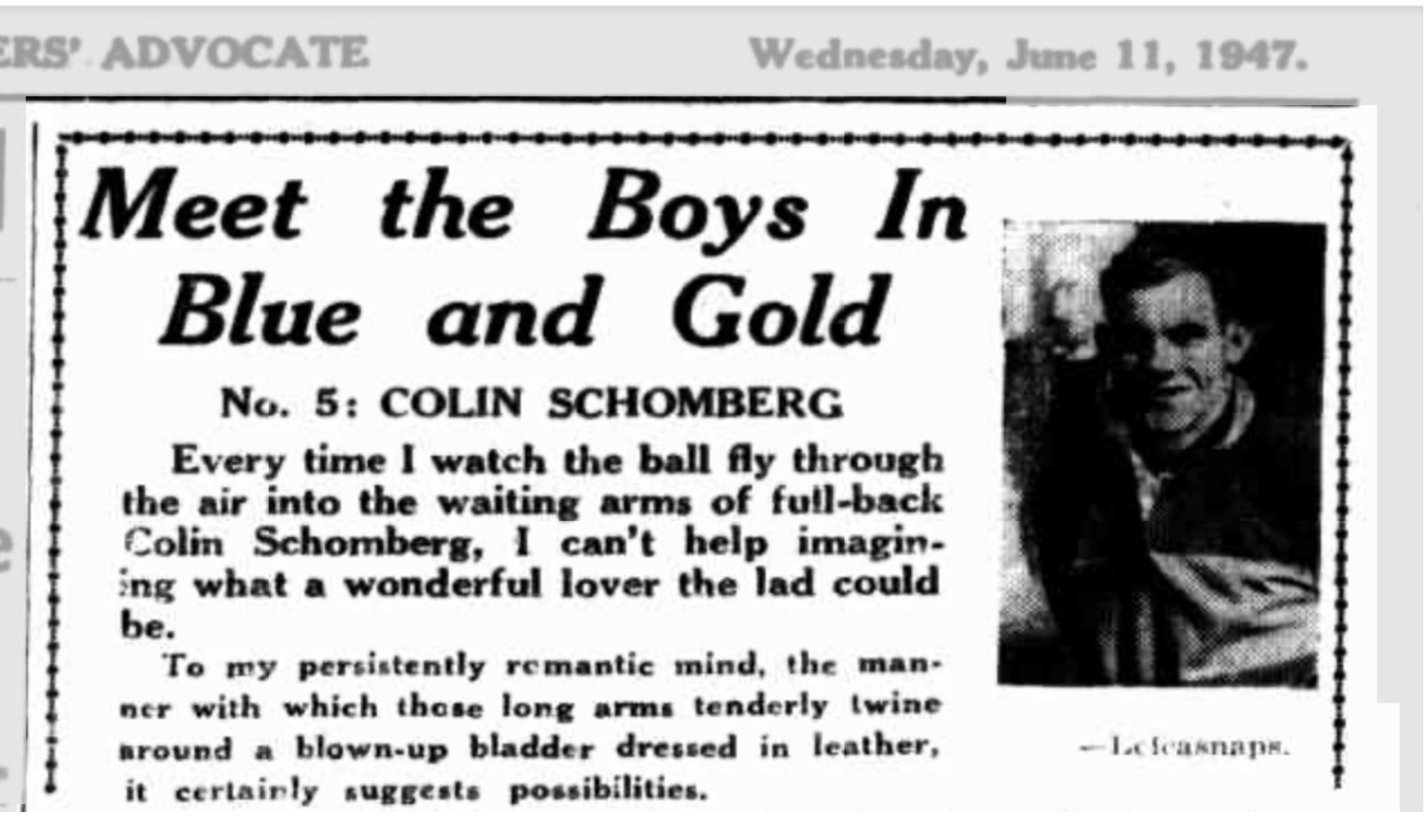
Colin Schomberg Player Profile – The Cumberland Argus and Fruit Growers Advocate, published 11 June 1947. Link to full article in Reference List
EEL #10 – COLIN GEORGE ‘SCHOMMY’ SCHOMBERG
World War II Veteran | Rugby Union Convert | Referee, Touchy & Administrator
Colin George “Schommy” Schomberg was born on 17 October 1925 in Homebush, NSW. His Cumberland Argus & Fruit Growers Advocate “Meet the Boys in Blue and Gold” Player Profile (11 June 1947) tells us he grew up in Sydney’s western suburbs and developed an early enthusiasm for football. By the age of eight, he was playing Union on the fields of The King’s School at Parramatta, where his talents would eventually earn him selection as fullback in the New South Wales Great Public Schools (GPS) rugby union representative team. His football abilities continued to develop, and he naturally progressed into first-grade rugby union with Parramatta Two Blues. By 1945, Colin had achieved representative honours, earning selection at fullback for New South Wales against Queensland before the call to serve his country diverted his sporting path.
According to the Department of Veterans Affairs, Colin George Schomberg (service number 444376) enlisted in the Royal Australian Air Force (RAAF) on 12 February 1944, in Westmead NSW. He was just 18 years old. His next of kin was recorded as his father James Schomberg, who under legislation at that time would have also needed to provide written consent for Colin to enlist as he was under 21. In his player profile, Schommy spoke of repeated setbacks in his attempts to enlist in the armed forces because of an injured shoulder. Despite these difficulties, he reportedly succeeded in completing his RAAF pilot training and was subsequently posted to No. 7 Aircraft Depot at Tocumwal, in southern NSW. However, the war ended before he could fulfil his ambition of taking a more active flying role abroad.
Established at Tocumwal in December 1942, No. 7 Aircraft Depot formed part of one of Australia’s largest wartime RAAF installations. Originally developed as an American heavy-bomber base, the sprawling airfield was transferred to the RAAF in late 1942 and became an important centre for aircraft maintenance, repair and storage. The depot serviced various aircraft types, including Hudsons, Beauforts and Spitfires, while the neighbouring No. 7 Operational Training Unit trained crews for the B-24 Liberator heavy bombers. Its workforce included members of the Women’s Auxiliary Australian Air Force (WAAAF), who undertook vital technical and maintenance duties. Although far removed from the front line, Tocumwal played an important supporting role in Australia’s wartime air operations.
At the time of his discharge on 13 August 1945, Schommy’s military records identify his final rank as Leading Aircraftman. His account provides an interesting insight into a young man whose determination extended beyond the football field. While his official service record confirms his RAAF service, rank and final posting, it is the newspaper interview that reveals his personal aspirations and the disappointment he apparently felt when those ambitions to serve abroad went unrealised.
Following the war, Schommy returned to football and quickly established himself as a talented rugby union fullback. However, as Parramatta prepared to enter the New South Wales Rugby Football League premiership in 1947, the newly established club began assembling its inaugural playing squad. His decision to change codes attracted considerable media attention. On 5 February 1947, The Sydney Morning Herald reported that the Parramatta and NSW rugby union fullback would be joining the new Parramatta rugby league club. It was reported that Parramatta’s provisional president, Jack Argent, confirmed that Colin was eager to play league and emphasised that the club had not pressured him into leaving rugby union.
The matter attracted considerable public interest too, enough for Schommy to address it personally at the Clubs Annual Meeting, held on 12 February 1947 at Parramatta Town Hall with approximately 200 members in attendance. In another SMH article published on 13 February 1947, Colin confirmed that his decision to transfer had been entirely voluntary. The public clarification reflected the sensitivities surrounding the establishment of a new rugby league club in an area with established rugby union traditions. For Parramatta, securing the services of an accomplished representative fullback was undoubtedly a valuable addition to its emerging first-grade squad.
Yet after all that, Schommy’s position in the inaugural team was not immediately guaranteed. As the Cumberland Argus reported on 2 April 1947, when the Parramatta Club initially announced its graded teams for the 1947 opening round, Colin Schomberg was named in reserve grade. The decision was short-lived; as the following week, The Cumberland Argus reported, his elevation to first grade. Under the headline ‘Schomberg Selection Shock for Critics’, the article noted that Schommy’s performances in the club’s trial matches had triggered a reshuffle and earned him the fullback position for Parramatta’s historic opening premiership encounter against Newtown.
On 12 April 1947, Colin ran onto Cumberland Oval, earning his place in history as Eel number ten, becoming the club’s inaugural first-grade fullback. His contribution to Parramatta’s beginnings would extend well beyond that first appearance. On 21 June 1947, when Parramatta recorded its first-ever premiership victory, defeating Western Suburbs 13–8 at Cumberland Oval; it was reported that Schommy played a memorable role in the victory, kicking two long-range field goals from approximately 40 metres. Almost four decades later, when interviewed for the club’s historical publication Road to Glory in 1986, he vividly recalled the field goals, the celebrations and the overwhelming excitement of supporters who surrounded the players following the historic victory. For a club that had endured years of campaigning simply to gain entry into the competition, it must have been a defining moment. Schommy continued representing the Blue and Gold until 1951, making 72 first-grade appearances across five seasons; and scoring 264 points, including two tries, 128 goals and one field goal.
Colin’s athletic abilities and achievements while at Parramatta were not confined to the football field. At Parramatta’s first annual club picnic, held at Hollywood on Sunday 26 October 1947, ‘Schommy’ won the club’s running championship cup, demonstrating that he was still in fine condition despite the football season having ended two months earlier.
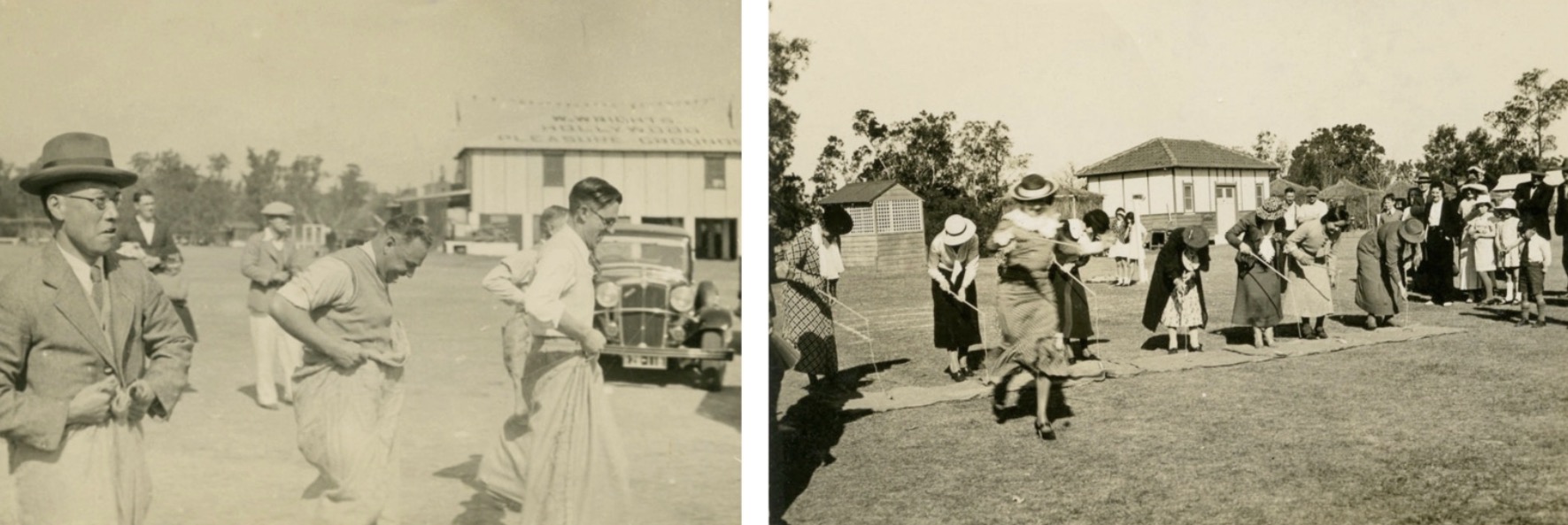
A little friendly competition at Hollywood Pleasure Grounds. Image Source: Liverpool City Library, Historic Photography Collection.
Hollywood Pleasure Grounds, situated near the junction of Prospect Creek and the Georges River in Lansvale (near Liverpool) NSW, was a popular recreational destination during the early twentieth century. The riverside grounds offered affordable leisure activities, including swimming, boating and picnicking, and regularly hosted organised gatherings for workplace groups, trade unions, lodges and Sunday schools. Historical photographs preserved by Liverpool City Library, capture some of the more entertaining activities, including sack races and an unusual fishing competition using magnets. Although these photographs predate Parramatta’s picnic, they illustrate the kind of sporting entertainment and community gatherings specifically associated with the location and broader period. Such occasions were an important part of Sydney’s social life, bringing families and communities together through friendly competition and recreation.
Parramatta’s first annual club picnic offers another glimpse into the social traditions that were developing alongside the fledgling football club. I imagine the occasion provided a welcome opportunity for players and their families to relax, enjoy some friendly rivalry and strengthen the development of friendships, team camaraderie and community connections.
Away from football, Schommy was described in his player profile as a tall, lean and personable young man whose appeal extended beyond the football field. The reporter seemed particularly interested in his romantic prospects, revealing that Colin, then living in Westmead, had become engaged to Elizabeth (Betty) Mason in April 1947. By June 1948, the couple had quietly tied the knot without even telling Colin’s teammates. In an article titled ‘Schommy’ Signs Up With The Benedicts, published on 16 June 1948, the reporter described confronting Colin in the dressing room before a match against Western Suburbs. Initially embarrassed, Colin admitted the marriage was true, explaining that they simply wanted to avoid a fuss. The article also revealed that Betty, a regular at Colin’s matches, had been crowned Belle of the Ball at Parramatta Rugby League Club’s inaugural ball at the Rivoli in October 1947; an event and local business profile we explored in Part Two of this series. NSW marriage records confirm their union was registered in Mosman in 1948. It’s a heartwarming glimpse behind the scenes of the fledgling club, revealing a more personal side of one of the men who helped establish Parramatta’s history.
While Colin’s playing career concluded in 1951, his contribution to rugby league was far from over. Following his retirement, Colin joined the Parramatta District Rugby League Referees Association, where he quickly established himself as a capable official and administrator; a commitment which was recognised when he served as the Association’s president in 1954 and 1955. In 1955, Colin was graded to the NSW Rugby League Referees Association as member number 491, making his first-grade debut as a touch judge that same year. Over a graded officiating career extending to 1968, he officiated in 64 first-grade matches. His appointments also extended to representative football, including Queensland versus New South Wales fixtures in 1961 and 1963, the New Zealand versus Australia Test at the Sydney Cricket Ground in 1963, and France versus New South Wales in 1964.
From 1968 onwards, Colin turned his focus to sports administration serving on the NSW Rugby League Referees Association’s Advisory and Referees’ Examination Boards, helping develop and assess future generations of officials. His longstanding service was recognised with Life Membership of the Manly-Warringah Referees Association in 1966 and the NSW Rugby League Referees Association in 1972.
Later that same year, the April edition of Rugby League News commemorated Parramatta’s 25th anniversary and invited the surviving members of its inaugural first-grade team to a reunion at Cumberland Oval. Among those remembered was Colin, whose continuing contribution to the game was acknowledged through his membership of the NSW Rugby League’s Referees’ Examination Board. It was a fitting reminder that, for some of Parramatta’s foundation players, their contribution to rugby league had continued long after they last pulled on the Blue and Gold jersey.
Colin spent much of post football life in Beacon Hill before moving to Berilee, NSW, where he died on 20 July 1998, aged 72. His contribution to rugby league continued for decades after his playing career, and his story reminds us that for many players Parramatta’s foundations were laid not only through performances on the field, but through an ongoing commitment to the game and the local community.
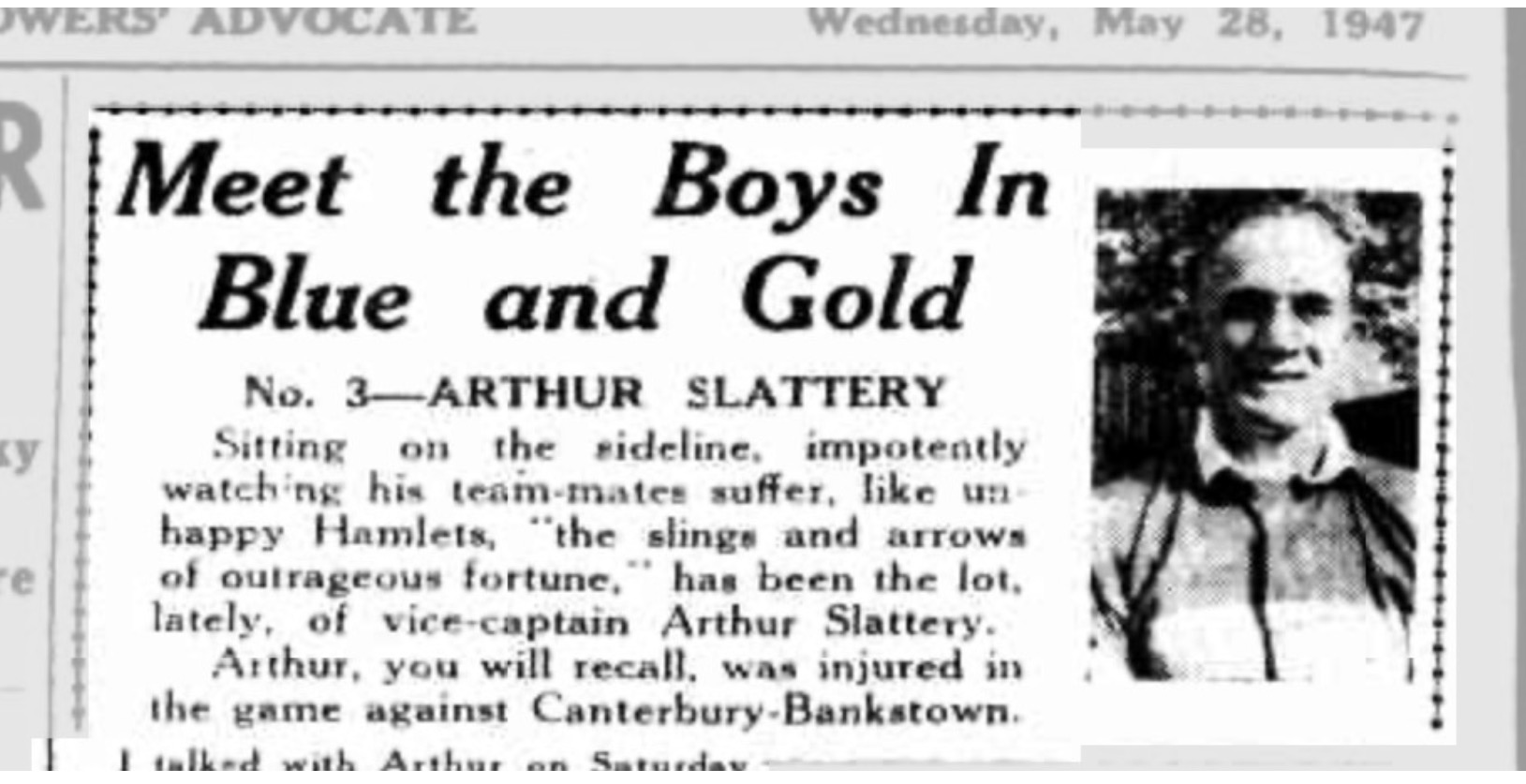
Arthur Slattery Player Profile – The Cumberland Argus and Fruit Growers Advocate, published 28 May 1947. Link to full article in Reference List
EEL #11 – ARTHUR GORDON SLATTERY
Glass Bottle Sleuth | Inaugural Vice-Captain | Country League Coach
Arthur Gordon Slattery was born on 12 April 1920 in Redfern, NSW. His early childhood may not have been without its challenges. A 1925 report in The Sun records a frightening accident involving a young boy named Arthur Slattery, who suffered facial burns after methylated spirits were poured onto a fire while he was playing with friends in a Redfern backyard. The child was subsequently admitted to Sydney Hospital for treatment. While I haven’t been able to conclusively establish that the boy was our Arthur, the shared name and locality, and the records indicating there were no other registered births of his namesake in the period of likelihood., strengthens my decision to make this calculated assumption. However, I cannot discount the possibility that these were two different individuals. Accordingly, I’ve included the incident as a plausible, rather than confirmed, part of Arthur’s early life.
According to his Cumberland Argus and Fruit Growers Advocate player profile (28 May 1947), Arthur’s football journey began at De La Salle College in Surry Hills, where he played lock forward for the school football team. After leaving school, he continued playing through workplace competitions before joining South Sydney’s senior grades in 1939, initially as a hooker. South Sydney’s official historical records identify Slattery as Rabbitoh 314, beginning as a member of its 1938 Under-21 representative team. He progressed through the club’s lower grades, participating in its 1942 third-grade premiership campaign and 1943-1945 reserve-grade premiership-winning squads. Making his first-grade debut against Western Suburbs on 22 May 1943, Slattery went on to make 21 first-grade appearances for South Sydney between 1943 and 1945, establishing himself as a hardworking, lightweight lock forward. His attacking capabilities were recognised in South Sydney’s club notes, with the 11 August 1945 edition of Rugby League News describing an impressive attacking effort from approximately 70 yards out as the team’s best effort of the day.
When Parramatta was admitted to the premiership in 1947, Slattery’s first-grade experience made him a valuable addition to the developing forward pack, and he was appointed the club’s inaugural vice-captain. On 12 April 1947, his 27th birthday, Slattery took the field as Lock in Parramatta’s historic first premiership match against Newtown at Cumberland Oval; securing his place in the club’s history as Eel number 11.
Newspaper reports within the National Archives provide a particularly strong picture of Slattery’s playing style. The Cumberland Argus regularly recognised his tackling alongside fellow foundation forwards George Saywell and Edward Hearn, while the 3 May 1947 edition of Rugby League News praised his transition from lock to second row, recognising his ability to perform well above his weight and contribute more than his share of tackles.
Unfortunately, a shoulder injury sustained against Canterbury-Bankstown in May sidelined Slattery for several weeks. Parramatta’s club notes observed that injuries were perhaps inevitable for a player who consistently performed above his weight, although there was considerable confidence in his toughness and ability to return. That confidence proved well founded. On 5 July 1947, Parramatta narrowly lost 6–2 to South Sydney in a match dominated by the Rabbitohs’ forwards. Despite the loss, The Daily Telegraph credited Slattery’s outstanding cover defence with preventing South Sydney from converting its advantage into further points. Playing against his former club, he was named the best player on the field.
His determination was further highlighted during Parramatta’s 14–13 victory over Eastern Suburbs on 26 July 1947. Despite receiving a heavy blow to the eye while attempting to stop an opposition break, Slattery played on. The Cumberland Argus (30 July 1947) declared: “Slattery was prominent whenever the going was heavy, and he gave every forward a lesson in the art of correct pig play.” A rather colourful description, but one that perfectly captures the uncompromising qualities Slattery brought to Parramatta’s forward pack.
Slattery continued to attract recognition throughout 1948, with Rugby League News praising his football intelligence, ability to identify attacking opportunities and excellent cover defence. Unfortunately, injury again interrupted his career in May 1949, when he suffered a fractured left collarbone during Parramatta’s 25–17 victory over Canterbury-Bankstown. Across three seasons with Parramatta, Slattery made 34 first-grade appearances, scoring three tries for nine points. Although the statistical record provides only a brief account of his playing career, contemporary reports reveal considerably more about a forward whose contribution was never determined by his physical stature.
Away from football, Arthur’s 1947 Meet the Boys in Blue and Gold profile provides a wonderful glimpse into his personal life. Arthur revealed married Jean Veronica Dickson in 1939, and by 1947 the couple were living in Castle Hill, raising their young family. He spoke fondly of his five-year-old son’s ability to send a football sailing over the backyard fence, suggesting the next generation of Slattery footballers might already have been in training. In the 4 June 1947 edition of The Cumberland Argus, Brock’s Roundabout column announced that Arthur and Jean had welcomed another son on 29 May. The happy news appeared in the column’s Fathers’ Corner, alongside an announcement that fellow foundation player Bob Andrews had also welcomed a son the following day.
Arthur’s player profile also revealed that his younger brother Garry; credited with five and a half years of service in the Australian Imperial Force; was serving with the British Commonwealth Occupation Force in Japan and playing rugby league as a lock forward for his military unit. His brother’s experience provides another reminder of the broader continuing impact of World War II on Australian families during Parramatta’s foundation season.
In his player profile Arthur said he worked for Butler & Norman Ltd, a bottle merchant operating from Mandible Street, Alexandria, and was involved in the recovery and supply of second-hand glass bottles. Historical records held by the Australian National University identify the business as a supplier to the NSW Bottle Company, whose bottle-recovery system serviced major breweries including Tooth & Co and Tooheys. In an era when glass bottles were routinely collected, cleaned and reused, Arthur’s occupation formed part of an important commercial industry. Interestingly, one of his bosses was Ray Norman, a former Australian rugby league international who represented South Sydney and Eastern Suburbs before coaching the latter to the 1923 premiership, giving Arthur a rather accomplished footballing connection in his working life.
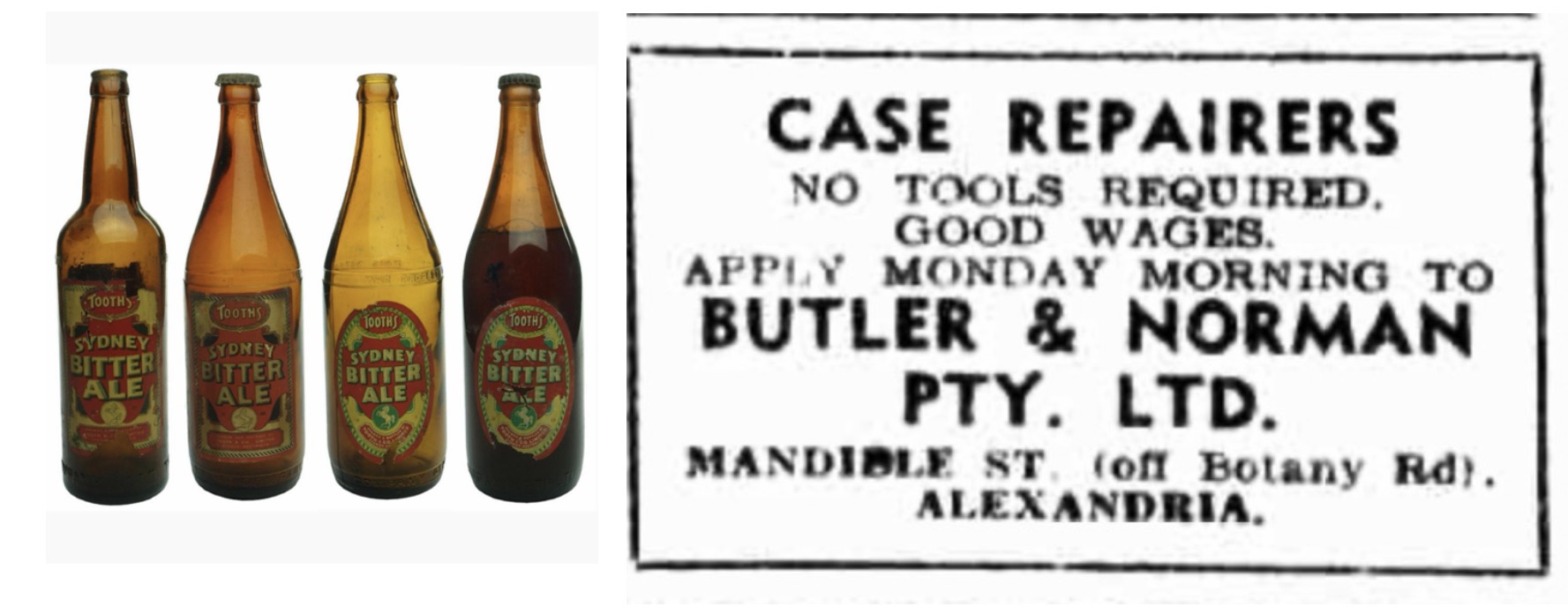
(Left) Tooth’s Sydney Bitter Ale bottles, representative of the glass bottles recovered by merchants such as Butler & Norman Pty Ltd, Arthur Slattery’s employer in 1947. Image: ABCR Auctions, Auction 46, Lot 731. (Right) Butler & Norman Pty Ltd recruitment advertisement, 1949. Image: Daily Mirror, 8 October 1949, p. 9. National Library of Australia.
Arthur Slattery’s contribution to rugby league did not conclude with his final first-grade appearance for Parramatta in 1949. In 1950, he accepted an appointment as player-coach of Harden-Murrumburrah, documented in The Maher Cup: A Social History. The Junee Southern Cross also confirms Slattery was captaining Harden that season, describing him completing an attacking movement to score a try out wide against Junee. His appointment saw him take his Sydney first-grade experience into the competitive country rugby league environment of southern NSW.
Although the available records have yet to establish the full extent of his coaching career or later life, official records confirm that Arthur returned to the Greater Sydney area after his country coaching role, where he passed away on 4 December 1981, aged 61. From the school football fields of Surry Hills to South Sydney, Parramatta’s foundation side and the country grounds of Harden-Murrumburrah, Arthur Gordon Slattery’s football journey was defined by determination, intelligence and leadership. As Parramatta’s inaugural vice-captain, he helped establish the playing standards and culture of our fledgling club during some of its most challenging early seasons. His subsequent move into country coaching ensured his contribution to the game extended well beyond his days in the Blue and Gold.
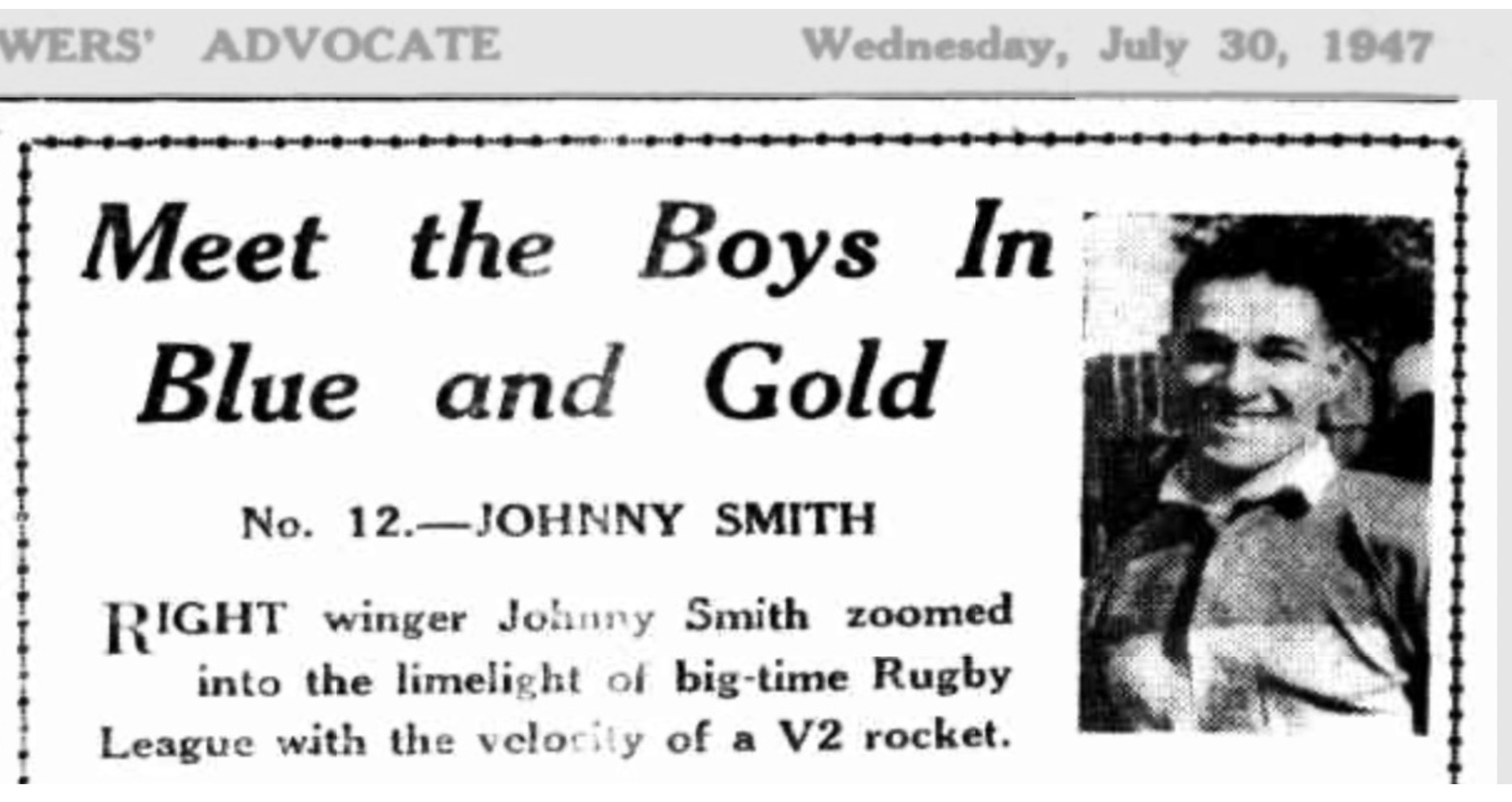
Johnny Smith Player Profile – The Cumberland Argus and Fruit Growers Advocate, published 30 July 1947. Link to full article in Reference List
EEL #12 – JOHN ‘JOHNNY’ SMITH
World War II Veteran | Domestic Painter | Club Trainer & Life Member
Before exploring Johnny’s story, it’s worth addressing an inconsistency I’ve encountered in the historical records. Our Johnny Smith is often credited as playing for North Sydney prior to arriving at Parramatta. Even North Sydney’s own historical player register makes this finding (Bear 438). However, through my research I have found match reports that do not support this narrative; but rather show that the Smith who debuted for Norths in 1945 was in fact a bloke named Jack Smith, who like Johnny, was also a North Shore born returned serviceman born in 1923. Cross-referencing these records with the Parramatta Eels and Sydney Roosters’ honour rolls, corresponding match reports in the National Library and archives and official Government records provides a clearer distinction between the two players. Our Johnny Smith was originally Eastern Suburbs player number 317, making 14 first-grade appearances across 1945–1946 before joining Parramatta as foundation player number twelve (12) in 1947. The following profile reflects these findings, building upon the valuable historical research undertaken by others, while carefully distinguishing between the two players.
Our Johnny Smith was born on 10 July 1923 in St Leonard’s NSW. Johnny grew up on the Lower North Shore, with his childhood spent in the Willoughby and Mosman area. His early sporting ambitions, however, were not originally focused on rugby league. According to his Meet the Boys in Blue and Gold player profile, published in The Cumberland Argus and Fruitgrowers Advocate on 30 July 1947, Johnny attended Mosman Junior High School, where he initially tried his hand at soccer. Unfortunately, Johnny had a habit of picking up the ball and running with it, a tendency that eventually prompted a change of codes; where his natural athletic abilities soon became evident.
In 1935, Johnny represented Combined High Schools against Lithgow, before continuing his development with the Neutral Bay C-grade and B-grade junior rugby league teams. Outside football, Johnny was learning the trade of industrial painting.
Like many of Parramatta’s foundation players, Johnny’s early adult life was shaped by the Second World War. Department of Veterans’ Affairs records confirm that John Smith (Service Numbers NX163943 and N236330) enlisted in the Australian Army at Townsville, QLD, on 15 May 1943, with Mosman NSW recorded as his locality on enlistment. At the time of his discharge on 29 April 1946, Johnny held the rank of Private, with his final posting recorded as the 16th Australian Heavy Anti-Aircraft Battery.
The 16th Australian Heavy Anti-Aircraft Battery formed part of Australia’s expanding air defence network during World War II. Following Japan’s entry into the war in December 1941 and the bombing of Darwin in February 1942, the threat of further attacks on Australia’s northern military installations prompted the rapid construction of fortified anti-aircraft positions. The 16th Battery was stationed in Townsville, QLD, where it was responsible for protecting the strategically important Garbutt Aerodrome and its approaches. The unit operated two principal gun stations: No. 1 Station at Rowes Bay, near Pallarenda, and No. 2 Station at Mount St John, later designated ‘Y’ Station or Gun Station 393. The latter was equipped with four 3.7-inch heavy anti-aircraft guns, supported by concrete ammunition magazines and a semi-underground command post and plotting room. The Australian War Memorial preserves the 16th Battery’s headquarters war diaries covering 1942 through November 1944, documenting its continued place within Australia’s wartime defence organisation.
For Johnny, military service also provided an unexpected opportunity to advance his rugby league career. His 1947 newspaper profile recalled that while stationed in northern Queensland, he played rugby league with service teams, developing his abilities on the football fields around Townsville. His performances earned him selection for New South Wales Services against Queensland Services in Townsville, followed by another representative appearance for NSW Services against a Metropolitan side.
It was an unusual pathway into senior rugby league, but one that would soon bring Johnny to the attention of Sydney’s established first-grade clubs. Johnny’s performances in service football eventually led him to Eastern Suburbs, where he made his first-grade debut in 1945 (Rooster 317). His pace and attacking ability complemented a talented Eastern Suburbs backline that included Australian representative Lionel Cooper. Between 1945 and 1946, Johnny made 14 first-grade premiership appearances for Eastern Suburbs, scoring two tries and forming part of the squad that won the 1945 Premiership for East’s but did not take the field on Grand Final Day due to injury.
At 23 years of age, Johnny joined the newly established Parramatta club, bringing valuable first-grade experience to its inaugural playing squad. On 12 April 1947, he took the field at centre for Parramatta’s historic opening match against Newtown at Cumberland Oval. Johnny gave Parramatta a player whose abilities extended beyond attacking football. In his 1947 player profile, the columnist described Johnny as an energetic young winger, likening his arrival in first-grade football to the speed of a V2 rocket, while contemporary match reports regularly recognised his tackling, determination and willingness to compete against more established opposition.
His exceptional pace was also evident away from premiership football, winning the backs’ running championship at the club’s inaugural annual picnic in October 1947. While fellow foundation player Colin ‘Schommy’ Schomberg claimed the overall running championship, Johnny demonstrated his own athletic abilities by winning the backs’ championship. As explored earlier in Schommy’s story, the event was held at Hollywood Pleasure Grounds in Lansvale. Throughout his time at Parramatta, match reports in the National Library consistently recognised Johnny’s attacking flair, polished finishing and defensive determination. His ability to produce decisive tries, coupled with his commitment in defence, made him a dependable and versatile member of Parramatta’s developing backline. By the end of his first-grade career in 1950, Johnny had made 47 premiership appearances for Parramatta, scoring five tries for a total of 15 points.
Away from football, the article described Johnny as a cheerful young man who was equally enthusiastic about life. By 1947, Johnny had returned to his trade as a painter and was living with his wife and young family in Baulkham Hills with ambitions to own his own home in the near future. The profile revealed that he was already the father of three young boys, with the youngest having arrived only weeks earlier. Johnny was apparently keen for his sons to follow him onto the rugby league field, although his expectations about their future playing positions were already proving entertaining. One son had apparently been earmarked as a future Parramatta three-quarter, but Johnny joked that the youngster’s rapidly developing size suggested he might be better suited to the forwards. A subsequent 1950 Rugby League News article revealed that Johnny and his wife were now raising three boys and a girl. The publication also expressed hope that some of his sons might eventually follow their father’s example and represent the club. Johnny’s two personal ambitions: owning his own home and seeing his boys eventually pull on a Blue and Gold jersey provide a particularly endearing glimpse into the everyday aspirations of a young working father balancing family responsibilities, employment and first-grade football in post-war Sydney.
Even as Johnny’s first-grade opportunities diminished, his commitment to Parramatta remained and he continued to contribute in reserve grade. Unfortunately, Johnny’s continued playing involvement was interrupted by injury. In June 1950, Rugby League News reported that he had suffered a broken jaw, forcing him away from football while he recovered. However, even after his playing career concluded, Johnny remained closely involved with Parramatta for several decades.
By the early 1950s, he had transitioned into the club’s training and support staff. The 25 April 1953 edition of Rugby League News identified Johnny among Parramatta’s trainers, recognising the important work performed by those responsible for supporting the players behind the scenes. It was a fitting continuation of his association with the club. The former foundation winger, whose own career had been built on athleticism and hard work, was now contributing to the preparation and wellbeing of a new generation of Parramatta footballers. The relationship continued through the following decades. In 1972, when Parramatta celebrated its 25th anniversary in the Sydney premiership, Johnny was once again acknowledged in Rugby League News. The commemorative article identified him as the club’s trainer, demonstrating that his involvement had endured long after his last first-grade appearance. For Johnny, Parramatta had become considerably more than the club he represented during its foundation years. It had become a lifelong association.
In 1976, Johnny’s longstanding contribution was formally recognised when he was awarded Life Membership of the Parramatta Rugby League Club. The honour acknowledged his years of service as both a player and trainer, recognising a commitment that had continued for almost three decades. It was an achievement of particular significance. Johnny had experienced Parramatta’s earliest struggles as a player, witnessed its development through the challenging post-war decades, and continued contributing as the club moved towards a new era of competitiveness and success. From the inaugural team of 1947 to the club’s growing prominence during the 1970s, he had remained part of the Blue and Gold story.
John “Johnny” Smith passed away on 2 October 2007, aged 84. From schoolboy soccer, to through wartime service football and premiership success at Eastern Suburbs, before finding his lasting home at Parramatta. Yet Johnny’s greatest contribution to the Eels may not have been measured in tries scored or matches played. As a foundation player, trainer and Life Member, he helped build and sustain the organisation that generations of Parramatta supporters would come to love. For mine, his story a reminder that a football club’s history is shaped not only by those who take the field, but also by those who continue to give their time, experience and commitment long after their playing days have ended.
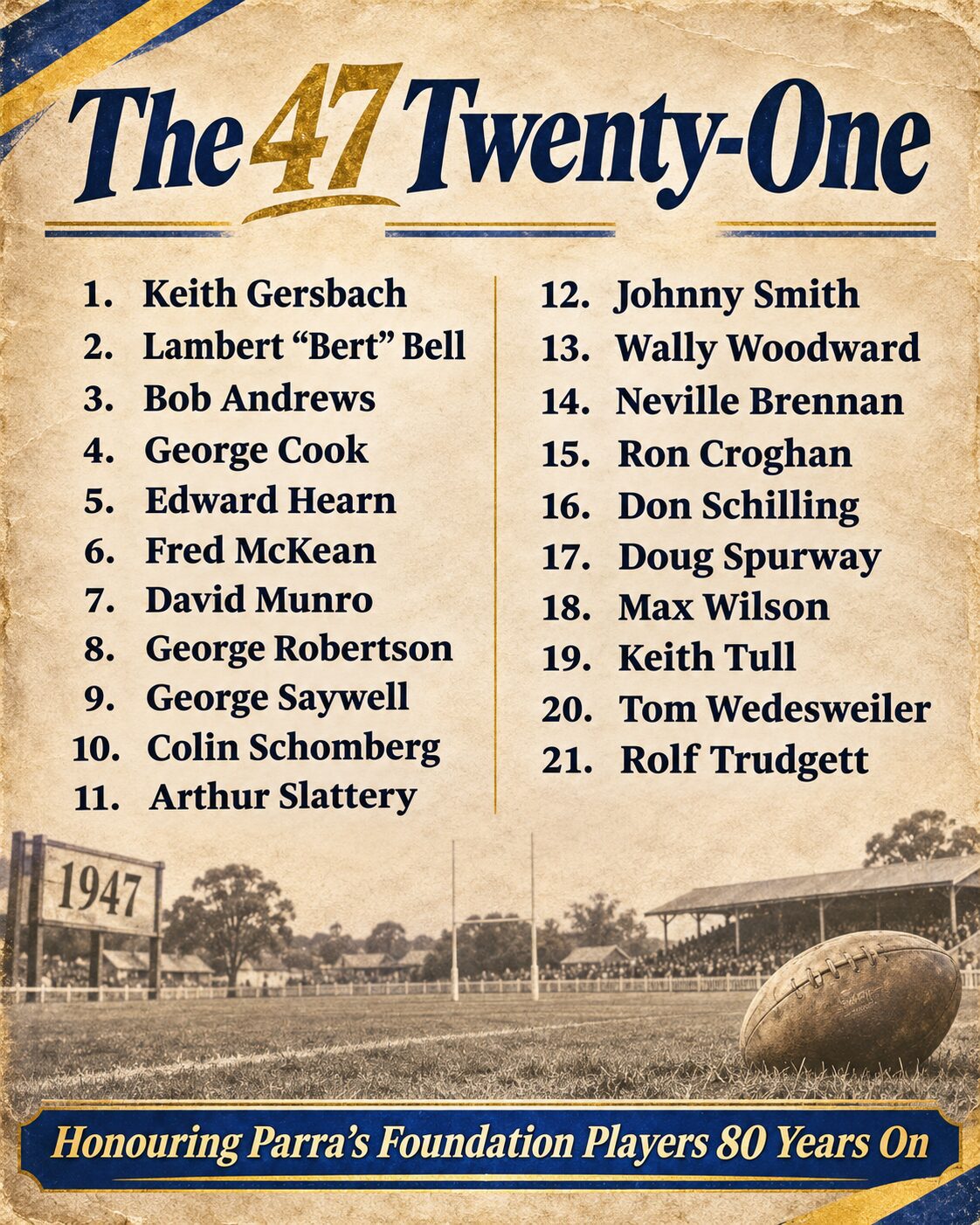
Twelve Down – Nine to Go – The 47 Twenty-One – Parramatta’s Foundation Squad – Source: Parramatta Eels Men’s Honour Roll – Image Created by the author using Canva Premium
The Golden Point: Names, Places and Historical Wild Goose Chases
As Part Three draws to an end, having uncovered another four remarkable player stories from Parramatta’s foundation year. One thing this project continues to teach me is that historical research is rarely straightforward.
Johnny Smith was particularly challenging from an information verification perspective. While there was plenty of distinguishable content documenting Johnny’s time at Easts and Parra, confidently establishing his birth, death and marriage records proved considerably more difficult. 28 John Smiths were born in NSW in 1923 alone, increasing to 80 when extending the search by a year either side of the record, as is my standard practice. Quite a contrast to the single Arthur Slattery registered over a similar period. With no middle name on Johnny’s military record and only an initial for his next of kin, I had little information to distinguish him from others. I narrowed it down to two with his birth record but couldn’t substantiate his parents’ names. I am also confident I found him and his wife on the electoral rolls, though I was unable to confirm the corresponding marriage records needed to substantiate these findings.
Once again, the archives delivered some wonderful and entirely unexpected gifts. Who would have thought that an almost 80-year-old newspaper article would reveal that Parramatta’s inaugural coach Frank McMillan had a mindset not dissimilar to our current administration in recent seasons. Or that a passing reference to Schommy winning a running championship at the club’s first annual picnic would lead me to historical photographs of sack races, magnetic fishing competitions and a newfound understanding of the term Pleasure Grounds in a historical context. These are the discoveries I enjoy most, as they don’t necessarily change our understanding of what happened, but they help bring the people, places and everyday experiences of 1947 to life. Sometimes the most entertaining parts of the journey are the things you weren’t actually looking for.
The further I delve into these stories, the more I appreciate that Parramatta’s history extends well beyond the results recorded in its inaugural season. Behind those original Blue and Gold jerseys were ordinary Australians navigating work, family, wartime experiences and the challenges of post-war life, while helping establish something that would become extraordinarily important to generations of supporters. Twelve foundation players down, nine more to go. There are still gaps to fill, stories to uncover and undoubtedly a few more historical mysteries waiting to test my patience. But each new discovery adds another little piece to our understanding of the men who started it all.
Until Part Four, take care Parra fans, and thanks for supporting TCT.
Roly-Poly

THE 47 TWENTY-ONE, PART THREE: COMPLETE REFERENCE LIST
Introduction and foundation-season context
1. The Daily Telegraph (1947, 6 April). [Frank McMillan explains that Parramatta is “team-building” following a North Sydney trial; reproduced in Part Three’s introduction]. Trove, article 248289755. Source
2. Parramatta Eels (n.d.). “Men’s Honour Roll.” [Official heritage numbers, first-grade seasons and statistics for Eels #9–12]. Source
3. Parramatta Eels / Neil Cadigan (2017, 28 March). “Throwback | 1947 – The Originals.” [Foundation-season history and the inaugural squad]. Source
4. Rugby League Project (n.d.). “Historical rugby league season and player statistics.” [Searchable database; specific 1947 Parramatta season URL not confirmed; compare statistics with the club’s official honour roll]. Source
Eel #9 — George Alfred “Sago” Saywell
1. The Cumberland Argus and Fruit Growers Advocate (1947, 18 June). “Meet the Boys in Blue and Gold: George Saywell.” [Birthplace, junior football, occupation, nickname, personal recollections and photograph]. Trove, article 105730509. Source
2. NSW Registry of Births, Deaths and Marriages (1924). Birth registration 30942/1924: George A. Saywell, Bulli; parents George C. and Alice. [Registry search-result page is session-dependent]. Source
3. The Cumberland Argus and Fruit Growers Advocate (1947, 12 March). “P’matta R.L. Trials Drew Big Crowd.” [Saywell recognised among the outstanding forwards in the Manly trial]. Trove, article 105737487. Source
4. The Cumberland Argus and Fruit Growers Advocate (1947, 26 March). [Canterbury-Bankstown trial report; Saywell’s defence]. Trove, article 105743339; headline to check. Source
5. The Daily Telegraph (1947, 6 April). [North Sydney trial reporting; Saywell’s performance and coach Frank McMillan’s team-building comments]. Trove, article 248289755. Source
6. Contemporary newspaper (1947, 6 April). [North Sydney trial; Saywell singled out among Parramatta players]. Trove, article 228981593; publication and headline to confirm. Source
7. The Cumberland Argus and Fruit Growers Advocate (1947, 9 April). “P’matta Confident Despite Setbacks in League Trials.” [Saywell named among the best for Parramatta]. Trove, article 105738551. Source
8. The Daily Telegraph (1947, 7 May). [Saywell returns after missing two games through injury]. Trove, article 248485324; headline to confirm. Source
9. The Cumberland Argus and Fruit Growers Advocate (1947, 25 June). “Pygmy Parramatta Slew West Giants in First Win Thriller.” [13–8 foundation victory; Saywell nearly scores]. Trove, article 105743236. Source
10. The Daily Telegraph (1947, 29 June). “Two Newtown Players Control Game.” [Saywell and Neville Brennan praised for persistent defence]. Trove, article 248480852. Source
11. The Goulburn Evening Post (1948, 1 April). “Inter-Town Game on Sunday.” [Port Kembla selection, identifying Saywell as a former Parramatta player]. Trove, article 103711970. Source
12. The Goulburn Evening Post (1948, 2 April). “Strong Port Kembla Team to Play Here.” [Saywell in Port Kembla’s representative side]. Trove, article 103719003. Source
13. The Illawarra Mercury (1948, 10 June). [Saywell’s continuing involvement with Port Kembla]. Trove, article 136451399; headline to check. Source
14. NSW Registry of Births, Deaths and Marriages (1954). Marriage registration 25038/1954: George Alfred Saywell and Raynor James, Bulli. [Registry search result; record-specific URL is session-dependent]. Source
15. Cumberland City Council (n.d.). Cumberland Historical Timeline, p. 25. [AGE plant, Auburn–Lidcombe, 1924 rail contract, merger, 1974 site exchange and 1976 demolition]. Source
16. Mitchell Library, State Library of NSW (n.d.). [Associated General Electric / Metropolitan Vickers factory history, 1936 AGE Hotpoint Football Club, and photographs of Auburn works, 1932–1952]. Archival collection 110354921. Source
17. Cumberland City Council Library Services, Local Studies Collection (1952). “Australian General Electric, 1952.” [Aerial factory photograph reproduced in the draft]. Source
18. NSW Registry of Births, Deaths and Marriages / public family-history research (2009). [Reported death of George Saywell, 28 November 2009, Bulli; exact record identifier not supplied]. [Research note — confirm underlying record before final citation]. Source
Eel #10 — Colin George “Schommy” Schomberg
1. The Cumberland Argus and Fruit Growers Advocate (1947, 11 June). “Meet the Boys in Blue and Gold: Colin Schomberg.” [School, rugby union, RAAF ambitions, relationship and portrait]. Trove, article 105735853. Source
2. Department of Veterans’ Affairs (n.d.). Second World War Nominal Roll: Colin George Schomberg, RAAF service number 444376. [Birth, enlistment, final unit, Leading Aircraftman rank and discharge]. Source
3. Australian War Memorial (c. 1944). “Two WAAAF flight mechanics checking aircraft engine components at No. 7 Aircraft Depot, Tocumwal.” Collection C291700. [Historical context for wartime depot]. Source
4. Australian War Memorial (c. 1944). “A WAAAF airframe fitter at work at No. 7 Aircraft Depot, Tocumwal.” Collection C291697. [Supporting depot context]. Source
5. The Sydney Morning Herald (1947, 5 February). “Schomberg to Play R.L.” [Rugby union to league transfer]. Trove, article 27906399. Source
6. The Sydney Morning Herald (1947, 13 February). “Change to League Voluntary.” [Schomberg’s explanation at Parramatta annual meeting]. Trove, article 18018779. Source
7. The Cumberland Argus and Fruit Growers Advocate (1947, 2 April). “Rugby League Teams Selected; Schomberg in Reserve Grade.” Trove, article 105738654. Source
8. The Cumberland Argus and Fruit Growers Advocate (1947, 9 April). “Schomberg Selection Shock for Critics.” [Elevation to foundation first-grade side]. Trove, article 105738553. Source
9. The Cumberland Argus and Fruit Growers Advocate (1947, 29 October). “Champ. Cup for ‘Schommy’.” [Parramatta’s first annual picnic at Hollywood, running championship and other results]. Trove, article 105735104. Source
10. The Cumberland Argus and Fruit Growers Advocate (1948, 16 June). “‘Schommy’ Signs Up With the Benedicts.” [Marriage and Betty Mason’s Belle of the Ball award]. Trove, article 105735222. Source
11. NSW Registry of Births, Deaths and Marriages (1948). Marriage registration 11144/1948: Colin George Schomberg and Elizabeth Maud Mason, Mosman. [Interactive historical index]. Source
12. New South Wales Rugby Football League (1972, 1 April). “25 Years at ‘Cumberland’.” The Rugby League News. [Inaugural team and Schomberg’s later refereeing duties]. National Library of Australia, item nla.obj-758399986. Source
13. NSW Rugby League Referees Association (2026, 22 October). “Behind the Whistle: Colin Schomberg.” [Officiating career, representative appointments, administrative service and life memberships; retrospective secondary source]. Source
14. Rugby League Project (n.d.). “Colin Schomberg: Playing career.” [Match record, seasons and points]. Source
15. ANU Press (n.d.). Georges River Blues, ch. 2, “The Picnic River: Pleasure Grounds and Waste Lands.” [Historical description and period photograph of Hollywood Pleasure Grounds; photograph attributed to Bankstown Historical Society]. Source
16. Parramatta Rugby League Club (1986). Road to Glory. [Retrospective interview with Schomberg about the foundation win, as quoted in the draft; publication details/page number still to verify].
Eel #11 — Arthur Gordon Slattery
1. The Cumberland Argus and Fruit Growers Advocate (1947, 28 May). “Meet the Boys in Blue and Gold: Arthur Slattery.” [Redfern origins, football career, family, brother Garry, Butler & Norman, Ray Norman and portrait]. Trove, article 105732939. Source
2. NSW Registry of Births, Deaths and Marriages (1920). [Arthur Gordon Slattery birth registration, Redfern; full registration number to confirm]. Interactive historical index. Source
3. The Sun (1925; exact issue date to confirm). “Boy’s Face Burned.” [Report about a child named Arthur Slattery; identity match is provisional]. Trove, article 222947157. Source
4. NSW Registry of Births, Deaths and Marriages (1939). Marriage registration 6234/1939: Arthur Gordon Slattery and Jean Veronica Dickson, Sydney. Source
5. South Sydney Rabbitohs Almanac (n.d.). “Arthur Slattery.” [Rabbitoh #314 and South Sydney grades and appearances]. Source
6. Rugby League Project (n.d.). “Ray Norman: Coaching Career.” [Corroborates the 1923 Eastern Suburbs premiership coaching connection; Slattery’s 1947 profile identifies Norman as an employer]. Source
7. New South Wales Rugby Football League (1945, 11 August). The Rugby League News, vol. 26, no. 18, p. 7. [South Sydney club notes praise Slattery’s long attacking run]. National Library of Australia, item nla.obj-667456608. Source
8. New South Wales Rugby Football League (1947, 3 May). The Rugby League News, vol. 28, no. 4. [Slattery’s move to second row and vigorous tackling]. National Library of Australia, item nla.obj-627000983. Source
9. The Sydney Morning Herald (1947, 21 May). “St. George Men to Miss Big R.L. Games.” [Slattery’s return to Parramatta after injury]. Trove, article 27900187. Source
10. New South Wales Rugby Football League (1947, 17 May). The Rugby League News, vol. 28, no. 6. [Parramatta notes about Slattery’s absence and hoped-for return]. National Library of Australia, item nla.obj-627001042. Source
11. The Cumberland Argus and Fruit Growers Advocate (1947, 4 June). “Roundabout” [Brock’s Fathers’ Corner birth announcement, Arthur’s son Garry Lee]. Trove, article 105744081. Source
12. The Daily Telegraph (1947, 6 July). “Rules Against Gersbach Try.” [Slattery’s cover defence and best-on-ground performance against South Sydney]. Trove, article 248394638. Source
13. The Cumberland Argus and Fruit Growers Advocate (1947, 9 July). [Report praising Slattery’s uncompromising tackling]. Trove, article 105743646; headline to confirm. Source
14. The Cumberland Argus and Fruit Growers Advocate (1947, 30 July). “For Persevering P’matta, a Smile from Lady Luck.” [Slattery plays on after a heavy blow to the eye]. Trove, article 105732145. Source
15. The Sydney Morning Herald (1948, 1 March). “Hooker Sent Off in First Training Game.” [Slattery among Parramatta’s best performers in trial]. Trove, article 27894103. Source
16. New South Wales Rugby Football League (1948, 17 April). The Rugby League News, vol. 29, no. 2, p. 12. [Club notes describe Slattery’s determined work against South Sydney]. National Library of Australia, item nla.obj-636102149. Source
17. New South Wales Rugby Football League (1948, 26 June). The Rugby League News, vol. 29, no. 15, p. 12. [Slattery praised for attack and cover defence]. National Library of Australia, item nla.obj-636102577. Source
18. The Sunday Telegraph (1949, 1 May). “Bryan, Star South Half, Refuses Country Offer.” [Slattery try against South Sydney]. Trove, article 248244017. Source
19. The Sunday Telegraph (1949, 8 May). “Parramatta Wins on Late Try.” [Slattery’s fractured left collarbone]. Trove, article 248245251. Source
20. The Cumberland Argus and Fruit Growers Advocate (1949, 11 May). “Parramatta Failed to Reproduce S.C.G. Form.” [Slattery injured against Canterbury-Bankstown]. Trove, article 111531482. Source
21. NSW Registry of Births, Deaths and Marriages (1981). Death registration 28171/1981: Arthur Gordon Slattery; parents John Bede and Millicent Muriel. [Death date 4 December 1981 also supported by an indexed death notice]. Source
22. The Sydney Morning Herald (1981, 5 December). Death notice: Arthur Gordon Slattery, dated 4 December 1981. [Indexed in MyHeritage, Australia Death Notices 1860–2019; original notice not independently examined]. Source
23. Pollock, Neil (2021) The Maher Cup: A Social History of Football in the Group 9 Towns 1920–1971. [1950 Harden–Murrumburrah appointment as player-coach. Physical Book – National Library. Source
24. The Junee Southern Cross (1950; exact issue date to confirm). “Harden Swamped by Junee Team.” [Arthur Slattery, captaining Harden, runs and scores a try]. Trove, article 286479660. Source
25. Australian National University, Noel Butlin Archives Centre (n.d.). “New South Wales Bottle Company Proprietary Limited.” [Bottle recovery system and Butler & Norman Pty Ltd among independent merchants]. Source
26. The Daily Mirror (1949, 8 October). [Butler & Norman Pty Ltd advertisement seeking case repairers at Mandible Street, Alexandria]. Trove, article 273689349, p. 9. Source
Eel #12 — John “Johnny” Smith
1. The Cumberland Argus and Fruit Growers Advocate (1947, 30 July). “Meet the Boys in Blue and Gold: Johnny Smith.” [Family, soccer, school, painter’s trade, war-service football and photograph]. Trove, article 105732114. Source
2. NSW Registry of Births, Deaths and Marriages (1923). Birth registration 34034/1923: John Smith, St Leonards; parents William and Ruth E. [Plausible identity match to be assessed against other sources]. Source
3. Department of Veterans’ Affairs (n.d.). Second World War Nominal Roll: John Smith, service NX163943 / N236330. [Enlistment, discharge, rank and final posting to 16 Australian Heavy Anti-Aircraft Battery]. Source
4. Anzac Square & Memorial Galleries / State Library of Queensland (n.d.). “‘Y’ Station, 16 Heavy Anti Aircraft Battery, Mount St John.” [Townsville gun positions and unit engagements in 1942; predate Johnny’s enlistment]. Source
5. Australian War Memorial (n.d.). “AWM52 4/16/20 — 16 Anti Aircraft Battery.” [Unit war diaries, 1942–44; contextual, not proof of Johnny’s individual movements]. Source
6. Parramatta Eels (2023, 21 April). “Veteran Eels: Celebrating Parramatta’s Ex-Servicemen.” [Wartime rank and unit]. Source
7. Sydney Roosters (n.d.). “Men’s Honour Roll.” [Eastern Suburbs #317, born 10 July 1923, died 2 October 2007, 14 games and two tries]. Source
8. North Sydney Bears / Old Bears Association (n.d.). “Bears Player Numbers: 1908–1999.” [Player #438 listed as “Johnny Smith” for 1945; compare with other sources before assuming an identity]. Source
9. Rugby League Project (n.d.). “Jack Smith: Playing Career.” [North Sydney record, contrasted with Eastern Suburbs’ Johnny Smith]. Source
10. Rugby League Project (n.d.). “Johnny Smith: Playing Career.” [Eastern Suburbs and Parramatta seasons, dates and career statistics]. Source
11. New South Wales Rugby Football League (1945, 14 July). The Rugby League News, vol. 26. [North Sydney notes call another player Jack Smith; identification comparison]. National Library of Australia, item nla.obj-622249302. Source
12. New South Wales Rugby Football League (1945, 28 July). The Rugby League News, vol. 26. [“Soldier Jack Smith” in North Sydney club notes]. National Library of Australia, item nla.obj-622249344. Source
13. The Cumberland Argus and Fruit Growers Advocate (1947, 4 June). [Johnny Smith’s solid tackling against Manly]. Trove, article 105744139. Source
14. The Cumberland Argus and Fruit Growers Advocate (1947, 13 August). [Johnny’s brilliant try and two near misses against Manly-Warringah]. Trove, article 105733823. Source
15. The Cumberland Argus and Fruit Growers Advocate (1947, 29 October). “Champ. Cup for ‘Schommy’.” [Johnny wins the backs’ running championship at Hollywood picnic]. Trove, article 105735104. Source
16. The Cumberland Argus and Fruit Growers Advocate (1948, 23 March). [Johnny Smith try-scoring performance]. Trove, article 105736274; headline to confirm. Source
17. The Cumberland Argus and Fruit Growers Advocate (1948, 23 June). “Parramatta Lacked Finish Against Tough ‘Berries’.” [Johnny’s polished play and vigorous tackling]. Trove, article 105742946. Source
18. The Cumberland Argus and Fruit Growers Advocate (1949, 13 April). “Fans See Blue and Gold Horizon After Parramatta’s Grand…” [Early 1949 game report; Smith’s strong running and tackling]. Trove, article 111530282. Source
19. The Cumberland Argus and Fruit Growers Advocate (1949, 27 April). “Parramatta’s ‘Heymakers’.” [Johnny’s tackling against Balmain; report cited in draft]. Trove, article 111532404; verify article date and identifier against screenshot. Source
20. The Cumberland Argus and Fruit Growers Advocate (1949, 13 July). “Last-Minute Try Was Golden.” [Smith’s role in the match-winning attacking movement]. Trove, article 111527257. Source
21. New South Wales Rugby Football League (1950, 6 May). The Rugby League News. [Johnny in reserve grade, family and longstanding service]. National Library of Australia, item nla.obj-654437064. Source
22. New South Wales Rugby Football League (1950, 24 June). The Rugby League News. [Johnny’s broken jaw and absence from football]. National Library of Australia, item nla.obj-654456802. Source
23. New South Wales Rugby Football League (1953, 25 April). The Rugby League News. [Johnny recognised among Parramatta’s trainers]. National Library of Australia, item nla.obj-634837435. Source
24. New South Wales Rugby Football League (1955, March; exact issue date to verify). The Rugby League News. [Johnny the trainer and a family birth announcement]. National Library of Australia, item nla.obj-631886972. Source
25. New South Wales Rugby Football League (1972, 1 April). “25 Years at ‘Cumberland’.” The Rugby League News. [1972 anniversary and Smith’s continuing role as trainer]. National Library of Australia, item nla.obj-758399986. Source
26. Parramatta Eels (n.d.). “Life Members.” [Official list includes John Smith, 1976]. Source
Historic photographs, illustrations and supplementary image credits
1. The Cumberland Argus and Fruit Growers Advocate (1947, 18 June). “Meet the Boys in Blue and Gold: George Saywell.” [Reproduced newspaper headshot]. Trove, article 105730509. Source
2. Cumberland City Council Library Services (1952). “Australian General Electric, 1952.” Local Studies Collection. [Aerial photograph of factory in Saywell profile]. Source
3. The Cumberland Argus and Fruit Growers Advocate (1947, 11 June). “Meet the Boys in Blue and Gold: Colin Schomberg.” [Reproduced player portrait]. Trove, article 105735853. Source
4. Liverpool City Library (1930s). “Leisure in the 1930s,” Historic Photography Collection, HL002413-2. [Men competing in a sack race at W. Wright’s Hollywood Pleasure Grounds; not Parramatta’s 1947 event]. Source
5. Liverpool City Library (1930s). “Leisure in the 1930s,” Historic Photography Collection, HL002413-1. [Women participating in a magnetic fishing competition at Hollywood Pleasure Grounds; not Parramatta’s 1947 event]. Source
6. The Cumberland Argus and Fruit Growers Advocate (1947, 28 May). “Meet the Boys in Blue and Gold: Arthur Slattery.” [Reproduced player portrait]. Trove, article 105732939. Source
7. ABCR Auctions (n.d.). Auction 46, Lot 731. “Four NSW Bottle Company Bottles with Original Labels for Tooth’s Sydney Bitter Ale.” [Examples of bottles in the trade, not bottles proven to have been handled by Butler & Norman]. Source
8. The Daily Mirror (1949, 8 October). Butler & Norman Pty Ltd “Case Repairers” advertisement, p. 9. [Reproduced notice]. Trove, article 273689349. Source
9. The Cumberland Argus and Fruit Growers Advocate (1947, 30 July). “Meet the Boys in Blue and Gold: Johnny Smith.” [Reproduced player portrait]. Trove, article 105732114. Source
10. The Daily Telegraph (1947, 6 April). [Frank McMillan team-building quote excerpt in the introduction]. Trove, article 248289755. Source