
Hey Parra fans, I hope you’re all well. With Remembrance Day upon us and the Eels’ 80th birthday celebrations approaching, I thought the off-season presented a fitting opportunity to delve into the National Archives and explore the lives of our club’s 21 foundation players. Many served in World War II, and each played a part in establishing the rugby league stronghold that Parramatta and Greater Western Sydney have become.

I knew I was about to go down a pretty big rabbit hole with this one, the National Archives can be a blessing and a curse for those who seek wisdom in its walls. What I wasn’t expecting was the sheer amount of information worth sharing about our foundation players. So much so that I simply couldn’t do the archives or the players justice in one article, nor could I possibly choose which players to research and write about. So bugger it, I’m going to do the lot of them. Not all at once of course; even we queens known for our dense long-winded essays have our limits. Hence, The 47 Twenty-One will be a multi-part research-based exploration of the 21 players who represented Parramatta during its inaugural 1947 season, uncovering the stories of the men behind the jerseys and the lives they led beyond the football field.
Rather than simply retracing the football careers of these 21 heroes, my research focus is to discover what else made them tick. Where did they grow up? How did they balance football with work and family? For those who served during the war, what can we establish about their military service? And what became of them when their playing days were over? These questions offer a window into lives lived in an Australia vastly different from today, culturally, environmentally, geopolitically, and socioeconomically,
Before we begin, a note on the research. Formal records and established publications form the core of these profiles, including material from Australia’s national library and archives, and official rugby league sources. I’ll distinguish documented facts from assumptions and flag conflicting sources or gaps in the evidence where appropriate. Recognising a player’s professional and community achievements or military service is important, but accurately linking that player to formal records can be tricky. Preserving these stories accurately matters to me as much as telling them.
A detailed reference list has been provided, with links where possible, so readers can be confident in what is presented. There will always be more to discover, and I hope this series encourages readers to conduct their own explorations, share knowledge and memories, and provide their own insights into our clubs incredible history.
The first graphic below contains the complete list of foundation players I intend to document in the coming weeks. If you believe you can provide information that might support my research, please do not hesitate to say so and I will happily credit you for your contributions.
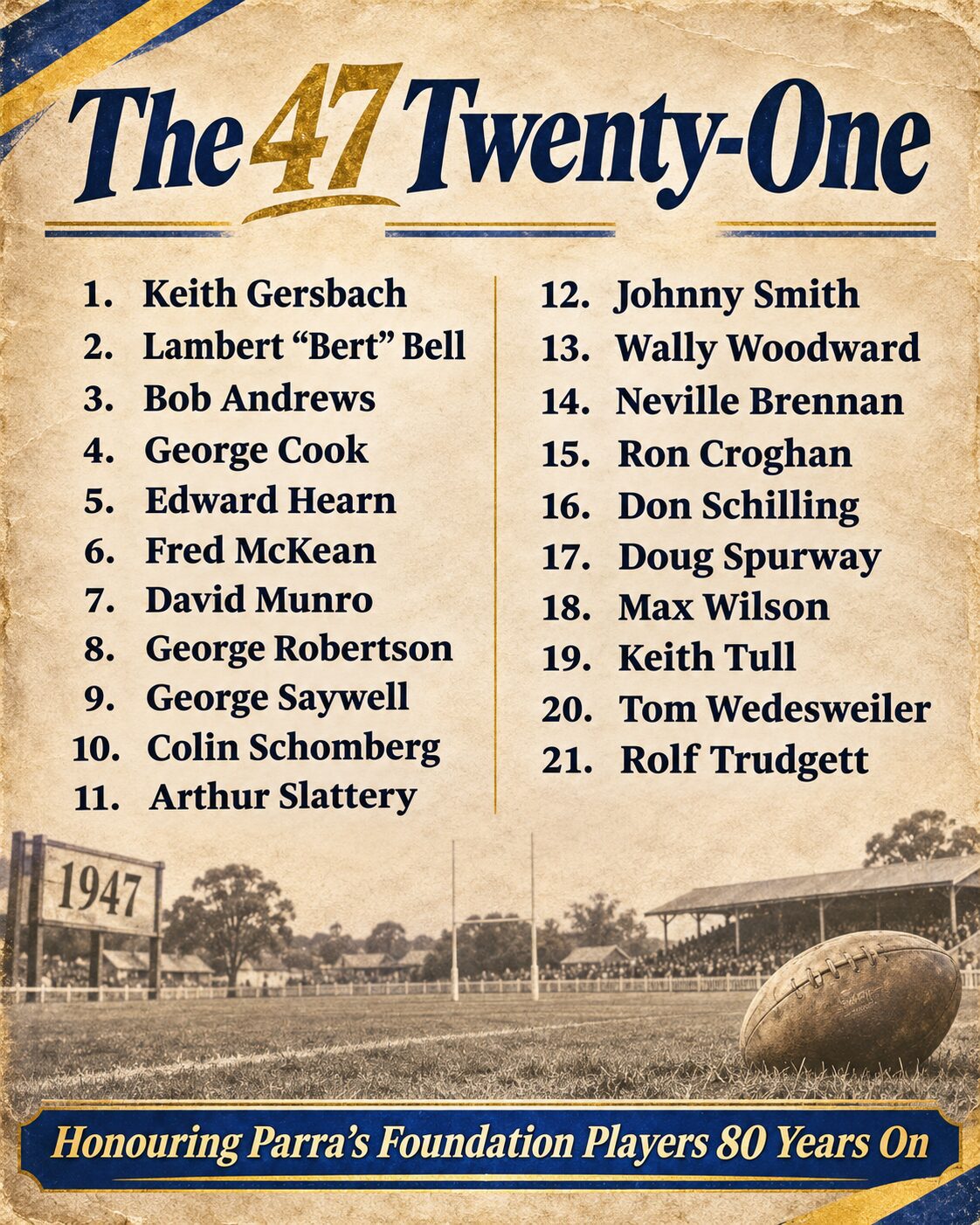
The 47-Twenty-One, Honouring our Foundation Players. Sources: ARL & PRLFC. Image created by the author using Canva Premium
Parramatta in 1947 – A District in Transition
To fully appreciate the lives of Parramatta’s foundation players and their contribution to the club’s inaugural season, we need to understand what everyday life looked like in Western Sydney in the years immediately following World War II.
Parramatta in 1947 was a district transitioning from its agricultural and industrial roots towards the suburban landscape we recognise today. Beyond its commercial centre, orchards, market gardens, poultry farms and emerging residential communities remained prominent features of Western Sydney. Population growth reflected this transformation. Between 1911 and 1947, the then neighbouring Municipality of Dundas gained almost 6,000 residents as housing developments expanded across the district.
The consequences of war remained evident in households, workplaces and local communities. For returning servicemen and women, readjustment to civilian life was not always straightforward. Experiences varied depending on the nature of their service, health, family circumstances and employment opportunities. Housing shortages and the demands of post-war reconstruction presented further challenges.
Despite the war having ended almost two years earlier, Australians were still living with food and clothing rationing. In April 1947, restrictions remained on meat, butter, sugar, tea and clothing. Sugar rationing ended that July, but meat and clothing remained restricted until June 1948, while tea and butter rationing continued into 1950. For a young family, what appeared on the dinner table could depend as much on ration coupons and availability as personal preference.
Household finances presented their own challenges. In September 1947, the Commonwealth Statistician estimated average weekly earnings for Australian men, including overtime, at £7 15s 9d, equivalent to approximately £405 annually. Women generally earned considerably less, with wage-setting arrangements reflecting the substantial gender inequality of the period. Although wartime employment had expanded opportunities for women, many faced pressure to relinquish their positions to returning servicemen or accept lower-paid work.
Meanwhile, post-war migration was beginning to reshape the district. Government resettlement programs introduced new communities and cultures to Western Sydney, with migrant accommodation established in areas including Granville, Dundas and Ermington. These changes would contribute to the region’s growing diversity and influence the communities from which future generations of footballers would emerge.
Nationally, almost one million Australians served during the Second World War. However, the number who came from the Parramatta district, as it existed in 1947, has not yet been reliably established. While national enlistment figures illustrate the scale of Australia’s involvement, they cannot adequately capture the experiences of individual communities.
For Parramatta’s foundation players, these were more than historical circumstances. They were the conditions in which they grew up, worked, served their country, raised families and played football. Their individual journeys differed, but together they helped establish a club that would become an enduring part of Western Sydney’s identity.
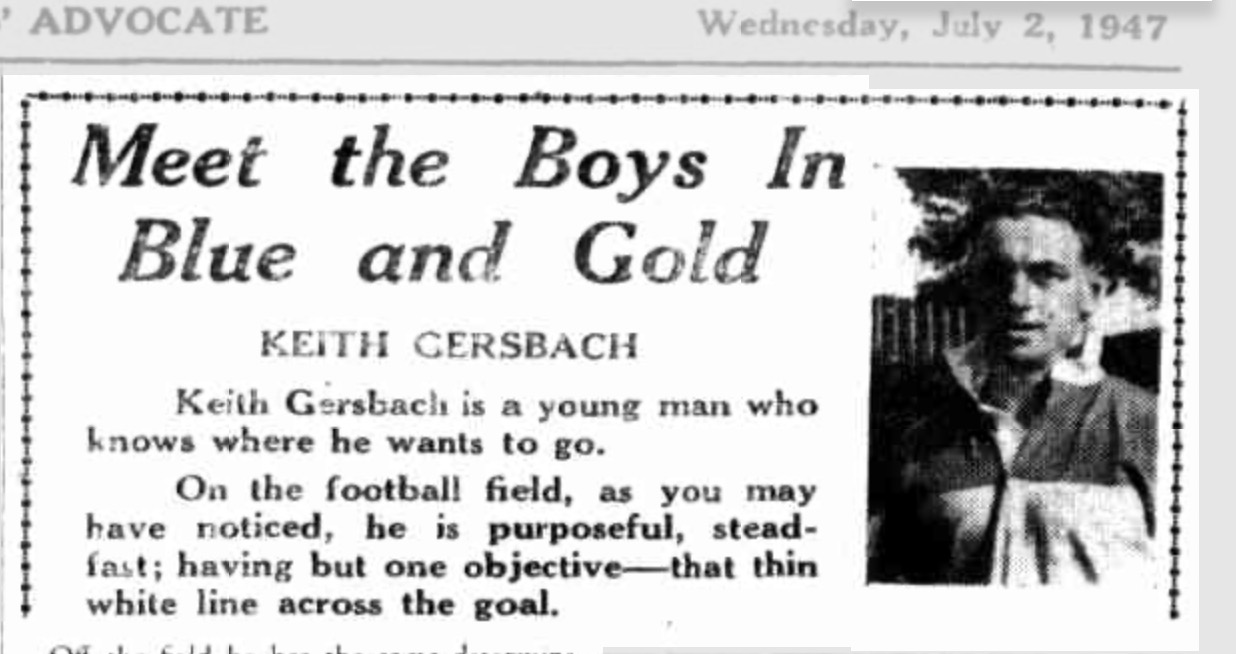
Keith Gersbach Player Profile – The Cumberland Argus and Fruit Growers Advocate 2 July 1947 Source: National Library of Australia – Link to full article in footer references
PARRAMATTA EEL #1 – KEITH GERSBACH
World War II Veteran | Timber Merchant | Community Leader
Keith Gersbach was born on 1 March 1923 in Penrith, and holds a unique place in Parramatta rugby league history as the club’s first officially recognised heritage player. Raised in the St Marys district, Gersbach began playing football at just seven years of age, developing his skills through local competitions and the Penrith school team. A contemporary profile published in The Cumberland Argus and Fruit Growers Advocate on 2 July 1947 described a determined young footballer whose sporting ambitions began long before his first-grade career.
On 12 April 1943, exactly four years before his first appearance as Parramatta Eel #1, Gersbach enlisted in the Australian Army at Lithgow, serving as Private NX166411 (N346803). He was deployed to New Guinea, where he served as an anti-aircraft gunner and reportedly contracted malaria at one point. His 1947 newspaper profile also revealed that he continued playing football during military service, representing his unit at centre. He was discharged on 30 July 1946, with his final recorded posting being the 52nd Australian Composite Anti-Aircraft Regiment (AIF).
Formed in New South Wales in September 1943, the regiment served with Merauke Force in Dutch New Guinea between 1943 and 1945. Operating in isolated tropical conditions, its personnel maintained radar, searchlights and anti-aircraft artillery to protect strategically important Allied airfields and shipping facilities from Japanese attacks. The regiment’s wartime contribution is commemorated by a bronze plaque at Argyle Place, Millers Point, Sydney, while its operational history is preserved in the Australian War Memorial’s Unit War Diaries collection.
Gersbach’s military commitments overlapped with his early first-grade career. He debuted for Canterbury-Bankstown against Balmain in 1945 and made 16 appearances across two seasons, scoring seven tries. His performances earned him representative selection for City Seconds in 1946, when he scored two tries against Country Seconds, followed by selection in the Possibles versus Probables representative trial.
In 1947, Gersbach joined the newly admitted Parramatta club as its highest-paid foundation player, reportedly receiving a guaranteed £108 for the season. He took the field on the wing in Parramatta’s inaugural first-grade match against Newtown on 12 April 1947 and quickly established himself as one of the fledgling club’s most productive players. He scored a hat-trick against South Sydney and finished the season as Parramatta’s leading try-scorer with ten tries. Across two seasons with the Eels (1947–1948), he made 24 first-grade appearances and scored 12 tries, bringing his overall premiership career to 40 matches and 19 tries.
Away from football, Gersbach was establishing a career in business. His July 1947 newspaper profile revealed that he had become a partner in a sawmill at Mount Druitt approximately nine months earlier, alongside several partners, including fellow returned servicemen. He was also engaged to Jean Brewer, although their wedding plans depended on securing suitable housing, a familiar challenge for young Australians during the post-war housing shortage. A wedding announcement published in the Nepean Times on 25 November 1948 suggests the couple had overcome that obstacle, reporting their marriage on 30 October 1948 and plans to reside in St Marys where both families had longstanding community connections. The family connection to Parramatta would extend further when Keith’s sister Shirley married fellow foundation-year player Rolf Trudgett (Eel #21) the following year, a player and connection we will explore later in this series.
Following his departure from first-grade football in 1948, Gersbach continued his involvement in local rugby league. A report published in the Nepean Times on 22 March 1951, identifies him as captain-coach of the St Marys A-grade side. He scored a try against Woronora and was named among the team’s best players, demonstrating his continuing contribution as both a player and local leader.
Keith Gersbach died in June 2015 and was farewelled in St Marys. Parramatta honoured its inaugural heritage player with black armbands and a moment of applause before its round 16 match against St George Illawarra the following week. From military service and first-grade football to establishing a business and contributing to community sport, Keith Gersbach’s story reflects the experiences of a generation balancing sporting ambitions with employment, family responsibilities and the rebuilding of post-war Australia.
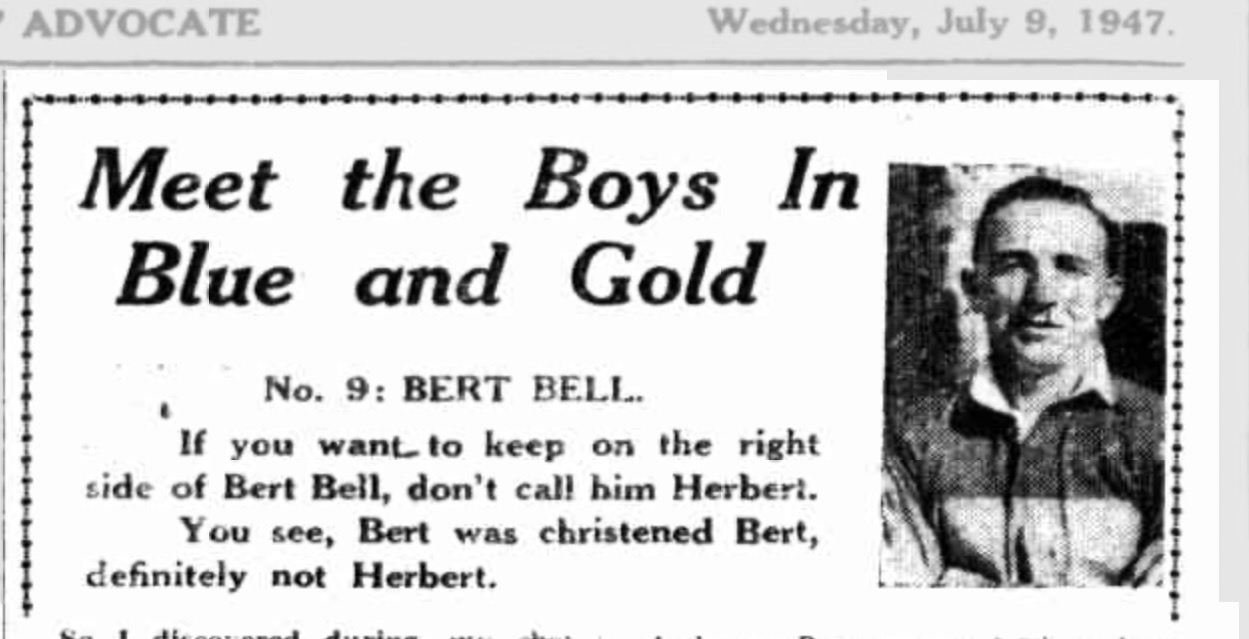
Bert Bell Player Profile – The Cumberland Argus and Fruit Growers Advocate 9 July 1947 Source: National Library of Australia – Link to full article in footer references
LAMBERT LYTHLE “BERT” BELL – PARRAMATTA EEL #2
World War II Veteran | Aluminium Works Inspector | A-Grade Fast-bowler
Historical Research Note: Existing research has helped preserve the story of Parramatta’s second heritage player, although some details of his identity, playing history and military service differ significantly across a range of credible sources. The NRL’s official inaugural team records identify him as Lambert ‘Bert’ Bell, while several other records commonly identify him as Lesley James Bell, who played for South Sydney between 1943 and 1946; though the South Sydney Rugby League Almanac distinguishes the two players as different people. To explore these differences, contemporary newspaper reporting has been considered alongside original Australian Army service documents, the Queensland Registry of Births, the National Archives and the Australian War Memorial’s historical records. Taken together, these sources support the identification of Eel #2 as Lambert Lythle Bell. The following profile draws on these findings, while acknowledging the significant earlier research into Bert’s time at the Eels.
Lambert Lythle ‘Bert’ Bell was born in Rockhampton, Queensland on 12 July 1918. A versatile back and accomplished goal-kicker, Bell’s journey to first-grade rugby league began in Western Sydney’s local competitions. A contemporary profile published in The Cumberland Argus and Fruit Growers Advocate on 9 July 1947 recounts his family’s relocation from Rockhampton to Liverpool, in the early 1930’s where he attended Liverpool Technical College. He subsequently captained Cabramatta’s junior A-grade side for six years, establishing himself as a prominent local footballer before the Second World War.
On 13 January 1942, Bell enlisted in the Australian Army at Liverpool, New South Wales. Serving as Private Lambert Lythle Bell, service number N375419, he remained in military service until his discharge on 14 January 1946. His final recorded posting was with the 8th Australian Infantry Battalion (City of Ballarat Regiment). His original discharge documentation records 602 days of active service outside Australia, including operational service in New Guinea, Emirau and the Solomon Islands.
Originally a Victorian Citizens Military Force (Militia) unit, the 8th Battalion was mobilised during the Second World War and deployed to Darwin in February 1942, arriving during the first Japanese air raids. Following further training, the battalion served at Lae in New Guinea before deploying to Emirau Island in October 1944 and participating in the Bougainville campaign during 1945. Its duties included defending Allied installations, surveillance, patrolling and combat operations against Japanese forces. Bell’s 1947 newspaper profile also described approximately two years of service in New Guinea and Bougainville, consistent with the broader geographical history recorded in his military documents. The battalion’s wartime contribution is commemorated by a dedicated plaque at Rocky Creek Memorial Park, near Tolga, Queensland. Its operational history is also preserved through the Australian War Memorial’s Unit War Diaries collection in Canberra.
In 1946, Bell helped the Cabramatta Two Blues secure its first A-grade Rugby League premiership, defeating Fairfield 17–5 in the grand final. His performances earned him the club’s Best and Fairest award, and in 1947 he became Cabramatta’s first player to represent the newly established Parramatta club in first grade. On 12 April 1947, Bell took the field at five-eighth in Parramatta’s inaugural premiership match against Newtown at Cumberland Oval and kicked three goals, contributing six of the club’s twelve points. Across three seasons with the Eels (1947–1949), Bell made 14 first-grade appearances, kicking 27 goals for a total of 54 points.
Away from football, Bell balanced his sporting commitments with employment and family responsibilities. His 1947 newspaper profile described him as a popular teammate employed as an inspector at Australian Aluminium Works, while enjoying married life with his wife Dorothy and their growing family. Later genealogical records identify additional occupations as a greengrocer and lorry driver, providing further insight into his evolving professional life beyond first-grade football.
Bell was also an accomplished cricketer. The 1947 profile credited him with taking six wickets without conceding a run while representing Parramatta in the A Reserve cricket competition. His involvement in local cricket may have continued well beyond his football career. An article published in The Broadcaster on 6 April 1965 identifies a veteran Bert Bell taking eight wickets across two innings for Cabra-Vale Diggers, although confirmation that this was the same player remains outstanding.
Lambert Lythle (Bert) Bell died on 24 October 1999, aged 81. His life reflects the experiences of a generation whose responsibilities encompassed the heavy weight of concurrent wartime service, manual labour and family care. From Cabramatta’s post-war premiership success to Parramatta’s historic inaugural season, to Cabra-vale cricket legend. Bell’s contribution extended beyond his first-grade statistics, leaving an enduring connection to the sporting communities and working-class industries that shaped Western Sydney.
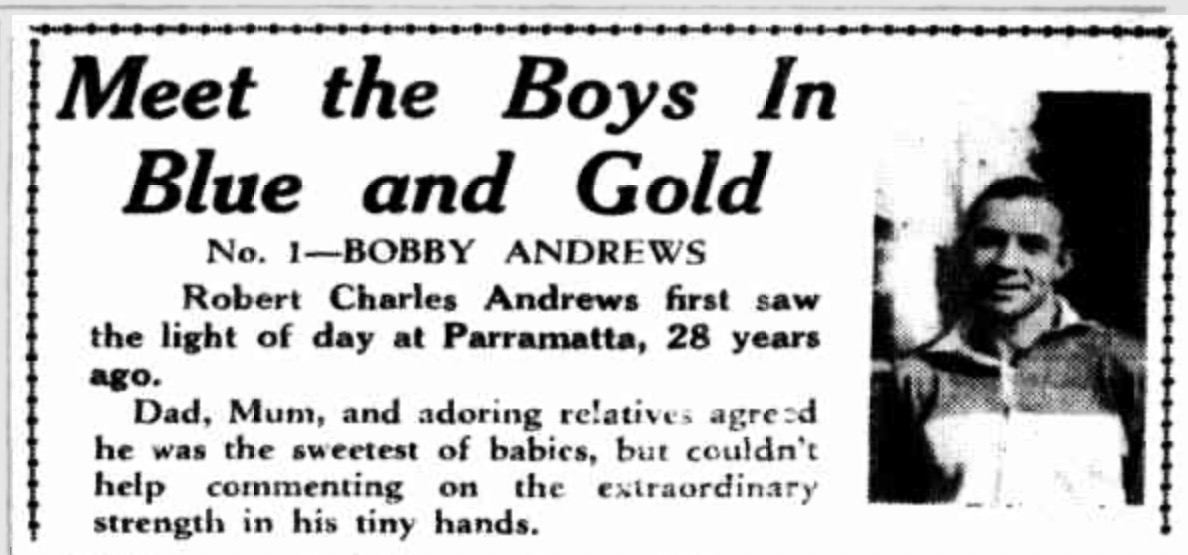
Bob Andrews Player Profile – The Cumberland Argus and Fruit Growers Advocate 14 May 1947 Source: National Library of Australia – Link to full article in footer references
Eel #3 – Robert Charles ‘Bob’ Andrews
World War II Veteran | Tyre Builder | Inaugural Captain
Robert Charles ‘Bob’ Andrews was born on 11 January 1919 and holds a distinguished place in Parramatta rugby league history as the club’s inaugural captain and third officially recognised heritage player. Official records name Concord NSW as his birthplace; though by his own recollection Andrews insisted he was born and bred in Parramatta where he developed his passion for football through the district’s intermediate rugby league competition, where he played for three seasons before switching to rugby union at seventeen.
His talent quickly emerged in rugby union, progressing from winger to centre and eventually captain of Parramatta’s first-grade side. A contemporary profile published in The Cumberland Argus and Fruit Growers Advocate on 14 May 1947 reported that Andrews scored 120 and 105 points across two seasons, with the former described as a New South Wales record. By 1943, he had made his 100th first-grade rugby union appearance before returning to rugby league with Western Suburbs.
Bob Andrew’s enlisted in the Australian Army on 6 January 1943 in Fairfield NSW serving as Signalman Robert Andrews (NX150178). Official military records associate Andrews with the 18th Australian Lines of Communication Signals, a domestic unit responsible for maintaining essential military communications during the Second World War until his discharge on 13 December 1945.
The 18th Signals developed from the expansion of Australian military communications operations in New Guinea during 1942. Its personnel established and maintained wireless, telephone and cable networks connecting military headquarters, operational units and strategic bases. These communications extended across Port Moresby, Kokoda and Oro Bay, with operations later expanding towards Lae and Morotai. Working in difficult tropical conditions, signals personnel provided infrastructure essential to coordinating Allied military operations. The unit’s wartime activities are preserved through operational records and photographs held by the Australian War Memorial in Canberra. Personnel who died serving with the unit are also commemorated on the Memorial’s Roll of Honour, including Signalman John William Lamp on Panel 27. More broadly, the contribution of Australia’s Second World War signallers is commemorated through The Signalman 1939–1945, a memorial painting by Ivor Hele at the School of Signals, Watsonia Barracks, in Melbourne. A dedicated memorial specifically for the 18th Signals has not yet been identified.
Following his move to Western Suburbs in 1943, Andrews made 42 first-grade appearances, scoring 13 tries and kicking 52 goals. His performances included a memorable five-goal contribution against Balmain, inflicting what the 1947 newspaper described as the Tigers’ only defeat of that season.
In 1947, Andrews joined the newly established Parramatta club and was appointed its inaugural captain. On 12 April 1947, he took the field as a centre and led the Eels onto Cumberland Oval for their first premiership match against Newtown, bringing considerable first-grade experience and a strong connection to the district. He captained Parramatta in 16 of its 18 matches during the inaugural season and finished as the club’s leading points-scorer with 61 points. His performances included a hat-trick against North Sydney on 3 May 1947. Across two seasons with the Eels (1947–1948), Andrews made 20 first-grade appearances, scoring four tries and kicking 32 goals for 76 points. His overall premiership career across clubs comprised 62 matches and 219 points.
Away from football, Andrews balanced his sporting commitments with professional and family responsibilities. His May 1947 newspaper profile revealed that he worked as a tyre builder at Goodyear, where the physically demanding work complemented his sporting fitness. He also coached the company’s rugby league side in the City Houses competition and spent Sundays identifying emerging junior talent. Andrews emphasised the importance of physical conditioning and preparation in preventing injuries among younger players. The article also offered a glimpse into his personal life. He talked about his marriage to Parramatta local Lily Sergeant in 1943 and recalled the memorable occasion when he kicked five goals for Western Suburbs against Balmain on the same day his daughter was born.
Bob Andrews retired from first-grade rugby league in 1948. Although comparatively little is publicly documented about his subsequent employment and community involvement, his family’s connection to Parramatta has endured. In October 2026, several of his descendants appeared in the Eels’ Made For Parra promotional campaign, celebrating the generational relationships between the club and its supporters.
Bob Andrews died on 2 August 1979, aged 59. His legacy extends beyond his inaugural captaincy and playing achievements. From his early involvement in district football to coaching workplace teams and supporting junior development, Andrews demonstrated a longstanding commitment to rugby league and his local community. Nearly eight decades after he first led Parramatta onto the field, his family’s continued association with the Eels provides a fitting reminder of that contribution.
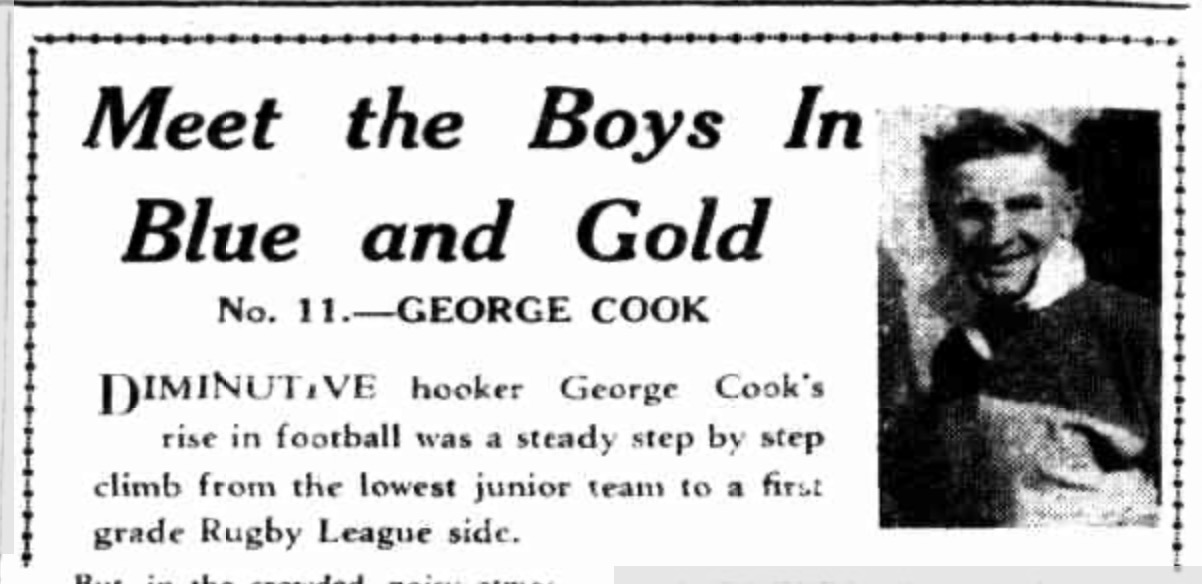
George Cook Player Profile – The Cumberland Argus and Fruit Growers Advocate 23 July 1947 Source: National Library of Australia – Link to full article in footer references
Eel #4 – George Edward ‘Seaweed’ Cook
World War II Veteran | Cross-cut Saw-Bench Tailer-out | Parramatta’s First Try-Scorer
George Cook was born on 30 October 1923 in Portland NSW, approximately 23 kilometres northwest of Lithgow. He holds a special place in Parramatta rugby league history as the club’s fourth heritage player and scorer of its first premiership try. A contemporary profile published in The Cumberland Argus and Fruit Growers Advocate on 23 July 1947 provides a rare glimpse into his early life, wartime experiences and the man behind the footballer.
Cook developed his Rugby League prowess through Blacktown’s junior rugby league competition, progressing from C-grade to representative football. His performances earned him selection in the President’s Cup competition and representative honours with Western District and Balmain, establishing himself as a promising young hooker before his first-grade career.
Cook served with the Royal Australian Air Force (RAAF) during World War II, enlisting on 10 October 1942 in Portland NSW. Official DVA nominal records identify him as a Leading Aircraftman (71049) associated with No. 3 Mobile Works Squadron. Formed in Darwin on 25 May 1942 as No. 3 Works Maintenance Unit, the squadron was renamed No. 3 Mobile Works Squadron in January 1943 before becoming No. 3 Airfield Construction Squadron in July 1944. Its personnel constructed and maintained airfields, buildings and supporting infrastructure across northern Australia and the Pacific, enabling Allied aircraft to operate from strategically important locations. The squadron’s wartime operations extended through New Guinea, the Netherlands East Indies, the Philippines and Borneo.
The contribution of Australia’s wartime airfield construction personnel is commemorated by a plaque at RAAF Memorial Grove, Majura, Canberra, recognising the construction and maintenance units that supported Allied operations. Their history is also preserved through military archives and historical records, including those held by the Australian War Memorial.
Cook’s military commitments overlapped with his early first-grade career. His 1947 newspaper profile describes more than four years of wartime experience in the Northern Territory and New Guinea, during which he continued playing football where possible, including appearances for a military representative side. He made his Canterbury-Bankstown debut against Newtown in 1944, spending much of his time in reserve grade while making limited first-grade appearances.
On 12 April 1947, Cook took the field at hooker in Parramatta’s inaugural premiership match against Newtown at Cumberland Oval and earned a permanent place in club history by scoring Parramatta’s first-ever premiership try. Across the inaugural season, he made 17 first-grade appearances, scoring three tries for nine points. His determination was evident despite suffering a broken nose earlier in the year, an injury that reportedly required further specialist examination.
Away from football, George Cook was employed in the timber industry as a tailer-out on a cross-cut saw bench, assisting with the cutting and handling of timber. His July 1947 newspaper profile described him as modest and unassuming, living at Rooty Hill with his wife and 27-month-old son, Garry Alan, while hoping to establish a family home in the Parramatta district.
The profile also revealed Cook’s pride in his young son, whom he had already earmarked for the five-eighth position, joking that he would not tolerate Garry kicking the ball from the scrum base. It was a light-hearted glimpse into the personality of a man whom the journalist described as more interested in discussing his son than his own football achievements.
The article also revealed Cook’s unusual nickname, Seaweed. When questioned about its origins, he suggested that fellow foundation player Fred ‘Snowy’ McKean (Eel #6) might provide the explanation, leaving the journalist, and in-turn future generations of Parramatta supporters, none the wiser.
Establishing verifiable details of Cook’s employment and community involvement following his playing career proved difficult. This appears to have been attributable, in large part, to the difficulty of distinguishing him from others of the same name: Commonwealth records suggest that approximately 22 men named George Cook resided in Sydney around 1947, complicating the reliable attribution of personal records to the player.
That said, a personal recollection published on The Cumberland Throw in April 2024 provides a glimpse into George’s later life. Longtime supporter Parra Pete recalled growing up near the Cook family in South Granville, attending school with his son Garry and knowing George personally. He also remembered Cook’s granddaughter and the family’s enduring affection for the Eels, offering a rare connection between the club’s foundation years and subsequent generations of supporters.
George Cook’s contribution to Parramatta’s foundation season was significant. From Blacktown’s junior competitions and wartime service to employment in Western Sydney’s timber industry, his story reflects the varied experiences of the men who established the club in 1947. While much of his later life remains undocumented, the personal memories shared with the Cumberland Argus and our readers decades later suggest that his legacy extended beyond the football field and into the community he called home.
The Golden Point – More Than a Heritage Number
Gersbach, Bell, Andrews and Cook will forever be remembered as Parramatta’s first four heritage players. Their first-grade careers were relatively brief, but their place in the club’s history is permanent. As supporters, we honour their contributions to Parramatta, and on this Remembrance Day, we also acknowledge their service during the Second World War.
Researching their lives has reinforced both how much historical records can establish and how much remains untold. Football statistics document appearances, tries and points, while military records identify enlistments, postings and operational service. Yet neither necessarily reveals what these men experienced, how those experiences shaped them, or the lives they built beyond their playing days.
The National Archives, contemporary newspapers, family history databases and official club publications have helped fill some of those gaps, but some questions remain unanswered. Our responsibility is not to assume or invent the missing chapters, but to preserve what the evidence allows us to establish and give these stories the recognition they deserve.
Not all twenty-one of Parramatta’s foundation players served during the war, and their individual journeys were shaped by different circumstances, opportunities and challenges. Yet each contributed to establishing a club that would become an integral part of Western Sydney’s sporting and community identity.
Through my research on The 47 Twenty-One, I hope to uncover more of those individual stories, recognising not just their football achievements but the people they were, the lives they led and the contributions they made beyond the field.
As supporters, we naturally celebrate the past premierships, and defining moments that have shaped Parramatta’s identity. But perhaps Remembrance Day offers a fitting opportunity to begin looking beyond those familiar achievements and acknowledge the lives, responsibilities, and sacrifices behind the jerseys.
As for our first four Eels, service to their country came before their place in Parramatta’s history. Their military contributions deserve remembrance, just as their lives beyond football deserve to be told. Eighty years on, their stories remain worth telling.
Lest we forget.
Roly-Poly

THE 47 TWENTY-ONE, PART ONE | COMPLETE REFERENCE LIST
Compiled from the historical-context research and the individual Keith Gersbach, Lambert “Bert” Bell, Bob Andrews and George Cook profiles, including the three Department of Veterans’ Affairs links supplied on 11 November 2026.
Sources include original records, newspaper articles, official club histories, military unit histories and informal recollections. The notes identify what each source supports and where an attribution remains provisional. Items marked “research lead” should not be treated as verified identity evidence.
Parramatta in 1947 — historical and social context
1. City of Parramatta Council. Parramatta’s European Heritage. undated, pp. 4–5. Source
Council heritage study outlining orchards, industry, housing development and the Municipality of Dundas population increase of almost 6,000 between 1911 and 1947.
2. Australian War Memorial. Rationing of food and clothing during the Second World War. undated. Source
Authoritative dates for rationing of sugar (ended July 1947), meat and clothing (June 1948), and tea and butter (1950).
3. Australian Bureau of Statistics. Average Weekly Earnings, Australia, 1941–1990. 1992; digitised Australian National University collection. Source
Historical national wage series. The particular September 1947 weekly amount of £7 15s 9d cited in the article should be checked against its underlying period table.
4. Fair Work Commission. Equal pay: a history of women’s wages and the Commission. undated. Source
Context for unequal pay, the wartime Women’s Employment Board and the changing legal framework for women’s wages.
5. National Archives of Australia. Migrant hostels in New South Wales, 1946–78. undated, Fact Sheet. Source
Documents post-war hostels, including those in Dundas and Ermington; does not independently establish a hostel at Granville.
6. Australian War Memorial. Second World War, 1939–45. undated. Source
National overview and corroboration that almost a million Australians served during the conflict.
7. Parramatta Eels / Neil Cadigan. Throwback | 1947 – The Originals. 28 March 2017. Source
Historical interpretation of Parramatta’s establishment, early district conditions, club recruitment, player remuneration and inaugural squad.
8. National Rugby League. Parramatta Eels — Club Records. historical club records, 1947–2020. Source
Confirms the 12 April 1947 inaugural team, first result, heritage sequence and George Cook’s first premiership try.
9. Parramatta Eels. Eels’ 75 Years: Top Five — #5. 14 April 2022. Source
Official club feature identifying the original 1947 team, football competition context and inaugural match.
Eel #1 — Keith Gersbach
10. Department of Veterans’ Affairs. Second World War Nominal Roll: Keith Gersbach. service numbers NX166411 / N346803. Source
Individual service summary cited for enlistment on 12 April 1943, discharge on 30 July 1946 and final recorded unit; compare differing birth years in secondary sources.
11. The Cumberland Argus and Fruit Growers Advocate. Meet the Boys in Blue and Gold — Keith Gersbach. 2 July 1947. Source
Contemporary interview covering his early football, service football, sawmill partnership and engagement to Jean Brewer.
12. Australian War Memorial. Second World War research guide and unit war diaries. research guide. Source
Archival route to operational records; unit activity should not automatically be treated as proof of Gersbach’s individual participation in every action.
13. Virtual War Memorial Australia. 110 Light / later 52 Composite Anti-Aircraft Regiment. historical military unit overview. Source
Additional overview of the anti-aircraft regiment associated with Gersbach. Unit service is not evidence of his participation in every operation.
14. Monument Australia. 50th Anniversary of the 52nd Composite Anti-Aircraft Regiment. memorial inscription; dedicated 22 August 1993. Source
Confirms the regiment’s formation, Dutch New Guinea association and Argyle Place, Millers Point commemorative plaque.
15. Rugby League Project. Keith Gersbach — Playing Career. online historical statistics. Source
Canterbury and Parramatta appearances, points, tries and season-by-season record.
16. Nepean Times. Gersbach—Brewer. 25 November 1948, p. 3; original clipping reproduced in a Geni document. Source
Contemporary wedding announcement confirming Keith Gersbach’s marriage to Jean Brewer on 30 October 1948 and their stated intention to live at St Marys.
17. The Cumberland Argus and Fruitgrowers Advocate. Football Families United. 4 May 1949, p. 7. Source
Contemporary notice confirming Shirley Gersbach’s marriage to Rolf Trudgett; relevant to the family connection mentioned in the final Keith profile.
18. Nepean Times. St Marys Rugby League Football — New Player Shines. 22 March 1951. Source
Reports Gersbach’s captain-coaching role, try and on-field performance for St Marys.
19. Parramatta Eels. Vale Keith Gersbach. 26 June 2015. Source
Club tribute documenting the commemoration following his death; note that the club’s stated birth year differs from the cited military date.
Eel #2 — Lambert Lythle “Bert” Bell
20. Queensland Registry of Births, Deaths and Marriages. Historical birth registration: Lambert Lythle Bell. 1918/C/10817, Rockhampton. Source
Primary civil-registration index cited for Bert’s identity and birth date of 12 July 1918; the online search requires use of the registration details.
21. The Cumberland Argus and Fruit Growers Advocate. Meet the Boys in Blue and Gold — Bert Bell. 9 July 1947. Source
Contemporary interview about his Rockhampton/Liverpool background, Cabramatta captaincy, wartime service, aluminium works employment, wife Dorothy and cricket.
22. Department of Veterans’ Affairs. Second World War Nominal Roll — Lambert Lythle Bell (record supplied for verification). user-supplied direct record; reported service number N375419. Source
Direct DVA reference supplied during research. The DVA record page did not load independently during final compilation, so confirm its displayed name and service number before treating the link as definitive. Original service documents are needed for the specific 602 days overseas.
23. Australian War Memorial. 8th Australian Infantry Battalion. unit history; AWM52/8/3/45 war diary. Source
Authoritative battalion history: Darwin, Lae, Emirau and Bougainville. Unit history is contextual and does not establish Bell’s specific movements unaided.
24. Australian War Memorial — Places of Pride. 8th Australian Infantry Battalion Memorial. Tolga, Queensland; dedicated 25 April 1999. Source
Documents the unit plaque at Rocky Creek Memorial Park.
25. South Sydney Rugby League Almanac. Lesley James “Les” Bell — South Sydney Player Report. online player record. Source
Specifically cautions that South Sydney’s Lesley James Bell must not be confused with Parramatta’s Les/Bert Bell.
26. Rugby League Project. Les Bell — Playing Career. online player record. Source
Contains Parramatta’s 1947–49 statistical totals but appears to combine the Parramatta player with a different South Sydney player; do not use as independent proof of personal identity.
27. The Broadcaster (Fairfield). Local cricket report referring to veteran Bert Bell. 6 April 1965. Source
Reports eight wickets for Cabra-Vale Diggers. Attribution to Parramatta’s Bert Bell is plausible but remains unconfirmed.
Eel #3 — Robert Charles “Bob” Andrews
28. The Cumberland Argus and Fruit Growers Advocate. Meet the Boys in Blue and Gold — Bobby Andrews. 14 May 1947. Source
Contemporary interview on district rugby union, Wests, captaincy, Goodyear employment, workplace coaching and family.
29. Rugby League Project. Bob Andrews — Playing Career. online biographical and match statistics. Source
Identifies him as Robert Charles Andrews, born 6 December 1919 in Parramatta; records 62 first-grade premiership games and 219 points.
30. Rugby League Project. North Sydney Bears v Parramatta Eels — head-to-head results. 3 May 1947 match. Source
Match summary confirms Bob Andrews scored three tries and kicked two goals in Parramatta’s 19–22 loss.
31. Parramatta Eels. The Eels connections behind “Made For Parra”. 15 October 2026. Source
Club article explicitly identifying Bob Andrews’ descendants in the promotional film.
32. Parramatta Eels. Veteran Eels: Celebrating Parramatta’s ex-servicemen. 21 April 2023. Source
Club honour roll associates Bob Andrews with Signals service; the name-level identification remains unresolved.
33. Department of Veterans’ Affairs. Second World War Nominal Roll: Robert Edward Andrews. NX150178; record linked by the Eels honour roll. Source
CAUTION: This record names Robert Edward Andrews, whereas the football record names Robert Charles Andrews. Do not treat the enlistment, date of birth or discharge as proven for the footballer without identity reconciliation.
34. Australian War Memorial. 18th Lines of Communication Signals — Kokoda photograph. 11 April 1944, accession 072431. Source
Contemporary photographic evidence of the Signals unit operating in New Guinea; establishes unit context, not the footballer’s personal service.
35. Australian Army Museum of Western Australia / Collections WA. Royal Australian Corps of Signals Memorial Painting — “The Signalman 1939–1945”. memorial painting, dedicated 25 June 1972. Source
Corroborates the memorial painting by Ivor Hele at Watsonia Barracks, commemorating Signals service broadly.
Eel #4 — George Edward “Seaweed” Cook
36. The Cumberland Argus and Fruit Growers Advocate. Meet the Boys in Blue and Gold — No. 11: George Cook. 23 July 1947, p. 12. Source
Contemporary source for Blacktown junior football, wartime football, work as a cross-cut saw tailer-out, residence at Rooty Hill, son Garry and nickname “Seaweed”.
37. Department of Veterans’ Affairs. Second World War Nominal Roll: George Cook. RAAF service number 71049; record linked from the Eels 2023 honour roll. Source
Individual service record cited for Cook’s RAAF status, enlistment and unit. Match against the underlying service file if expanding personal details.
38. Northern Territory Library — Territory Stories. 3 Airfield Construction Squadron. WWII Military Units collection. Source
Unit background: formed at Darwin on 25 May 1942 as No. 3 Works Maintenance Unit, later No. 3 Mobile Works Squadron and Airfield Construction Squadron.
39. Monument Australia. Airfield Construction Squadrons. RAAF Memorial Grove, Majura, ACT. Source
Describes the RAAF Airfield Construction Squadrons’ plaque and identifies the units and theatres commemorated.
40. Rugby League Project. George Cook — Playing Career. historical match statistics. Source
Parramatta’s 17 appearances and three tries in 1947; also records two earlier Canterbury first-grade games.
41. The Cumberland Throw / Sixties; comment by Parra Pete. It’s In Our Blood — 77 Years of Blue and Gold. 13 April 2024; reader comment. Source
First-person recollection of living near Cook in South Granville, going to school with his son Garry and knowing the family. Valuable testimony, not a verified civil record.
42. National Archives of Australia. Royal Australian Air Force — service records and unit records. research guide; series A9301 and A9186. Source
Explains where individual RAAF postings and service details can be independently checked.
43. Virtual War Memorial Australia. No. 3 Airfield Construction Squadron (3ACS). historical military unit overview. Source
Supplementary unit history and service context for the squadron associated with George Cook.
44. Australian War Memorial. No. 3 Airfield Construction Squadron — PR00577. private-record archival collection; papers dated 1942–1995. Source
Correspondence and recollections from members of the squadron, including wartime documents. This collection does not by itself identify Cook’s individual duties.
45. No. 3 Airfield Construction Squadron Association (Victorian Branch). 3 ACS: History and Chronology. historical association chronology. Source
Detailed 1942–1945 unit chronology, including formation at Darwin, renaming, and later deployments.
46. Parramatta Eels. Veteran Eels: Celebrating Parramatta’s Ex-Servicemen. 21 April 2023. Source
IDENTITY & EVIDENCE NOTES
Bob Andrews: the linked DVA record names Robert Edward Andrews (NX150178), while rugby league biography sources identify Robert Charles Andrews; historically Birth names & Christened names can often differ. There is far more evidence to support the record than not.
Bert Bell: the NRL and contemporary newspaper support Lambert Lythle “Bert” Bell, while a Rugby League Project entry apparently combines him with Lesley James Bell of South Sydney.
Defence unit histories document military units’ collective operations; they do not establish where every individual served on every date. Personal posting records are needed to attribute individual actions.

I am the daughter of No: 5 – Edward Hearn a would love him to be included in the players profile.
Could you email me something as to what you are requiring so I can put something together.
Good afternoon Alison,
Thank you so much for reaching out. As luck/history would have it, Eels 5-8 will form volume 2 of this series, hence your father Edward (Eel number 5) is on the top of my list of TCT priorities.
I really appreciate you offering to support this series. We would love for you to assist us with learning more about your fathers background and life outside of football (before and after his time with Parramatta). It is so important to me that I give each player appropriate recognition and time. Your contribution would be an invaluable addition.
I will email you this evening after work.
Best Regards and thanks again
Roly