

Hey Parra fans, welcome to Part Two of The 47 Twenty-One, a series exploring the lives of the 21 foundation players who represented Parramatta in its inaugural 1947 season. With the club’s 80th anniversary approaching, I’ve been researching archival material, military service records, club publications and historical match reports to look beyond their football careers and uncover their contributions to family, community and country.
In Part One, published on Remembrance Day, we explored Parramatta’s post-war beginnings along with the stories of our first four foundation members Keith Gersbach (1), Lambert ‘Bert’ Bell (2), Robert ‘Bob’ Andrews (3) and George ‘Seaweed’ Cook (4).
In Part Two we turn to the next four foundation players: Edward ‘Barney’ Hearn (5), Fred ‘Snowy’ McKean (6), David ‘Darby’ Munro (7), George ‘Togs’ Robertson (8).
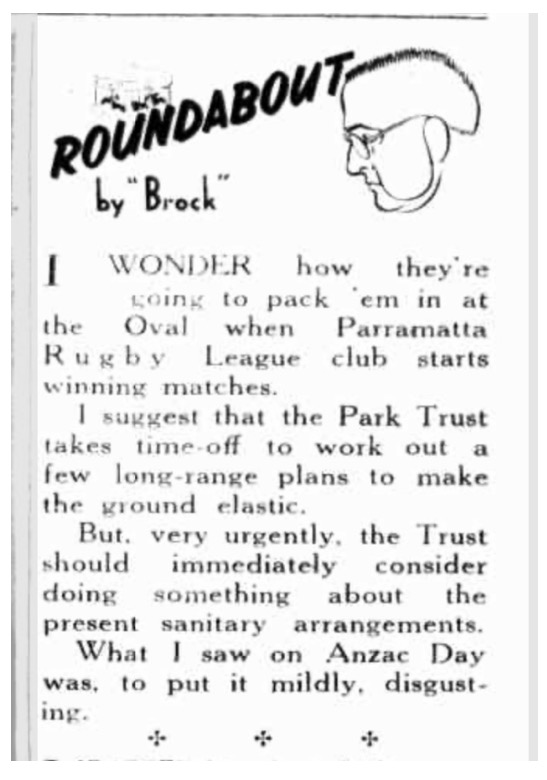
Roundabout by Brock – Cumberland Oval Critique – Cumberland Argus and Fruit Growers Advocate – 30 April 1947 – Link to full article in reference section
The National Archives continue to reveal compelling accounts of life beyond the football field, while also providing a clearer picture of Parramatta and Greater Western Sydney at the time. One discovery—a satirical commentary published on 30 April 1947—took aim at Cumberland Oval’s amenities, highlighting the lack of creature comforts faced by our foundation-year players and fans. It also suggested that the ground might struggle to accommodate the crowds once Parra started winning. According to Sixties, the plumbing and facilities improved very little over the following decades, appearing to remain largely unchanged until what my father called “the great fire of 81”. Whether or not any interim improvements were made between 1947 and 1960, however, remains uncertain. Childhood camping holidays with long-drop toilets and cold showers gave me some sense of the smells and discomfort Sixties describes. Though I am not quite old enough to say I experienced Cumberland Oval first-hand, these accounts alone make me appreciate Commbank’s modern comforts all the more.
Righto let’s get cracking then, we have a lot of legends to discuss.
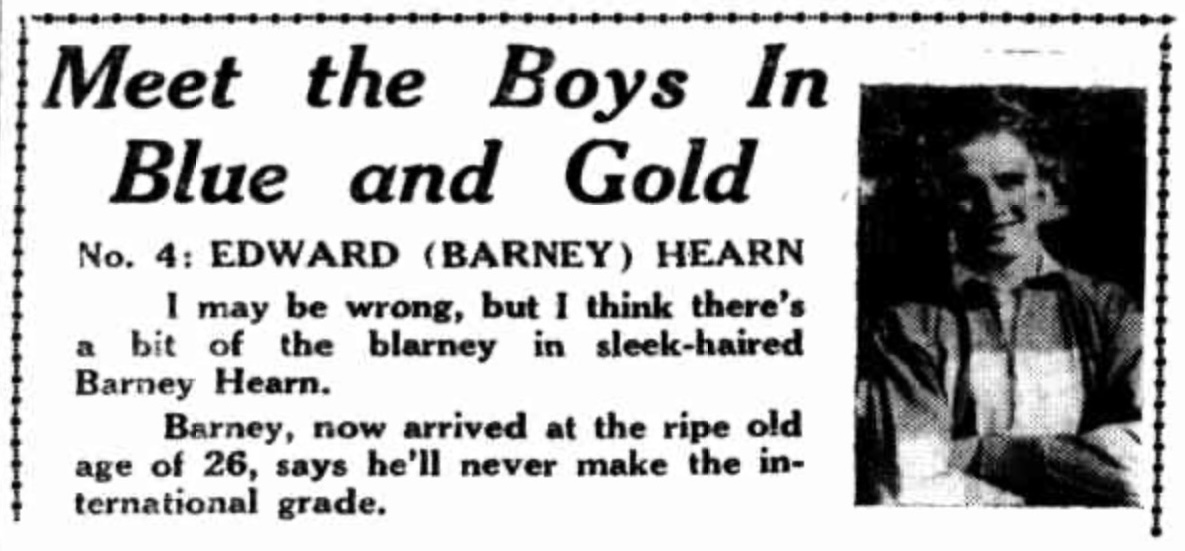
Barney Hearn Player Profile – Cumberland Argus and Fruit Growers Advocate, 4 June 1947 – Source: National Library of Australia – Link to full article in References List
EEL #5 – EDWARD BERNARD ‘BARNEY’ HEARN
Rugby Union Convert | Country NSW Coach | Family Man
Edward Bernard “Barney” Hearn was born on 14 July 1920 in Auburn, NSW, and grew up in Toongabbie NSW. His early life and football journey was documented in The Cumberland Argus and Fruit Growers Advocate on 4 June 1947, as part of the newspaper’s Meet the Boys in Blue and Gold series.
At the time, the 26-year-old was still living in the family homestead at Toongabbie, a district where poultry farms and market gardens remained familiar features of the local landscape. The article confirms Barney began playing rugby league at 15 with Toongabbie Juniors before switching codes to rugby union, where he spent four seasons playing first grade for Parramatta. When the district entered the New South Wales Rugby Football League premiership in 1947, he returned to rugby league as one of the club’s inaugural first-grade players.
On 12 April 1947, Barney took the field in the second row for Parramatta’s historic opening match against Newtown at Cumberland Oval. On this day The Rugby League News offered a rather amusing glimpse into the physical demands of football, joking that Barney was becoming something of an authority on sewing. He had already accumulated five stitches in an ear, three in an eyebrow and another three in his chin—a total of eleven stitches before Parramatta’s inaugural premiership season had even officially begun. Barney survived round 1 without the need to draw upon his needle and thread and retained his position for the following two rounds, before moving to lock in Round 4. From Round 5 onwards, he transitioned into the centres, where he spent the remainder of his foundation season. His versatility was evident in both the forward pack and backline, a reflection of the different positional demands and opportunities within the developing team. Barney made 15 first-grade appearances during Parramatta’s inaugural season, scoring his only premiership try on 3 May 1947 against North Sydney at Cumberland Oval. After the 1947 season he made one further first-grade appearance for Parramatta in 1950, bringing his recorded premiership career to 16 games across the club’s first four seasons.
Barney’s 4 June 1947 newspaper profile offers an entertaining glimpse into his personality. The columnist described him as a promising inside centre whose performances were attracting attention from football critics. Barney, however, was considerably more modest about his prospects, expressing the view that he would never reach international representative standard. The journalist wasn’t entirely convinced, suggesting Barney might have been underestimating his own ability.
Away from football, Barney’s personal life was also a source of amusement for the columnist. When questioned about marriage, the reportedly carefree bachelor declared, “No time to worry about dames.” Though as it turned out, Barney’s bachelor days were numbered; as NSW BDM records identify his marriage to Alice May Macclure later that year. Together, Barney and Alice went on to have eight children; one of whom (Alison) has reached out to TCT in support of this project, for which we are very grateful.
Barney’s involvement in rugby league continued well beyond his time at Parramatta. On 9 January 1951, The Forbes Advocate announced his appointment as playing coach of Forbes Rugby League for the upcoming season. Selected from 20 applicants, Barney came highly recommended by Parramatta officials, with the article highlighting his extensive rugby union and league experience, versatility and character. The appointment also revealed his continued involvement in junior development, having served as honorary coach of the Toongabbie club, which had won the Parramatta Junior League competition in the preceding two seasons. The Forbes appointment offered Barney £25 per week and free board for himself and the family. Arriving in Forbes on 6 March 1951, Barney received an enthusiastic welcome from the local rugby league community at Spooner Oval. His first appearance as captain-coach proved equally impressive. On 1 April 1951, Barney scored two tries and helped guide Forbes to a 13–0 victory over Grenfell, the reigning holders of the Maher Cup.
Barney’s contribution to country rugby league continued over the following three seasons. In July 1952, Barney was selected to represent Group XI against Broken Hill, with reports describing him as the district’s outstanding lock forward. A May 1953 article also reflected on his positional versatility, noting that after initially struggling at five-eighth, Barney had returned to lock the previous season and rediscovered his best form. Although he reportedly announced his retirement from playing in March 1954, he was still willing to lend a hand when needed. Having briefly returned to the field due to player shortages, he was again mentioned in August 1954 when Forbes reserves overcame Parkes 13–7 in a semi-final. His years in Forbes provide an interesting continuation of his Parramatta story.
Edward Bernard “Barney” Hearn died on 4 January 1998, aged 77, in Forbes, NSW. From his early football days at Toongabbie, four seasons in rugby union, his fundamental role in Parramatta’s foundation season, and his country NSW coaching prowess, his sporting journey reflected the strong local connections to community and family upon which the Parramatta club was founded.
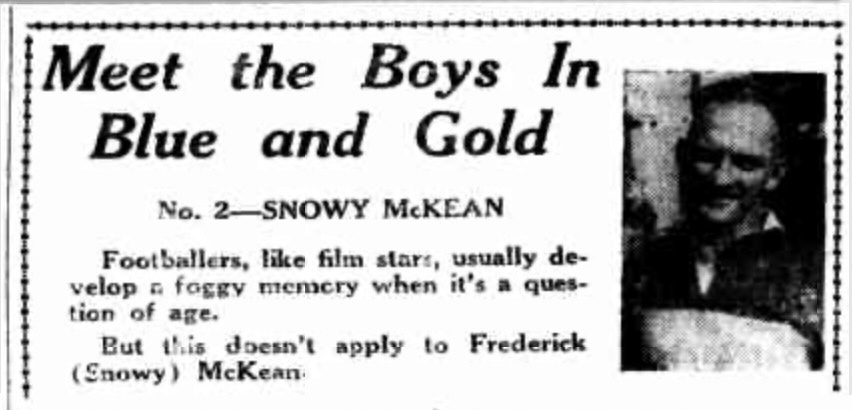
Snowy McKean Player Profile – Cumberland Argus and Fruit Growers Advocate, 21 May 1947 – Source: National Library of Australia – Link to full article in Reference List
EEL #6 – FREDERICK AUGUST DANIEL ‘SNOWY’ McKEAN
World War II Veteran | Industrial Process Worker | Junior Rugby League Coach
Frederick August Daniel “Snowy” McKean was born on 27 January 1913 in Balmain, NSW. His early life and playing career were documented in The Cumberland Argus and Fruit Growers Advocate on 21 May 1947, as part of its Meet the Boys in Blue and Gold series.
In the interview, Snowy traced his competitive rugby league career to Warren in Western NSW, where he began playing at around 20. As the local team’s captain and second-rower, he helped Warren win the Johnny Walker Cup, a competition the journalist described as particularly prestigious among country footballers. He then moved to Cunnamulla, Queensland, where he continued playing inter-town fixtures and exhibition matches. He recalled a memorable trip in 1936, when his team travelled about 600 miles to play at the Brisbane Cricket Ground during an England–Australia cricket Test. In 1939, he returned to Sydney and joined Western Suburbs (Wests #360), making 51 first-grade premiership appearances over six seasons through to 1944, mainly in the second row.
Snowy’s wartime service occurred alongside his established rugby league career with Western Suburbs, and employment as a process worker residing in Merrylands. According to the Department of Veterans’ Affairs World War II Nominal Roll, Frederick August Daniel McKean (service number N372084) enlisted in the Australian Army at Merrylands on 18 February 1942, aged 29, serving with the Volunteer Defence Corps (VDC). By the time he was discharged on 29 March 1944, he had attained the rank of Lieutenant, with his final recorded posting being to the 19th Battalion, Volunteer Defence Corps.
Established in 1940 and modelled on Britain’s Home Guard, the Volunteer Defence Corps (VDC), with which the 19th Battalion served, played an important role in Australia’s domestic defence during World War II. It expanded considerably following Japan’s entry into the war and the increased invasion threat in 1942. Duties included local defence training, protecting strategic infrastructure, observation and preparations against possible enemy attacks. The Corps enabled Australians in reserved occupations or otherwise unavailable for conventional military service to contribute to national defence. Although no dedicated memorial to the 19th Battalion has been identified, the wider Corps is commemorated with a memorial in Nelligen, NSW. The Australian War Memorial preserves a 1945 photograph of Snowy’s battalion assembled for inspection at St Ives—a rare visual record of his unit.
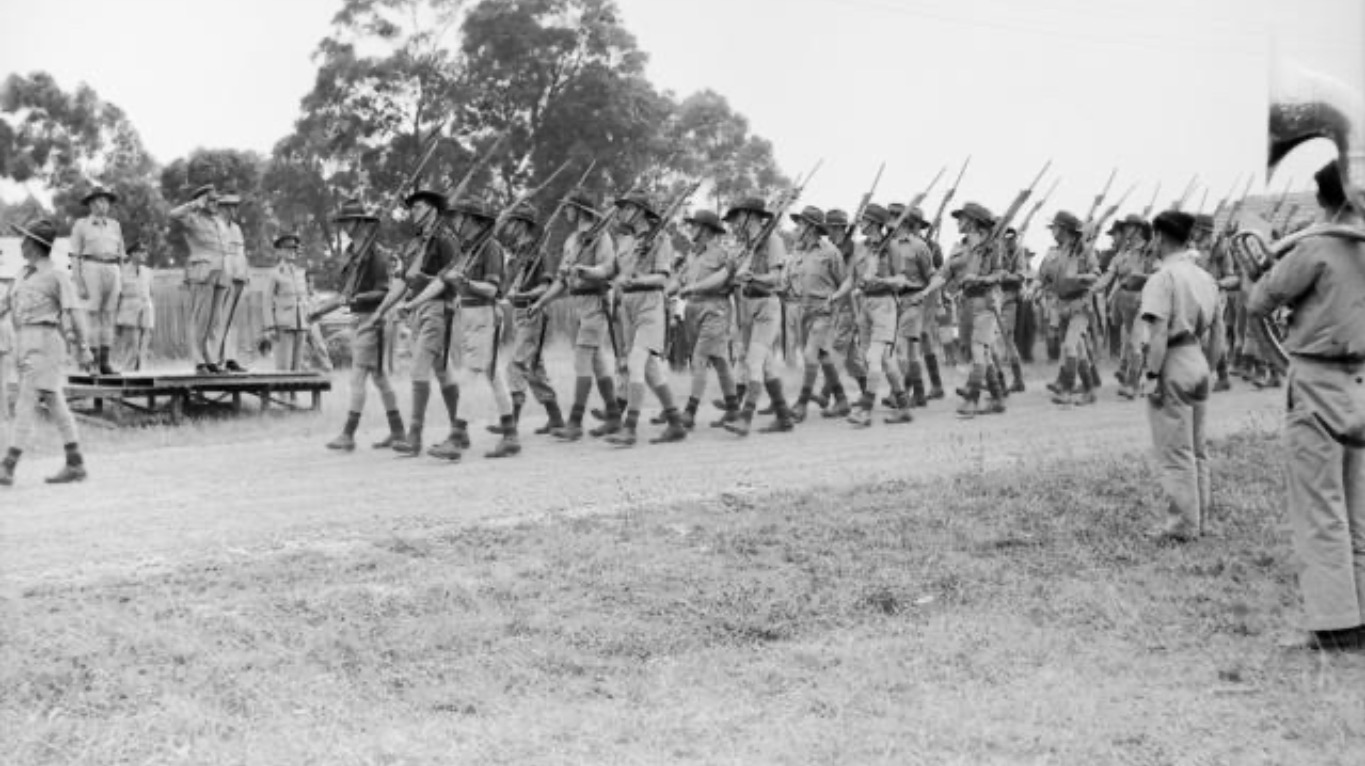
Original 1945 photograph of the 19th Battalion VDC assembled for inspection at St Ives, Sydney. Source: Australian War Memorial – n.d. – Link to full article in Reference List
Following his military discharge, Snowy continued his involvement in rugby league, taking on a player-coaching role with the Granville Shamrocks in 1945. The Broadcaster and Cumberland Argus newspapers celebrated this appointment, describing Snowy as an outstanding former Western Suburbs first-grader whose experience and leadership would be a considerable asset to the local club. His commitment to developing younger footballers was also evident in his 1947 interview, when Snowy expressed particular pride in seeing players he had previously coached, including Neville Brennan (Eel #14) progress into Parramatta’s grades.
By the time he arrived at Parramatta, Snowy was among the foundation side’s most experienced players. On 12 April 1947, aged 34, Snowy lined up in the Front Row for Parramatta’s historic opening match against Newtown at Cumberland Oval. He scored one of Parramatta’s two tries, becoming one of the club’s earliest first-grade try-scorers. Match reports portrayed his performance as that of a determined, powerful forward with a dangerous attacking run. Snowy made 18 first-grade appearances and scored three tries in 1947; followed by three more appearances in 1948 which brought his Parramatta premiership tally to 21 games and nine points.
On 8 October 1947, The Cumberland Argus reported that Snowy had been presented with a special award including a fountain pen at Parramatta’s inaugural end of season club ball held at The Rivoli on Church Street. The newspaper amusingly noted that within five minutes of receiving the pen, Snowy was already putting it to good use signing autographs, which provides a lovely little glimpse into the community enthusiasm surrounding Parramatta’s earliest players, even before the club had experienced much success on the field.
The Rivoli (“The Riv”) was a once iconic multi-purpose entertainment centre in the heart of Parramatta. First opened in 1911 as an open-air cinema, it became a roller-skating rink in 1930 and a dance palace in 1932. It was then used as an Army kit store during WWII, before reopening as a ballroom in December 1946, hosting dances, sport, markets, and community events until its demolition in 1973. More than an entertainment venue, in 1947, the Riv reflected Parramatta’s changing social and cultural life as servicemen, families and residents rebuilt their community after the war.
Away from rugby league, family-history records indicate that Snowy married Enid Jean Athorn in Queensland in 1935. By the time of his 21 May 1947 player profile, the couple were living in Balmain with their three children: Fred, aged 10, Janice, nine, and Roy, seven. The interview portrayed a devoted family man who spoke enthusiastically about his children and took particular pride in his sons’ sporting interests. Fred was already making his mark as a winger for the Marist Brothers school team at Granville, while young Roy was showing a keen enthusiasm for rugby league. That same interview captured Snowy’s cheerful approach to being the veteran of the Parramatta side. Asked about his age, Snowy readily acknowledged that he had seen 34 summers, showing none of the reluctance the journalist jokingly attributed to ageing footballers. He seemed as comfortable talking about his family and footballing experiences as he was tackling opponents on the field.
Following his final recorded first-grade appearance in 1948, the available records provide relatively little information about Snowy’s later working life or continued involvement in rugby league. Family-history records indicate that he eventually settled in Kuranda, Queensland, where he passed away on 8 November 1984, aged 71.
Although much of Snowy’s later life remains unknown at present, his contribution to Parramatta’s foundation years is well documented. From country football in Warren and Cunnamulla to first-grade rugby league with Western Suburbs, wartime service with the Volunteer Defence Corps, and coaching young players at Granville. Snowy arrived at Parramatta with a wealth of experience and left an immeasurable mark on the club’s foundation season.
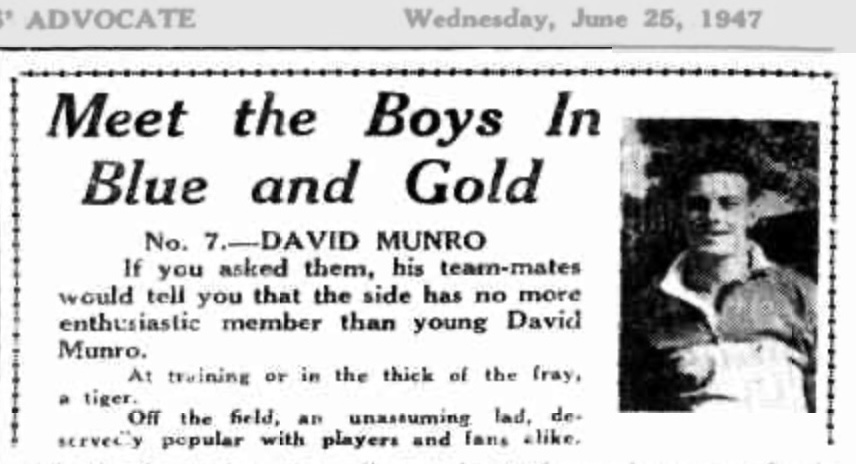
David Munro Player Profile – Cumberland Argus and Fruit Growers Advocate, 25 June 1947 – Source: National Library of Australia – Link to full article in Reference List
EEL #7 – DAVID FERGUSON ‘DARBY’ MUNRO
World War II Veteran | Wagon Works Hard Collar King | Campbelltown Local Legend
Historical Research Note: Existing rugby league records have helped preserve the story of Parramatta’s seventh heritage player, although discrepancies exist concerning his full name, date of birth, hometown and military service. A number of publications identify Eel #7 as Daniel Fergus “Darby” Munro, born in Barellan in 1922 who played for St George in 1946. However, the National Archives do not support this record. To investigate these differences, contemporary newspaper accounts have been cross-referenced with Department of Veterans’ Affairs records, family-history research and the NSW Registry of Births, Deaths and Marriages. Taken together, these sources strongly support the identification of Eel #7 as David Ferguson “Darby” Munro. The following profile draws on these findings, while acknowledging the significant earlier research into Darby’s time at the Eels.
David Ferguson “Darby” Munro was born on 26 May 1925 in Campbelltown, NSW. His early life and football career were well documented across The Cumberland Argus and The Campbelltown News. These records, together with his military service and family-history documents, provide valuable insight into his life before and after his time at Parramatta.
Darby’s 25 June 1947, Meet the Boys in Blue and Gold player profile, confirms he attended Parramatta Intermediate High School, where he was still revered for his footballing ability as a valued member of the school team. His early sporting development was undoubtedly influenced by his family’s connection to rugby league, particularly his father, Tom, who had been a prominent player in the Campbelltown district during his younger years.
According to the Department of Veterans’ Affairs World War II Nominal Roll, David Ferguson Munro (service number NX173383/N462569) enlisted in the Australian Army at Bathurst on 4 August 1943, aged just 18. His locality on enlistment was Campbelltown. His next of kin was recorded as his father Thomas Munro, who under legislation at that time would have also needed to provide written consent for Darby to enlist as he was under 21. He served for more than three years before being discharged on 18 November 1946 with the rank of Private. His final recorded posting was to the 2/4th Australian Infantry Battalion. A March 1947 article in The Campbelltown News also referred to Munro’s wartime service throughout the islands between New Guinea and Borneo, providing a contemporary account of his reported overseas experiences.
The 2/4th Australian Infantry Battalion was formed at Ingleburn NSW in November 1939, as part of the Australian 6th Division. The battalion had an extensive wartime history, including campaigns in North Africa, Greece and Crete before returning to Australia in 1942. Following defensive duties in Darwin and training in northern Queensland, it deployed to New Guinea in November 1944, participating in the Aitape–Wewak campaign against Japanese forces in 1945. The battalion’s service is commemorated at the Australian War Memorial in Canberra, the Heidelberg Repatriation Hospital in Melbourne and, the Ingleburn Memorial Wall, which honours the 2/4th as part of the 6th Australian Division.
By 1946, Darby had established himself as a talented winger in the Campbelltown district. In his 25 June 1947 Player profile, he recalled his performance in the previous year’s Group Six semi-final between Campbelltown and Moss Vale where Darby scored three tries in a display that drew considerable praise from football observers. The performance occurred several months before his formal Army discharge in November 1946, although the available records do not establish his leave or service arrangements at the time. His performances helped establish his reputation as one of the district’s promising young players; and by March 1947, The Campbelltown News was reporting that he had been selected to join Parramatta’s inaugural first-grade side.
On 12 April 1947, aged 21, Darby lined up on the wing for Parramatta’s historic first premiership match against Newtown at Cumberland Oval. Despite the challenges faced by the newly established club, Darby made an immediate impression. His 25 June 1947 player profile described him as one of the most enthusiastic members of the team, equally committed to training and the physical demands of match day. The journalist characterised him as a quiet and unassuming young man who was popular with teammates and supporters alike. At the time of the interview, Darby had already scored six first-grade tries for Parramatta, an impressive contribution to a side still struggling to find consistency in its inaugural season. He made 12 first-grade appearances in 1947, scoring six tries for 18 points.
Although Darby did not continue with Parramatta beyond its inaugural season, his football career continued. By 1950, he was again representing Campbelltown in the Group Six competition, where his attacking and try-scoring ability remained a feature of his game until his retirement at the end of the 1952 season.
Away from football, Darby’s player profile offers a warm glimpse into his personal life. Brock, the columnist, revealed that he had attracted the attention of Miss Betty Allan of Concord and jokingly suggested that wedding bells might not be far away. As it turned out, Brock was onto something: NSW marriage records confirm that David Ferguson Munro married Eileen Betty Allan that same year, with the marriage registered in the Concord district. It is a lovely link between the light-hearted observations of his foundation-season interview and the family history preserved in official records.
The profile also noted the high regard in which Darby was held by his mates at the Clyde Wagon Works near Granville where he worked as a Hard Collar maker. Operated by the NSW Government Railways and established around 1912, the workshops repaired and maintained railway goods wagons carrying livestock, agricultural produce, coal and other freight across New South Wales. Nearby stood the privately owned Clyde Engineering works, originally established by Hudson Brothers in 1883 before being reconstituted as Clyde Engineering Company Limited in 1898. The company manufactured railway carriages, wagons, trams, locomotives and agricultural equipment. By 1947, both facilities were established features of Western Sydney’s industrial landscape, providing local employment and supporting the state’s extensive railway network.
Darby’s connection with his wartime comrades also appears to have endured well beyond his service. The June 1970 edition of White over Green, the journal of the 2/4th Infantry Battalion Association, recorded David “Darby” Munro of Campbelltown attending a reunion and joining the Association.
David Ferguson “Darby” Munro died on 7 November 1983, aged 58, in Campbelltown, NSW. His journey took him from local football in Campbelltown to wartime service with the Australian Army and an integral place in Parramatta’s foundation side. He also made a lasting contribution to group-level rugby league. His story highlights the close ties between military service, community life and rugby league in post-war Australia.
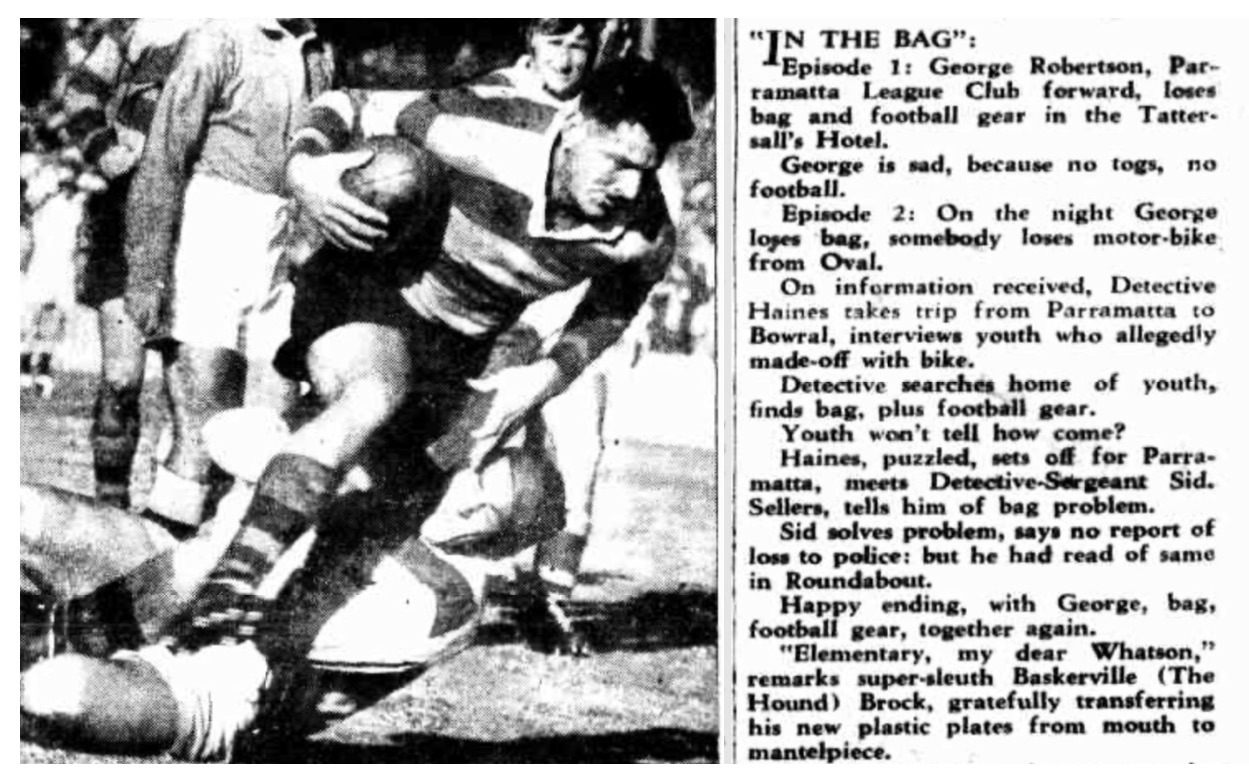
Our George Robertson being tackled by St George’s Bob Bower (1951): The Sun Sydney 21 April 1951; + Part 3 of the Togs saga Cumberland Argus and Fruit Growers Advocate 14 May 1947 – Source: National Library of Australia – Link to full Articles in Reference List
EEL #8 – GEORGE ALLAN ROBERTSON
World War II Veteran | Country Rugby League Coach | Local Councillor
George Allan Robertson was born on 28 February 1916 in Inverell, NSW. Little is known about his childhood and early football career, but his World War II service records and surviving newspaper accounts help trace his life before, during and after his time at Parramatta. Although he does not appear to have featured in the 1947 Meet the Boys in Blue and Gold series, contemporary match reports and opinion pieces offer glimpses of his playing style and vibrant personality.
According to the Department of Veterans’ Affairs World War II Nominal Roll, George Allen Robertson (service number 21039) enlisted in the Royal Australian Air Force on 15 April 1940, aged 24. Although his locality on enlistment was recorded as Inverell, his place of enlistment was Newcastle. Robertson served in the RAAF for more than five years before being discharged on 27 November 1945 with the rank of Leading Aircraftman. His final recorded posting was to No. 1 Central Reserve, a unit with a particularly interesting wartime history.
The history of No. 1 Central Reserve dates back to October 1941, when land at Marrangaroo, near Lithgow, was acquired for military purposes. Established on 1 April 1942, the unit was responsible for storing and distributing RAAF munitions, including chemical weapons containing mustard gas and phosgene. To conceal these operations from potential Japanese aerial reconnaissance, the Marrangaroo facility was disguised as a fictional township known as Hokesville, complete with shops, a hotel, garage and livestock. By 1945, thousands of tonnes of munitions were passing through the facility each month.
Following Japan’s surrender in September 1945, Hokesville’s existence was revealed, with photographer Victor Johnston documenting its elaborate disguise. Although the fictional township eventually disappeared, No. 1 Central Reserve continued operating, supplying munitions during the Korean War and supporting the processing of National Servicemen from 1951. In 1956, the unit’s headquarters relocated to Kingswood, before the remaining RAAF detachment at Marrangaroo closed in 1958. The wider site remained in military use, with environmental remediation between 2008 and 2010 uncovering buried wartime ordnance, including hundreds of empty chemical-weapon casings. While Hokesville’s remarkable history survives through photographs and military records, Robertson’s precise duties at No. 1 Central Reserve, and whether he personally worked at Marrangaroo, remain unknown.
On 12 April 1947, aged 31, Robertson took his place in the Front Row for Parramatta’s historic first premiership match against Newtown at Cumberland Oval. He made five first-grade appearances in Parramatta’s inaugural season before establishing himself as a regular member of the forward pack over the following four years. Match reports describe Robertson as a powerful, hard-working front-rower whose strong charges and clever dummy passes could break defences and create tries. In total, Robertson represented Parramatta in 68 first-grade premiership matches between 1947 and 1951, scoring four tries for 12 points.
One particularly entertaining glimpse into Robertson’s life during his playing days appeared across three instalments of Brock’s Roundabout column in The Cumberland Argus and Fruit Growers Advocate, between 30 April, and 14 May 1947. The short story goes like this: Following Parramatta’s Anzac Day match against St George, our George had apparently been enjoying a well-earned refreshment at Tattersall’s Hotel Parramatta, when his bag containing his football togs mysteriously disappeared. The column first appealed for the Togs safe return, joking that Robertson might otherwise have to take the field against North Sydney in an outfit that would challenge the censors. A follow up column reported that fortunately, George recovered his belongings in time for the match, although the circumstances of their return proved even more entertaining. As Brock subsequently revealed in his third instalment, what began as a humorous appeal for the return of George’s missing football togs; eventually became an unlikely detective story involving a stolen motorcycle, a trip to Bowral and some rather resourceful police work. Luckily for George, Detective-Sergeant Sid Sellers, had read about the missing togs in Brock’s earlier column, and naturally recognised their significance despite George never having formally reported the loss to police. And just like that, George and his football togs were reunited, bringing an unexpectedly entertaining chapter of Parramatta’s foundation year to a positive end.
Robertson’s contribution to rugby league did not end with his final first-grade appearance in 1951. Historical records compiled in Neil Pollock’s The Maher Cup: A Social History identify Robertson as coach of Gulgong Terriers in 1952 before he moved to the Young Cherrypickers in 1953, where he continued his involvement in country rugby league. He subsequently represented the Riverina against the touring American All Stars in July 1953, scoring a try in a 30–14 victory, before facing Great Britain in May 1954. His involvement with the Young Cherrypickers extended well beyond his initial move to the district. Maher Cup records identify him as the club’s coach in 1957 and again in 1963, while team records also identify him as captain during the 1962 season.
A newspaper article published ahead of Parramatta’s 1977 grand final offered a glimpse into Robertson’s later life. Headlined Big George Is Off on a Sentimental Journey, it described his excitement at watching Parramatta face St George at the Sydney Cricket Ground, thirty years after playing in the club’s foundation side. It also reported that he had completed eight years as a local councillor and was seeking re-election, though the full extent of his council career remains unconfirmed. Interestingly, I discovered this newspaper clipping through a public social media post shared to a fan group several years ago by one of George’s relatives. The family member was seeking information about whether Parramatta had preserved or displayed any history recognising its early players, as they were planning to take George’s granddaughter and great-grandson to their first Eels game. The family member hoped to share some of their family’s football heritage and inspire their next generation’s love of the game. Although the clipping is attributed to journalist Bill Mordey (Daily Mirror) and was published 16 September 1977; I haven’t yet established an online source for its original publication. I’ve since reached out to the family member who posted, in the hope of learning more about George and his life beyond football; and I also sent them an advanced copy of George’s section of this post. Whether I hear back from them or not, I hope they enjoy this story.
Although details of George’s family and personal life remain unconfirmed, surviving records trace decades of service to sport and community. From his beginnings in Inverell, he went on to serve more than five years in the RAAF during World War II, represent Parramatta in its foundation years, coach country rugby league and serve as a local councillor. His story reflects a generation of players whose contributions extended well beyond the football field.
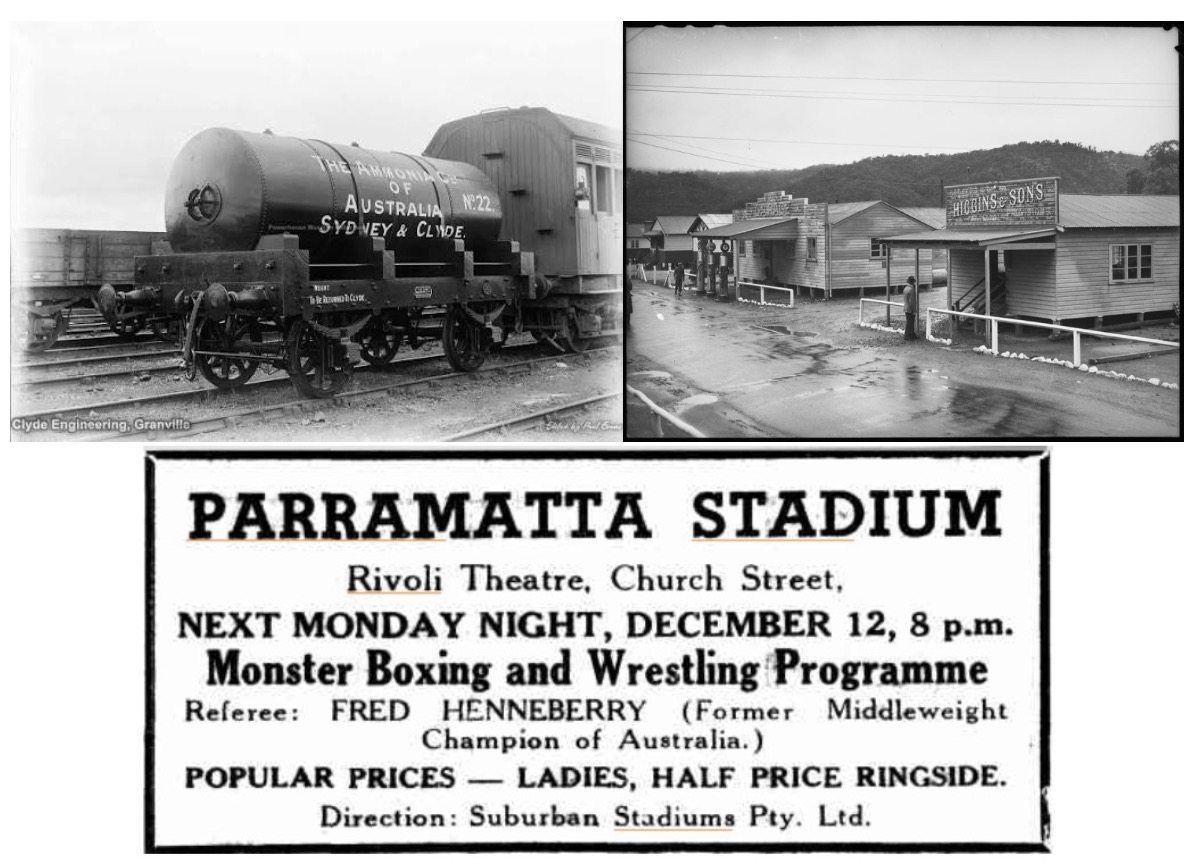
Clyde Wagon Works circa 1940’s, National Library of Australia; Hokesville 1945, Powerhouse Museum Collection; Rivoli Theatre Advertisement Circa December 1949 – City of Parramatta Research & Collections. Link to sources in Reference List
THE GOLDEN POINT – Manners Maketh the Man
Four more heritage numbers, four very different lives, and another fascinating glimpse into the twenty-one players who helped establish our club in its foundation year.
The more I learn about the 47 Twenty-One, the more I realise that honouring our foundation players means remembering not just what they contributed to the club, but who they were beyond it. What I’ve particularly enjoyed so far is stumbling across the smaller details tucked away in the archives, which, for the most part, have been found by accident while researching other elements of their lives: the amusing anecdotes, personal milestones and everyday experiences that rarely make it into football history. From family life and workplace friendships to wartime experiences and the occasional off-field misadventure, these discoveries offer a glimpse into the personalities and lives behind the jerseys, and that’s what I hope this series continues to achieve.
As my research continues, I’m increasingly conscious of ensuring that every player’s story receives the respect and dedication they and their families deserve. While the archives and historical records are plentiful, there is still so much left to uncover, my focus is on accuracy over completeness. As I said in part one: My responsibility is not to assume or invent the missing chapters, but to preserve what the evidence allows us to establish and give these stories the recognition they deserve, as authentically as possible. A detailed reference list has once again been provided, with links where possible, so readers can be confident in the accuracy and authenticity of what is presented.
If you have a connection to or memory of one of the 47 Twenty-One and you are comfortable sharing your knowledge with TCT, please reach out to us. Even the smallest recollection could help build and preserve this important part of our club’s history for future generations. If these first eight stories are anything to go by, there is plenty more worth uncovering.
I hope these stories bring you as much enjoyment as researching and writing them brings me.
The 47 Twenty-One, Part Three will be out next week.
Thanks for supporting TCT.
Roly-Poly

THE 47 TWENTY-ONE, PART TWO: COMPLETE REFERENCE LIST
Introduction and foundation-season context
1. Roly-Poly (2026, 11 November). “The 47 Twenty-One, Part 1.” The Cumberland Throw. Source
2. The Cumberland Argus and Fruit Growers Advocate (1947, 30 April). “Roundabout” [Brock’s commentary on Cumberland Oval amenities]. National Library of Australia, Trove, article 105734237. Source
3. Parramatta Eels (2022, 14 April). “Eels’ 75 Years: Top Five – #5.” [Background on the club’s early years]. Source
4. Rugby League Project (n.d.). “Parramatta Eels, NSWRFL 1947 season.” [Match and player statistics]. Source
Eel #5 — Edward Bernard “Barney” Hearn
1. The Cumberland Argus and Fruit Growers Advocate (1947, 4 June). “Meet the Boys in Blue and Gold: Edward (Barney) Hearn.” Trove, article 105744097. Source
2. New South Wales Rugby Football League (1947, 12 April). The Rugby League News, vol. 28, no. 1 [stitches anecdote]. National Library of Australia, item nla.obj-627000812. Source
3. Rugby League Project (n.d.). “Edward Hearn: Playing career.” [Parramatta statistics and positional history]. Source
4. NSW Registry of Births, Deaths and Marriages (1947). Marriage registration 22023/1947: Edward Bernard Hearn and Alice May Macclure. [Registry search results; record-specific search URL is session-dependent]. Source
5. MyHeritage (n.d.). “Edward Bernard Barney Hearn,” BillionGraves index / associated family-history records. [Birth and death details; secondary genealogical Source]. Source
6. The Forbes Advocate (1951, 9 January). “Forbes Appoints Football Coach: ‘Barney’ Hearne Selected.” Trove, article 219098967. [Historical spelling Hearne]. Source
7. The Forbes Advocate (1951, 6 March). “R.L. Coach Arrives To-day.” Trove, article 219098913. Source
8. The Forbes Advocate (1951, 9 March). “Coach Welcomed: Forbes Rugby League.” Trove, article 219102018. Source
9. The Forbes Advocate (1951, 3 April). “Forbes Coach Scores Two Tries.” Trove, article 219097856. Source
10. The Forbes Advocate (1952, 18 July). “Four Forbes Men in Group XI Team.” Trove, article 219113441. Source
11. The Forbes Advocate (1953, 29 May). “Rugby League Notes.” Trove, article 220724194. Source
12. The Forbes Advocate (1954, 30 March). “League Trials at Canowindra.” Trove, article 220720949. Source
13. The Forbes Advocate (1954, 24 August). “Reserves on Top.” Trove, article 220734724. Source
14. The Forbes Advocate (1952, 6 June). [Contemporary reporting on Hearn’s continued involvement with Forbes]. Trove, article 219106755; article headline to confirm. Source
Eel #6 — Frederick August Daniel “Snowy” McKean
1. The Cumberland Argus and Fruit Growers Advocate (1947, 21 May). “Meet the Boys in Blue and Gold: Snowy McKean.” Trove, article 105731269. Source
2. Department of Veterans’ Affairs (n.d.). Second World War Nominal Roll: Frederick August Daniel McKean, service N372084. Source
3. Wests Archives (n.d.). “Frederick August Daniel ‘Fred’ ‘Snowy’ McKean”, Heritage Player No. 360. [Playing career, employment and residence; note incorrect secondary death date]. Source
4. Rugby League Project (n.d.). “Fred McKean: Playing career.” Source
5. The Broadcaster [Fairfield] (1945, 21 February). “Fred McKean to Coach Granville Shamrocks.” Trove, article 143947450. Source
6. The Cumberland Argus and Fruit Growers Advocate (1947; exact issue date to confirm). “For P’matta, Victory Again So Near, Yet So Far.” [North Sydney match report]. Trove, article 105739969. Source
7. The Cumberland Argus and Fruit Growers Advocate (1947, 8 October). “Five Received Awards for Merit.” Trove, article 105740515. Source
8. Australian War Memorial (n.d.). “Australia’s Home Guard / Volunteer Defence Corps.” [Historical overview]. Source
9. Australian War Memorial (1945). “St Ives, NSW: Members of the 19th Battalion Volunteer Defence Corps awaiting inspection.” Photograph, AWM 125458 / collection C225813. Source
10. Monument Australia (n.d.). “Australian Volunteer Defence Force” [Volunteer Defence Corps commemorative plaque, Nelligen, NSW]. Source
11. Arfanis, P. (2014, 16 January). “The Rivoli: Parramatta’s Bygone Entertainment Venue.” City of Parramatta, Parramatta Heritage Centre. Source
12. Queensland Registry of Births, Deaths and Marriages (1984). Death registration 1984/58027, Frederick August Daniel McKean (8 November 1984). Historical records index. Source
Eel #7 — David Ferguson “Darby” Munro
1. The Cumberland Argus and Fruit Growers Advocate (1947, 25 June). “Meet the Boys in Blue and Gold: David Munro.” Trove, article 105743240. Source
2. The Cumberland Argus and Fruit Growers Advocate (1947, 14 May). “Long Range Forecast Came True.” Trove, article 105733727. Source
3. The Campbelltown News (1947, 21 March). “Kolum 9” [Campbelltown’s David (Darby) Munro distinguished from the Randwick namesake]. Trove, article 261996131. Source
4. The Campbelltown News (1947, 11 April). “Football.” Trove, article 261996252. Source
5. Department of Veterans’ Affairs (n.d.). Second World War Nominal Roll: David Ferguson Munro, NX173383 / N462569. Source
6. Australian War Memorial (n.d.). “2/4th Australian Infantry Battalion.” [Unit history and campaigns]. Source
7. NSW War Memorials Register (n.d.). “Bardia Barracks Memorial Wall”, Ingleburn. [Commemoration of the 6th Australian Division]. Source
8. Australian War Memorial (n.d.). “2/4th Infantry Battalion memorial plaque,” collection PL00092. Source
9. Monument Australia (n.d.). “2nd/4th Infantry Battalion,” Heidelberg memorial. Source
10. The Campbelltown News (1950, 22 August). “Football.” [Four-try performance against Wingecarribee]. Trove, article 262288048. Source
11. The Campbelltown News (1951, 15 May). “Football.” [Group Six result]. Trove, article 262296425. Source
12. The Campbelltown News (1951, 19 June). “Football.” [Match against Bowral]. Trove, article 262296975. Source
13. NSW Registry of Births, Deaths and Marriages (1947). Marriage registration 28947/1947: David Ferguson Munro and Eileen Betty Allan, Concord district. Source
14. MyHeritage (n.d.). “David Ferguson Munro.” [Member-contributed family tree; use with caution for death and burial information]. Source
15. 2/4th Infantry Battalion Association (1970, June). White over Green, vol. 25, no. 6, p. 6. [David “Darby” Munro attending reunion]. Source
16. Powerhouse Collection (n.d.). “Builder’s plate by Eveleigh Workshops” [Institutional historical note on establishment of Clyde Wagon Works, c. 1912], object 213032. Source
17. State Library of NSW (n.d.). “Hudson Brothers Building and Engineering Company.” [History of the private Clyde Engineering predecessor]. Source
18. Rugby League Project (n.d.). “Dan Munro: Playing career.” [Secondary database with conflicting identity; cite when discussing discrepancy, not as proof of birth details]. Source
Eel #8 — George Allan Robertson
1. Department of Veterans’ Affairs (n.d.). Second World War Nominal Roll: George Allan Robertson, RAAF 21039. Source
2. Rugby League Project (n.d.). “George Robertson: Playing career.” [68 Parramatta first-grade appearances, 1947–51]. Source
3. Barker, G. (2024, Spring). “Hokesville 1945: The Town That Never Was.” book, State Library of New South Wales, pp. 72–75. Source
4. Plunkett, G. (2018). Chemical Munitions: Sea Dumping off Australia, 4th ed. Department of Defence. [Context for Marrangaroo chemical-munitions facilities]. Source
5. Department of Foreign Affairs and Trade (2010–11). Australian Safeguards and Non-Proliferation Office Annual Report, “Performance”. [Recovered chemical-weapon munitions]. Source
6. The Sun [Sydney] (1945, 2 September). “Hokesville’s Hoax Joint” [Illustrated report of the wartime disguise]. Trove, article 229020263. Source
7. The Cumberland Argus and Fruit Growers Advocate (1947, 30 April). “Roundabout,” part 1 [Robertson’s missing football kit]. Trove, article 105734237. Source
8. The Cumberland Argus and Fruit Growers Advocate (1947, 7 May). “Roundabout,” part 2 [kit recovered]. Trove, article 105740140. Source
9. The Cumberland Argus and Fruit Growers Advocate (1947, 14 May). “In the Bag” / “Roundabout,” part 3 [police investigation]. Trove, article 105733675. Source
10. The Daily Telegraph [Sydney] (1949, 8 May). “Parramatta Wins on Late Try” [Robertson’s winning try]. Trove, article 248245251. Source
11. The Cumberland Argus and Fruit Growers Advocate (1949, 11 May). “Parramatta Failed to Reproduce S.C.G. Form.” Trove, article 111531482. Source
12. The Cumberland Argus and Fruit Growers Advocate (1949, 1 June). “Three Parramatta Men in City Second Team.” Trove, article 111532163. Source
13. Pollock, N. (2022). The Maher Cup: A Social History. [George Robertson’s Gulgong/Young career and coaching]. Source
14. Pollock, N. (2017, revised). Maher Cup Players List. [George Robertson entries and coaching years]. Source
15. Mordey, B. (1977, date unconfirmed). “Big George Is Off on a Sentimental Journey.” Unidentified newspaper clipping shared in a public social media post by a relative of George Robertson, approximately 2021. Original newspaper and precise publication date unverified; no original-page link available.
16. Robertson family member (c. 2021). Public social media post asking about Parramatta Eels historical displays ahead of taking Robertson’s granddaughter and great-grandson to their first Eels match. Original public post details not included here for family privacy; author retained a copy.
Historic photographs, illustrations and supplementary image credits
1. Australian War Memorial (1945). Photograph of the 19th Battalion VDC at St Ives (collection C225813). [Snowy McKean section]. Source
2. The Sun [Sydney] (1945, 2 September). “Hokesville’s Hoax Joint” (Trove 229020263). [Robertson/Hokesville image]. Source
3. The Cumberland Argus and Fruit Growers Advocate (1947, 14 May). “In the Bag,” part 3 (Trove 105733675). [Reproduced Robertson clipping]. Source
4. The Cumberland Argus and Fruit Growers Advocate (1949, 7 December). Advertisement for boxing at Parramatta Stadium (Rivoli), reproduced by Arfanis (2014). [Historic Rivoli illustration]. Source
5. The Sun [Sydney] (1947, 26 April). Photograph captioned as George Robertson being tackled by St George’s Bob Bower.
6. Powerhouse Collection (n.d.). Historic Clyde railway wagon-works photograph reproduced in Part 2. Source

I’m thoroughly enjoying these articles. What a brilliantly researched and written insight into the club’s beginnings. Thanks Roly Poly for taking the time to pull it together for us. It’s worthy of a separate book!
Thank you Roly-Poly Eel. As a newer member of the club ( my 3rd year ) it is important for me to increase my knowledge of the history of this beautiful club and the marvellous people who have helped make it what it is today.
Thank You