
Hey Parra fans, welcome to Part 3 of the Beyond the Blame Game series — and thank you for your patience while life briefly called me elsewhere. It’s good to be back. This week, we take the potential issues identified and analysed so far and hypothesise what might actually improve them.

BEYOND THE BLAME GAME SERIES – PART 3: TEST THE SOLUTION, LEARN FROM THE RESULT
In sport, and in life, recognising what went wrong is often easier than confronting why it happened and deciding what needs to change. Whether juggling competing priorities, managing the performance of 30 professional athletes or carrying the expectations of more than 36,000 members, poor performance rarely improves simply because it has been identified. Meaningful improvement requires critical reflection, honest acknowledgement of what could have been done differently and deliberate action.
For the Eels, the evidence is often visible. Missed tackles can be counted, errors replayed and poor decisions isolated frame by frame. Coaches can identify where the defensive line disconnected, supporters can pinpoint the moment momentum shifted, and statistics can show precisely where possession, field position or execution began to deteriorate. But knowing what went wrong does not automatically tell us what will make it right. That contrast sits at the core of Part Three of the Beyond the Blame Game series.
Part One, Ask Why?, used the Five Whys to look beneath visible symptoms and consider what might be causing them, while RASCI clarified who is Accountable, Responsible, Supporting, Consulted and Informed. Part Two, Challenge the System, used Double-Loop Learning to ask whether the assumptions, behaviours, structures or processes around those problems might also be helping them persist.
Both are important steps towards meaningful organisational improvement, but neither guarantees that the next response will work. A football club can identify a recurring weakness and still choose the wrong intervention. It can increase training volume when the real issue is the conditions under which a skill is practised, recruit to solve one roster problem while creating another, or introduce a sensible process change that adds complexity without producing improvement.
That is not necessarily failure if it is followed by critical reflection and intentional remedy. The greater failure would be assuming that a solution worked simply because it was implemented, rather than monitoring what happened next and establishing whether the intended improvement actually occurred, to what extent and with what consequences. Which is why Part Three starts with a different inquiry:
What if we have reasonably identified who owns the problem, why it may be occurring and what within the system may be allowing it to persist—but the solution we propose is still insufficient?
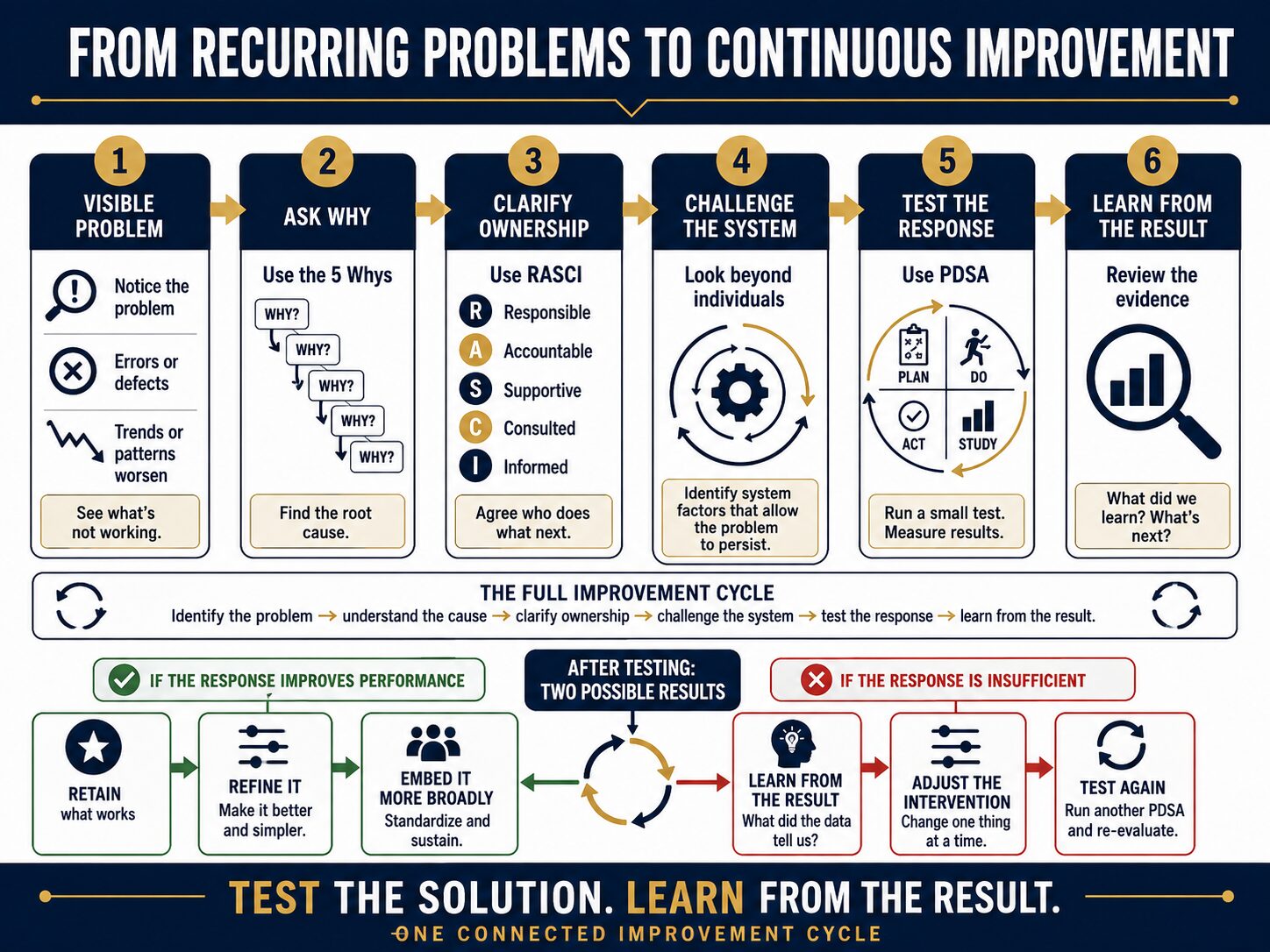
Part 3 Brings it all together –Theory derived from Toyoda, Sheehan, DuPont, E&Y, HBR & Argyris, Shewhart and Deming and drawing on the authors relevant professional experience – graphic created by the author using Canva Premium
The Plan–Do–Study–Act Cycle (PDSA)
PDSA evolved from Walter Shewhart’s mid 20th century scientific theorems and was later developed and popularised by W. Edwards Deming. PDSA provides a practical way to test a proposed change on a manageable scale, examine what actually happens and refine the response before embedding it more broadly. It does not require The Eels to know the perfect solution before acting. It creates a disciplined process for turning a plausible improvement into a testable intervention and using evidence to judge whether it produces the intended result.
In football terms, it is the difference between identifying something on review and simply telling the team to fix it, and deliberately changing one part of the preparation, putting that change under pressure, observing what happens when the same situation arises again and learning from the outcome.
RASCI remains relevant because testing improvement still requires clarity about who owns what happens next. Being Accountable does not mean personally performing every stage of the PDSA cycle; it means ensuring the problem is defined, the intervention remains connected to the intended outcome, evidence is examined and findings lead to a decision. In short, PDSA gives improvement a method; RASCI ensures that method has ownership.
The examples that follow are hypotheses rather than diagnoses. From outside the club, I cannot know whether these weaknesses exist internally or whether any proposed intervention would improve them. Their value is in showing how a plausible explanation could be tested, challenged and, if the evidence demands it, discarded.
PDSA therefore lets this humble fan ask a more useful question: if the hypothesis were correct, how could the organisation test a proposed response rather than assume it would be better?
The following examples apply that approach to the same eight stakeholder groups considered throughout the series. Each begins with a possible hypothesis and then uses PDSA to ask two related questions:
- What could reasonably be tested?
- Who should appropriately contribute to testing it?
As always, I hope you find this insightful and engaging. More importantly, I look forward to hearing your own views and perspectives in the comments, whether they are similar, dissimilar or indifferent.
| PDSA FOR THE BOARD: FROM OVERSIGHT TO EFFECTIVE GOVERNANCE | |
| HYPOTHESIS | If significant strategic or football-related problems become visible only after they have materially affected performance, existing governance mechanisms may not always provide sufficiently early evidence for corrective action. Testing different leading indicators or review mechanisms could determine whether earlier visibility improves the timeliness and quality of governance oversight. |
| RASCI LENS | The Board remains Accountable for ensuring appropriate strategy, oversight and accountability mechanisms are in place. The CEO is Responsible for organisational execution, while relevant football leaders provide Support and are Consulted where their expertise is required. |
| PLAN | The Board could select one strategic football outcome and determine what evidence might reasonably indicate whether it is progressing before the final ladder position provides the answer. Roster sustainability, for example, might be considered through indicators such as positional depth, pathway readiness, succession risk, player availability or future contractual exposure. The CEO and relevant football leaders could help determine which indicators are operationally meaningful, while the Board determines what information and level of challenge it requires to govern effectively. |
| DO | The CEO and relevant football executives could trial the agreed measures through the existing reporting structure for a defined period. The Board would not need to interfere in recruitment, coaching or operational decisions. Its role would be to establish the governance parameters for the test while those closer to the work generate, contextualise, and interpret the information. |
| STUDY | Relevant executives and football leaders could analyse what the additional measures or review mechanisms revealed and provide that evidence to the Board.
|
| ACT | If the intervention improves strategic oversight, the Board could refine and incorporate the most useful elements into broader governance processes. If not, the measures could be modified, discarded or replaced with another test. The objective is to determine whether the governance system provides earlier information, challenge and visibility for meaningful oversight. |
| PDSA FOR THE CEO: FROM INDIVIDUAL FUNCTIONS TO COLLECTIVE ACCOUNTABILITY | |
| HYPOTHESIS | If individual functions perform reasonably well within their respective responsibilities while an outcome dependent upon several of those functions still falls short, accountability may become less clear where responsibilities intersect. Clearer cross-functional accountability around selected outcomes might improve coordination, information flow and earlier problem resolution. |
| RASCI LENS | The CEO is Accountable for organisational performance and the effectiveness of the systems connecting its individual functions. Relevant football and operational leaders become Responsible or provide Support according to the work involved, while the Board retains appropriate governance oversight. |
| PLAN | The CEO could select one clearly defined outcome requiring genuine cross-functional contribution, establish who is accountable for its delivery and identify what each relevant function contributes to producing it. That might hypothetically involve player availability, pathway transition, implementation of a broader football capability priority or another outcome that cannot be delivered effectively by one function acting alone. The test could establish:
|
| DO | The relevant leaders could trial the approach for a defined period using shared measures, clearer escalation points, common information or a targeted cross-functional review process. Each function would continue performing its own work. The change being tested is how effectively those individual responsibilities connect around the selected outcome. |
| STUDY | The responsible leaders could contribute evidence about what changed, while the CEO facilitates or oversees the collective review:
|
| ACT | If clearer cross-functional accountability improves the outcome, the approach could be refined and applied to other areas where responsibilities intersect. If not, it could be modified or discontinued. If accountability was already clear, that finding would be useful, shifting attention to another possible cause rather than reforming a system that was not responsible for the problem. |
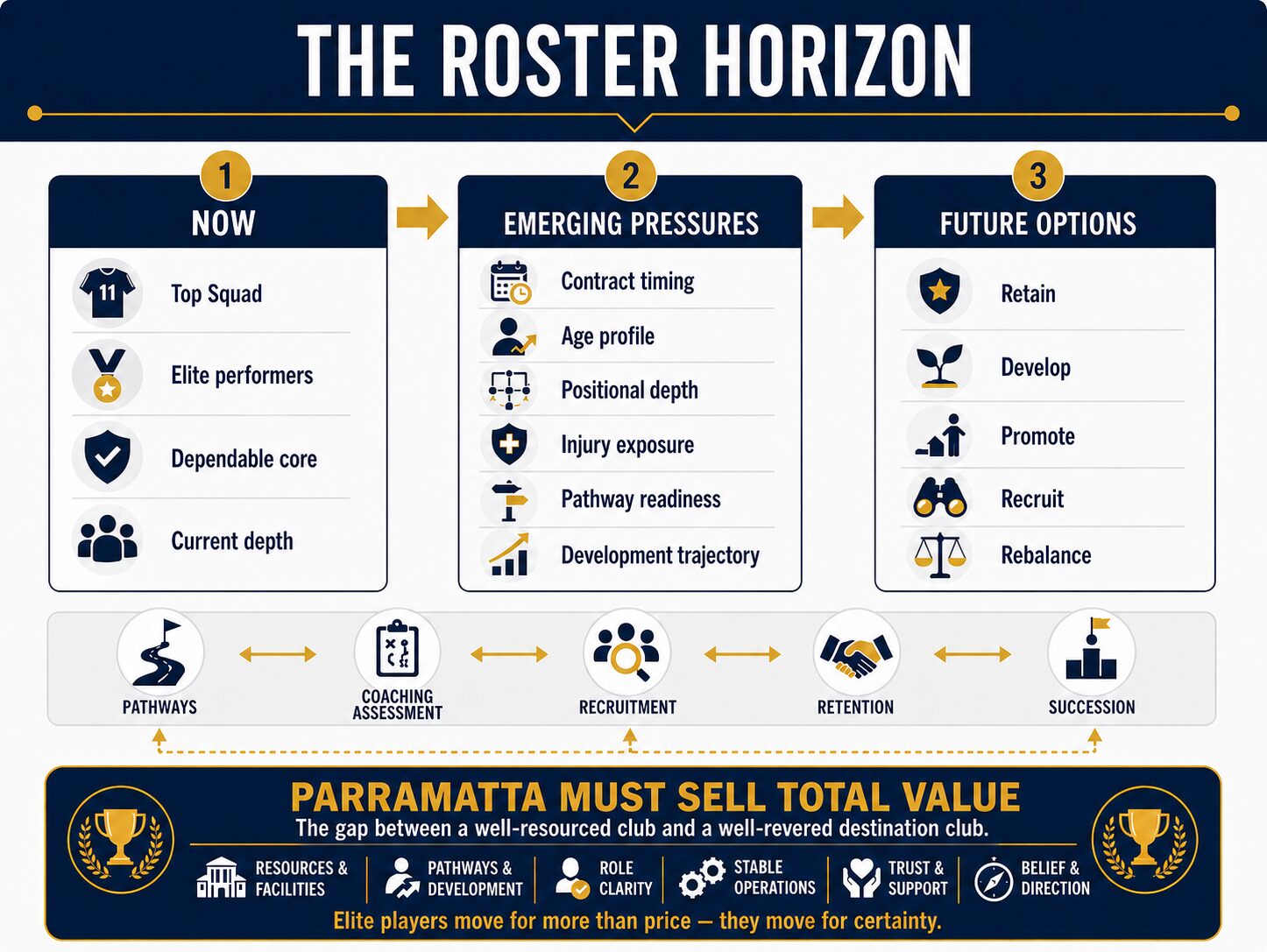
There is light if we can sell certainty. Theory derived from Toyoda, Sheehan, DuPont, E&Y, HBR & Argyris, Shewhart and Deming and drawing on the authors relevant professional experience – graphic created by the author using Canva Premium
| PDSA FOR THE GM OF FOOTBALL: FROM REACTIVE RECRUITMENT TO ROSTER COHERENCE | |
| HYPOTHESIS | If similar roster gaps, depth concerns or succession challenges repeatedly emerge, future requirements may not always be identified early enough for recruitment, retention, development and pathways to respond as one integrated strategy. Earlier modelling of future roster requirements, together with a clearer understanding of the total value The Eels can offer current and prospective players, might create better options before critical decisions need to be made. |
| RASCI LENS | The GM of Football is Accountable and Responsible for the integrated roster strategy. Football Operations provides Support, while the Head Coach and Coaching Team are Consulted for relevant tactical, positional and player-development expertise. |
| PLAN | The GM could select one projected roster requirement and model it across several seasons, considering positional depth, contract timing, age profile, pathway readiness, development expectations and realistic external alternatives. Where recruitment or retention may be required, the analysis could also consider Parramatta’s total player value proposition: facilities, development, role clarity, operational stability, support environment and confidence in the club’s football direction.
The Head Coach and Coaching Team could contribute assessments of tactical requirements and player development, while Football Operations supports the contractual, information and administrative components of the exercise. |
| DO | The GM could apply the model prospectively through a defined recruitment and retention period. As player development changes, contracts move, injuries occur, external opportunities emerge or anticipated targets become unavailable, assumptions could be updated rather than treated as fixed predictions.
Alternative scenarios could prevent the strategy from depending on one player, target or pathway outcome. The test is not whether the model dictates a decision, but whether earlier planning creates better-informed and more adaptable options. |
| STUDY | The GM, supported by football staff and coaching expertise, could assess whether the model improved real decision-making.
|
| ACT | If earlier integrated modelling improves options and decision-making, the approach could be refined across the wider roster. If not, the assumptions behind the model could be reconsidered. The objective is not to predict every future roster problem, but to be better prepared for the pressures the club can reasonably anticipate, with both the roster options and organisational value proposition required to respond. |
| PDSA FOR FOOTBALL OPERATIONS: FROM FIXING PROBLEMS TO PREVENTING THEM | |
| HYPOTHESIS | If similar operational problems repeatedly require last-minute correction despite ultimately being resolved, success may be measured more effectively by whether the immediate task was completed than by whether the process producing the problem has improved. Deliberately identifying recurring issues and testing preventative changes might reduce the need for repeated intervention. |
| RASCI LENS | Football Operations is Responsible for reviewing and improving the systems that support the football program, while the GM of Football remains Accountable for ensuring those functions collectively enable performance. Coaches, players and staff directly affected by a particular process can be Consulted when defining the problem and evaluating the intervention. |
| PLAN | Football Operations could select one recurring operational issue and clearly distinguish the immediate incident from the process that allowed it to occur. The issue might involve communication, travel, scheduling, equipment, player preparation, match-day logistics or another repeated activity. The team could establish:
If repeated communication problems were selected, for example, one intervention might be testing a single confirmed source of match-week information with clear ownership and version control. |
| DO | Football Operations could trial the selected preventative change across a limited number of training weeks, trips, matches or another appropriate period.
The GM could provide the authority and support required without unnecessarily managing the operational work itself. The intervention should remain manageable enough that its effect can be observed without simultaneously redesigning the wider operation. |
| STUDY | Football Operations could collect the evidence and seek feedback from the staff, coaches or players affected.
|
| ACT | If the intervention reduces recurrence, Football Operations could refine, document and embed the improved process. If not, the result should prompt another look at the original assumption: the cause may have been wrong, the intervention may have treated another symptom, or the problem may have originated further upstream. The objective is not merely to become more efficient at fixing problems, but to progressively remove the conditions that keep creating them. |
| PDSA FOR THE HEAD COACH: TRAINING FOR THE RESPONSE, NOT JUST THE PLAN | |
| HYPOTHESIS | If players understand the required response but continue to reproduce similar execution, discipline or decision-making failures under fatigue, scoreboard pressure or changing momentum. Those behaviours may not yet be reinforced consistently enough across preparation, role clarity, standards, selection and accountability. Testing greater alignment across that broader coaching environment might make the required response more reliable under match conditions. |
| RASCI LENS | The Head Coach is Accountable for the overall coaching response. The Coaching Team is Responsible for coordinated delivery, Football Operations provides Support, while the Captain and Squad are Responsible for translating preparation into behaviour on the field. |
| PLAN | The Head Coach could select one recurring pressure situation and define the specific response the team is expected to reproduce. After conceding points, can the team consistently complete the next set, achieve a controlled kick and restore defensive organisation before attempting to force momentum back?
The plan would go beyond designing a pressure drill. It could establish how the desired response will be reinforced through training, review, role clarity, behavioural standards, selection expectations and accountability. |
| DO | The Coaching Team could deliberately recreate the selected situation under realistic conditions, including fatigue, scoreboard pressure, restricted possession, disruption or changing momentum. The same behavioural expectations could then be reinforced consistently across relevant coaching areas, reviews and role discussions rather than existing only within the individual training exercise. The Captain and players would be required to reproduce the response themselves, while the Head Coach ensures the wider environment supports what is expected. |
| STUDY | The Coaching Team could analyse training and match evidence and gather relevant player feedback.
If it did not, was the problem the tactical response itself, the realism of the training environment, role clarity, inconsistent reinforcement, selection and accountability—or player execution despite appropriate preparation? |
| ACT | If the intervention improves match-day reliability, the successful elements could be retained, refined and embedded into the broader coaching program. If it does not, the coaching group could reconsider which part of the system requires adjustment and begin another cycle. The answer should not automatically be to train harder or repeat it again. The purpose is to determine what combination of preparation, expectations and accountability makes the required response most likely to survive genuine match pressure. |
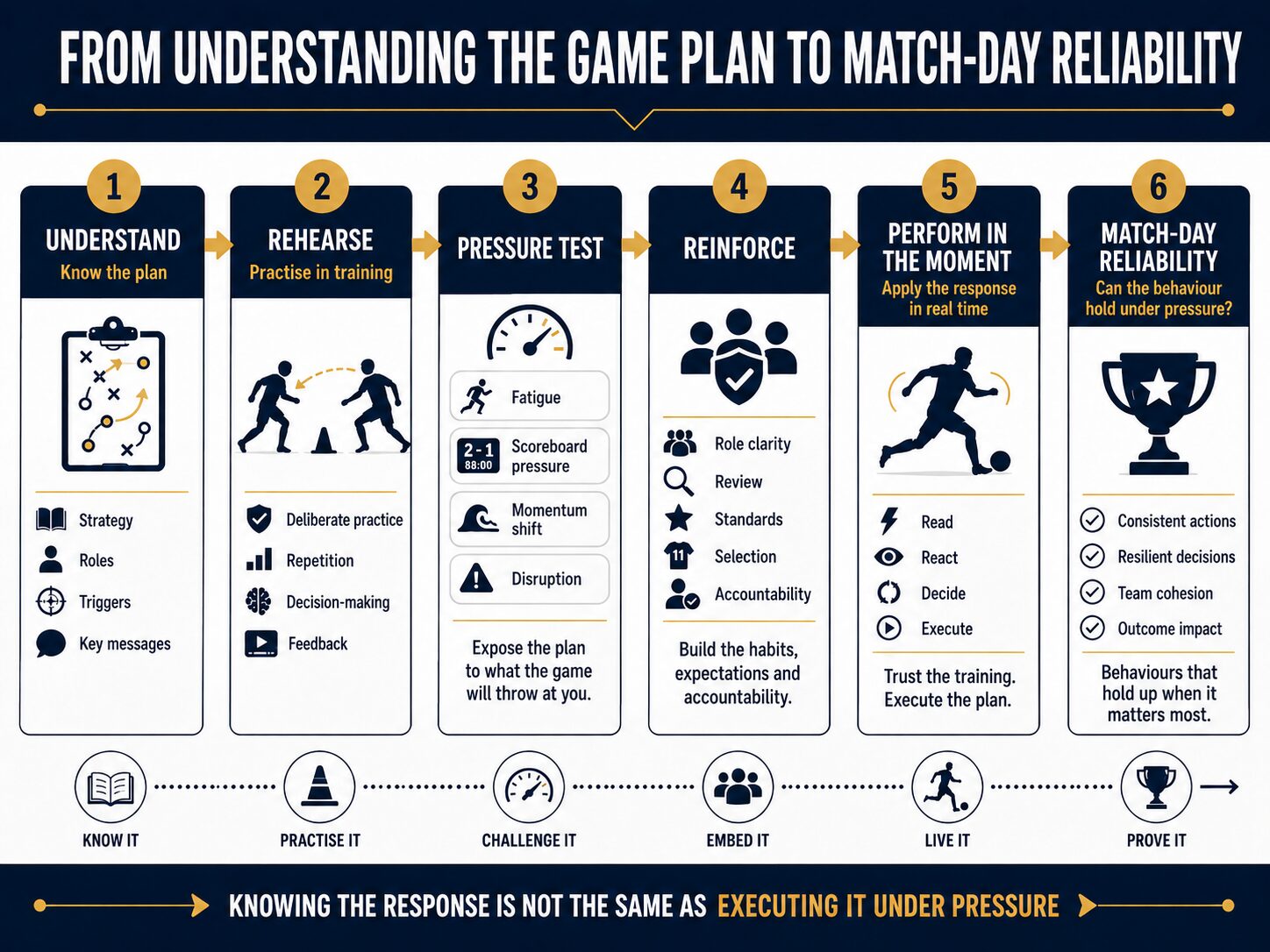
Materialising the Game Plan – Theory derived from Toyoda, Sheehan, DuPont, E&Y, HBR & Argyris, Shewhart and Deming and drawing on the authors relevant professional experience – graphic created by the author using Canva Premium
| PDSA FOR THE COACHING TEAM: FROM CORRECTING ERRORS TO EMBEDDING BEHAVIOUR | |
| HYPOTHESIS | If recurring performance weaknesses persist despite being identified and technically corrected, otherwise sound coaching interventions may not be reinforced consistently enough across individual, positional and team environments to become embedded match-day behaviours. Greater consistency of coaching cues, priorities and reinforcement might improve the transfer of a targeted behaviour into competition. |
| RASCI LENS | The Head Coach remains Accountable for the broader coaching program. The Coaching Team is Responsible for delivering the coordinated intervention, relevant football and performance staff provide Support, and players can be Consulted to establish how the coaching message is being understood and experienced. |
| PLAN | The Coaching Team could select one recurring performance issue involving several coaching disciplines and clearly define the behaviour being targeted.
The coaches could then agree on the terminology used to describe it, how each specialist area will reinforce it, the situations in which it should be reproduced and what evidence would demonstrate improvement. Player input could help determine whether the intended coaching message is being received consistently. |
| DO | The relevant coaches could apply the coordinated approach across individual, positional and team environments for a defined training period.
Instead of each coach simply working harder within their own specialty, the intervention would deliberately test whether those specialist areas can repeatedly reinforce one common behavioural objective under increasingly realistic conditions. |
| STUDY | The Coaching Team could analyse the targeted behaviour and seek player feedback regarding the clarity and consistency of the intervention.
• Could players clearly articulate what was expected? • Were specialist coaching messages complementary? • Did the behaviour improve within individual drills? • Did that improvement survive positional and full-team training? • Did it remain reliable under fatigue and disruption? • Most importantly, did it appear consistently enough in competition to suggest the behaviour was becoming embedded? |
| ACT | If stronger coaching alignment improves transfer into matches, the approach could be refined and repeated in other appropriate areas.
If it does not, the result might show that repetition was insufficient, the training conditions were not representative enough, the messages required simplification—or that coaching alignment was already strong and therefore was not the source of the recurring problem. That would not represent a failed PDSA. It would represent a hypothesis successfully tested and rejected. |
| PDSA FOR THE CAPTAIN: FROM DIRECTING THE TEAM TO BUILDING COLLECTIVE LEADERSHIP | |
| HYPOTHESIS | If Parramatta’s organisation sometimes deteriorates when pressure and momentum shift, too much responsibility for recognising, communicating and correcting the response may become concentrated through one central leader. A more deliberately distributed leadership structure might allow the Captain’s influence to remain clear while enabling others to assume greater responsibility around him. |
| RASCI LENS | The Captain is Responsible for reinforcing on-field standards, communication and collective responses, while the Head Coach remains Accountable for the broader leadership environment. The leadership group and wider Squad provide Support through shared ownership and behaviour, with the Coaching Team supporting the development and reinforcement of those expectations. |
| PLAN | The Head Coach, Captain and leadership group could identify one match situation in which collective leadership becomes particularly important.
After conceding points, for example, defined senior players might assume specific responsibilities for defensive organisation, discipline, communication through the middle, tactical reset or restoring emotional control. Moses would retain his overall captaincy and game-management responsibilities. The proposed change would be greater clarity about which leaders around him are expected to recognise and respond to particular needs without waiting for every instruction to come through the Captain. |
| DO | The Captain and leadership group could test those responsibilities through pressure-based training scenarios and, where appropriate, allow the same structure to operate during matches.
The Coaching Team could deliberately create situations involving scoreboard pressure, fatigue, controversial decisions, repeated defensive demands or loss of momentum. The critical part of the experiment would be allowing designated leaders to initiate their responsibilities rather than waiting for Moses to direct every response. |
| STUDY | The Captain, leadership group and coaches could examine what occurred.
|
| ACT | If distributed leadership improves the team’s response, the responsibilities could be refined and embedded within the leadership model. If it creates confusion or fails to improve performance, the structure could be simplified, redistributed or abandoned. The purpose is not to reduce the Captain’s influence, but to test whether that influence extends further when leadership becomes something the team increasingly reproduces around him rather than something he must continually provide for it. |
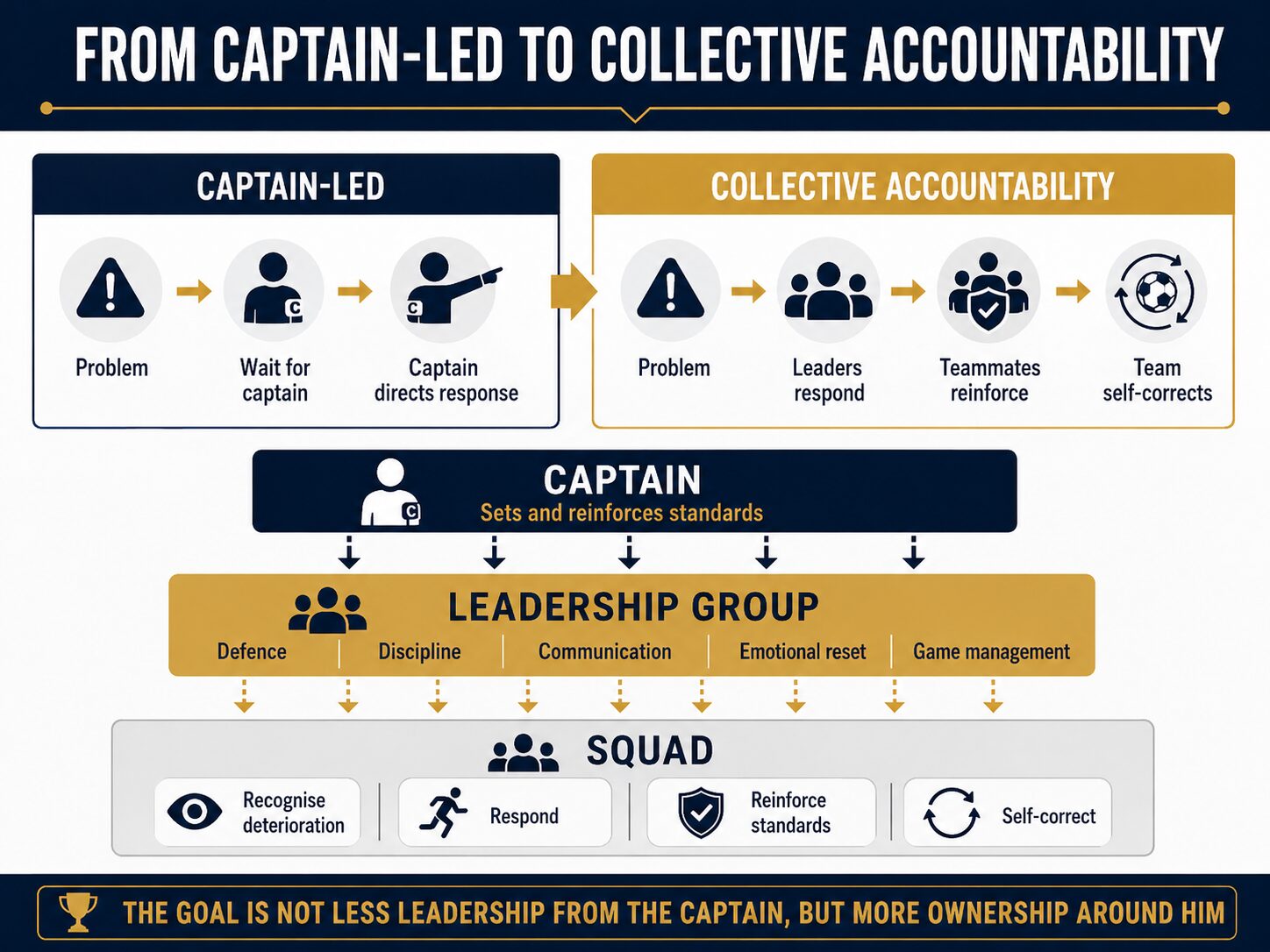
Collective Accountability – Theory derived from Toyoda, Sheehan, DuPont, E&Y, HBR & Argyris, Shewhart and Deming and drawing on the authors relevant professional experience – graphic created by the author using Canva Premium
| PDSA FOR THE TOP SQUAD: FROM IMPLIED ACCOUNTABILITY TO OWNING PERFORMANCE | |
| HYPOTHESIS | If execution, discipline and decision-making deteriorate under fatigue, scoreboard pressure or changing momentum despite the required standards being understood, those standards may not yet be sufficiently embedded or collectively reinforced for the Squad to self-correct consistently. Stronger horizontal accountability and player-led correction might make those standards more resilient under pressure. |
| RASCI LENS | Each player is Accountable and Responsible for their own execution. The wider Squad provides Support by reinforcing collective standards, while the Captain and Coaching Team help establish and reinforce the behaviours required under pressure. The Head Coach remains Accountable for the broader football program in which those behaviours are prepared. |
| PLAN | The coaches, Captain and Squad could identify one recognisable form of performance deterioration and agree upon a small number of observable player-led responses.
That might involve what the team should recognise and do when communication begins to fall away, discipline deteriorates, consecutive sets lose their shape or urgency begins replacing patience. The desired response could include immediate communication, restoration of defensive organisation, reinforcement of agreed standards and clear player ownership of the next action. Players themselves should have meaningful input because they are the people required to recognise and correct those moments while fatigued and under pressure. |
| DO | Training could repeatedly recreate the selected circumstances while progressively reducing coaching intervention.
The Coaching Team establishes the environment and expectations. The Captain and senior players reinforce the standard. But the wider Squad must increasingly recognise the deterioration, communicate what is required and initiate the corrective response themselves. An intervention designed to increase player ownership cannot be properly tested if coaches continue stopping the exercise and supplying the answer every time the problem emerges. |
| STUDY | The Coaching Team, Captain and playing group could review what happened.
|
| ACT | Where player-led recognition and correction become more reliable, those behaviours could be reinforced as Squad standards and applied to other match situations. Where they do not, the playing group and coaches could examine whether the required behaviours were sufficiently clear, adequately practised and realistically tested—or whether the original explanation for why standards were deteriorating was simply incorrect.
Individual players remain accountable for their own execution, while the Squad reinforces the collective standard. The larger test is whether Parramatta can progressively become a playing group capable of recognising when its own performance is deteriorating, reinforcing its standards and correcting itself while the game is still there to be won. |
THE GOLDEN POINT: FROM ACCOUNTABILITY TO ACTION
One club. Eight hypothetical tests. No predetermined answers.
The examples in Part Three are deliberately hypothetical. I am not suggesting that Parramatta lacks Board reporting, cross-functional accountability, forward roster planning, operational systems, pressure-based coaching, coaching alignment, distributed leadership or player ownership. From outside the organisation, I could not know that, nor whether any proposed intervention would work; that is precisely my point. From the outside looking in, we are free to respectfully hypothesise and propose. But without internal access or comprehensive oversight of the actual facts, figures and circumstances, it is irresponsible and entitled, in my view, to form inflexible opinions, demand the removal of individuals, or expect major organisational change to occur both instantly and effectively without appropriate process, legal compliance and proper governance.
That’s why each PDSA starts with a hypothesis, not a fixed opinion. Some tests may add little, fail under real pressure or create confusion instead of clarity. Even then, the exercise has value because it reveals what does and does not work. PDSA does not prove a proposed change was right, it tests whether it was.
That process brings the three parts of Beyond the Blame Game together. The Five Whys asks what might actually be causing the problem. RASCI clarifies who owns what happens next. Double-Loop Learning challenges the assumptions, behaviours and systems that might be allowing the problem to persist. PDSA then puts the proposed response to the test and asks whether changing something actually produces the improvement expected of it. Together, they create an accountability process that can move vertically and horizontally through an organisation without responsibility becoming blurred somewhere between the Boardroom and the football field.
- The Board can govern without coaching.
- The CEO can hold functions accountable without performing their work.
- The GM of Football can own strategy while drawing on coaching and operational expertise.
- Football Operations can improve the environment without determining the game plan.
- The Head Coach can remain accountable for the program while specialist coaches deliver their parts of it.
- The Captain can lead without carrying every responsibility himself. And,
- players can be fully prepared and supported while remaining accountable for what only they control: their own execution.
The person who identifies a problem will not always be the person accountable for solving it. The person accountable for the outcome will not always perform the work. And the people responsible for implementing an intervention should not automatically assume that its implementation proves its effectiveness.
That is where accountability becomes more than assigning responsibility after something has gone wrong. It becomes a process for learning what needs to happen next.
Ask why. Clarify who owns it. Challenge what sustains it. Test what might improve it. Study the evidence. Act accordingly. Then repeat.
Because recognising the problem is not the same as learning, changing something is not necessarily improvement, and accountability should not end once responsibility has been assigned. Understanding that is where improvement begins.
See you at the game on Sunday.
Roly-Poly


Savala is a shocking player. And people here want him. – absolutely unbelievable