
Hey Parra Fans, This week I am continuing on from the recent recruitment discussion and looking at: the correlation between organisational capability and premiership success through the lens of three well established organisational frameworks: Organisational Ambidexterity, Dynamic Capabilities, and The Theory of Constraints. Together, these concepts provide a valuable lens through which to assess the overall functionality of the Eels as an organisation, rather than simply as a football team.
Yes this is another part evidence based analysis, part subjective opinion piece that in theory holds significant relevance to the Parramatta Eels; while once again acknowledging that I neither know or understand the whole picture and have no experience running a football club.
As always, I hope you find it insightful and engaging and I look forward to your views and perspectives in the comments, whether they are similar, dissimilar, or indifferent.

BEYOND THE TEAM LIST: BUILDING ORGANISATIONAL CAPABILITY FOR PREMIERSHIP SUCCESS
In any organisation, sustainable performance depends on alignment across several interdependent systems. Organisational performance reflects how effectively the entire system is functioning and failure at any level is rarely the result of one function alone. More often, it emerges from interconnected issues across the organisation: operational disconnects at the micro level, poor planning and execution at the meso level, and strategic or cultural resistance to change at the macro level.
TCTGP 28 June 2026 explored how for the most part, the ingredients for sustained success at the Parramatta Eels (The Eels) already exists. It argued that, from a recruitment and retention perspective, the club would benefit from leveraging its considerable resources and strengthening its employee value proposition to better develop, attract and retain marquee talent.
This TCTGP explores how some organisations continually adapt and evolve while others fail to reach the same heights, despite possessing talented people and significant resources. The question this raises for The Eels is not whether the ingredients exist, but whether the club can consistently bring them together in a way that delivers sustained success.
This is not about dwelling on the past or explicitly criticising the present. Rather, it is about applying evidence-based organisational theory to explore how the Eels can strategically adapt to achieve sustained performance over time, and to better understand the operational practices that underpin long-term organisational success.
Organisational Ambidexterity
Despite the intimidating name, the idea of organisational ambidexterity is quite simple. It refers to an organisation’s ability to exploit what it already does well; while simultaneously exploring new ways of doing things:
- Exploitation is about maximising today’s performance. It’s refining systems, improving consistency, developing existing talent and getting the most from the resources you already have.
- Exploration is about preparing for tomorrow. It’s investing in new ideas, challenging existing thinking, acquiring new capabilities and making strategic decisions that may not deliver immediate results but improve the organisation’s long-term position.
Originally popularised through the work of James G. March, organisational ambidexterity which argues that every organisation faces the same balancing act, recognising that long-term success depends on avoiding over-reliance on either approach. Organisations that focus only on exploitation risk stagnation and decline, while those that prioritise exploration without maintaining current performance can become unstable. High-performing organisations deliberately integrate both, ensuring they remain competitive today while continuously building the capabilities needed for tomorrow.
So, what does that look like at The Eels?
In some ways, The Eels have often appeared to oscillate between exploitation and exploration rather than balancing them. For example:
- Developing young players then undervaluing retention by either releasing junior talent before their development fully matures; or losing them to rival pathways programs due to poor succession planning.
- Relying heavily on their commercial strengths as the primary measure of value and success; without consistently prioritising translating that value into sustained on-field success.
- relying heavily on a small number of elite players to drive performance rather than lifting the capability of the broader squad.
Don’t get me wrong, the exploitation in these examples is bloody exceptional; but at what point does exploitation alone stop being a strategy and start becoming an excuse? Every organisation reaches a point where internal growth alone is no longer enough. Sometimes the missing capability has to be brought in from the outside, and that’s where March’s theory becomes particularly relevant.
Love him or hate him, the signing of Jarome Luai isn’t simply about recruiting a marquee player. It signals an acknowledgement that 2026 is about exploring, not merely exploiting. A team cannot genuinely rebuild while remaining dependent on one superstar to solve systemic issues, but equally, it cannot expect inexperienced players to shoulder the burden indefinitely. Daddy can’t fix everything, but there is an air of optimism for mine that he can become an important piece of a much larger build; while not losing site or respect for the exploitation components that help make it all possible.
As established within my recruitment and retention piece, the ingredients for success at The Eels already exists. The challenge is ensuring those ingredients are consistently aligned and mutually reinforced across the entire football club. Because recruitment is only one part of that equation, and premiership contenders aren’t built solely on key signings. They’re built by extracting maximum value from existing people, systems and resources while continuing to invest in the capabilities needed for tomorrow.
Perhaps the biggest challenge for The Eels isn’t trying to balance exploitation and exploration, development and recruitment, habitual strategy and positive disruption. As a starting point it might require critical reflection or simply recognising that sustainable success requires balance. The best organisations don’t choose one or the other, and the NRL clubs that consistently compete for titles aren’t those that are best at exploiting the present or exploring the future; they’re the ones disciplined enough to balance both.
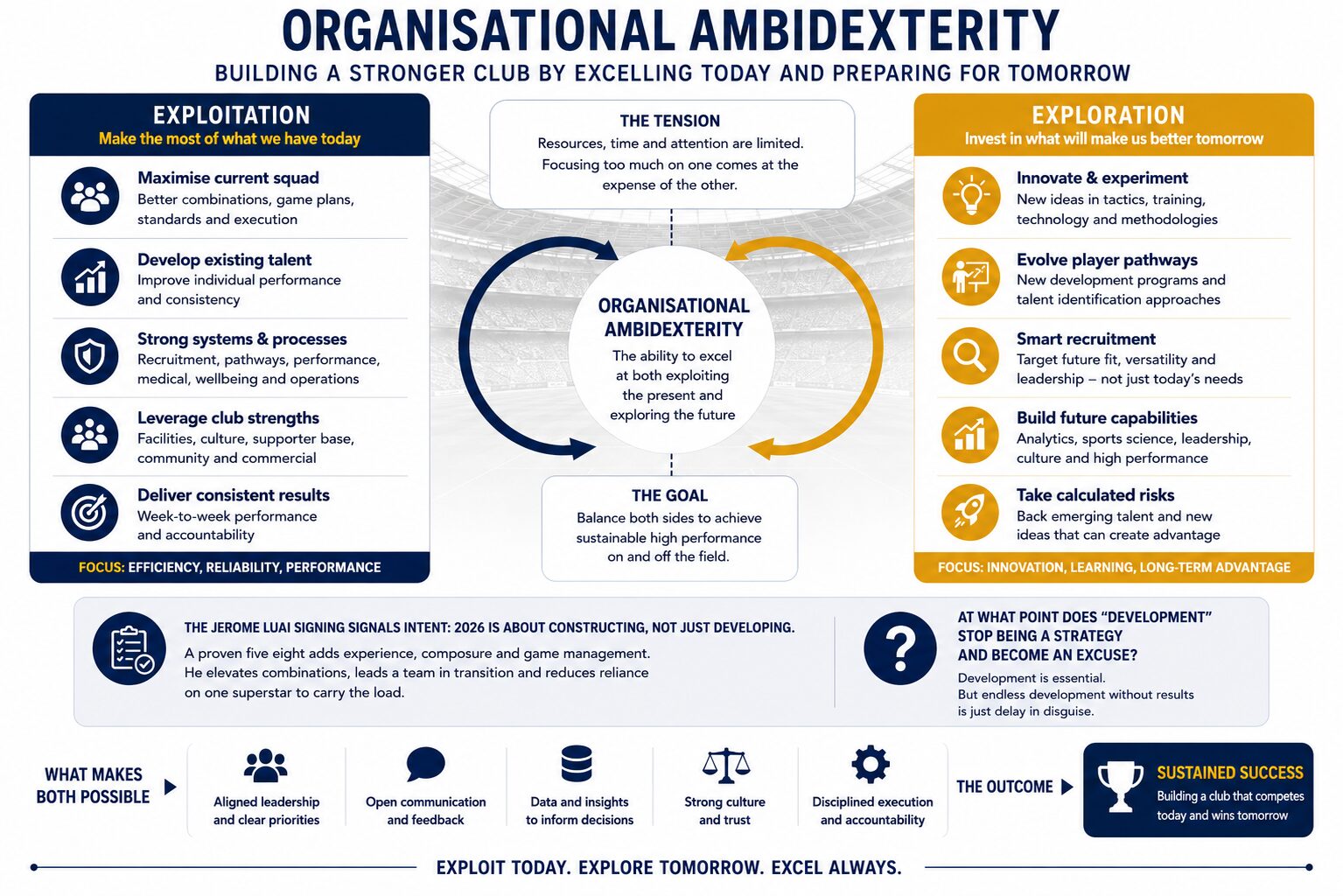
Organisational Ambidexterity at The Eels – Source: Theory from March, J.G. (1991). Conceptualised by the author into Rugby League terms specific to the Parramatta Eels.
Dynamic Capabilities
If organisational ambidexterity is about balancing today’s performance with tomorrow’s opportunities, then dynamic capabilities are about developing the organisational ability to keep adapting as those opportunities and challenges emerge.
David Teece’s Dynamic Capabilities Framework argues that sustained success is not determined simply by the resources an organisation possesses, but by how effectively it can sense change, seize opportunities and transform itself when circumstances demand it. In other words, competitive advantage comes from continuously renewing capabilities rather than relying on yesterday’s strengths.
For The Eels, this shifts the conversation away from remaining reliant on their commercial success and bountiful resources; to how the club can consistently convert those resources into sustained on-field success. In essence: resources create potential and capabilities convert potential into performance.
Viewed through this lens, many of The Eels recurring challenges become capability questions:
- How can we identify roster gaps before they become obvious to everyone else?
- How can we replace departing leaders without losing its identity every time an experienced player leaves?
- How can more juniors successfully transition into consistent NRL first graders rather than becoming “promising prospects” who move on to win premierships with other clubs?
- How can recruitment strategy evolve as the competition changes without feeling like every few years the club is starting another rebuild?
These are micro level recruitment and retention issues that require macro level action and accountability. Strong dynamic capabilities allow clubs to continually scan the environment, evaluate emerging trends, learn from successes and failures, and adjust without abandoning everything that already works:
- Succession planning should start years before a captain retires.
- Development pathways should be designed to identify and nurture NRL-ready players for the clubs own future.
- Lessons from poor business decisions become organisational knowledge rather than repeating cycles.
This shifts the conversation away from resource reliance and places primary focus on proficient execution. The best organisations are rarely the ones with the most resources, they are the ones that repeatedly adapt faster than everyone else while maintaining a clear long-term direction.
For The Eels, improving dynamic capabilities will not require another complete reset. However, it will require significant reflection and a commitment to systematic change: building operational EQ and IQ, anticipating issues before they become crises, responding earlier, and embedding the lessons from both successes and failures into every football decision. Successful execution would not be measured by one strong recruitment period, or one successful generation of players, but by the club’s ability to continually regenerate itself, regardless of who comes or goes from the team list or the board room.
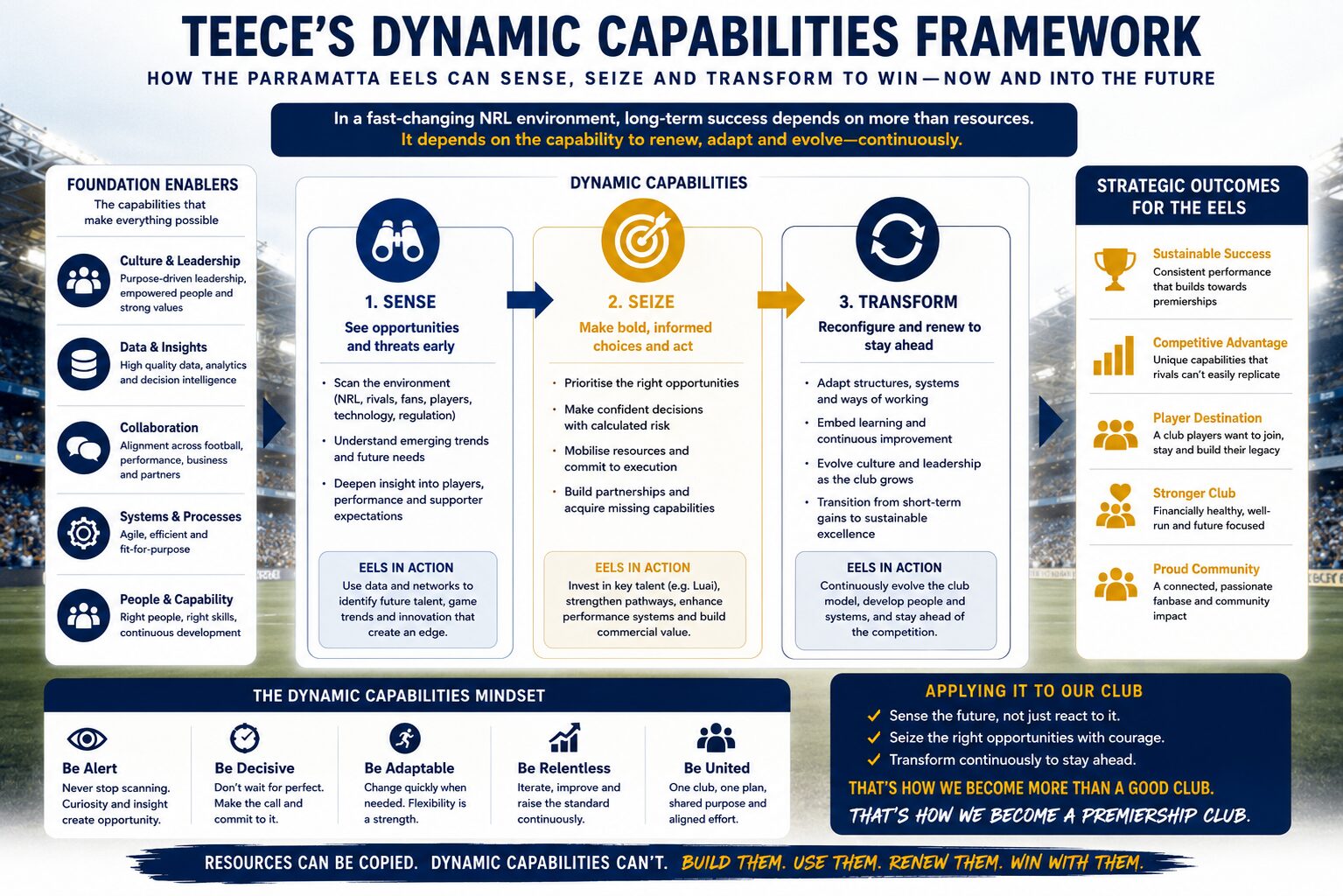
Dynamic Capabilities at The Eels – Source: Theory from Teece, D. (2007) Conceptualised by the author into Rugby League terms specific to the Parramatta Eels.
Theory of Constraints
Of course, even organisations with strong capabilities can still fail to achieve their objectives if one critical part of the system continually limits everything else. That raises another important question: what is the single biggest constraint preventing Parramatta from converting capability into consistent performance? That is where the Theory of Constraints provides another valuable perspective.
The Theory of Constraints (TOC), developed by Eliyahu M. Goldratt, contends that every organisation’s performance is limited by at least one critical constraint. Rather than trying to improve everything at once, TOC focuses on identifying the biggest obstacle to success and directing effort towards removing it. Once that constraint is addressed, another will emerge, creating a continuous cycle of improvement. Goldratt summarises this through five steps that broadly translates to: identify the constraint, make the most of it, align everything else around it, remove it, then repeat the process.
For a rugby league club, this is a powerful concept because sustained success rarely depends on improving every aspect of the organisation simultaneously. For the Eels, the obvious question becomes: what is the constraint? The Eels continue to struggle to convert its tangible resources into sustained on-field success. That raises the possibility that the club’s greatest challenge is not the visible problems themselves, but an underlying organisational constraint that continues to limit the effectiveness of everything else. Rather than focusing solely on the symptoms, should the club instead be asking what sits beneath them?
If organisational ambidexterity asks whether Parramatta is balancing today’s success with tomorrow’s development, and dynamic capabilities asks whether the club can continually adapt, then the Theory of Constraints asks an even simpler question:
What is one thing that could be improved to make everything else easier?
For mine, the likely constraint is the quality and authority matrix of decision-making. When the people making decisions fail to earn the confidence of those expected to execute them, buy-in diminishes, implementation suffers and performance becomes inconsistent. Whether that stems from gaps in organisational capability, entrenched cultural norms, or a disconnect between those holding the purse strings and those expected to deliver the outcomes is open for debate. But whatever the underlying cause, until that constraint is identified, acknowledged and addressed, any attempts to improve broader systems or business functions will not be successful.
Equally, if the real constraint is organisational alignment, then no amount of spending will solve it. Every football department; from recruitment and pathways to coaching, performance and leadership; must be working towards the same long-term strategy. The danger is treating every symptom as a separate problem. Replace the coach, change the roster. Recruit another marquee player, restructure the football department. While each may provide temporary improvement, none will create sustained success unless they address the underlying constraint.
For The Eels, the challenge may be openness to critical reflection, which will be required to appropriately identify constraints that are repeatedly limiting everything else. Because until the true constraints are addressed, every other improvement initiative risks becoming a marginal gain in a system still held back by its inability to change.
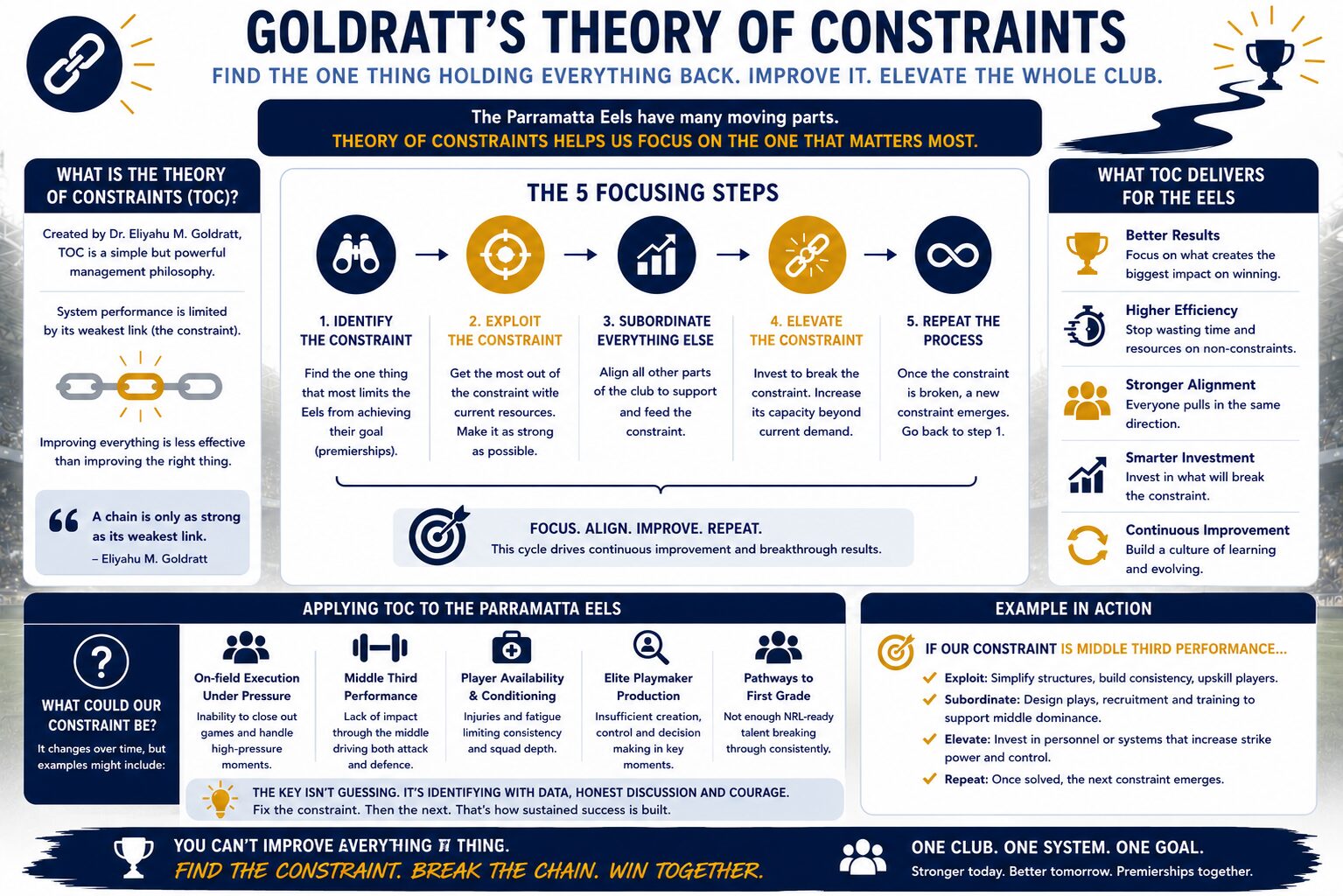
Theory of Constraints at The Eels – Source: Theory from Goldratt, E. M. (1984) Conceptualised by the author into Rugby League terms specific to the Parramatta Eels.
Bringing It All Together
Ultimately, these three theories complement one another. Organisational ambidexterity provides the balance between today’s performance and tomorrow’s success. Dynamic capabilities provide the ability to continually adapt, learn and renew. The Theory of Constraints provides the discipline to identify and improve the one issue limiting the performance of the entire system. Together, they offer a framework not just for rebuilding a football team, but for building an organisation capable of sustaining success long after any individual player, coach or administrator has moved on.
Organisational Ambidexterity:
- Are we balancing today and tomorrow?
- An ambidextrous organisation knows when to rebuild
Dynamic Capabilities:
- Can we continually adapt?
- Dynamic capabilities determine how effectively it rebuilds.
Theory of Constraints:
- What is the single issue currently limiting everything else?
- The Theory of Constraints identifies where effort should be focused first.
Viewed in unison, The Eels challenge may simply be that the club is trying to solve multiple complex problems simultaneously while one or two critical constraints continue limiting the effectiveness of everything else.
The Golden Point
The ingredients are visible, the commitment appears genuine, and the resources certainly exist. The question is no longer whether the Eels have enough pieces to complete the premiership puzzle, but whether they can consistently assemble those pieces into a system capable of sustaining success:
- In business, that is the difference between possessing resources and building organisational capability.
- In rugby league, it is often the difference between being competitive and becoming a genuine premiership contender.
For the Eels, the next premiership may depend less on finding the next superstar and more on becoming the kind of club where sustained success is no longer dependent on one manager, one player, one coach or one recruitment cycle. Because success should be proactively built into the way the club thinks, decides, learns and performs. That is how organisations develop capability; and how the dreams of an estimated half a million supporters globally become something more than a distant hope.
Roly-Poly


Brilliant evidence based insights and conclusions.
Roly has excelled once again Martin.
Thanks Martin, I genuinely appreciate the support. I put a great deal of effort into these analyses, and I try to ensure all my pieces, even the subjective ones are predominantly evidence based even though they’re ultimately opinion pieces.
A great read and very insightful in relation to the Eels – even if I have to read numerous times to fully understand ( a reflection on me, not your skillful writing ). I think a lot of fans should be reading this and not baying for blood right now.
Gaby, in my conversations with Roly I find she can be very self critical about whether her writing is too complex. I said that she elevates the standards here in addition to adding to the variety of content on offer.
Thanks for the support Gaby, Sixties is right, I do often worry I write too technically and that it will put people to sleep, so I am glad/relieved it resonated and you enjoy the insights/perspectives. I wrote my son out a recipe last week and he said “mum its a pie not a federal policy”. It’s the curse of overseeing APS operational compliance; if you’re not specific the margin for error increases but if your too specific you sound like a robot; finding the balance can be hard. I often ask my colleagues to proof-read articles; but not in the traditional punctuation sense; more in a “does this make sense” way. Thank you for being such a solid supporter of TCT.
I’ve earned the right to criticize the present after supporting this club for years of my life🙋🏻♂️
If the club are still asking themselves how can we identify gaps in the roster, then that points to inept management- 90% of the Eels problems are very apparent and have all been said before in this platform, if the club is still scratching its head after 3 years of rebuilding then we have the wrong people running the place
While I appreciate the article, I don’t believe the sanitized corporate language is advantageous to the culture of a rugby league team that’s objectively is to fold opponents. Is this why there’s a noteworthy decrease in folding from the eels?
I just hope there are changes as a result of the investigation and the report is made public
Also, can we stop with the “daddy”, it’s weird.
I appreciate and value your perspective Bob. It is totally your right to be critical. I myself get incredibly frustrated at times after several decades of disappointment; though being raised by one Norths suppporter and one Parra supporter was great preparation for the purposes of managing disappointment and resilience in my adult years.
My optimistic takes should never be perceived to be diminishing the sentiments of fans who are frustrated by the clubs performance. I guess I look at it as providing a different take on the repetitive narratives in Rugby League reporting; and I believe that subjectively throwing around a few ideas involving topics and concepts that are proven to work well across multiple industries is refreshing albeit adventurous.
As for the daddy comment: it was a flippant attempt at humour within a highly theoretical piece that meant no harm; but retrospectively I appreciate why it might be a trigger. It’s a reminder for me to be more careful as I don’t want one word to take the focus off a comparative assessment that took several hours to complete.
As I acknowledged in my article I am no expert when it comes to Rugby League administration. These are just evidence based opinion pieces in the end, no right or wrong, just fans throwing around ideas and sharing their perspectives. I appreciate your input to the conversation.
‘Bro’ may have worked…
I can work with that. Henceforth I shall refer to him as bro in lieu of daddy where appropriate. Writing that just now I can feel the cringe. We live and learn lol.
Agree let’s not call Jarome daddy again!
A good article but even with an amazing recruiting and retention club, nothing that was written in the article is black and white, injuries can destroy everything and makes a roster have a lot of grey.
We need to look at developing our juniors and keeping them, 5 in the aus schoolboys is huge but retaining them and not losing the likes of blaze and sanders is a big piece of the puzzle. Even harder now that there will be 3 new teams very soon.
Thanks Tony! I assure you, the light hearted attempts at humour will cease from here on in.
You’r so right, nothing is black and white and as this season has shown, rule changes and injuries can turn everything on its head. I think you make a great point with the juniors. I tried to touch on the retention of retaining those we develop in this piece, and in my previous recruitment article. I think this is crucial, especially with the new teams entering over the next few years. Thanks for your insights.
Thanks Roly,
Again you take me back to my working days where theoretical models were espoused by many a senior. Few actually understood what they were saying and even less were able to put it into working practice (my entire working life being in the public sector) – which I guess in a way is exactly what your post is pointing out for the Eels.
The tension between exploitation and exploration is so true. I did a fair bit of futures analysis but trying to get seniors to focus on anything further out than six months was nigh on improving. I would hope at NRL clubs there would be a lot more thinking at least 3-5 years ahead although I’d prefer to see 10, 15 and 20.
I agree mildly with Big Bob that, as an NRL club, we also need to concentrate on the real business of getting results on the field. The theoretical models often get lost when the first salvos of an actual game starts (fog of war and all that). So, as Bob infers we still need to focus on having a capable team on the paddock as the main corporate thinking.
Thanks again for another post that looks at footy from a different angle. I really enjoy your posts, although my family and friends do say I have non-mainstream interests they don’t understand!
*improving/impossible (trying to type while watching the Titans Sea Eagles game).
Hey Namrebo, I understand from my own work that no-one loves a theoretical framework more than the APS, and my writing is proof they haven’t changed in that respect. My family say the same about me with respect to my professional interests, my love for Parra and in my writing.
As a genuine lover of Rugby league who can barely catch a ball; I feel like I am of better served delving into areas that I am trained and knowledgeable in and making genuine connections from a business perspective rather than pretending I am Jason Ryles or a seasoned pundit. I think that’s the great thing about about TCT. Different perspectives are welcomed and there is no set narrative. Just lots of people from different walks of life who love Parra.
Regarding your comments on Exploitation/Exploration, I think that’s exactly the challenge. Most organisations understand the importance of long-term thinking, but the pressure to deliver next week’s results often crowds it out. In rugby league, I can imagine you probably need to think on multiple horizons simultaneously—winning this weekend, building a roster and pathways for the next 3–5 years, and ideally shaping the club’s identity, culture and infrastructure over 10–20 years. The clubs that consistently succeed are usually the ones that can find the balance rather than sacrificing one for another.
Thanks for your thoughts. Really valuable perspectives as always.
Good article.
While i am sure for most people reading, they immediately apply what they are reading to the one thing we can all see as a glaring issue – Recruitment.
But taking a further step into the Club is where these theories need to be considered and applied in order to address the constraint that is our recruitment/retention. Accountability for example. Does the organisation demand it at all levels?
Adaptability. Back in the day we were a strong club because we had a competitive advantage of a highly profitable leagues club. These days a profitable leagues club is good to have, but you can’t rely on it. Licensed Clubs, know gaming revenue will dry up via reform, so they are actively looking for ways to invest their money into ventures that create a return. Throw in that the world of sport is more commercially savvy, and maybe we need to look at the Eels inability to Explore other initiatives and ideas. They will want to. With Parra Leagues engaging in a major site redevelopment funds are going to be tied up for quite a while.
Balance. I have always been for people outside the game being involved in management – to create that outside the rugby league box commercial and people leadership thinking. But you still need people who appreciate the nuances for running a footy club as well. Do we have the balance right? Jim would seem to know nothing about footy club ops, but if we are relying on MoN for that, well yes he played the game, but has he shown any leadership capacity? Do people in the Eels organisation, and across the game, look to him as an industry leader?
In any business it is hard to self-reflect particularly if it requires individuals to say, “I might be part of the problem.”. It is probably that little bit harder when it is a footy club and the emotional attachment that goes with that. It is certainly time to start having those conversations and internal reflections. Whether our Board and leadership have that capacity… Time will tell.
Thanks BA, I really appreciate your response and insights. I agree that recruitment is probably the most visible symptom, but not necessarily the root cause.
The theories discussed all become far more valuable when applied to the organisation as a whole—its leadership, decision-making, culture, accountability and ability to adapt. Recruitment and retention are ultimately outputs of those systems. Whether the club is willing and able to have those honest internal conversations is probably the biggest question of all. Time will tell as you said, Thanks again.
Tks Roly. The Constraints thing is so relevant and if managed well a real winner. We used to apply it as ‘Force Field’ analysis…identify the constraint and the fix and sell it as a double whammy to get the buy in from key people..’we’re getting rid of a weakness and replacing it with a strength’. More than one weakness can be addressed but under a prioritised agenda. As you know, there’s no single perfect way to run and adjust an organisation.
A sidebar…I can relate to Big Bob’s ‘Fold Theory’. Rugby League is a unique beast, I learned this at Primary School when we were recognised as the outstanding team in the district but in the Grand Final each teacher/coach refereed a half and the other teacher allowed mayhem which we didn’t back off but just put us off our game and we lost. We learned later that it was a planned strategy and it caught us out…11/12 year olds folding each other, fair or foul. From that day I’ve always carried that thought about this sport being a no quarter asked or given proposition, the moment you blink you’re in trouble and how do you instil that constant awareness. I also got a dose of learning from the yearly trial game against the local Catholic school, those lads at an early age were into folding, their corporate language came from above.
Rather than compromise expression, I’ve always reminded myself of the game’s nature, somewhere the text book expression has to get converted to ‘folding’ world…Jack Gibson was an expert at that.
“Fold theory”, I like it
In rugby league, fold theory is a theoretical framework in which putting-a-shot-on physics are prioritized by players aiming up, playing for club pride and in the lead up to contract renewal.
Fold theory describes how folding one’s opponent can deter running it straight interaction, thus increasing the probability of a win. Therefore it is reasonable to assume that if you aren’t folding you will be folded (proverb 8:10, fold or get folded).
Love this
Well put.
Thanks BDon. I really enjoyed reading that. I think you’ve hit on something important—there’s no single framework that has all the answers, and the real value comes from adapting those ideas to the environment you’re operating in. Your example of Force Field Analysis is a great one because it focuses people on both removing barriers and building strengths at the same time.
I also like your thoughts on “Bob’s Fold Theory”. It looks at my thought through an alternative lens and helps me recognise/understand/acknowledge that rugby league has its own unique realities that don’t always fit neatly into management textbooks. The best leaders seem to understand both worlds—they can apply sound organisational principles while never losing sight of the competitive, physical and psychological nature of the game. Jack Gibson was probably one of the best examples of that.
Thanks everyone for sharing your thoughts, insights and stories. They really do add value to TCT’s content and purpose.