
Greetings Parra fans, and welcome to another fashionably late but thorough TCT Golden Point. This week I am drawing heavily on my natural inclination to find new ways to merge my professional life with my love of the Eels and Rugby League.

This part evidence based analysis, part subjective opinion, and overall a balanced and somewhat optimistic take on one of the prevalent debates currently dominating Eels fan discourse online: The State of Recruitment, Retention and Succession Planning at our great club. Whats working, what we can and can’t control and what might help improve the overall situation (in theory); while acknowledging that I neither know or understand the whole picture and have no experience running a football club.
While I might come across as an eternal optimist; I do genuinely resonate with some of the frustrations fans are feeling at the moment; particularly with reference to form inconsistency and match performance. I was one of the 14 odd thousand suckers, who sat through Thursday nights underwhelming match in the rain and cold after an equally as underwhelming 13-hour work day that can best be represented retrospectively by the kind of milky fart noise that emits from a slowly deflating balloon.
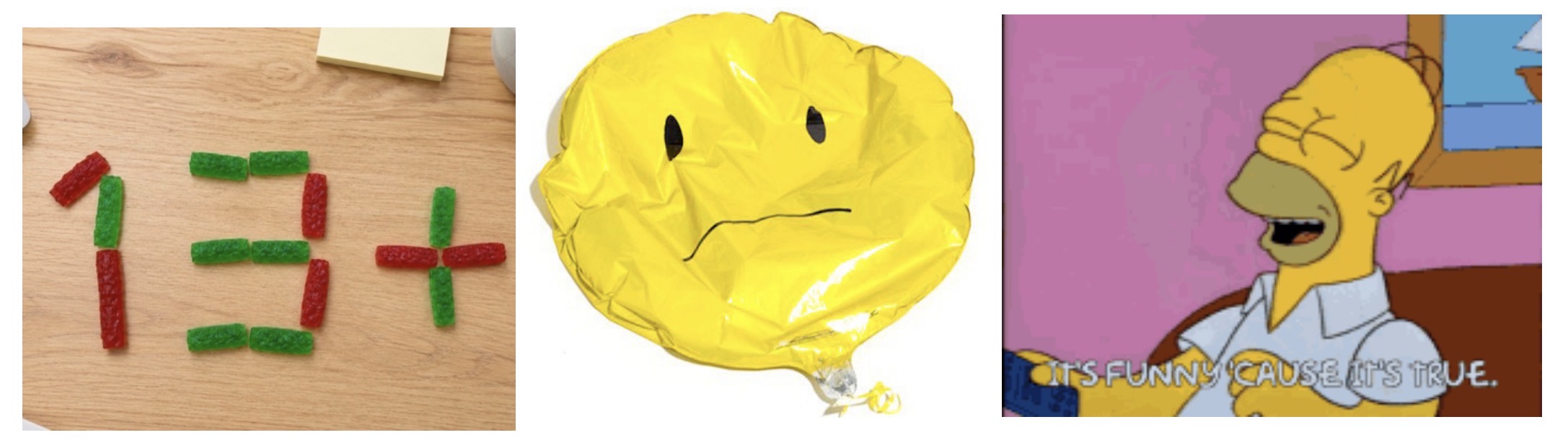
When supporter suffering meets clever heckling and bad days can only be healed by humour – created by the author using her own image and others from Canva Premium
But just as I accept that woeful days can happen even in otherwise incredible jobs, I also have to acknowledge that: despite how I felt getting home close to midnight soaked, cold, and exhausted due to poorly timed torrential rain just as we stepped off the delayed train and began the one-kilometre walk home because my phone was dead and I couldn’t call an Uber; And despite facing the prospect of barely five hours’ sleep and a workday full of taunts from colleagues after my very vocal pre-game confidence — I still woke up the next morning with optimism, hope for the club’s season, and a genuine belief in its future. I even laughed off the chopped up killer pythons a colleague left on my desk that were cleverly placed to to spell out 13+. Why? Well there are two reasons:
- Generational attachment: This club feels like an extension of my family, and it has for generations. Much like my approach to parenting, no matter how much they frustrate me at times, I will never stop loving them, I will never give up on them, and I will always try to see the good in them. That is simply who I am. But I also have nothing against those who feel differently, or who are finding it harder to hold onto that same optimism.
- Data over emotion: Despite the score-lines, the ladder position, the injuries, the challenge of recruiting elite players, and the growing pains of a relatively inexperienced but undeniably talented squad, the data still points to plenty of positives for our club — both in the present and in its projected future. Some of those positives are tangible, others are intangible, but together they suggest there is far more to build on than the current frustration might suggest.
This TCTGP focuses on the positives within that data, and on how the club could better leverage both its tangible and intangible strengths to evolve from being a well-resourced club with an iconic history into a genuinely revered destination club — a place where elite players want to come, stay and win.
As always, I hope you find it insightful and engaging and I look forward to your views and perspectives whether they are similar, dissimilar or indifferent.
The Gap Between Well Resourced and Well Revered: Dollar Value v Total Employment/Employee Value
Emotions and Fan fatigue aside, there is no denying that the Parramatta Eels have enviable financial resources, a vast Western Sydney supporter base, a powerful leagues club ecosystem, strong commercial reach, an impressive pathways footprint, and one of the most advanced rugby league training facilities in the world.
In addition, the RLPA’s player driven subjective data on non-salary factors, places the Eels as the second-best club all-round for overall player experience, and celebrates its results alongside the Panthers and the Storm as leading the way for its members.
With reference to secondary factors beyond the aforementioned enviable strengths, the Eels scored considerably well in the areas of psychological & cultural safety; family supports & services; education, health & wellbeing supports; and match-day & travel services and facilities. Even the less impressive results in – workload and balance, workplace environment and high performance staff are still well above the pass-mark. Sure C’s are a valid marker for potential review and evidence-based improvements; but when you’re grades are an A-B average; a couple of C’s are by no means a signal that the clubs administration needs to be taken to the cleaners, like some online discourse consistently suggests.
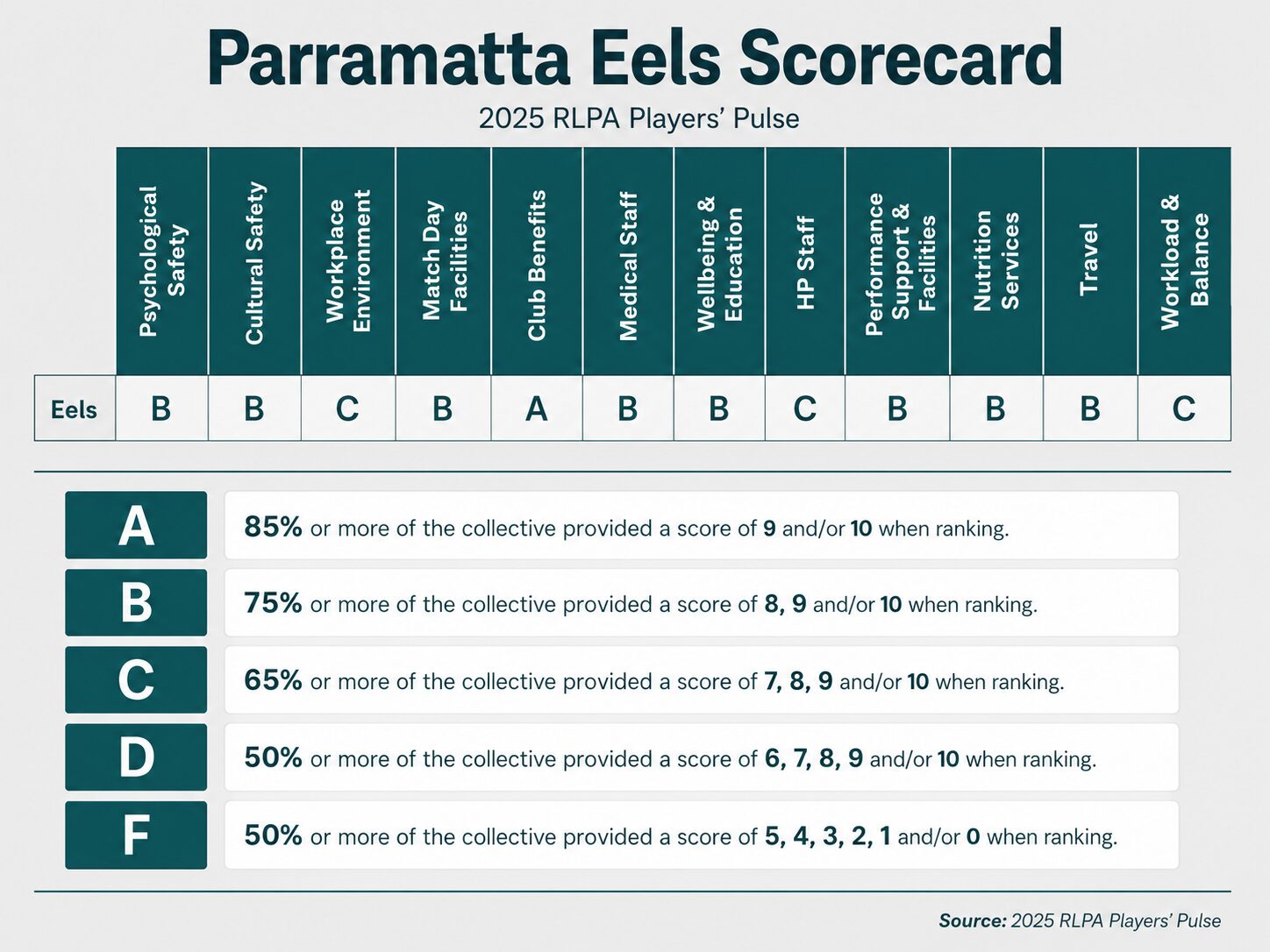
Our Players know the clubs resources are good, but how does the club convince prospective players? Source: RLPA
Putting score-lines and ladder position and the 40-year drought aside (just for the moment), and considering the clubs strong financial position, the RLPA player pulse data and the world class training and playing facilities:
How is there still a broad media driven narrative, that regularly has opposition fans and pundits alike genuinely asking: why would anyone want to come to Parramatta ever?
The club has many of the hallmarks that define a destination club, but it has not yet consistently turned those markers into a clear, trusted and compelling career proposition. Being well resourced helps, but tangible components are rarely a hard sell without purpose and this is where hi-stakes talent acquisition methodologies become relevant and useful. Parramatta needs to recruit and market itself less like a well resourced club that needs saving, and more like an employer of choice that knows its value and markets that value in a way that attracts marquee talent. It is not a lack of resources, it is resources to results conversion that’s the issue.
The following critical analysis attempts to apply theoretical recruitment and selection methodologies to explore why the Parramatta Eels are struggling to attract marquee players despite possessing many enviable hallmarks of a destination club.
The-Total-Employment/Employee-Value-Proposition
Elite players are not only choosing a salary, they are looking for a buy-in that goes well beyond that. They are choosing role clarity, long-term security, premiership probability, coaching stability, family wellbeing, personal brand, legacy and career trajectory. They are asking whether the club can make them better, protect them through pressure, build a competitive roster around them, and avoid wasting their prime and time.
A strong recruitment and retention package is rarely just about the headline salary; it is about the Total Employment/Employee Value Proposition (TE/EVP). For Parramatta, that should mean selling the holistic value of the move: family support, relocation assistance, wellbeing and medical care, education, leadership development, media and commercial opportunities (where appropriate), club-community profile, business connections and post-career planning. Western Sydney’s consistent and projected growth gives the club a genuine advantage here, as it is not only a rugby league nursery, but one of the most commercially sound, culturally diverse and historically significant regions in the country, creating an unmatchable and self sustaining player-life proposition alongside its TE/EVP.
But these are more than just superficial buzzwords; and well crafted PR statements, because their core components have genuine evidence based value and data driven impacts on player performance, commitment and results. The core components of what an effective Rugby League Club TE/EVP might look like from the subjective opinion of the Author are below.
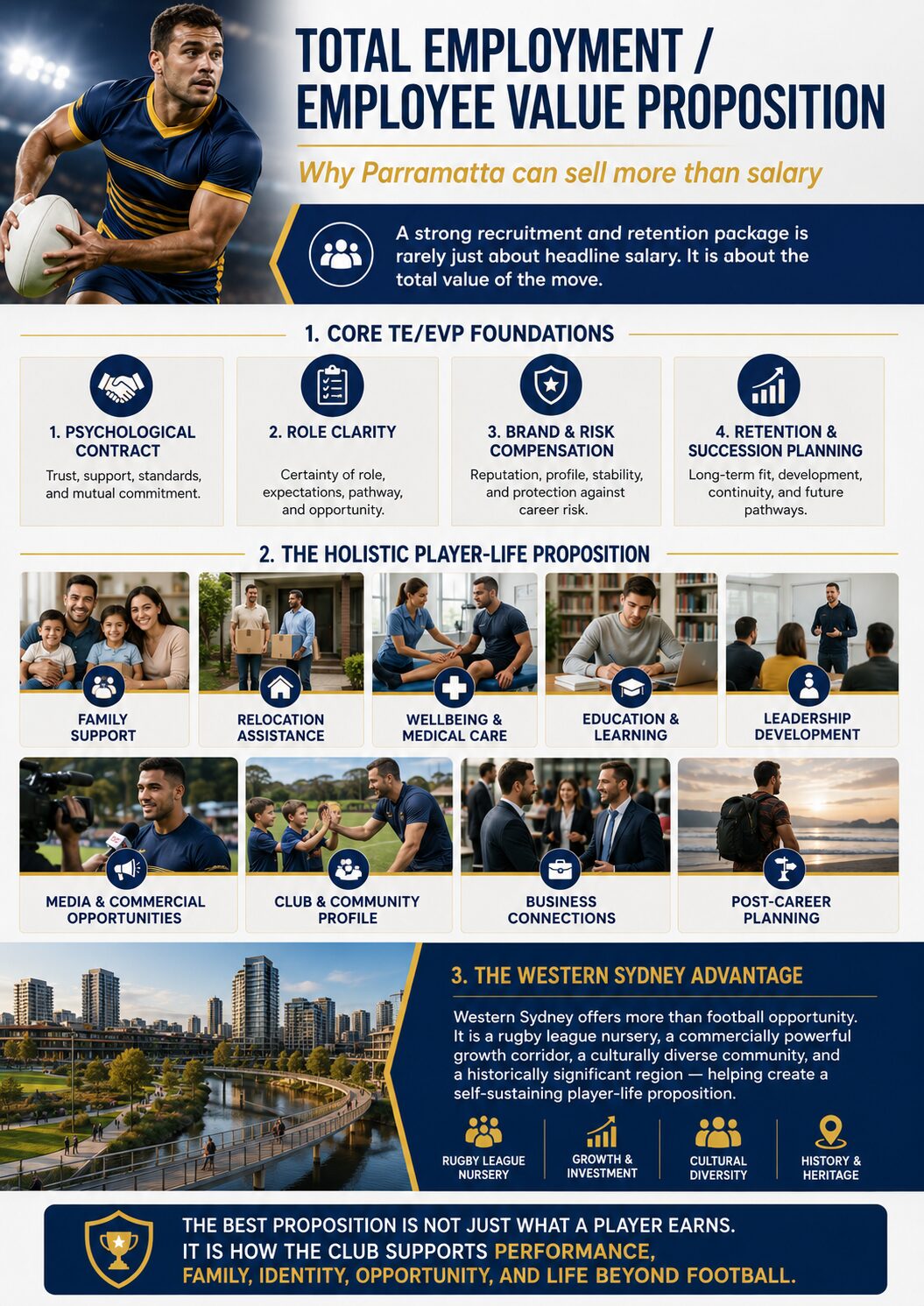
A premium contract goes beyond Salary – Created by the Author using Canva Premium – Sources: HBR; ABS; AIHR
The Psychological Contract
The formal contract is the document outlining salary, period, terms, core benefits and key obligations. The psychological contract is something much deeper: it is the unwritten agreement between the employer (club) and the employee (player) that builds and nurtures trust, opportunity, standards, support and mutual obligation. Big bucks aside, it is essentially what the player believes the club is really promising beyond their pay-cheque. For a marquee player, that psychological contract is not simply: you pay me, I play; it is closer to: I will give you my prime years if you provide me with: role clarity, job security, honest leadership, consistent development, succession stability and evidence of a genuine chance at premiership glory.
Elite players do not want vague ambition, they want evidence. They want to know who the coach is long-term, what type of football the team will play, where they fit in the plan, which players are currently around them, and who is being developed for future seasons. They want to see the clubs projections for what success looks like in years one, two, three and beyond. They want to be shown how the club will support them through any scrutiny, injury, pressure, and family demands they may face in their playing careers and be confident that this will set them on a trajectory for a positive life after their playing career is over.
If the psychological contract is vague, the money has to work harder; if it is stronger, the club becomes easier to choose. That is why an TE/EVP of this magnitude must manifest an appealing and intentional psychological contract.
For the Eels, their psychological contract cannot be carried by the ideals of wealth, hope and history alone. In a competitive market where several clubs are similarly blessed in these factors and are also winning competitions; Parra needs to stand out holistically or continue to be out-bid.
A narrative I have heard many times before we are out-bid reads something along the lines of: “We are a great club, with a proud history and a lot to offer by way of resources and we would love to have said player sign with us”.
That is no longer adequate. And although I acknowledge that I only know the public narrative and don’t know what’s being said behind closed doors, I would like to hope the private sell is much closer to this:
Come to Parramatta not only because we have enviable financial resources, a vast supporter base, a powerful leagues club ecosystem, strong commercial reach, an impressive pathways footprint and one of the most advanced rugby league training facilities in the world. Come because your role will be paramount, your game will improve, your family will be supported, your welfare will be respected, your personal brand will grow, and you will be part of a realistic premiership build.
The psychological contract is the difference between being a contender and sealing the deal.
Role Clarity: Person-to-job and Person-to-Team Fit
An employer looking to fill a high stakes position, does not chase the biggest name available and then work out the plan for them later. They must plan first, then recruit someone who can perform and improve within existing systems, enhance team skills and capabilities, and if/when necessary fulfil the leadership needs of the wider team and the overall objectives of the organisation.
Role clarity in rugby league teams matters because elite players are protective of their prime years. They do not want to be moved around without purpose, be used primarily as a marketing symbol, or be asked to compensate for poor roster design. They want to know that the club has a plan, and that they are central to that plan for the right reasons.
Penrith sells dominance, development and dynasty, the Roosters sell polish, status and representative refinement, Brisbane sells scale, profile and one-team-town power and Melbourne sell consistency and excellence coated in ignorance.
Parramatta needs an equally clear hook that underpins its role clarity pitches to prospective players, and until they taste premiership success this century, it not only needs to be appealing, it also needs to be believable.
Potential Hook: Parramatta sells Diversity, Growth and Sustainability
Corresponding Player Pitch: This is the exact role we see for you. This is how we will use your strengths. This is who we are putting around you. This is how our system will make you better. This is how you help us win. We want you to be part of the next great Western Sydney powerhouse: elite pathways, incomparable supports, clear roles, high standards and a roster built for sustainable success.
Selling the Deliverables: Stability & professionalism in practice, player-centred without being player-burdened, collaborative coaching without being devoid of leadership, autonomy with routine, well-revered but open to critique, demanding without being destructive.
That is the kind of brand serious professionals trust and something a player, agent and family can can be drawn to. Though for the moment, Parramatta may also have to pay above market for certain players in order for them to take a chance on the buy-in, no matter how appealing the original offer and EVP is.
Paying Above Market (when plausible)
Yes, Parramatta may sometimes need to pay above market as the NRL era trophy cabinet is too empty. But that should be a secondary lever, not the primary strategy.
Above-market money makes sense when it buys scarcity and builds foundation for the broader game plan. It can be justified for a fundamental vacant position where an elite player is available, or for a more seasoned but still elite leadership figure who has the potential to lift on field performance and behavioural standards across the playing group. It can also make sense when the player’s arrival creates an acquisition multiplier: someone who makes the next player more likely to come. Though clubs must be careful to ensure these decisions are justified and explained to the existing cohort; because otherwise paying overs simply to win a public bidding war on a whim can be dangerously risky to internal cohesion and external reputation.
- Existing players may begin to ask why loyalty is worth less than external leverage;
- Younger players may wonder whether the club values external reputation more than potential in pathways;
- Senior players may accept a star being paid like a star, but only when the role, output and leadership burden justify the premium.
- Prospective players may question the stability of the clubs purported EVP
Players know the best players earn more, and that certain positions command more money, but they also know when a club has paid for status instead of fit and this will impact retention. Clubs should pay above market for strategic fit over reputation and desperation; but if a player does not fit the coach’s model, strengthen the roster, lift standards and improve the club’s premiership probability, then the money is buying noise rather than progress.
Employer Brand and Risk Compensation
The RLPA pulse result gives Parramatta a valuable flex when it comes to its overall playing environment. Players clearly rate the club well as a workplace and that should be held proudly. But employer brand is not only what members of the club say about it or how the club markets itself. It is what agents, current players, former players, families and rival clubs say when Parramatta is not in the room.
That reputation is shaped by everything: roster logic, contract management, public messaging, injury support, player exits, coaching clarity, media noise, internal standards and how professionally the club appears to act under pressure.
This is where the Zac Lomax situation is relevant. From a legal and governance perspective, Parramatta was entitled to protect its contractual position. Clubs cannot simply allow contracted talent to leave, reappear elsewhere, and receive no fair value in return. Contract integrity matters, and members, players and supporters should expect the club to defend its interests.
But recruitment markets do not only measure legal rights, they feed on perception. While most legal professionals saw PE RLFC v ZJ Lomax as a fundamental step in the right direction, that set the strongest precedent in protecting the integrity of contract law in sport since the Super League War; and even though most rugby league supporters applauded the Eels stance in ensuring the respondent was bound to his contractual obligations to the applicant: The NRL and ARLC saw it as disruptive and The RLPA saw it as a backwards step in player rights.
Further to this, some Players and their Agents may have seen this result positively as a club that is firm, professional and unwilling to be walked over. Though some may have seen a situation that became messy and public.
All interpretations can exist at the same time, but only one is legally binding
That is why clean messaging matters when maintaining a strong brand. Even when a club is right, it still has to manage public trust, and explain decisions in a way that protects the organisation without making the environment feel unstable. Parramatta should never be afraid to enforce standards, but it must do so with clarity, consistency and composure.
That does not mean the club will never be a contender in the eyes of prospective marquee players. It just means that for the moment some players may still look at the Eels and ask whether they are joining a genuine premiership contender or false hope with good facilities.
That uncertainty sometimes costs money. When a player is unsure, the salary has to compensate for the risk. When a player is more certain, the club does not always need to be the highest bidder to acquire the players services
That is the real recruitment challenge. Parramatta should be trying to reduce the amount of money required to make players comfortable saying yes. The more trust the club builds, the less it needs to rely on financial persuasion.
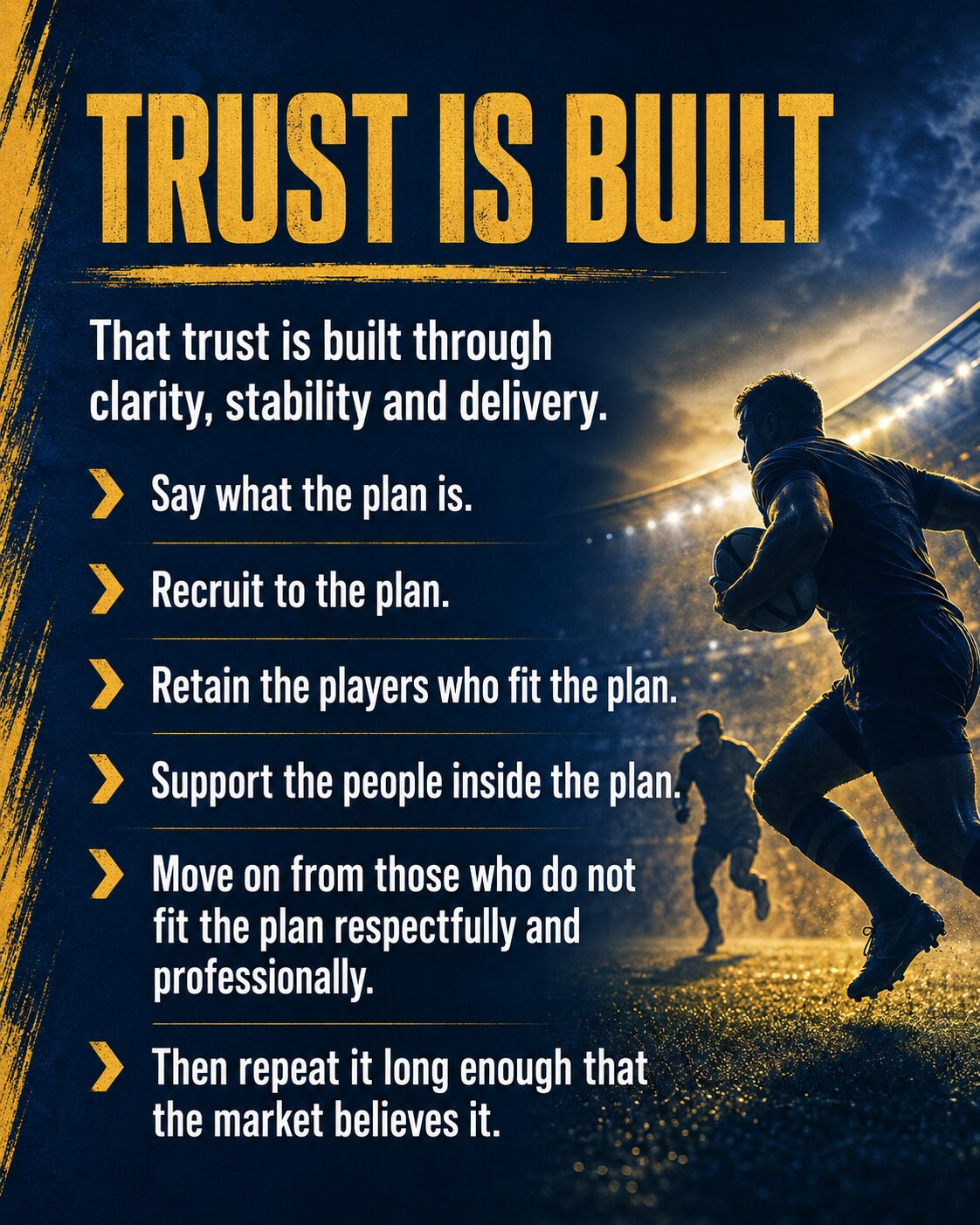
Trust is built through meaningful intentions that lead to results. Source: HBR, AIHR, Kleynhans et al. 2022; AIS.
Proactive Retention and Succession Planning as an Ongoing Strategy and Value-add
Retention and succession planning should not be treated as a last-minute bidding contest, it should be treated as an ongoing relationship-management system.
Their mechanisms should be designed to ensure that all players enter the open market without any uncertainty about their future with the club. Even the players with long-term contracts and those considered safe from departure through geographical or community ties, should be monitored to ensure they remain confident and secure in their role, purpose and with regards to their future with the club.
Current clubs can negotiate with their own players earlier than rival clubs can, which creates the opportunity to proactively manage this across the squad. Theory suggests organisations should always:
- remain mindful of how their key employees are travelling, that they remain emotionally connected to the club and ensure appropriate and adequate maintenance supports are in place (retention);
- know who their future leaders are, develop them accordingly and make sure they know there is a plan for them (succession planning);
- know which employees need role clarity and/or reassurance and which players may be vulnerable to an offer elsewhere; prior to them entering the open market.
If an employee leaves ‘unexpectedly’, it’s a good sign the employer has missed some of these markers at some point during the employment lifecycle.
A strong long-term retention and succession strategy in a rugby league club could develop systems and mechanisms that proactively prevent or reduce the risk of these occurrences by regularly asking themselves the following questions and ensuring any red flags are addressed before they become big regrets.
- Who is central to the next premiership window?
- Who needs to be extended before the market speaks?
- Who needs a development plan, not just a contract?
- Who needs to feel that the club sees them as more than a number?
- Who is being asked to carry too much uncertainty?
This is about managing talent proportionately to the cost of losing talent, because in any high-performance workplace, elite employees rarely leave for money alone. They leave when the total offer elsewhere feels clearer, safer or more aligned with their future.
Parramatta can’t stop every player from leaving, and it cannot pay above market routinely, but it can make sure players are not reaching the market with unanswered questions about role, direction, support or ambition. The lesson is to reduce the uncertainty earlier, before another club gets the chance to frame itself as the safer long-term option.
The Golden Point: Parramatta Must Sell Certainty
Parramatta has the resources, facilities, pathways, fan base, geography and workplace credibility to be a highly attractive club for elite and emerging elite players. It already holds many of the tangible assets elite players look for, along with a strong socio-cultural identity within both its local and broader rugby league community.
The next step is to further establish and communicate the intangible assets that truly influence marquee recruitment: trust, clarity, stability and belief. Because in the end, elite players do not move for resources alone, or simply because the price is right. They move for certainty. Certainty of role, standards, direction, support; and ultimately certainty that their time in there will not be wasted.
That is where Parramatta’s Total-Employment/Employee-Value-Proposition matters. The club must be clear in its motives, stable in its operations and serious in its premiership trajectory. It needs to develop, evidence and market that proposition with the same intent it applies to its facilities, pathways and financial strength.
The challenge is not financial or resource-based; it is relational, strategic and psychological. The club’s TE/EVP needs to focus on these intangible factors and provide achievable benefits, with a clear, evidence-based scope for how they will be delivered. No ifs, buts or maybes, no entertaining external narratives that the whole club needs saving; and no dreams sold on hope and history alone. A good TE/EVP should ask current and emerging marquee players to perform, develop, and lead within a club that has the tools to evolve and knows where it is going.
That is how a wealthy, well-resourced club like Parramatta becomes a destination club that is well revered…In theory
See you at the game next Sunday.
Roly-Poly


That’s a really interesting observation about the Eels and professional life – it makes a lot of sense to look for connections like that.
Maybe our recruitment team (Do we actually have one? Must be the lowest KPI”s in the world if we do) can read this instead of playing video games or cards or whatever the hell they do all day instead of recruiting. Maybe we can add some more under delivering reserve graders to the roster next year? How exciting.
Of course players that are here are going to say they are happy. Where else can reserve graders get paid so well? The low rating for high performance is not a surprise and it shows on the field.
I don’t know about that, I think the performance labs and the mental performance coaches, fan engagement targets and HR all muddy the waters, and dilute what Jason Ryles is aiming for throw cultural *anything* in (not white European culture obviously) and are they even playing for the pride of the club anymore or are they a bunch of self serving individuals getting paid the big bucks holding the club to ransom because they know recruitment is operating remotely from Bali- the formula for mine is simple, recruit well, keep HR away with their thought crime policing, get the right key personnel and put in the work at training. If in doubt have a look at Penriths systems
Have we made it too complicated at Parra?
Wherefore art thou folding some C***?
We run a small pack(smallest) and cop a pounding that would make Bonnie Blue blush week in week out, can’t be much fun there for the boys
Don’t get me started on Moses either.
Up the Parra
Really well written, all excellent points.
The bit that is missing – maybe the next chapter is the question: “And Yet?”
Presuming on some level we sell all these tangibles and intangibles – that we are selling the lifestyle, the quality of employer/employee relationship etc.. we still don’t sign anyone of note in a competitive bid contest.
I would suggest one element you skip over, possibly mention but i think it is a much bigger deal than people give credit to, is ‘future beyond footy’, i.e security. I think today more than ever players look to that.
The Roosters sell life after footy as they have a Board who can and do work with players to set them up for business after football. Google “Ex-Roosters players with their own businesses” and you have everyone from Luke Rickertson to Todd Carney and a couple of dozen ex players in between. The quality and diversity of that Board matters.
Souths and Russell Crowe. Crowe has the power to open doors for players post footy. Whether it is that power or the lure of the celebrity and his convincing, passionate manner, that would sell.
Brisbane. You finish playing at Brisbane and retire from footy, there is a job for you in and around footy somewhere. There is only one NRL club in the city but you have all the footy in and around Brisbane and the Q-Cup, and then there is always the Titans…
The power to help them create a future for themselves is big. As is the power of third party contracts. We simply do not seem to have those sorts of relationships with the commercial world – which is crazy given the size of our club and its location in the commercial hub of Parramatta. Again, you look to the names and influence of people on the Boards at the successful clubs, and our Board doesn’t stack up.
I accept the Player Pulse survey results appeal to some players when looking for a club. They would appeal to me if i was looking for a job in the corporate world. but money and future job security talks. I do think that some of those metrics (not all), are an indicator to a comfortable “work at your own pace” culture, and not one where pushing our players and coaches to work harder than everyone else is driven, which is what it takes to win.
Ultimately though; Some players are going to want the lifestyle of the beach, some being around family, some being in more regional areas. Some just want to grab the most money they can, some grab the only offer they have. Some are comfortable with the money and want to win a comp (i feel like that number is getting smaller), some are thinking life after football. The are a wide range of reasons a player chooses where they land and invariably its is a combination of all of these things.
Parra can offer most of those elements on some level, so it comes back to who is selling it. Who do we think players are more interested in hearing from MoN, or Phil Gould? MoN or Frank Penisi? MoN or Joe Kelly? MoN or Russell Crowe? (and yes, Crowe isn’t going to a coffee shop to convince Bronson Xerri to sign up, but for that big name player, you bet Soley has his number). Who are the Ex Eels that are recent enough and relevant, that would sell Parra as a destination?
I respect the eternal optimist. I wish it were me. But from the glass half empty side, the article shows al the reasons why the Eels should be a powerhouse….. And Yet? We have the resources a player needs, we don’t have the pull power to get them in the building. That’s a Board/CEO/Foot Ops issue that seems unlikely to be fixed.
Well written .. excellent
Spot on BA. I would add that if the current state of affairs is not addressed soon season ticket holders may in these tough economic times start voting with their feet. You cannot continue to ask people, the majority of whom are working class to part with their hard earned money to watch a second class product. People are making lifestyle choices to fit in with tighter family budgets.. This may well be a luxury they are prepared to forgo.
I think that is already happening Joe. I am getting a lot of emails and SMS’s i never used to get on the day before kick off on home games with discounted tickets, and other last minute pushers to try and draw a crowd. Totally fine, but ideally, you have your ticket sales numbers locked down long before 24 hours before kick off. We used to.anyway.
It’s a really shitty reality to face and accept as a Parra fan who’s (like most of you) tired our best to be optimistic because we all saw us play well at the end of last year.
But I’m afraid the eels are dire straights here.
We only have two origin level players on the roster, one is now past that stage (Paulo) and Moses who looks this year like it could be his last state of origin potentially.
What I’m asking here is this. When was the last time parramatta had this little of actual talent in the roster?
If we are being honest Moses best days are unfortunately behind him now. Paulo was an origin player what 3 years ago? He might be done in the NRL soon.
There’s legitimately zero players in the eels roster good enough to be a walk up start for NSW or QLD. Maybe hopegood could fight for a maroons bench spot or extended bench (when healthy).
The eels roster compared to 4-5 years ago is DRAMATICALLY weaker unfortunately and I’m tired of all the excuses and cope people throw around.
There is seemingly no accountability at the top end of the eels: Where is the sackings and accountability for those club “leaders” who are responsible?
Brad Arthur? Oh… he’s actually coming first in the super league. And took a struggling side to #1 on the ladder in 2 years. The way it’s looking – BA might actually have had a more successful career than Ryles. BA (besides last 1-2 seasons) actually had a pretty high winning % rate overall…
And the roster issues BA has while he was at parramatta? WELL.. it appears all of those same issues (inability to SIGN tier 1-2 players) is STILL the same issue at parramatta even under Ryles.
We haven’t won a comp in what 40 years. Can we see ourselves winning a comp in the next 40 years if the club settles on this standard of leadership, staff, and roster?
If we are being honest I would not even be suprised if none of us live to see parramatta win another premiership.
The place has mediocrity and average so engraved into its DNA that fans (and the board l) accept this nonsense, and nothing changes.
If anyone wants to despute me on this and push back. How were the dolphins able to come into the NRL and have better teams & results than us almost from the get go?
The bears and PNG (you watch) will likely have better rosters and results than us in their first 2-3 seasons like the dolphins did.
I’m tired of all the excuses and what not.
Our club is ran by people who are not competent like other club’s leaders, we don’t have a winning mentality CEO, R & R committee, the board etc accepts mediocrity as being “good” so long as we aren’t going broke or being fined for salary cap violations.
Our version of “stability” is good profit coming in and not getting caught breaking the rules.
It’s time the club starts to be aggressive, hire leaders who are proven WINNERS and will not accept this mediocrity that has fully plagued the DNA of our mighty parramatta eels.
“Winning starts at the top” was a famous quote mentioned by our famous coach that won us our last premiership…
Is it time we start to re-visit that wisdom he shared?
Muz also well written in fact all the replies have been very good.
I’ve said it time and again, the reserve grade side exists for the sole purpose of supplying the NRL.
It is NOT a place to park players that will never play NRL to take up space.
Look at the absolute rubbish we have in the Cup side now. Blokes that are either rejects from other clubs or those that sit for years at our club and just dont progress.
Would never happen at one of the professional clubs.
It’s not a charity but we continue to reward blokes like it is.
Can you imagine Gus Gould putting up with blokes that don’t cut the mustard for years upon years ? Or the Storm/Roosters ???
Players at flegg level want to progress but their path is inevitably blocked by these potatoes and they look for other clubs.
We are so very scared of daring to win, to expose a player lest he crumbles and dies.
We really are the nanny club in the NRL.
The tigers are an up and coming club. They filled the club with the best juniors and PLAYED THEM !!!
They will not be on the bottom again for years.
People laugh but St George will be an absolute powerhouse next year.
Recruited really well.
If the Eels just sit and wallow and make excuses like injuries etc then they are dead set certainties for the spoon for the next 2 to 3 years.
I just don’t see any teams that are going to be below them.
Look spark dragons have recruited well, tigers have in recent years, bulldogs and even titans potentially could be stronger than us over the next few seasons going off their emerging talent
I and concerned we are sleeping walking into potential wooden spoons again
If we fault to recruit and rely on two old players in Moses & Paulo
We are in a extremely vulnerable position
Yep. And with the two extra teams, it is going to become a more competitive market to try and secure players.- something we already can’t do – making it even harder to get off the bottom.
I think the Eels situation, with no change in management, is bordering on a 3-5 year project just to get back in the battle for 8. The optimistic fan doesn’t see it that way, but as the realist/pessimist i don’t see how one see’s it any other way – unless we have a massive change in philosophy, or human resources in our Front Office and Board..
Location location location!!
I grew up in Winston Hills and now live in Newcastle and commute to most Home games so this is a view from a distance of the structure of the Club.(yes it was a very solemn drive home up the freeway on Thursday evening with my young daughter. I couldn’t convince my wife and other daughters to come.)
I feel our great club committed a big own goal by setting up a centre of excellence along way from the dead centre of parramatta.
I feel they need to move the first grade squad to training in the heart of Parramatta immediately.
Can you imagine when they reached out to Herbie Farmworth and he said “where do I have to train? I can respond exactly as he did “are they joking.”
If we had Setup in the dead centre of Parramatta, he could’ve lived in any of the many blue colour suburbs that are within a 40 minute drive to the centre of parramatta .
We could’ve poached players ( we used too) from any other Sydney club without them having to move house or suffer the extended commute. Realistically, if given another option no one in greater Metropolitan Sydney is going to move house because they need to be closer to Kellyville.
The commute went from reasonable to a bit of a stretch as soon as we moved to Kellyville.
What’s more half of our quality kids come from south western Sydney so they’ll be reviewing which club they’d like to join and whether they want to travel to Kellyville as well.
It’s the “Parramatta eels” not the Northwestern Sydney eels.
The West Tigers are having more success with recruitment and I believe their centre of excellence is in Concord. Go figure.!!!
Have a clear vision (Premiership), recruit and retain based on those who have that as their top goal, give them clarity on our game plan and their role in achieving it and repeat.
Our players assessing “Club Benefits” as our only A concerns me as this suggests they value what’s provided to them, not necessarily what THEY CONTRIBUTE to success.
We currently recruit guys who are happy they got another NRL contract and it shows.
We need winners who know what it takes and hold others accountable, not players who are prioritising prolonging their careers.
I don’t pretend to know as much about NRL prop forward play as Jason Ryles
Maybe Keiran Foran does.
I see that Manly has signed Toni Mataele. Who clearly we didn’t want.
Manly has a record of hiring Eels players we didn’t want. Jamie Lyon n(who maybe we wanted but couldn’t keep), Steve Jackson who tackled Terry Lamb out of the 2006 grand final, The Wolfman Williams who couldn’t get a run with us but won a premiership with them and played for Australia, Trent Hodkinson who couldn’t get a run with us but won a premiership with Manly and won a State of Origin. Two current members of their current pack who couldn’t get. a run with us on our junior reps, one who will play with NSW next week, Sean Keppie who have them excellent service before moving on to South’s.
I think that there’s powerful evidence that Manly have got people who are better judges of our juniors than we are.
Good luck to Toni Mataele. I think he’s a very good footballer.
And Tony Williams….
And Nathan Brown (to a lesser extent – but he would still start in our pack today)
Coming the other way we got the corpse of Foran, the corpse of Watmough, the corpse of Hopoate. A single good season of Shaun Lane, Morgan Harper… i mean sheesh…
Dealing with Manly has not served us well.
… Mind you, they can keep Jamie Lyon…ingrate.
Let’s not forget Jeremy Ticehurst.
Se, of course have signed players from Manly. Remember Keiran Doran’s time with us? Remember Anthony Watmough?
Great article – and well thought out. Very similar to the analysis on the Parramatta Eels that was written on Gainline Analytics which identified numerous problems we have had for years and noted all the points mentioned above – and from the top down.
But for Eels fans – the question is – where do we go from here – and who do we go there with.
Ultimately, we do need an experienced Head of Football to take control of recruitment and retention – build a team around them – back the coach and then get him e the recruits he wants, and then retain the players we develop that the coach wants
And the current powers that be need to be able to step back and hand over control and let a new person to run that part.
No difference to how a new management team comes in to a failing business and fixes the place up – the previous leadership team in a business needs to say that what they were doing was not working, and new people need to move in.
But who is that person ?
I still believe we have upside with resources and facilities – but something is wrong in retention and recruitment
Compare where we are at – with what the Dolphins have built in 3 years.
Hey Greg, do you have a link to that article? I am not familiar with the article or the author/publisher; the but would be interested in reading it.
The actual article – i dont have the link. But you can find the author on LinkedIn – Ben Darwin. Company is called Gainline Analytics – and you can subscribe to the emails, or read the posts on linked in . Very interesting to read
Actually – I found one of the articles – unfortunately it mentions that Eels in it…..as one of the 6 profiled teams
https://gainlineanalytics.substack.com/p/10-years-on-where-are-they-now
In any team/business the primary goal should be continuing improvement and the right management in place to deliver that. Not even a generous assessment of our R&R team would be anything more than acknowledgement that the quality of the eels top 30 has been on the decline since 2022.
It can’t be a case of let’s recalibrate by sucking up another few years of rebuilding particularly at a time with new teams entering the competition. When/how will that happen with the same people at the helm?
While other clubs appear to be recruiting to significantly improve their roster, or at the least add good depth, we continue to sit on our hands. That might be that the eels R&R don’t leak targets but just as likely that it’s because they’ve not landed any.
Regardless of what players are recruited for 2027 it can’t continue to be so hit and miss and I’m all in for the changes in the R&R team.
I know a lot of us on here have expressed frustration or concerns regarding people who run the club, roster decisions, inability to sign players, etc.
But hear me out.
I had a thought just then I sincerely believe this because we saw this under BA as well.
I actually think that parra would be a near top 8 side right now if we had two genuinely good props, at least one origin prop.
I think that if you stuck a Payne haas or a Moses Leota at the eels, and one other prop to partner him who’s in their prime.
We would nearly look like a completely different side and be winning some of those close games we lose.
I actually think ryles sliding defence, attack (at times), development of younger players has shown to be pretty good.
What’s missing? Two big strong in prime props. The eels have a middle forward issue.
Can you imagine prime Jnr & Prime RCG running up the middle for this team we have? With the speed we have in a few of our backline players.
I’m actually convinced since thinking about this that the eels need to go all in on TWO elite props, one of them your $700k – $1.3m prop (pay overs if needed) you need middle forward ONE leader.
Then get another prop who’s on the up, very established, maybe 1-3 seasons before his prime, or only just past his prime. $650 – $950k.
We used to have two elite props at parra in RCG & Paulo. And we won more games than we lost.
I can actually see this spine, and outside backs looking vastly improved just by not playing off the back foot in every single game.
I know we get critical of our backs, Moses included.
But have we ever seen Moses (or any halves for that matter)… THRIVE / destroy opponents when they’ve been on the back foot all game? Almost never.
We currently do not lay a platform up the middle. We lose the middle every game. There’s no go forward momentum.
I actually think Jason Ryles needs to swallow his ego here and self admit the “mobile pack” experiment really hasn’t worked this year. Hasn’t worked this year especially.
See the top 8? ALL of them have a stronger forward pack than ours. Panthers and warriors especially basically dominate every team up the middle of the park.
Their forward packs are very dominant. There’s no teams who’s losing the middle as much as the eels (as far as the eyes test goes)…
Could putting all our chips into two tier 1-2 level props completely change our results?
No argument. The problem, of course, is finding them. I had hoped for Mataele but he’s moving on
Su’A at he’s best is a very good forward though ,he’s not a particularly big man by NRL standards. Doorey, Moretti and Guymer all are signed for a year or two and they can all play football but they are all part of the “smaller, more mobile” experiment.
I would have been starting Mataele who is both big and fast. We certainly gave him scant encouragement.
That’s all well and good Muz (you’re sounding like an optimist), but how do we sign that player? Wouldn’t that player have been Koloamatangi? Wouldn’t have literally been Payne Haas? (we didn’t even get in the room with him).
I don’t know how we land that player and once we do, I don’t know how we build around 1 prop with what we have. A spine that is years away from its peak (if it has a peak), we don’t have a 5/8 and by the time we get one, chances are the halfback will be done – either in skill level or will to win. We don’t have a backrower who can run an attacking inside out line and we don’t have a centre who can run over or around or just out run (take your pick) his opponent.
A big gun prop would be a great start, but it is far from the complete answer and the quesiton remains, how do we get one?
Ba sports I agree with what you are saying
And regarding how to sign those players like Keon (who we missed)..
Our club MUST pay overs for a few select players, be aggressive
We go in thinking we are smart and “don’t over pay” which in theory sounds nice
But in reality people do not want to go to this club, there’s no current or recent success in history, AND, we don’t pay overs either?
You can understand why they don’t come when you think about it from their perspective
The only solution is to over pay on 1-3 key marquee players then drag along all the younger players & vets at the eels
There’s no other solution, the eels cannot sign players – there’s a reason for that.. money
We can over pay for select players I think, it’s only a big issue when the player is OLD or very injury prone
Look at brown and ponga at Newcastle eels fans would go mad if eels had those two players were signed at over a million per year
But guess what? Both of them are still kind of young, could be 5+ seasons of NRL left for both of them
They went from wooden spoon to 5th place in one off season from recruiting a sold half in brown to combine with ponga, and hiring a proven NRL coach
While the eels are 3rd last and are currently on a trajectory to be even worse in 2027 should the eels fail to recruit any significant props or halves to bolster the team
Paulo and Moses are looking very aged, and way past their primes, there’s no tier 1-2 players besides them on the roster who can lead a team around
Eels have to be aggressive or risk wooden spoons, it’s very possible dragons & titans improve more than us by next season going off their rosters & recruiting for 27’
Thoughts?
Tks Roly. You and Ray Price have something in common…a strong grasp of philosophy, just expressed rather differently!
Getting flogged by 50 odd in the first game of the year doesn’t exactly attract positive interest from elite players..there’s a saying about first impressions. So whatever the sales pitch, the evidence has flaws. The evidence also indicates our sales pitch, however well tuned, isn’t reverberating. There exists a case for different execution by different people. If we were a public company, continuing the same things would be cited by shareholders as insanity.
Well I knew this would be a conversation starter but this goes beyond my expectations. All really great points and views with one thing in common, wanting our club and team to improve, progress and perhaps win before we all cark it.
I don’t pretend to know what I am saying from running a football club. I was just applying executive recruitment theory and correlating legislation to the broader situation and essentially saying completely gutting is probably not a good idea (maybe some selective changes in the pain points of the acquisition process though). whatever we do, it cant be nothing and it needs to be more proactive.
Sorry i haven’t been able to reply to everyone individually of late. I am managing family stuff similar to sixties, with FT work so juggling a lot.
But I am really grateful for everyone’s engagement and want to say thanks to you all for all the insight you have provided. This is a great example of a healthy online discussion that is critical without becoming cruel. Keep it going.
Thanks again
Well written Roly and quite informative. I love the fact that you’re an optimist and you keep things possitive on here because as you know there is a lot of negativity creeping in and being posted.
I’m not sure if anyone was listening to the Saturday Scrum on triple M on the weekend and their interview with Jason Ryles because I found it really good to hear from the coach and what his thoughts were. He was saying that the club is looking for a middle forward and an outside back to add to the roster but acknowledged that with the Bears and PNG also looking it is quite difficult. He was also saying about all the young blokes and regies in the side and how it is difficult for them to stay up for games week after week and that their performances have highs and lows because of well, who they are. He is dissapointed and frustrated because he see just how hard they are working at training and then they shoot themselves in the foot during games( as we’ve all seen).
While I’m as frustrated and get the shits as much as everyone after winable games I do try to temper it with a bit of objectivity at our current situation.
As well as the Bears and PNG the League has announced that there will be a new side – probably Christchurch in 2030. That means that, under current rules, they can start recruiting two years from the start of November and no doubt will be competing for some of our superior existing talent.
Do we have sufficient league talent to fill 600 senior places? I personally don’t think so! I predict that the fate of a couple of teams will be to get mercilessly flogged week after week. It is simply vital to hang onto such elite talent as emerges in your club when it emerges.
Yeah Noel I didn’t think about the extra extra team coming in. I agree that the amount of talent available will be stretched to say the least. A vital position for any club will be talent ID and making your club an attractive place to go. We definitely have work to do in that regard but hopefully with the things Roly wrote about above and fingers crossed we show improvement on the field we start to become a club players will want to come to.