
Greetings TCT Readers, happy bye-round and welcome to another edition of TCT Golden Point. This week I look at the broader cultural and administrative issues beneath the Ashley Klein gambling controversy. As always I hope you find it insightful and engaging.

THE GAME BEHIND THE GAME: GAMBLING CULTURE AND THE ACCOUNTABILITY GAP
On face value, Australia’s gambling culture and corporate risk-management frameworks appear to be worlds apart. But in rugby league, both expose the same uncomfortable truth: many of the game’s biggest problems begin with questionable decisions made behind closed doors, by decision-makers whose identities remain unclear, within systems where accountability is blurred, delayed or absent.
On Friday 12 June, Chris Barrett of the Sydney Morning Herald published an article exposing what has since become apparent was a well-guarded secret within the game: for several years, one of rugby league’s most senior referees, Ashley Klein, had a significant gambling problem. According to the report, Klein lost an estimated $400,000 betting on greyhounds and horse racing through corporate bookmakers, while the NRL had been aware of the matter since 2019. As part of the SMH article, Klein acknowledged a past gambling problem, stated that it did not involve rugby league, said he ceased the activity in 2023, and insisted it never influenced his work as a match official.
That evening, the NRL effectively responded to the exposed handling of the matter with an opaque and inauthentic statement that, in my view, amounted to this: we knew, we investigated, we were satisfied no NRL rules or policies had been breached, and we allowed Ashley Klein to continue refereeing. Now that the matter has been publicly revealed, we will acknowledge our prior involvement without properly explaining what safeguards, restrictions, monitoring or independent oversight were imposed (if any), and we will say no more because it is an internal employment matter.
For mine, the NRL’s response reduces a legitimate public integrity concern to an internal HR issue, and asks the rugby league community to accept trust on demand, without transparency, accountability or meaningful reassurance.
That is what makes the Ashley Klein revelation so confronting. It is not simply a story about one referee with an addiction, it is a story about gambling, welfare, integrity, transparency and governance colliding in a sport that has normalised betting and administrative secrecy; while asking the public to simply trust that its internal safeguards are adequate in theory and practice.
The Uncomfortable Truth
Broadly, this situation highlights a well established and uncomfortable truth: Australian sport has a gambling problem, and the NRL is no exception. That does not mean every gambling-related issue is corruption, nor does it mean every person who struggles with gambling should be publicly condemned. But what it does mean is that the NRL can no longer pretend gambling is only a personal risk, when it is evidently and unashamedly embedded within the games commercial model, broadcast product and spectator culture.
The issue is not simply whether or not Ashley Klein bet on rugby league, its whether the NRL managed a foreseeable integrity risk in a way that protected public trust? The deeper issue is that Australian sport has built a gambling-dependent environment and then acts surprised when gambling harm and integrity concerns emerge from within it. Much like tobacco taxation, where governments publicly frame policy around health while quietly relying on billions in revenue from the product causing harm; our game has developed its own health v profit contradiction.
Betting is treated as dangerous enough to restrict, ban or regulate for players and officials, yet normal enough to advertise, sponsor, promote and weave into the fan experience. Fans are surrounded by odds, multis, bonus bets, sponsor logos, stadium signage and betting prompts. Gambling is no longer sitting outside the game, it has long been invited into the broadcast, the commercial model and the broader culture. It is sold as entertainment, analysis, engagement and part of the spectacle; but when gambling addiction impacts people inside the sport, the system treats it like an isolated personal failing; and therein lies the hypocrisy.
Players and officials are expected to protect the integrity of the game by keeping their distance from betting. But clubs, codes, broadcasters and commercial partners continue to benefit from the normalisation of betting around the game. Individuals carry the moral and professional risk, while institutions bank the revenue, and that contradiction is no longer sustainable.
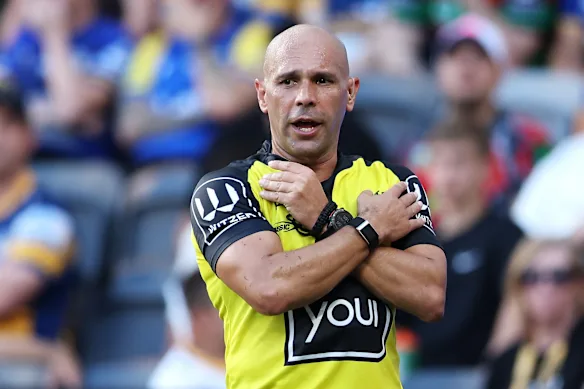
No Try? Or No Deal? Who holds the broader responsibility and what parts sit with Ashley Klein – Source: NRL
The Higher Integrity Burden: Why Referees Must Be Held to a Stricter Standard
A senior match official is not an ordinary employee; and with the level of power, control and oversight they possess, the expectation that their actions will remain integral and compliant must be held to a stricter standard. In many workplaces and professions, employees/practitioners and their families are excluded from certain contests, promotions or activities, because even the appearance of unfairness can damage trust. In my own profession, I accept that there are restrictions placed on me that do not apply to other people in day-to-day life. I cannot maintain a public online presence in the same way others can, and I cannot turn a blind-eye to unlawful conduct within my area of professional specialisation/responsibility even when I am not at work. That is not control, over-policing or censorship; it is an application of the reality that public perception, professional integrity and employer reputation matter at all times; and every person is accountable for their contribution to the problem.
The same principle should apply to NRL referees because their role carries a higher integrity burden. A referee’s decisions directly influence multiple aspects of the competition, both on and off the field. Allowing referees to gamble on sport in any form creates an unnecessary public perception risk, undermining trust in match integrity and competition fairness and the credibility of the game itself. If ordinary professionals are expected to avoid conduct that could compromise public confidence in their employer, product, service or purpose, the NRL should exclude referees from sports gambling to protect the perception of fairness, the integrity of results and the trust of fans. There is also a strong argument that elite referees should be subject to stricter disclosure, monitoring and conflict-of-interest rules around all gambling activity; not because they are inherently untrustworthy, but because their role carries significant power.
Risk Management Is a Trust Function
Organisational risk management directly impacts public trust because trust is shaped not only by what an organisation knows, but by how openly, consistently and proactively it manages what it knows. At its best, risk management proves that an organisation is not merely reacting when something goes wrong, it shows that risks are identified early, warning signs are taken seriously, controls are put in place and decisions are communicated clearly. It tells the public: we understand our responsibilities, we are monitoring the risks, and we are prepared to act before harm occurs. When risk management is hidden, defensive or overly reliant on internal reassurance, public trust erodes quickly. Pretty soon people begin to suspect the organisation is protecting its reputation rather than protecting the stakeholders affected by its decisions; and that’s when predictable risks start to present as negligence, delayed action as indifference and poor communication as secrecy.
This is why the NRL’s response to this feels inadequate. If they knew about the matter in 2019, investigated it internally and found no breach, then why hide it? Whether their actions satisfied their own employment and compliance processes is irrelevant and “we looked into it” is simply not enough, because public trust requires more than an internal conclusion, especially when the person involved is one of the game’s most powerful referees, and when the game itself is deeply entangled with gambling revenue, advertising and markets. A sufficient investigation for an adverse event of this type should not just ask whether any rules or policies were broken, it should also ask questions about the system around them and whether it contributed to the creation or magnitude of the problem.
Fans and the broader public, as the primary consumers who fund the spectacle, are entitled to ask legitimate questions. Scrutiny of the NRL’s handling of this matter does not require a flat accusation of corruption against Ashley Klein. It requires only a reasonable concern about transparency, safeguards, oversight and public trust. For mine, there are two central questions the NRL still needs to answer:
- If there was no rugby league betting, no rule breach and no impact on officiating, why was the matter not disclosed in 2019 when the NRL first became aware of it, or when its internal investigation concluded?
- Now that the SMH has brought the story to light, why has the NRL provided so little transparency about the process, safeguards, independence and monitoring that allowed one of the game’s most senior referees to continue receiving major appointments after the matter was known internally?
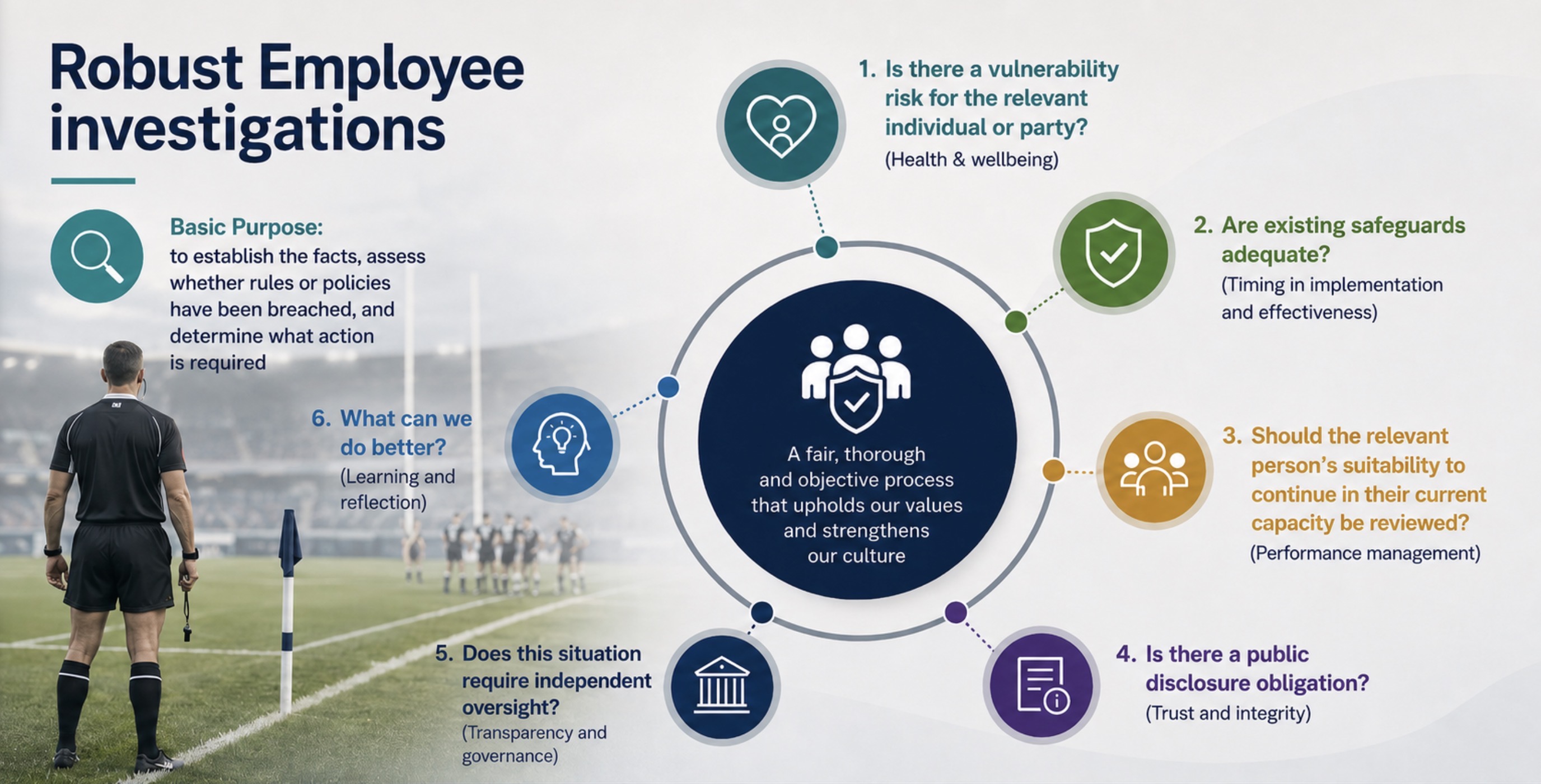
What did the NRL’s Investigation Involve? It’s anyone’s guess – Created by the Author using Canva Premium
There may have been good personal reasons not to expose every detail. Gambling addiction; like any addiction; requires careful consideration of personal privacy, welfare and dignity. But there is a significant difference between protecting an individual’s private health information and disclosing nothing about how a major integrity risk was assessed, managed and monitored. There is no legitimate reason for the NRL to say virtually nothing, then respond so flippantly once its lack of transparency is exposed. When an integrity issue of this magnitude emerges retrospectively without a clear explanation, fans cannot be expected to simply trust the administration’s opaque conclusion without asking legitimate questions.
An integrity-based response would not be “trust us.” That is not good enough in a gambling-saturated sport. A more appropriate response would be: here is who assessed the matter; here is whether the process was independent; here are the rules that applied; here is why no breach was found; here are the safeguards imposed; and here is how the game protected both the individual and the integrity of the competition.
The Governance Problem
The Ashley Klein situation also raises broader governance concerns in our game. Strictly speaking, the ARLC is not without oversight as the Commission exists as the game’s controlling body, with clubs and state leagues as key stakeholders. But the concern is functional oversight: whether the structure allows enough independent challenge when integrity, gambling, refereeing, discipline and commercial interests collide.
That is why the executive-chairman debate from my previous TCTGP is so important (See: The Executive Exit, The Power Shift & the Corporate Minefield)
In Summary the issue is not whether one individual is capable, popular or commercially successful. The issue is whether power, commercial ambition and integrity management sit too closely together. If the chair also becomes the executive driver of the organisation, the separation between board oversight and management action becomes blurred; and in moments like this, that matters. Strong governance requires leadership structures that are open to scrutiny, not insulated from it. Integrity is not protected by secrecy. It is protected by independent processes, visible safeguards and decision-making strong enough to be questioned.
Concurrent Welfare Support
Problem gambling is a health and welfare issue. A past gambling addiction should not automatically end a persons career, and his recovery should be supported with dignity, privacy and care. For any person dealing with or recovering from gambling addiction, the mental health and welfare component of their ongoing treatment is real, and it should make the discussion more careful, but it does not make the issue irrelevant.
While Ashley Klein deserves support, privacy and dignity; as an elite level match official, a gambling history cannot simply be treated as a private employment matter; and welfare support and integrity management at this level must co-exist with proportionate individual accountability and consequence measures.
The Line in the Sand
The Ashley Klein revelation should not become a crusade against one person; it should become a line in the sand for the whole system. The deeper issue is that the NRL (and most other Australian sports) have allowed gambling to move from the margins of the game to the centre of its commercial identity, while still pretending integrity can be protected by individual rules alone.
- If gambling is dangerous enough to threaten integrity, then it is dangerous enough to question its place in advertising, sponsorship and fan engagement.
- If gambling addiction is serious enough to require welfare support, then it is serious enough to stop flooding supporters with inducements and normalised betting content.
- If officials and players are expected to avoid gambling conflicts, then governing bodies should be expected to confront their own commercial conflicts too.
Furthermore integrity in managing gambling in our game requires more than telling players and officials what they cannot do. It requires:
- Governing bodies to examine what they are willing to sell;
- Transparency when concerns arise;
- Independent processes when public confidence is at stake; and
- The courage to admit that the current relationship between sport and gambling has gone too far.
The Ashley Klein situation and how it has been “managed” exposes a contradiction the NRL can no longer avoid: a sport cannot normalise gambling for profit, manage integrity concerns in private, and then expect public trust to remain untouched. Trust is not protected by silence, it is protected by standards, safeguards and accountability the public can actually see.
See you at the game on Thursday and thanks for supporting The Cumberland Throw
Roly-Poly


Thank you Roly-Poly. I am conflicted as I don’t think Ashley Klein should be hung out to dry, so was for the discrete approach. However, that is clearly not appropriate and more serving the NRL interests than anyone else’s. I do have a major issue with gambling in the game – it is completely hypocritical to say gambling is ok and smoking and alcohol not, when the social ramifications are, if anything,,worse.As always, thank you for putting into writing the thoughts of many fans.
Gaby, whilst I too have concerns about Klein’s privacy, I reckon Roly addressed this well. Furthermore, I reckon that the NRL made the situation worse for him by it being exposed by a journo.
Great write-up with some very good points made. As I understand it, Klein was not found to be betting on NRL games; rather, he lost his money on horse racing and greyhounds via corporate bookies. Given this is not related to his circle of influence, he did nothing wrong and as an adult has the choice of how he spends his own money.
It’s worth noting that “responsible gambling” is very much down to individual circumstances. While most people would consider $400k over 4 years to be a substantial amount of money to lose and would cause significant issues, for others, this may not be the case. Without knowing Ashley’s financial circumstances, it’s hard to say either way.
That said, sports betting is the fastest-growing form of gambling in the world, supercharged recently by multiple US states regulating it. According to the Australian Gambling Statistics (40th edition), in 2023/2024 Australians lost over $8.4 billion on sports betting and racing. This is a huge market, with a massive portion of sports betting coming from bets placed on NRL and AFL games. Sports betting companies aggressively market towards young men, who are at the greatest risk of experiencing gambling harms.
While the NRL needs to be seen to be doing their bit, make no mistake—they are very much embedded in a broader sports-betting culture that normalises gambling for institutional profit. So it’s no surprise they kept this story as quiet as possible, given Ashley didn’t lose the money betting on the NRL, or bring into question the integrity of his officiating.
As highlighted in the Four Corners exposé ‘Game, Bet, Match’, many sporting organisations actually get a percentage of the bets placed on their sport. It was reported the NRL gets 1.2% of each bet placed on NRL games, and that percentage can increase for riskier bets or premium events like the State of Origin and the finals series.
With the NRL earning an estimated $50 million from this arrangement in 2022 (and the AFL around $30–$40 million), the code has built a massive reliance on this revenue stream. While Klein’s specific losses went to racing bookmakers rather than rugby league turnover, his situation highlights the exact cultural contradiction you mentioned: it is highly unlikely the administration will implement any significant deterrents to sports betting advertising or sponsorship any time soon when the wider business model relies so heavily on it.
While gambling can be fun, it’s important to keep in mind that the odds are always in favour of the bookmakers, and the longer someone bets, the greater their chances of losing.
I believe there should be more education around gambling, especially for younger people. It’s important that they are aware of what gambling harms are, understand how the mechanics work, and have the tools to make educated choices if they choose to gamble.
So the issue would have first come to light for the previous administration of the NRL. I wonder how the weight of conversation balanced out. Was it the welfare of the employee? That’s fair. Was it brand damage? I would think without doubt. I can only assume that the rights of the public to know featured minimally.
It’s interesting to see how these administrative gaps can really fuel deeper cultural attitudes around gambling.
Great article. Recent years has seen a concerted effort by those who make millions from gambling – and that’s not the punters – being embedded in the rugby league experience. It is insidious and exerts a disproportionate influence on the marketing and structuring of our game. Right from the beginning it was my belief the whole Las Vegas push was primarily about expanding betting markets. Let’s not forget the NRL’s chairman is a racing / betting man to his back teeth. It’s a blight upon the game and a seriously dangerous at that.
Jim I agree about the Vegas push. Without question it has been successful in achieving the Australian Sports headlines, but in terms of making any mark on the American sports market it just hasn’t.
Thanks Roly,
Another inciteful post on a matter of immense importance. Integrity is everything and must be seen not just mouthed from on high.
Like you, I’ve worked in areas where I’ve had social media and many other aspects of life curtailed as part of integrity, governance and anti-corruption regimes. The money involved and cultural importance of professional sport in Australia means these regimes should be of the highest standards.
A point not really touched on is the risk of organised crime taking advantage of vulnerabilities emanating from an individuals gambling debts. In this instance we’ve had an NRL referee with large losses/debts in other sports. There is nothing to stop organised crime figures taking advantage to pressure a referee to do something. Doesn’t have to be fixing a game. Could be simple spot betting outcomes, say three penalties in the first four minutes etc.
We’ve seen minor league soccer players in Australia beholden to organised crime to fix games and it has occurred overseas. So it is not some fantasy.
That is why transparency is paramount. To be brutally honest the first step in NRL is that all officials should be banned from betting/gambling with a strict oversight regime.
I could add a plethora more things here but will leave it at that for now.
Good write up – lots of valid points, much which I agree with.
I think your average person, who doesn’t work in and around gaming and gambling is probably not aware of the time and level of checks and balances around AML mitigation, consumer protection, and other risk related areas go into the governance of businesses in these industries of gaming and gambling. Its probably a valid position to say “if it requires that much scrutiny to deliver, then just ban it and remove the risk al together.” But as we know, that just opens the door for unregulated options which in this day and age of dark webs etc, could be even worse.
Good governance is critical. I think the ARLC/NRL has a huge problem with a Chairman who is effectively a CEO and a Board who are unelected. Its probably a much broader topic. And it is reasonable to think, if the governance is so overtly poor at that top level which we can all see, what does it say for the policies and approach at the back end which we don’t see?
I understand peoples concerns with gambling in general. I think they could look to putting limits on how much a person can bet on an outcome, or how much they can bet on multiple outcomes on a fixture. Doesn’t solve all the problems but limits them. Probably reduces the investment these businesses put into sport, which hurts sport. Its catch 22.
Generally speaking if you work in a licensed club, you won’t be allowed to play the machines in that Club (on or off shift). Should refs be banned from betting? On the NRL? Of course they shouldn’t bet. On sport altogether? Probably. They should be held to a higher standard. If they have large debts, they are at risk of being influenced to alter an outcome for someone else who might help them with the debts. If you want to be an NRL ref, you can’t bet on sports/racing. Is that too much to ask?
As it speaks to Klein. He did nothing wrong. it isn’t an integrity issue with him per se. It more speaks to who he is and what we have seen for years. The arrogance to think he knew the outcome of horse racing results, double down by the arrogance that he could bet his way out of it, is consistent with the attitude we see on the field where he thinks he is the smartest man in the room. Seeing things no one else see’s. Thinking his way of managing a game, is better than everyone else’s, so he does it different. The arrogance is consistent with the first hand accounts of young Ashley Klein and his behaviour and confidence in social settings with the ladies. Nothing illegal or wrong, just the way he went about it was… interesting and very confident according to those who claim to have had first hand dealings.