
Hey Parra Fans, Welcome to this week’s issue of TCT Golden Point, happy game-day and greetings from sunny Townsville. This week I am looking into regulation, power and influence across the NRL, and how it impacts the game’s core employment relationships. As always, l hope you find it insightful and engaging.

REGULATION, POWER & INFLUENCE – IT’S JUST FOOTY A BUSINESS
As rugby league evolves within an increasingly complex environment of regulators, administrators, officiators, broadcasters, media personalities, player managers, sponsors and political stakeholders, scrutiny around the integrity and transparency of those shaping the game’s systems, outcomes and narratives continues to grow. The NRL is no longer just a sporting competition; it is also a multi-million-dollar entertainment product, media asset, and cultural institution. With that growth comes increasingly complex professional relationships, external influences, and conflicts of interest.
Importantly, in professional sport, overlapping professional interests are often unavoidable and do not automatically constitute a conflict of interest. Former players move into media, coaching and leadership roles, commentators maintain relationships with clubs and agents, broadcasters pursue commercial outcomes, and governing bodies attempt to balance entertainment, expansion, financial growth and player welfare simultaneously.
The issue is not necessarily that conflicts exist, but rather what can occur when they are insufficiently disclosed, separated or managed. Even where no rules are broken, perceived competing interests can erode trust, transparency and confidence in decision-making.
Over time, perception itself becomes significant because the games longevity relies heavily on public trust and confidence:
- Fans invest emotionally and financially believing the competition is fundamentally fair.
- Players expect welfare, judiciary and contractual matters to be handled independently and consistently.
- Clubs expect governance standards to apply evenly across the competition.
Once enough doubt enters the system, even without evidence of corruption, confidence in the integrity of the game can begin to weaken. This is where the distinction between illegality and governance risk becomes important.
This week’s golden point aims to address increasing fan concern regarding perceived conflicts of interest, particularly at macro-level; and highlights that the greatest threat to our game posed by external influences and their competing interests is not criminal misconduct, but rather the gradual erosion of public trust & confidence in the governing bodies decisions, motives and priorities.
Perceived Conflicts of Interest in Rugby League
Conflicts of interest in any professional environment; sporting or otherwise; are frequently viewed as arising only when a person or business obviously occupies two competing roles at once. That is certainly one significant form of conflict, but it is not the only one, and often not the most important.
The most difficult conflicts to identify and manage are often structural rather than individual. They arise when governance systems are exposed to overlapping incentives that are insufficiently separated, regulated or scrutinised:
- Regulators may face pressure to prioritise spectacle, expansion and audience growth.
- Media figures may reinforce narratives that align with commercial, relational or organisational interests.
- Sponsors and commercial partners may receive strategic prominence despite broader ethical or social responsibility concerns.
None of this automatically implies corruption or misconduct. The risk instead lies in how concentrated influence and overlapping incentives can gradually shape priorities, narratives, and decision-making within the game.
Once this happens, the issue extends beyond individual bias, to a systemic integrity problem, where conflicts of interest become less obvious but more significant. The main concern then shifts from breaking rules to whether external influences are undermining fairness, transparency, and independence in decision-making.
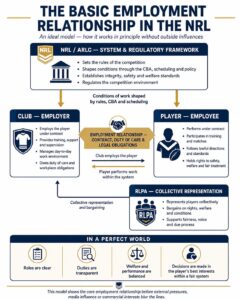
Created by the author using Canva & MS PowerPoint – sources nrl.com + requisite knowledge & business acumen
Why understanding the Basic Employment Relationship Matters
The game’s core employment relationship in its clearest form is a good starting point for this analysis because it represents a clean baseline, showing how the game is meant to function before outside pressure complicates it.
At its core, an NRL player is employed by a club within a system regulated by the NRL and ARLC, while the RLPA provides collective representation on player rights, welfare and working conditions. In principle, the arrangement is straightforward: the regulator governs, the club manages the workplace, the player performs under contract, and the RLPA represents the player’s interests. Each role is distinct, and accountability is easier to identify.
In theory, the system balances performance, welfare, governance and representation. In reality, the difficulty is that professional rugby league does not operate in isolation. It exists within an environment shaped by media attention, commercial interests, commentary, public pressure and powerful external voices. Those influences can distort priorities, complicate decision-making and blur the boundaries between governance, representation and external influence.
That is where conflict of interest becomes structural rather than merely individual. Once external pressures begin influencing regulators, clubs or players, the issue is no longer simply who holds responsibility on paper, but whether those responsibilities remain independent, transparent and capable of being exercised as intended.
How External Pressures and Perceptions Shape Narratives and Outcomes
Conflict of interest is rarely static; It ebbs and flows, depending on the volatility and power of the environment or system in which it is occurring. External factors shape public perception > public perception creates pressure > which can alter regulatory priorities, public messaging or interpretive tendencies. Those perceptions then flow into the mindset of clubs, players and officials. The consequences are eventually felt at ground level, even if the original force came from well outside the formal employment relationship. Systems may still appear intact on paper while becoming increasingly unstable in practice.
These examples of external pressuresare provided in terms of their broader impact rather than a specific instigating incident or action:
- A strong narrative in the media does not have to formally direct a rule change to exert influence.
- Public outrage does not need to be widely recognised to create pressure for visible action.
- A persistent commercial preference does not need to be written into policy to affect the environment in which policy is made.
- The most consequential influence is not always formal. Informal influence can be harder to govern, precisely because it operates indirectly, through relationships, perception, access and cultural pressure rather than transparent decision-making structures.
This is exactly why starting with the basic employment model is so important. The lines are distinct enough that duty, responsibility and accountability can be understood. However, once external influences begin pressing upon that arrangement, those lines do not disappear, but they do become harder to follow:
- A club may still owe a duty of care, but its decisions may be shaped by competitive, reputational or commercial pressures flowing down from the broader system.
- A regulator may still be responsible for the integrity of the competition, but its priorities may be affected by outside narratives, broadcast interests or public urgency.
- A player may still be the employee, but the conditions under which they work may increasingly reflect forces beyond the immediate employment contract.
The Regulator’s Role in Shaping Everything it Governs
The NRL and ARLC set the conditions under which the game operates. They shape rules, scheduling, policy settings, integrity standards and the broader competition environment. In doing so, they are not just managing a sport, they are shaping narratives, perceptions and priorities, and determining outcomes that define the conditions of work and sustainability for all stakeholder groups within the systems they govern.
That responsibility carries a need for independence, because a regulator that is serious about integrity must be capable of:
- Balancing competing interests without becoming captured by any one of them.
- Listening to external voices without being governed by them.
- Supporting commercial interests without allowing them to override fairness, welfare or due process.
- Making decisions that remain anchored to the long-term interests of the game rather than the loudest pressure of the moment.
This is where external influence becomes especially important. Media pressure, commercial incentives and dominant public narratives can all shape the environment in which regulators operate. Even where no formal impropriety exists, those pressures may still influence which issues receive attention, how quickly decisions are made, what risks are tolerated and whose interests carry the greatest weight.
That is why disclosure alone is not enough. Simply acknowledging overlapping interests does not prevent them from influencing outcomes. The more important question is whether the system has sufficient separation, transparency and accountability to ensure those interests do not distort decision-making or compromise the integrity of the process.
Why Upholding Independence in Governance Matters
The NRL & ARLC cannot be expected to eliminate all pressure, but there is a significant difference between operating functionally in a pressured environment and allowing pressure to reshape or disregard core responsibilities and accountability.
A competition serious about integrity must ensure that those making major decisions are able to do so with enough separation from the interests most capable of distorting them. That requires stronger:
- Boundaries between influence and authority.
- Transparency around overlapping interests.
- Confidence that welfare, fairness and due process are not quietly losing ground to spectacle, preference, or profit.
Without that, the system becomes vulnerable to a slow manipulation of purpose. Decisions may still be justified after the fact, and processes may still appear intact. But the underlying question remains: were those decisions truly made for the right reasons, or were they shaped by pressures the system was supposed to resist?
Integral Officiation – The Undeniable Influencer
Referees are one of the clearest examples of how blurred lines can emerge without any direct impropriety. They operate at the pointy end of the game, making real-time decisions under fatigue, crowd pressure, noise and relentless scrutiny. Yet their role is not merely operational, they are the live delivery point of the rules and, by extension, the integrity of the competition itself.
That makes officiating especially vulnerable to external influence. Commentary cycles, media framing, public outrage, and ongoing narratives about inconsistency all shape the environment in which referees operate and are judged. Over time, those pressures can affect confidence, consistency, and the broader perception of independence.
The concern is not that referees make mistakes; human error is inevitable in any fast and complex environment. The deeper issue emerges when decisions appear shaped by anticipated reaction rather than principled interpretation. At that point, officiating risks drifting from rule application toward reactive management, often influenced by broader pre-defined directions and external pressure.
If that occurs, the issue extends beyond any one official. It becomes a governance question about whether the competition has adequately insulated key decision-makers from the pressures surrounding them.
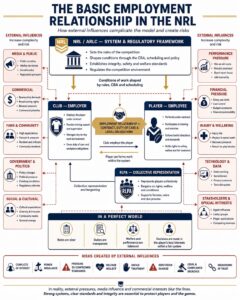
Created by the author using Canva & MS PowerPoint – sources nrl.com + requisite knowledge & business acumen
Putting It All Together: The Reality of the Modern Game
As the rich picture above represents, when all external influences and their potential impacts are considered alongside the basic employment relationship, it presents as a worrying conglomerate of competing interests, potential conflicts, and systematic risks that on face-value are being normalised and accommodated rather than addressed.
The central question is not simply who holds power and where, but also whether that power remains independent enough to still be considered regulatory in nature.
These questions matter because they move the conversation beyond blame and towards better governance. They ask not only whether a conflict is visible, but whether the pathways that allow conflicts to emerge are being properly managed. Those are the spaces where priorities are set, pressures accumulate and regulatory direction takes shape. If they are not properly managed, the consequences flow through every level of the game and ultimately affect public trust in the game itself.
Until next week…
Roly-Poly Parra


Thanks Roly,
Another enjoyable read and on an issue of exceptional importance. The number of individuals/organisations that try and influence the game is enormous and, I imagine, quite difficult to navigate for the officials who do, or should.
An interesting layer for the NRL must derive from the increased federal government involvement in the game through underwriting/endorsing the PNG entry in a few years, including providing the tax free status and a desire to reduce other countries influence in the region. How that will play out in overt and soft influencing by the government is something that intrigues.
Another huge actor of influence is the gambling industry as a whole and associated criminal elements. It has gone a long way from my dad’s local club handing out tipping cards from the local sp bookie for chaps to bet on. When large sums of money are involved the regulation and transparency you discuss becomes even more critical. Years ago I discussed integrity and transparency issues around new casinos with a federal government minister. He made it clear the government wasn’t really interested as long as taxation revenue from the casinos was coming in. In recent years we have seen those transparency issues play out badly at the major casino operators.
We’ve seen PVL create the Vegas thing as a way of increasing NRL revenue through US gambling. That can only increase the need for appropriate governance rules and transparency.
While the subject can seem dry and removed from the game it is so critical to get right and seen to be right. I don’t want to be a person going “say it isn’t so Joe” after the NRL governance is found wanting terribly at some point in the future.
On the gambling issue. You are 100% right. AML laws are getting tighter and tighter and ensuring the right rules are in place for sporting bodies is something the Federal Govt should be all over. States regulate a lot of it from the gaming perspective and i would imagine places like Parra Leagues, who would have had a Gaming manager and a side kick 10 years ago, probably have a team of 5+ people looking after risk with a focus on AML.
I am not sure what that looks like. I think it is probably harder to montor in the world of sport and sponsors. But tracking where the money comes from, and who owns those companies – and what other connections they have to companies involved in the sport or the leadership of the sport is critical.
Great perspective BA, thank you for sharing. I really appreciate your insights.
I think it is vital to understand that not all perceived conflicts are bad and conflicts by association in a niche market are often unavoidable and beneficial for business relationships and longevity.
AML is potentially the biggest governance issue at Macro level for sure. Vegas and PNG as much as they present as diamonds have a lot of red flags from a governance standpoint despite being marketing genius. PNG will be the focus of next weeks column. I have been working on it for a while but wanted to wait until the federal budget is announced and confirms any taxation stuff because at this stage it’s just promises. But taxes are only a small component of the piece. It also looks at domestic economic health, community benefits and loads of other interesting things. It’s by no means an anti-png piece, I believe if done right the Chiefs can have a great impact on PNG and its people. I am just flagging risks and worries that there is more in this for nrl bottom line than for png and its people; as well as potential impacts on the wider competition.
Good point Namrebo. The potential problems should be safeguarded against. All businesses should be undertaking some form of risk assessment and not just from a profitability perspective.
I couldn’t agree more Namrebo,
There are some huge red flags within business decisions like Las Vegas & PNG. Appropriate allocation of funds, tender based contract legitimacy, sufficient separation between political interests and operational decisions, accountability for outcomes (return on government investment).
This is going to be the basis of next weeks column. There is a lot to discuss on this from a governance and corporate social responsibility standpoint. Its going to be a ripper.
Good work Roly,
Unfortunately the world we live in today has created so much scepticism and distrust in all facets of life. In various sectors of society you have a small number of corrupt actors, now people in power are trying to seize on the ability to get in on the corruption, and then you have a media which no one trusts because while a journalist has a code of ethics, and a social media blogger or podcaster doesn’t, for whatever reason, we have been convinced to try and believe the latter.
The employment relationship/ Organisational structure in an NRL context, lets look at it from the ground up.
At the micro level, I am happy to have a view on a good or bad ref performance, but we must be careful pointing the finger at them doing anything other than applying the rules they are told to apply in the way their boss tells them to, based on what they see in front of them. Because we don’t know what their instructions are, we just know what the rule book says. When calls go against a fans team they want to cry corruption or suspect motives. But it isn’t. It just isn’t.
The Refs take orders from NRL Operations. NRL Operations should be setting the rules of the game and how they are to be interpreted. They can get feedback from clubs and even from the Board, via their CEO. It seems right now that the Board (in place for driving strategy) is directing operational tasks. That is problematic. I have issue with certain people running our game (like Annesley and Maxwell), but neither them, nor the coaches in our game, who have dedicated a lift to working in the game, want the on field product to be what it is right now.
The ARLC Chairman seems to be over stepping his remit. The ARLC has one person (Pearce) with a background in the execution of the game – and at this point it is 20+ years removed. They should be having next to no say in how the product is delivered day-to-day. So either PVL is going with a gut feel, going with what investors/broadcasters say they want, or high profile media people have his ear. Is it conflict of interest, or people pushing their own agendas? Well I can’t imagine betting agencies want more tries, because more points generally means more pay outs. But who knows. But one could question the structure that keeps PVL in the position he is in and one he is unlikely to ever be voted out of.
One thing that shouldn’t be restrained is Clubs who have good operators. People have long theorised all their conspiracies around the Roosters and brown paper bag payments. But look at their CEO. Look at their Chair. Look at their entire Board. Well rounded, highly successful people. We should be encouraging that sort of quality people into our game. Those people have the networks that help others grow. Like them or not, you only have to look at the Anasta, Minichiello, Ricketson with their own business’s – mentored by directors. Radley and Townsend have their own clothing brands (yes there is a Board member from the Apparel world) Craig Wing and Mansour are in property and facility management (the Roosters have directors in those areas too). The networks it creates are second to none. The networks create third party opportunities which might be cash based but might also be driven by long term future opportunity. That isn’t conflict, that is just better business. And it is poles apart from the majority of other clubs (including ours) but it is an advantage they earn, so they are entitled to it.
Once again I enjoyed reading your reply BA as much as I enjoyed Roly’s post.
I agree about refs – no corruption, just the NRL making their job hard, a bit too much prep (I don’t think refs should do homework on teams as I believe it leaves them looking for infractions rather than just working with what they see, and I think there are some refs just not up to standard.
I believe as you suggested that PVL has overstepped his remit. He has accomplished some great things but needs to step away from the on field product.
Finally, Boards can be that attraction that get recruits across the line via their networks. Not necessarily in TPAs as they have to be arms length but in connecting players post career.