
Hey Parra Fans, Welcome to this week’s issue of TCT Golden Point. This week I am exploring modern technology saturation, its impact on the game, and whether/why after 10 years in practice, the bunker might need a new coat of paint. As always, I hope you find it interesting and engaging.

OFFICIATING THROUGH BLURRED LINES – IT’S A GROUP EFFORT
NRL officiating has become one of the most polarising forces in the game.
Right now, officiators are not just part of the contest—they’re shaping it. Highly influential, heavily scrutinised, and frustratingly inconsistent, their impact is fuelling growing tension between players, coaches, and fans alike.
Debate now centres on more than just individual calls. Referees are tasked with making rapid, high-stakes decisions in real time—where human error and bias, conscious or not, are inevitable, especially in the biggest moments. But they aren’t acting alone, or creating all of the controversy.
Too Many Cooks, Too Much Tech: Why the NRL Bunker Still isn’t Getting it Right
The individual on field adjudicators cop the most heat all round, yet the overall distrust when broken down shows much of the negative discourse regarding the games adjudication is in-fact a group effort between the ref, the touchies, the bunker, the judiciary, and the governing bodies. It’s the combination of contradiction from a broad group of highly influential stakeholders, and their combined inconsistent officiating that is the real fuel in this fire. So why is the most heat being directed towards a singular person with the narrowest of visibility and a whistle?
Each season the game is getting faster, more physical and confusingly complex in rule and interpretation. To combat this growing issue and the scrutiny that goes with it, the National Rugby League introduced the Bunker in 2016 – a complex technology driven system of cameras and assessors designed to eliminate controversy, improve accuracy, and bring overall consistency to officiating. This system replaced an on-demand video ref that had assisted the on-field referee to solely determine try validation since 1997.
On paper, it was a no-brainer. In practice, it’s become anything but.
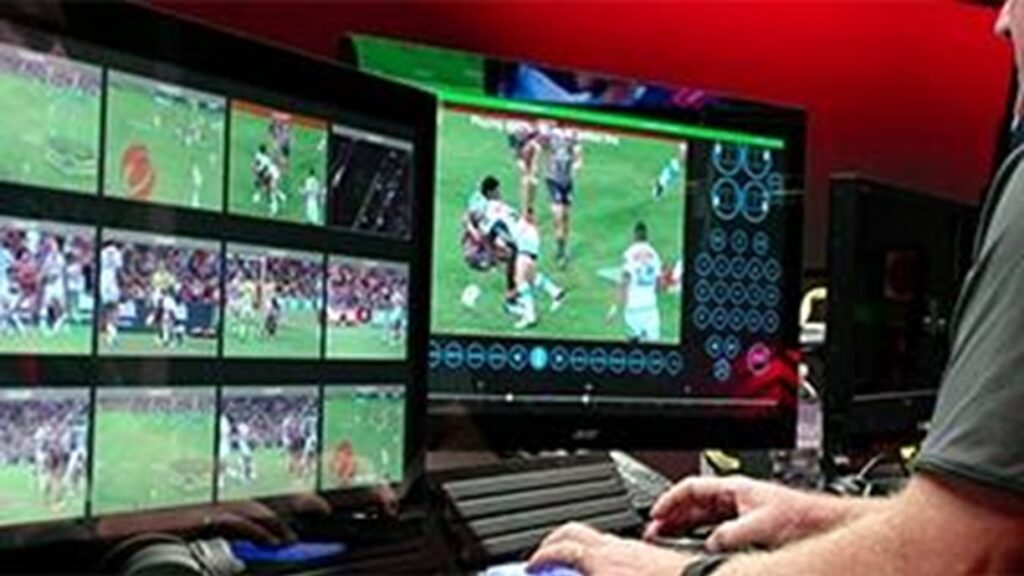
The Bunker (source: NRL)
When More Technology Stops Helping
The bunker was meant to remove controversy. Instead, it has repackaged it. Every weekend, fans, players, and coaches are left wondering why simple decisions take so long, why rulings on the same issues significantly change from week to week and why actions that are so obvious to the naked eye are evaluated incorrectly.
At its core, the bunker is a textbook case of technology saturation. The NRL has invested heavily in implementing and promoting multiple camera angles, ultra slow-motion replays and frame-by-frame analysis interpreted subjectively and communicated in the moment to a decision maker with limited oversight. But more resources don’t always mean more clarity, it more often means the opposite.
A decision that looks straightforward in real time can become increasingly ambiguous the more you slow it down. A split-second judgment call—like a knock-on or grounding—gets stretched into a forensic investigation. The result? Not certainty, but doubt, and when doubt increases, so does disagreement.
Too Many Cooks in the Kitchen
If technology is one half of the problem, the decision-making structure is the other. Right now, the bunker system involves: the on-field referee, two touchies and the bunker official.
Even though their roles are defined, the reality is blurred. There’s a constant push and pull between what was called live and what is being reviewed off-field. Instead of one clear voice, decisions can feel like a negotiation and the outcomes are often marred by justifications that provide less certainty and greater inconsistency. As fans we can accept the occasional mistake, but it’s difficult to accept the same situation producing different outcomes week in & week out.
Individual biases in high-stakes decision making is a foreseeable risk, but when there are too many cooks in the kitchen, with similar objectives but varying levels of understanding, and different sources of information driving their decisions; a foreseeable risk can become a treacherous implosion.
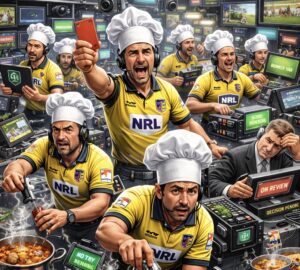
Too many cooks – too much tech
Professional Biases in Theory & Practice: Preferential Decision Making in Officiation (Nankervis et al. 2020 people management strategy and practice)
To provide theoretical context, here are some common managerial biases that we see in NRL officiating. The more you put together at once, the more problematic they become.
- Halo Bias: where one impressive factor influences the officiators perception of actions or situations. (e.g. a marquee player with a golden boot or a team with successive premierships receiving favourable line-ball calls).
- Recency Bias: where a recent (often adverse) action or overall performance is a primary factor in the officiators decision-making processes. (e.g. a player with a recent warning or history judicial history is penalised for a marginal offence).
- Similarity Bias: where officiators subconsciously favour individuals or teams whom they see as being more like them and their personal and/or political preferences. (e.g. ‘Redacted’s’ favourite colour is purple and he officiates accordingly).
- Attribution Bias: where officiators attribute an adverse incident or action solely to behavioural factors while disregarding more contributory environmental factors. (e.g. A player legitimately slips over in torrential rain inadvertently leading to momentary ruck interference).
- Severity Bias: the systematic tendency for officiators to apply rules with varying levels of strictness. This is more likely to occur due to psychological and environmental pressures as opposed to objective actions (e.g. ‘Redacted’ has a political dislike for river dwelling Anguilliformes and he officiates/adjudicates/regulates accordingly).
- Central Tendency Bias: the systematic tendency for officiators to consciously err on the side of caution avoiding extreme decisions whether they relate to favourable decisions or adverse actions, for the purposes of minimising indiscretions and potential conflict. (e.g. fence sitting for peace and consistency across decisions over absolute accuracy. Good in theory but only if the consistent decisions are reasonable).
The Illusion of Objectivity in Interpretation – Expectation v Reality
NRL referees are supposed to be impartial, yes, but as human beings’ biases (both conscious and unconscious) are par for the course; Team reputations, emotive influential player interactions, and crowd pressure, will obviously influence decisions, though these factors mostly affect marginal moments, not entire games. However, while these biases are present particularly with rule interpretation, the main subjective drivers of inconsistency are the speed of the game and environmental factors.
- Speed of the Game: to keep up in theory and practice referees must prioritise certain infringements over others—leading to perceived inconsistency.
- Environmental Factors: Influences from media, club and fans can create an intense game-day atmosphere in which referees might subconsciously overcorrect or hesitate in key moments.
One of the biggest misconceptions about the bunker is that it removes human bias. Spoiler alert! It doesn’t. Even with all the available technology, decisions still rely on individual interpretation: I.e. What constitutes “control” when grounding the ball? When does a hand movement become a knock-on? How much interference counts as an obstruction? These aren’t objective questions—they’re subjective judgment calls. The bunker doesn’t eliminate subjectivity; it simply relocates it to a different room.
There’s also a psychological factor at play. Because the bunker exists, and is portrayed as the solution, we as fans expect perfection. Every angle, every replay, every decision is supposed to lead to the correct outcome, so when an error or a controversial call occurs it feels amplified; and the reaction isn’t just frustration; it’s partially disbelief. How can they get things that wrong with all that technology? Because not every moment can be reduced to a definitive yes-or-no answer, no matter how many cameras are involved.
What’s the Fix? Is there one?
Let me start by saying I am fully aware that my drawn out overly bookish views hold no weight in reality. But isn’t it better to think about and discuss potential solutions rather than get caught up in a negative broken record narrative of “what’s wrong with this place”
While I have seen some heated discourse around whether or not the bunker should be scrapped, I am more inclined to suggest that its purpose could benefit from some refinement.
Rugby league rules are inherently interpretive, as technology can often expose grey areas rather than resolving them. particularly when adjudicating tries, knock-ons, ruck infringements and obstructions. As a starting point, process design adjustments that might require review include:
- When should the bunker intervene?
- What standard/type of proof is required?
- Who should have the final say on what, and when?
Drawing upon recent Video Assistant Referee (VAR) reforms being piloted by FIFA at this years Soccer World Cup: Some key changes to the bunker could include:
- Simplifying the decision hierarchy: One voice, one call, full accountability
- Raising the threshold for intervention: Only step in for clear and obvious errors
- Letting the game breathe: Reduce unnecessary stoppages and over-analysis
- Clarifying rules: Especially around subjective areas like grounding and obstruction
In summary, the bunker should support the referee, not replace them, or compete with them.

Does a Bunker need a binning?
Final Thought
The Bunker was introduced to bring greater certainty and safety to the game. Instead, it has exposed just how complex, interpretive, and imperfect rugby league really is. As it stands, there is a sense of overreach—too much technology applied beyond its optimal scope, too many voices contributing to decisions, and not enough clarity or transparency to genuinely benefit players, clubs, fans, or the game itself.
It’s tempting to romanticise a time when three officials with whistles and flags seemed to get by just fine without technological support. But that version of the game was slower, less technical, and far less scrutinised. Fans were limited to their own vantage point, and referees answered only to the noise of the crowd and the next day’s headlines.
The perceived shortcomings of the Bunker do point to elements of technological misalignment, but they are only part of the story. Human judgement, procedural inconsistency, and cultural expectations all play a significant role.
Technology + subjective rules + inconsistent processes + heightened expectations = the current reality. Ironically, the very system designed to reduce doubt and enhance the viewing experience has delivered only partial optimisation—while introducing new layers of complexity and uncertainty. It is both frustrating and fascinating. What are your thoughts?
See you at the game on Sunday
Roly-Poly Parra


This is such a big issue for the game currently and unfortunately it is getting worse.
Inconsistency which you covered in clarifying the rules would go a long way toward solving this problem.
Bunkers never surprise me anymore. The problem being interpretation and further some bunker refs seem to go out of their way to try and not override the on field decision.
I have long held the view that they need to have specialist Bunker refs. This will go a long way to getting consistency in the bunker.
Another issue is that referees are now in the habit of managing the game and telling them what to do in lieu of refereeing the game.This I believe is driven by the NRL.
I enjoyed your perspective on this. Keep posting.
As it stands John, the refs are relying more and more on the bunker. The best example is obstruction plays. Many times an obstruction play in the red zone is allowed to play out with the ref waiting to see the outcome. Try=review + penalty. No try=no call.
Thanks John,
You make really good points with the bunkers way of assessing on demand, interjecting at will and interfering with game flow, momentum and outcomes. It definitely feels like sometimes the bunker are trying to find a problem as opposed to assessing the on-field decision.
They step in far too often and with the exception of HIA and serious off the ball indiscretions I think they need to let the on field ref lead and call on them as required.
I will keep posting. I am finding it very therapeutic as a fan and professionally too as it’s a nice mental break from all the bureaucratic formalities of day-to-day legal operations in practice. The challenge for me is trying to have the pieces ready at a similar time each week and remembering to reply to comments. I reckon that will come with practice. Sixties & Forty are good teachers and leaders. Very patient and helpful.
Good read. There was a bunker review of a knock on off Sorensens bicep last night (Penrith v Canterbury). For all money it appeared to glance his bicep and continue travelling backwards but ruled a knock on by the bunker. Wrong or right is not my point… I would have thought they have the technology to micro-track the ball and also pinpoint the exact location the ball hits Sorensons arm in relation to the location it hits the ground. All we got is ‘the ball makes contact with Sorensons arm and goes in the direction of Canterburys dead ball line’…the decision really looked like it needed a bit more validation than that.
I reckon that was a case of benefit of the doubt supporting the ref’s call. Even allowing for the physics associated with moving ball and moving bodies, that looked like the ball had clearly gone backwards. I believe the technology exists to track ball movement but we probably never want it implemented. The number of forward passes would shock people and bring in stoppages – and we know what PVL thinks of those
Too true. Broncos threw one from dummy half last night that was so far forward the commentators said it arrived in Townsville. Yet there was nothing to see there apparently. That was one of many
Thanks BDon,
I was baffled by the outcome of this one. I have always found knock-on’s via the upper arm quite contentious in general. Its hard to prove an intentional play and there is a fine line between bicep shoulder and chest with reference to proximity and interpretation.
For mine the way the bunker justifies it to the audience is quite patronising. We can see what they’re looking at too and I think they forget that sometimes when they provide woefully poor justifications like we don’t have brains of our own.
I’m with sixties, I reckon refs call / benefit of the doubt would have been the best decision here, it wasn’t definitive enough to override.
Thanks Roly,
Multiple instances to support your article in the Broncos V Cowboys last night. The best thing about that game is I don’t support either team. So I could just laugh at some of the calls while shaking my head. Spooking players catching the ball, forward passes etc etc
Whoever can figure a way to ameliorate it significantly will deserve a hefty payday and my eternal gratitude.
Well said Namrebo. It was a mess of inconsistency last night. I hate the Broncos but that call to deny the try when Shibasaki was penalised was so soft. It ended up determining the match as the Cowboys scored in their next set.
Apply the KISS principal, problem solved.
Simple in theory but always seems to become complicated in the implementation. Go figure!
Hi Namrebo,
All you can do is shake your head and laugh a lot of the time, it’s that baffling. When I chose this topic I wasn’t sure whether we were far enough into the season to bring up my bunker concerns, but it does appear that round 6 is providing excellent examples that support the need for “a new coat of paint”.
Pretty much every game has had a questionable call that’s impacted momentum, flow or the scoreline. PVL wants a fast game on his terms but it shouldn’t come at the cost of the clubs or the consumer.
Or, dare I say, the integrity of the games fabric.
If the shoes fits! (And it does) I don’t see the harm.
Unambiguously greatness? Jaydan S’Ua will join us next year. How much are we paying him? I don’t care.
I guess that lessens our chances of resigning Junior.
Excellent analysis
Too many cooks too many opinions in the mix
Those charged with running the game are ruining the game
Houston you have a problem
Thanks Mark,
Agreed. What was once pure competition has become profit at all costs (monetary, morally, ethically). It’s pretty sad even if it is a universal trend across codes and sports globally.