
Hey Parra fans!
This week’s TCT Golden Point examines the legal dispute between New Zealand Rugby (NZR) and the Australian Rugby League Commission (ARLC), the governing body responsible for the NRL. Specifically, this analysis examines the competing arguments, the Australian and New Zealand court systems, relevant case law, and potential outcomes.
I acknowledge there is also a wider geopolitical dimension to the PNG franchise’s 2028 entry into the NRL, including the strategic interests associated with expansion. Those issues matter, but this edition concentrates on the legal and commercial questions. For my broader views, see two earlier Golden Point editions: The PNG Paradox; and Expansion Equity v Competitive Balance.

PREFACE
Legal disputes are rarely static in their trajectory. New evidence, procedural developments and judicial decisions can significantly alter the strength of either party’s position, sometimes in ways that challenge what initially might appear a straightforward conclusion. With that in mind, I want to be clear about the scope of this analysis and preface the following:
- This article reflects publicly available information as of 16 October 2026.
- The discussion of relevant case law is intended to explore the legal principles, competing arguments and potential outcomes, rather than offer a definitive prediction of what the courts will decide.
- Unlike my usual Golden Point articles, which primarily apply Australian state and Commonwealth legislation to real-world scenarios, this edition examines ongoing litigation involving New Zealand law and legal authorities from multiple jurisdictions. For transparency and independent verification, a consolidated list of sources has been included.
- This article presents my independent analysis and opinions, informed by publicly available information, legislation and case law. It is intended for general information and discussion, not as legal advice.
- As proceedings remain ongoing, the analysis and conclusions may change as new developments emerge.
With that context in mind, this article considers what is actually at stake, what the law says, and whether there is room for two Chiefs in the Southern Hemisphere.
TCT GOLDEN POINT – WHAT’S IN A NAME? THE CHIEFS, THE COURTS AND THE QUESTION OF COEXISTENCE
There are few things in rugby league more reliable than Peter V’landys (PVL) making headlines, particularly when the subject involves expansion, commercial interests, or critiquing other football codes. This month, the contest has moved beyond the familiar exchanges of sporting politics and into considerably more formal territory. On 8 October 2026, New Zealand Rugby (NZR) announced proceedings against the Australian Rugby League Commission (ARLC) in the High Court of New Zealand, over the naming of the PNG Chiefs, the NRL’s new Papua New Guinean (PNG) franchise scheduled to enter the competition in 2028.
The dispute centres on a single word: Chiefs. Yet behind this seemingly straightforward disagreement lies a complex intersection of intellectual property rights, commercial reputation, consumer perception, territorial jurisdiction and sporting identity. Both NZR and the ARLC have interests they consider legitimate and worth defending. Ultimately, the question is not who used the name first or which code enjoys greater popularity, but whether an established sporting organisation can prevent a team from another country and code from using the same name.
The Court has already delivered its first procedural decision, refusing NZR’s application for an interim injunction on 16 October. However, the underlying trade mark infringement claim remains unresolved. To explore that question, we need to look beyond the headlines, separate the legal arguments from the sporting rhetoric and consider what courts have actually decided in comparable disputes. First, that means setting out the competing positions.
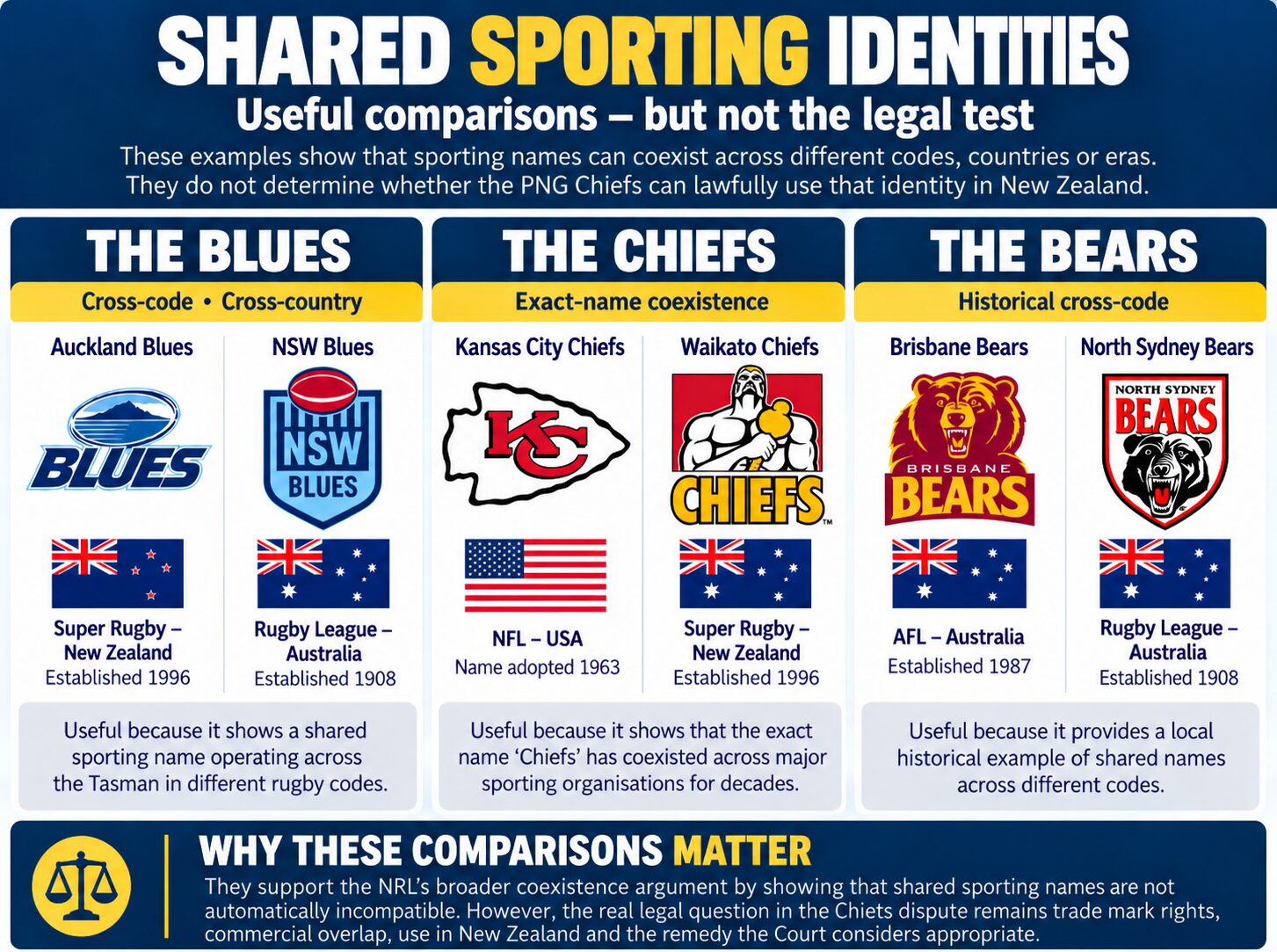
Shared identities are a thing in sport globally. Sources: NZR, NRL, AFL, NHL Official Sites, AUS Cth & NZ Legislation (See Footer Sources). Created by the Author using Canva Premium
The Case for the ARLC: Different Teams, Different Codes, Different Identities
The ARLC’s strongest argument begins with the identity of the PNG Chiefs themselves. This is not a New Zealand rugby union organisation seeking to replicate an established Super Rugby club, but a Papua New Guinean rugby league franchise representing a distinct national and cultural identity.
When PNG Prime Minister James Marape announced the name in October 2025, he linked it to traditional leadership structures and the role of chiefs, both men and women. Selected through a national campaign attracting more than 20,000 submissions, the name reflects PNG’s history and cultural heritage. With no publicly established evidence of an intention to appropriate NZR’s reputation, the franchise has an independently grounded identity.
PVL has highlighted the coexistence of the Auckland Blues and the considerably older NSW Blues rugby league identity, questioning rugby union’s objection to a shared sporting nickname. While politically effective, the comparison is not legally conclusive. The relevant trade mark rights and commercial circumstances must be assessed independently.
The Kansas City Chiefs provide an even more direct comparison. The NFL franchise adopted the Chiefs name in 1963, some 33 years before Waikato entered Super Rugby. Despite sharing the same nickname for three decades, both organisations have maintained distinct sporting and commercial identities. Historically and closer to home, the Brisbane Bears (AFL) and North Sydney Bears (NSWRL-ARL) coexisted across different codes for 10 years without any obvious conflict.
Geographical proximity may increase commercial overlap, but it should not be confused with widespread brand recognition. Anecdotal online reactions suggest some rugby league supporters outside New Zealand were unfamiliar with the Waikato Chiefs before the dispute attracted publicity. While this raises questions about the brand’s recognition beyond New Zealand, it does not diminish NZR’s enforceable domestic rights. Together, these examples demonstrate that sharing a sporting name does not necessarily mean sharing a commercial identity. The distinction between rugby league and rugby union, their respective competitions and geographical identities may influence consumer perception, although commercial overlap in merchandise, sponsorship and promotion remains relevant.
Ultimately, trade mark protection is territorial. The ARLC may therefore argue that any remedy should be confined to commercial activities infringing NZR’s enforceable rights within New Zealand, rather than requiring the PNG Chiefs to abandon their identity internationally.
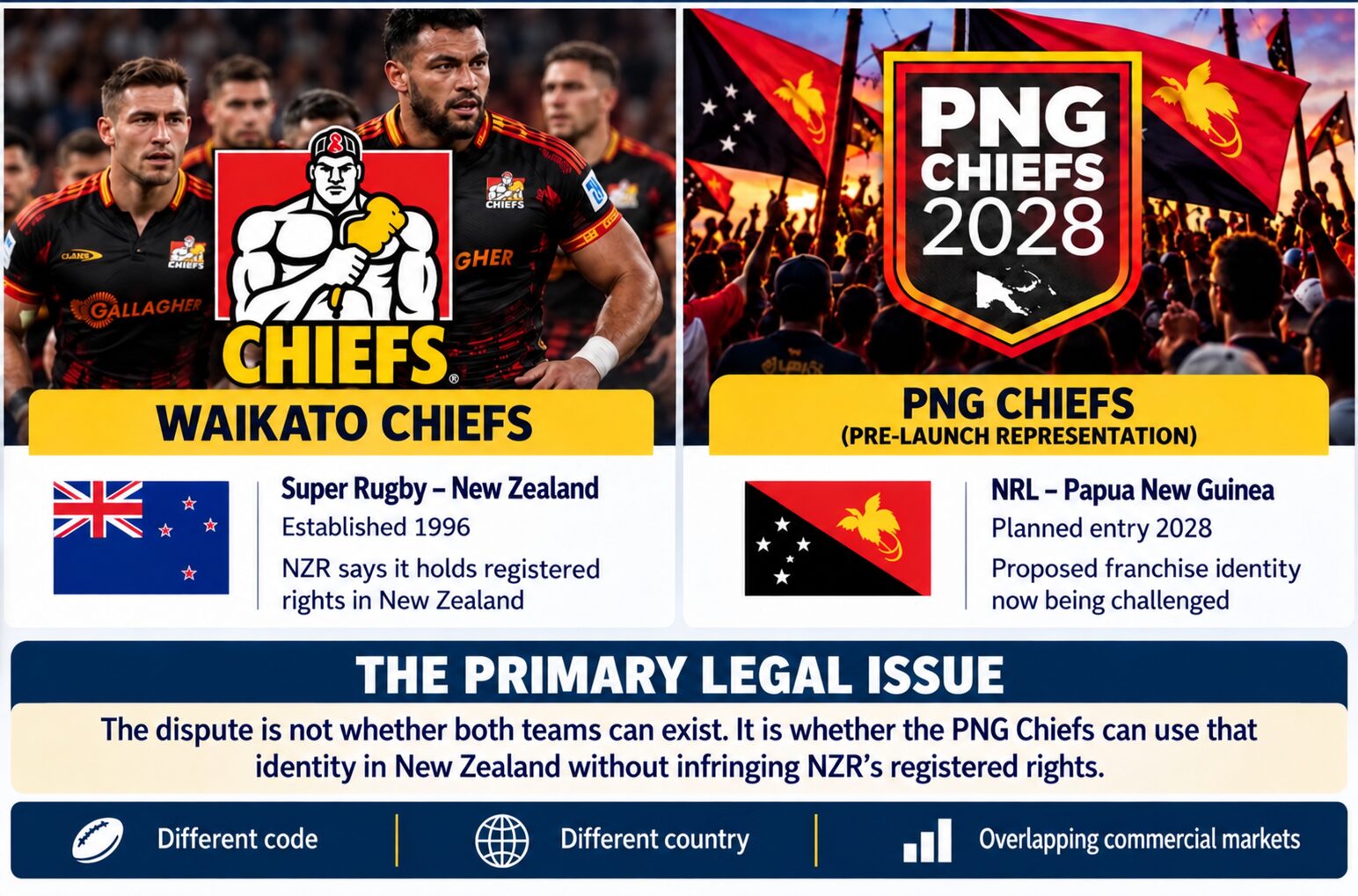
One Word – Cultural Significance Across Borders: Sources NZR, ARLC, AUS Cth & NZ Legislation (See Footer Sources) – Created by Author using Canva Premium
The Case for NZR: Thirty Years of Identity and Commercial Protection
NZR’s argument is stronger than simply asserting first use. The Hamilton-based Waikato Chiefs have played in Super Rugby since 1996 and, over nearly 30 years, built recognition through players, supporters, competitions, merchandise and commercial partnerships. According to NZR’s 8 October statement, it owns registered Trade mark rights to the word CHIEFS and the Chiefs logo in New Zealand, and has held Australian Trade mark protection for the Chiefs logo since 1998. NZR seeks interim and final injunctions preventing the ARLC from using PNG Chiefs, Chiefs or similar names in New Zealand. Importantly, it is not seeking a worldwide ban. The immediate dispute concerns use within New Zealand.
Although rugby league and rugby union are different sports, they operate in overlapping commercial markets. They compete for television audiences, sponsorships, players and supporters across Australia, New Zealand and the Pacific, and both sell sporting merchandise. A consumer buying a Chiefs jersey online, seeing a promotional campaign or assessing a sponsorship opportunity could encounter both brands in the same commercial environment. That overlap may matter more to Trade mark law than the difference between a rugby league tackle and a rugby union ruck. Chiefs Rugby CEO Simon Graafhuis has acknowledged that organisations in different sports and markets can coexist under the same name, while identifying this particular commercial overlap as the concern.
NZR also relies on IP Australia’s response. The Australian Trade mark regulator initially raised objections to the ARLC’s PNG Chiefs applications, including a real and tangible risk of confusion with existing rights. By 10 October, the position had shifted: one application had progressed to acceptance, subject to possible opposition, after parts of the original application were removed, while a separate revised application remained unresolved. That does not prove infringement, nor does it establish that the NRL is entitled to every aspect of its proposed branding. Trade mark examination and judicial findings are different processes. But the history shows that concerns about commercial overlap are not merely speculative.
Even those sympathetic to the NRL should therefore accept that NZR has an arguable commercial interest in protecting the identity it has built. The real question is whether that interest justifies the restrictions being sought.
Two Countries, Two Court Systems: Why Jurisdiction Matters
Having set out the competing arguments, the next question is where the dispute is being fought, how the proceedings are likely to be managed, and why the answer might differ if similar proceedings were commenced in Australia. Australia and New Zealand share closely related common-law traditions, in which legislation, precedent and procedural fairness all play central roles.
Those similarities, however, should not obscure the differences that matter for this case. The two countries have distinct court hierarchies, separate intellectual property statutes and territorial Trade mark regimes. As a result, the forum is not merely procedural background; it may influence both the course of the litigation and the remedies available.
That matters at the outset because one immediate source of confusion for Australian readers is the title “High Court of New Zealand”. In Australia, the High Court is the country’s final appellate court, and its judgments can establish legal principles binding upon courts throughout Australia. In New Zealand, the High Court occupies a different position. It sits below the Court of Appeal and the Supreme Court, and exercises both original jurisdiction over significant cases and appellate jurisdiction over decisions from lower courts. Consequently, the NZR proceedings have not commenced in New Zealand’s highest court. They have commenced in a superior trial court, where substantive commercial disputes of this nature can be heard in the first instance.
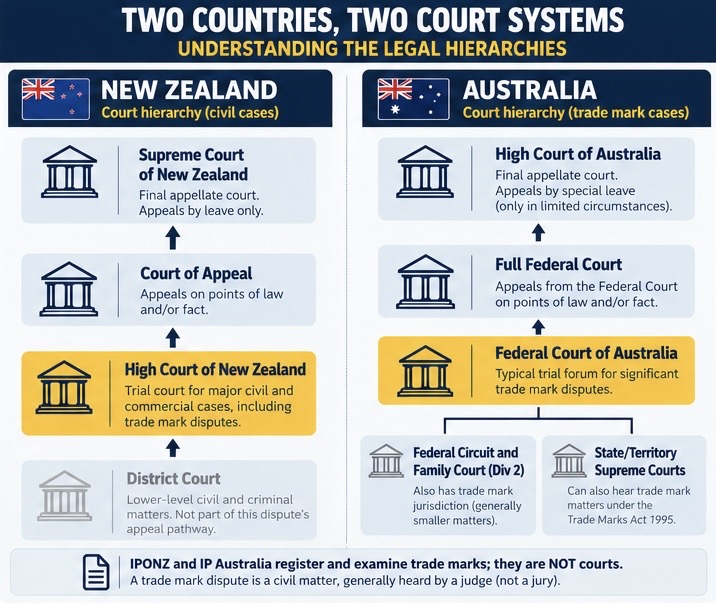
The Legal Hierachies – Sources: Federal Court of Australia Entity, Federal Registrar of Legislation (AU), High Court of NZ, New Zealand Legislation. Specifics in Footer Sources – Created by Author using Canva Premium
Understanding the Two Court Hierarchies
Although Australia and New Zealand share common-law traditions, their judicial hierarchies differ in ways relevant to this dispute.
In New Zealand, the High Court sits below the Court of Appeal and Supreme Court, the country’s final appellate court. Unlike Australia’s High Court, which is the nation’s highest judicial authority, New Zealand’s High Court also exercises original jurisdiction over significant civil proceedings.
NZR commenced its claim directly in the High Court because section 5 of New Zealand’s Trade Marks Act 2002 establishes its jurisdiction over civil trade mark infringement proceedings. The District Court’s monetary jurisdiction is therefore not the determining factor. Any subsequent appeal would ordinarily proceed to the Court of Appeal, with further appeal to the Supreme Court requiring leave (permission).
Australia’s federal structure is more complex, with federal, state and territory courts exercising sometimes overlapping jurisdictions. A substantial trade mark dispute would typically commence in the Federal Court of Australia, although sections 125 and 190 of the Trade Marks Act 1995 (Cth) also provide jurisdiction to the Federal Circuit and Family Court of Australia (Division 2) and state and territory Supreme Courts. For proceedings originating in the Federal Court, an appeal would ordinarily be heard by the Full Federal Court. Further appeal to the High Court of Australia requires special leave, generally reserved for matters involving significant legal questions or broader public importance.
Another important distinction concerns intellectual property regulators. IP Australia and New Zealand’s Intellectual Property Office (IPONZ) administer trade mark examination, registration and certain administrative disputes. They are not courts, and an examiner’s objection does not constitute a judicial finding of infringement. This distinction is particularly relevant to the Chiefs dispute, as IP Australia’s examination of the ARLC’s applications and NZR’s High Court proceedings are separate processes governed by different legislation.
Ultimately, the applicable court hierarchy, enforceable rights and avenues of appeal depend on the jurisdiction in which proceedings are commenced.
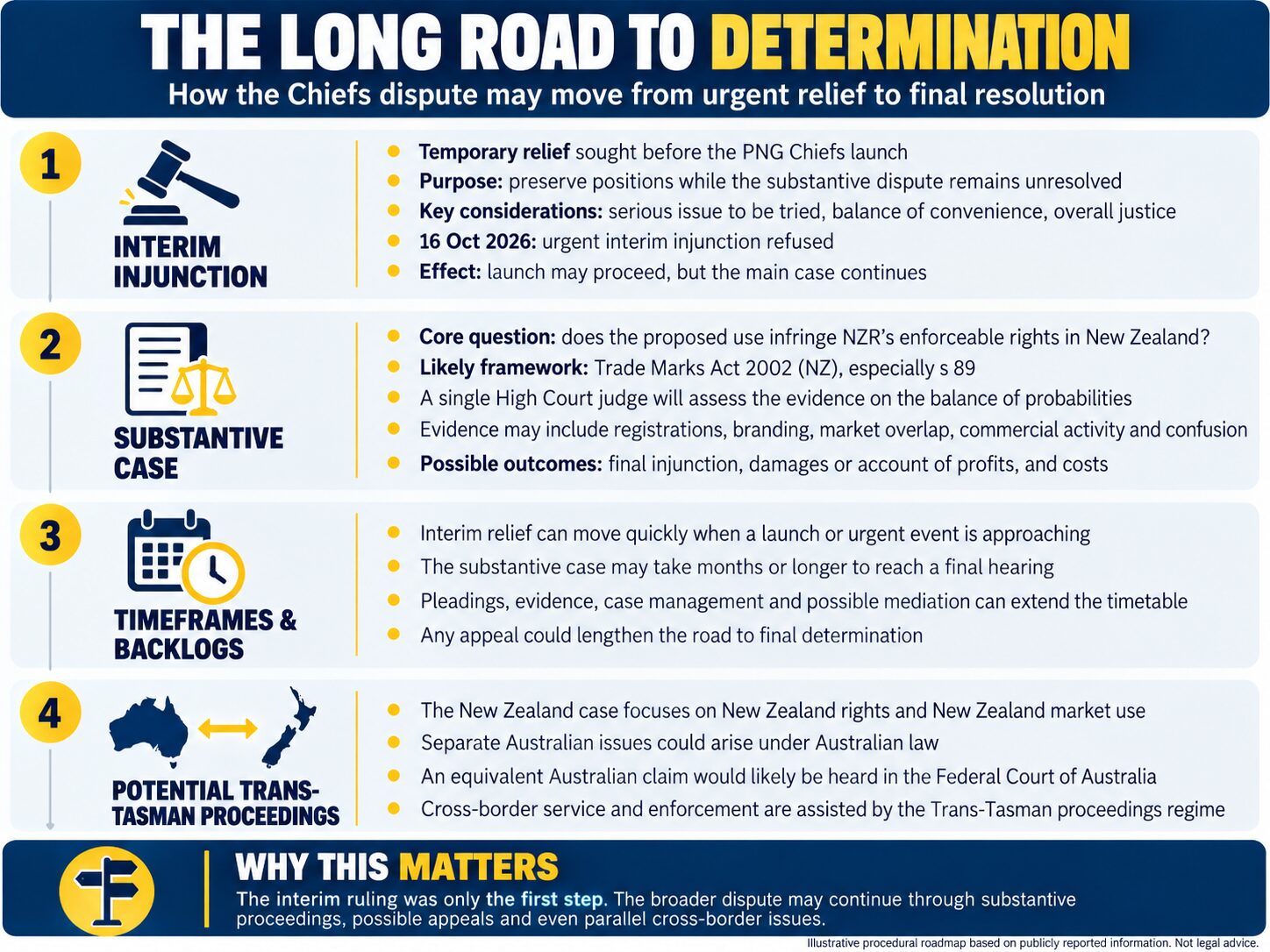
The Slow Burn – A final determination may be years away. Sources: Federal Court of Australia Entity, Federal Registrar of Legislation (AU), High Court of NZ, New Zealand Legislation. Specifics in Footer Sources – Created by Author using Canva Premium
How the High Court of New Zealand May Determine the Outcome
The dispute is a civil proceeding before a single High Court judge, who will assess admissible evidence and determine contested facts on the balance of probabilities. The principal legal framework is section 89 of New Zealand’s Trade Marks Act 2002, although claims under the Fair Trading Act 1986 or common-law passing off may also arise, depending on the pleadings. While the complete pleadings and substantive hearing timetable remain publicly unconfirmed, New Zealand’s procedural framework provides an indication of how the case is likely to progress.
The First Contest: The Interim Injunction — 12–16 October 2026
The dispute has already produced its first significant judicial outcome, although the underlying trade mark infringement claim remains unresolved.
On Monday, 12 October 2026, NZR and the ARLC appeared before Justice Karen Grau in the High Court at Wellington. The immediate issue was whether NZR’s application for an interim injunction should be heard urgently, ahead of the PNG Chiefs’ scheduled branding and jersey launch on 21 October.
An interim injunction is a temporary order intended to protect relevant interests while a substantive dispute remains unresolved. In considering such applications, the Court ordinarily examines whether there is a serious question to be tried, where the balance of convenience lies, and which outcome best preserves justice between the parties. Consideration is also given to potential financial harm and the applicant’s usual undertaking as to damages should temporary restrictions subsequently prove unjustified.
The initial proceedings revealed conflicting accounts of the parties’ attempts to resolve the dispute:
- Representing the ARLC, barrister Joe Edwards questioned the urgency of NZR’s application, arguing that it had known about the proposed name for almost twelve months. According to Edwards, NZR raised concerns shortly after the October 2025 announcement, the ARLC responded in December, and no further correspondence was received until September 2026. He maintained that this delay undermined the need for immediate judicial intervention.
- The NZR’s counsel, Earl Gray, disputed that characterisation, maintaining that NZR had repeatedly attempted to engage with the ARLC without meaningful progress. He told the Court that a draft statement of claim had been provided on 28 September as a final attempt to encourage engagement before litigation. NZR also argued that the approaching branding launch created additional urgency, particularly because promotional activities, merchandise and commercial commitments could become increasingly difficult to reverse.
These were the parties’ competing submissions, not established judicial findings. Following the initial appearance, the Court scheduled an expedited hearing for Friday, 16 October, at which Justice Grau declined NZR’s application for an interim injunction, removing the immediate legal obstacle NZR had sought to impose on the PNG Chiefs’ branding launch.
The decision represents an early procedural success for the ARLC. However, according to reporting by the NZ Herald, Justice Grau indicated that her full reasons would not be released until next week. Until those reasons become available, it would be premature to conclude which considerations proved decisive.
Importantly, the refusal of interim relief does not establish that the ARLC’s proposed use complies with New Zealand trade mark law, nor does it invalidate NZR’s registered rights. The substantive infringement proceedings remain a separate question, potentially involving different evidence, legal considerations and lasting remedies.
The Second Contest: Establishing the Substantive Case
Unless the parties resolve the matter through negotiation or another procedural outcome, the dispute would ordinarily proceed through the civil litigation process. NZR’s statement of claim would identify the legal rights it seeks to enforce, the alleged infringement and the remedies requested. The ARLC would have the opportunity to defend those allegations and, where appropriate, raise additional legal arguments or counterclaims.
Under the New Zealand High Court’s revised civil procedure framework, introduced in January 2026, parties generally exchange factual evidence and relevant documents before a judicial issues conference, unless the Court directs otherwise. The purpose is to identify the real issues in dispute, reduce unnecessary procedural activity and consider whether settlement or mediation is appropriate.
For the Chiefs dispute, the relevant evidence could include NZR’s precise Trade mark registrations, the goods and services they protect, historical commercial use, proposed PNG Chiefs branding, intended marketing activities in New Zealand and evidence relevant to consumer confusion. The Court may also need to determine whether particular conduct amounts to use of the protected mark in trade within New Zealand, rather than simply the adoption of a sporting nickname outside that country.
If the matter proceeds to a substantive hearing, the judge will apply the relevant New Zealand law and decide whether infringement has been established. A successful claim could result in a final injunction restricting particular conduct. Depending on the claims and evidence, additional remedies or costs orders may also be available. Either party could then consider the appropriate avenues of appeal, potentially progressing to the Court of Appeal and ultimately, with leave (permission), the Supreme Court.
The Longer Timeframe: Months, Years and Court Backlogs
The longer timeframe is less predictable. New Zealand High Court statistics recorded a national median waiting time of 664 days for general civil proceedings with scheduled defended hearings at 31 December 2025, rising to 698 days in Auckland. Those figures are historical waiting-time measures, not a timetable for this litigation. They measure the interval between a case being directed to have a hearing date allocated and the scheduled hearing, rather than the entire period from filing proceedings to delivery of judgment.
Preparation of evidence, case-management directions, interlocutory applications, mediation and any subsequent appeal could extend the overall process. Conversely, judicial directions, settlement or expedited handling could shorten it. A final determination before the PNG Chiefs enter the competition in 2028 is possible, but cannot be assumed.
That uncertainty adds commercial pressure to both parties. NZR wants to protect its established identity before the PNG branding becomes embedded, while the ARLC must continue building a new franchise and securing sponsors. The first procedural decisions may therefore have practical effects long before any final ruling on trade mark infringement. They may also give the parties a reason to seek a workable negotiated arrangement.
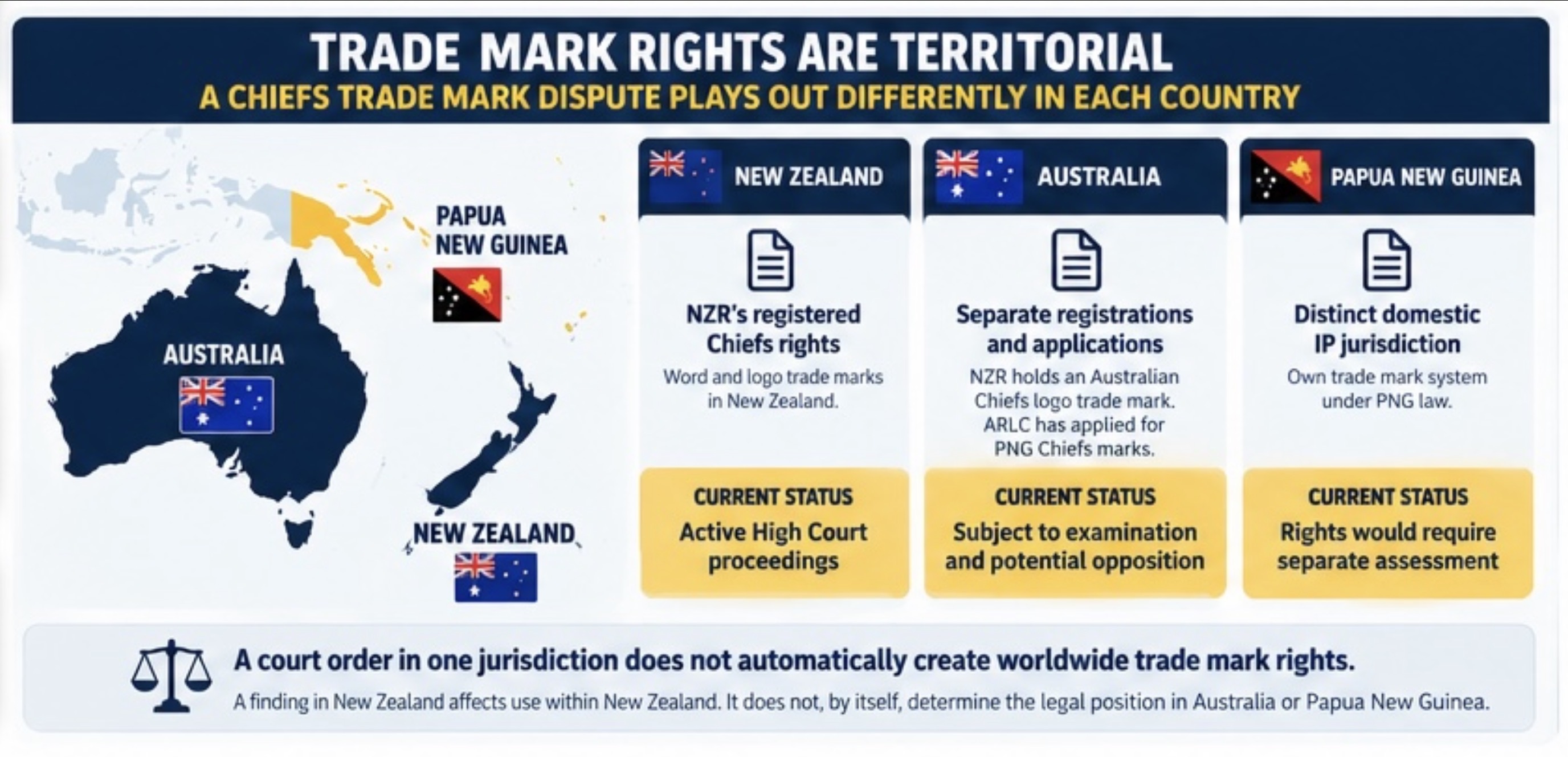
Different Countries, Different Rules – Sources: Federal Court of Australia Entity, Federal Registrar of Legislation (AU), High Court of NZ, New Zealand Legislation. Specifics in Footer Sources – Created by Author using Canva Premium
Trans-Tasman Proceedings and the Australian Comparison
The ARLC’s Australian base does not prevent NZR from pursuing proceedings in New Zealand. Where a dispute concerns registered New Zealand trade mark rights and commercial activities affecting its domestic market, NZR has a legitimate basis for bringing its claim before the New Zealand High Court.
Although Australia and New Zealand have comparable approaches to civil trade mark litigation, their enforceable rights differ. An equivalent Australian claim would likely be heard in the Federal Court of Australia, under the Trade Marks Act 1995 (Cth), rather than New Zealand legislation. NZR claims registered New Zealand protection for both the CHIEFS word mark and logo, alongside longstanding Australian registration of its Chiefs logo. Any Australian proceedings would therefore require separate consideration of the rights enforceable in that jurisdiction.
The Trans-Tasman proceedings framework, established through corresponding legislation in both countries, facilitates civil litigation involving parties operating across their borders. Its principal mechanisms include:
- Service of documents: Certain initiating documents can be served across the Tasman without the usual requirement to obtain permission for overseas service.
- Forum challenges: A defendant may seek a stay on the basis that a court in the other country is the more appropriate forum, subject to statutory criteria rather than geographical location alone.
- Remote participation: The framework facilitates participation in certain proceedings from the other country, reducing the practical difficulties of cross-border litigation.
- Recognition and enforcement: Eligible civil judgments may be registered and enforced in the other country, subject to statutory conditions and exclusions.
These mechanisms allow NZR to pursue proceedings against an Australian organisation and potentially enforce an eligible New Zealand judgment across the Tasman. However, procedural cooperation does not extend the territorial scope of trade mark protection. Recognition of a New Zealand judgment does not transform NZR’s domestic registrations into Australian rights or grant worldwide exclusivity over the Chiefs name.
Ultimately, the framework governs how cross-border proceedings are conducted and judgments enforced, while domestic trade mark legislation determines the rights being protected. For the Chiefs dispute, NZR’s rights remain territorial, even though the practical consequences of enforcing them may extend beyond New Zealand.
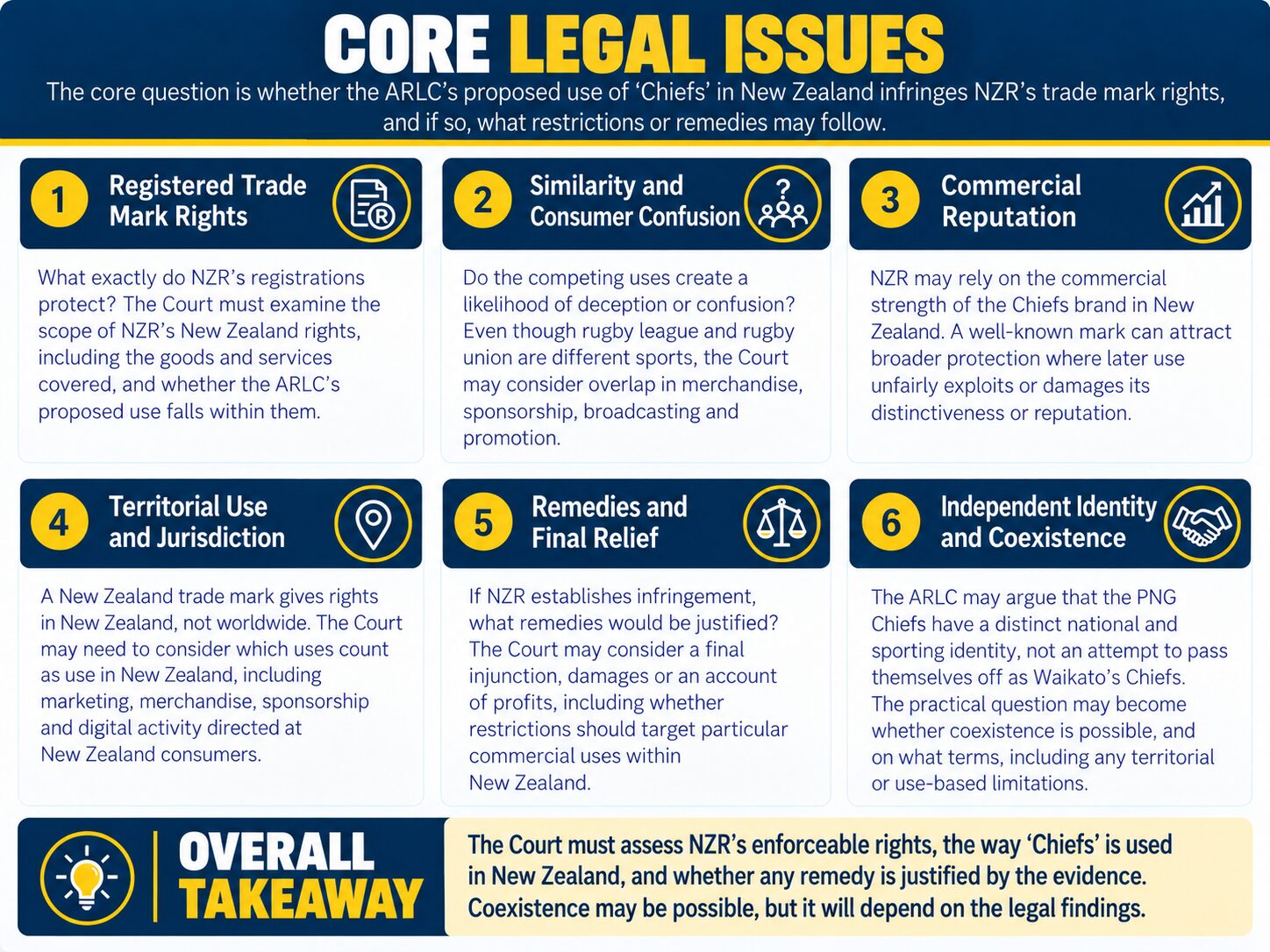
Core Legal Issues – Sources: Federal Court of Australia Entity, Federal Registrar of Legislation (AU), High Court of NZ, New Zealand Legislation. Specifics in Footer Sources – Created by Author using Canva Premium
Core Legal Issues and What Existing Case Law Determinations Suggest
The New Zealand High Court is not being asked to decide which rugby code has a greater claim to the name Chiefs, nor whether Papua New Guinea’s cultural connection to the word is more compelling than Waikato’s sporting history. The central question is whether the ARLC’s proposed use of the Chiefs identity, infringes NZR’s enforceable trade mark rights in New Zealand and, if so, what remedies are legally justified. That requires consideration of several interconnected legal issues. While no previous judgment provides a definitive answer, core legal principles and existing case law help explain how the Court may approach them.
It is important to distinguish between the authorities discussed below. New Zealand legislation and binding domestic precedent provide the governing framework. Australian and European decisions offer comparative reasoning, but do not determine the outcome under New Zealand law.
The Scope of NZR’s Registered Trade Mark Rights
The starting point is section 89 of New Zealand’s Trade Marks Act 2002, which governs infringement involving identical or similar signs used in the course of trade. NZR says it holds registered New Zealand rights to both the word CHIEFS and its associated logo. However, registration does not necessarily grant unrestricted ownership over every possible use of a word.
The Court must consider precisely what those registrations protect, which goods and services they cover, and whether the ARLC’s proposed commercial activities fall within their scope. Under section 89, the applicable infringement test depends upon the relationship between the registered mark, the sign being used and the goods or services concerned. Importantly, proof of likely consumer confusion is not required in every circumstance, including certain uses of an identical mark for goods or services covered by its registration.
Two Australian decisions help illustrate why the distinction between commercial reputation and registered legal rights matters.
In Campomar Sociedad, Limitada v Nike International Ltd 2000 HCA 12, the High Court of Australia considered competing rights involving the internationally recognised Nike sporting goods business and another company holding Australian registrations for NIKE in relation to products including perfume. Nike’s considerable international reputation did not automatically extinguish the other company’s registered interests. Nevertheless, particular marketing involving NIKE SPORT FRAGRANCE could still be restricted because of its misleading commercial implications.
More recently, Taylor v Killer Queen LLC 2026 HCA 5 examined competing rights involving Australian clothing designer Katie Perry and international singer Katy Perry. The High Court of Australia rejected the cancellation of the designer’s registered mark on the grounds considered, reinforcing the importance of examining actual rights, reputation and evidence at the legally relevant dates.
Neither decision binds the New Zealand High Court, and both involved different statutory questions. However, they demonstrate why established commercial reputation does not necessarily determine the entire scope of legal protection. For the Chiefs dispute, the starting point is therefore not simply that NZR has used the name since 1996. It is what its registrations protect and whether the ARLC’s proposed use interferes with those rights.
Similarity, Commercial Overlap and Consumer Confusion
The second issue concerns the extent to which the respective brands and their commercial activities overlap. The NRL’s argument that rugby league and rugby union are different sports is relevant, but it does not necessarily resolve the question. Both organisations operate within sporting markets that include merchandise, sponsorship, broadcasting, advertising and digital promotion. The Court may therefore need to consider whether consumers encountering the PNG Chiefs identity within New Zealand could reasonably assume an association with the Waikato Chiefs.
A particularly useful New Zealand authority is InterCity Group (NZ) Ltd v Nakedbus NZ Ltd 2014 NZHC 124. That dispute involved a transport company using variations of a competitor’s registered name in online advertising. The NZ High Court distinguished between purchasing internet search keywords, which did not establish infringement in those circumstances, and displaying similar wording in advertisements in a manner capable of confusing consumers. The latter conduct supported findings of trade mark infringement, passing off and misleading conduct. The decision illustrates that commercial context and presentation can be important, particularly when assessing whether conduct amounts to use as a trade mark and whether the applicable statutory test for confusion is satisfied.
For the PNG Chiefs, a distinctive logo, prominent geographical identification, and different sporting code may help distinguish the organisations. However, those differences would not necessarily defeat an infringement claim, particularly where NZR relies on registered rights to the word itself. The Court’s assessment will depend on the relevant statutory provision, the commercial activities involved and the evidence presented.
Commercial Reputation and the Protection of Sporting Identity
A third issue is whether NZR’s established commercial reputation provides additional grounds for protection. Section 89(1)(d) of the Trade Marks Act 2002 provides protection in certain circumstances involving a registered mark that is well known in New Zealand, including particular uses involving dissimilar goods or services that unfairly exploit or harm its distinctiveness or reputation. That protection is subject to specific statutory requirements. Reputation alone does not automatically establish infringement.
There is also a useful sporting comparison in Arsenal Football Club plc v Reed (Case C-206/01, 2002). The European Court of Justice considered unofficial merchandise displaying Arsenal’s registered names and emblems. The decision recognised that sporting marks can perform a protected commercial function even when supporters also regard them as expressions of loyalty or allegiance.
Although the decision is not binding in New Zealand and involved merchandise bearing the identity of the very club whose rights were being protected, it illustrates the broader commercial significance of sporting identities. That assists in understanding NZR’s position. The Chiefs name is not merely a nickname used on the field; it is also associated with merchandise, sponsorship and an established commercial identity.
However, the PNG Chiefs are proposing to operate as a separately established rugby league franchise, representing a different country and possessing an independently articulated cultural identity. The relevant distinction is therefore between recognising the commercial value of NZR’s existing brand and determining whether the ARLC’s particular use unlawfully interferes with it.
Territoriality and Commercial Use Across Borders
Perhaps the most significant issue for the eventual outcome is the territorial nature of trade mark protection. Australians are already familiar with how this principle operates, even if they have never considered it in a legal context.
When Burger King entered Australia in the early 1970s, its internationally recognised name encountered existing Australian trade mark rights. Rather than launch under the same name, the business adopted Hungry Jack’s and subsequently developed a distinct local commercial identity. That example illustrates that international brand recognition does not automatically override existing domestic intellectual property rights.
For the PNG Chiefs, the principle cuts both ways. NZR’s registered New Zealand rights cannot simply be dismissed because the franchise originates in Papua New Guinea and participates in an Australian-administered competition. Equally, those registrations do not automatically provide NZR with exclusive worldwide ownership of the word Chiefs. The more complicated question is what constitutes relevant commercial use within New Zealand.
The NRL already operates across the Tasman through the New Zealand Warriors, while its merchandise, sponsorship arrangements and promotional activities frequently reach audiences across national borders. Consequently, the Court may need to consider not only physical activities occurring in New Zealand, but also online sales, advertising and other commercial conduct sufficiently connected to the New Zealand market.
This creates a practical difficulty, because the PNG Chiefs could retain their identity in Australia and Papua New Guinea while facing restrictions upon particular commercial uses within New Zealand. That may be legally distinguishable, but managing those restrictions within a competition built around shared branding, broadcasting and sponsorship arrangements could prove considerably more complicated. It is this distinction between international sporting identity and domestic commercial protection that I believe will be central to the eventual outcome.
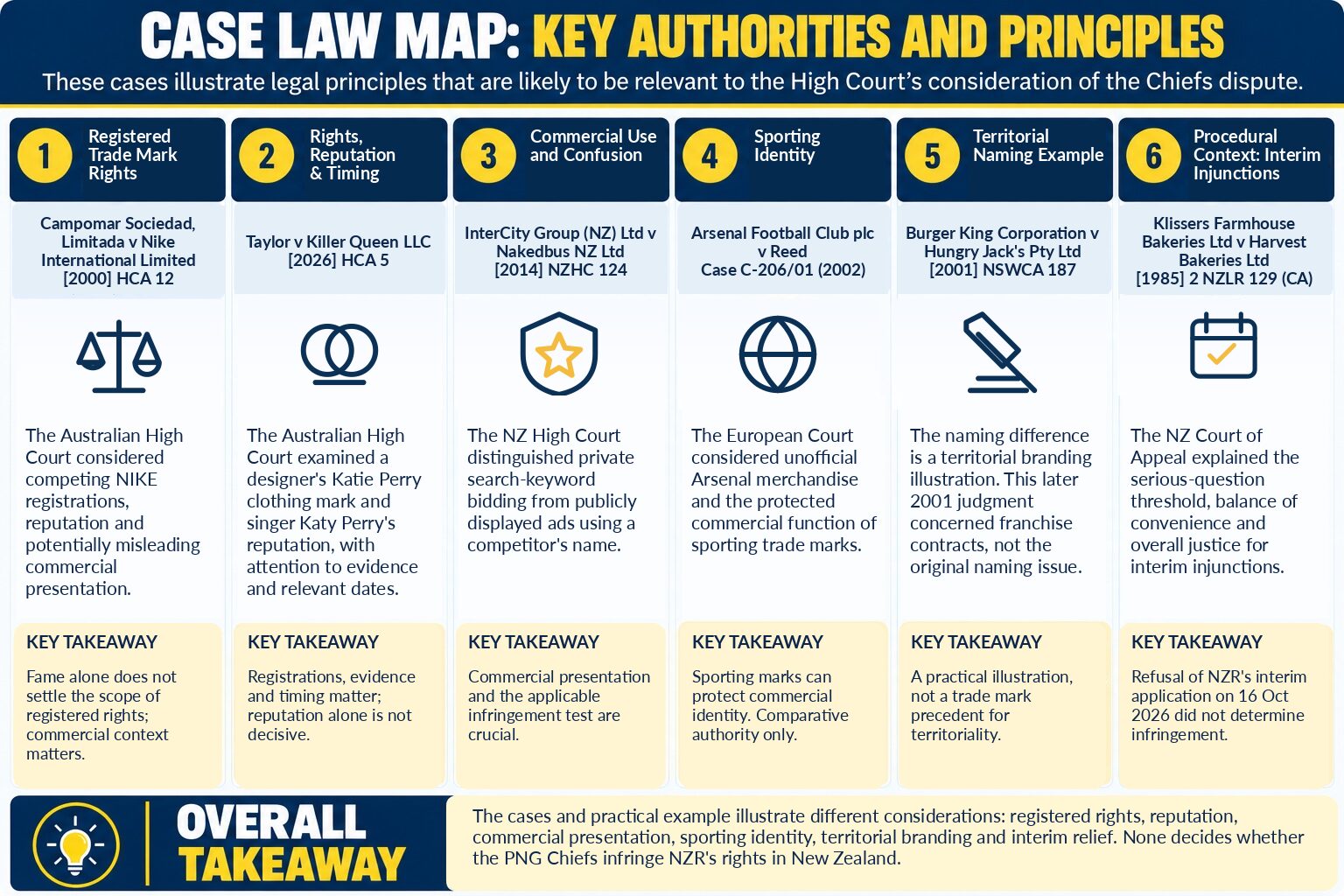
Contextual Case Law Examples – Sources: Federal Court of Australia Entity, Federal Registrar of Legislation (AU), High Court of NZ, New Zealand Legislation, EU/UK Legislation – Specifics in Footer Sources – Created by Author using Canva Premium
Remedies, Injunctions and the Possibility of Coexistence
The final issue is not simply whether infringement can be established, but what should happen if it is. Under section 106 of New Zealand’s Trade Marks Act 2002, available remedies include injunctions, damages or an account of profits. The Court may also award additional damages where the statutory requirements are met. As discussed earlier, NZR has applied for both interim and final injunctive relief. The interim application concerns temporary protection while the substantive dispute remains unresolved.
At the final stage, the Court would need to consider the infringement established and the appropriate scope of any lasting remedy. That distinction is important because a finding of infringement does not necessarily require the PNG Chiefs identity to be abandoned everywhere. Depending upon the evidence, NZR may establish grounds for restrictions directed at particular uses of the name, branding, merchandise or other commercial activities within New Zealand.
However, coexistence cannot simply be assumed. Nor is the Court required to create a commercially convenient arrangement merely because it might benefit both sporting organisations. A negotiated coexistence or licensing agreement is a separate possibility that would require the parties’ agreement.
Such an arrangement could potentially address geographical identification, branding distinctions, merchandise, promotional activities and other commercial considerations while preserving the PNG franchise’s broader identity.
The difficulty is that restrictions capable of being expressed clearly in legal terms may prove less straightforward to administer within an international sporting competition. Nevertheless, that practical challenge also provides an incentive for both parties to consider whether negotiated boundaries could deliver greater certainty than prolonged litigation.
What the Legal Issues and Case Law Suggests Overall
Taken together, the legislation and case law suggest that this dispute is unlikely to be resolved solely by identifying which sporting organisation adopted the name first, or by establishing that rugby league and rugby union are different sports. The Court must consider the registered rights, the particular commercial uses involved, the relevant markets, the possible infringement of those rights and the remedies justified by the evidence. The comparative decisions reinforce that reputation, registration and commercial presentation are distinct considerations, though none independently guarantees victory.
Ultimately, the dispute is not simply about whether two teams can share a name, but whether NZR’s established commercial rights can be protected without unnecessarily restricting the PNG franchise’s distinct sporting identity. That distinction lies at the heart of my prediction: coexistence may be possible, but within the territorial and commercial boundaries of New Zealand trade mark law.
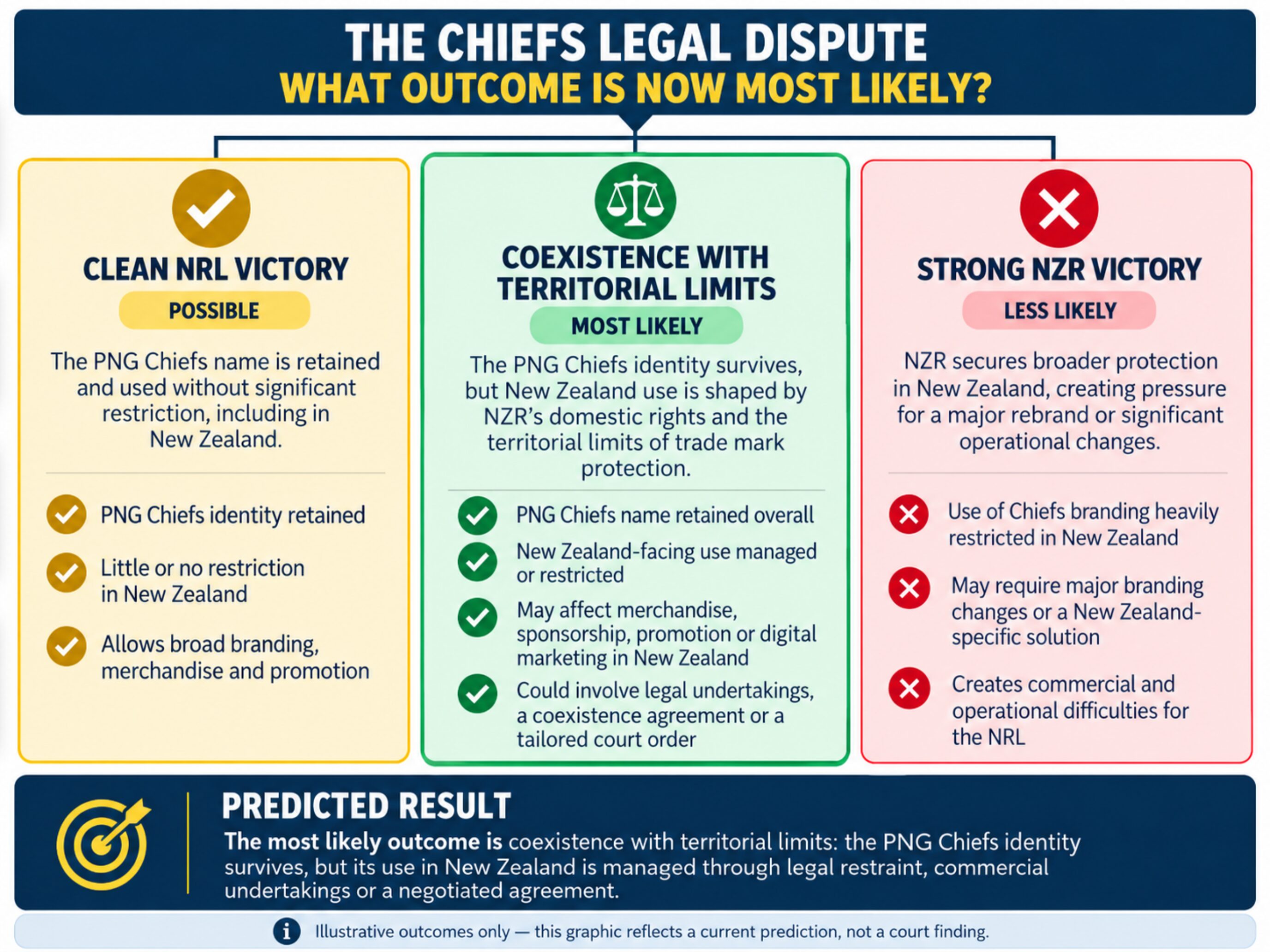
My Present Prediction – Sources: Federal Court of Australia Entity, Federal Registrar of Legislation (AU), High Court of NZ, New Zealand Legislation. Specifics in Footer Sources – Created by Author using Canva Premium
The Prediction: Coexistence with Territorial Limits
My prediction is not that the NRL will achieve a clean, unrestricted victory, but that the PNG Chiefs will retain their identity while potentially facing limitations on its commercial use within New Zealand. The distinction lies between a franchise’s right to operate under a particular name and its ability to use that name without restriction in every market.
The ARLC’s strongest argument is that the PNG Chiefs represent a distinct national and sporting identity, with an independently established cultural connection to PNG’s traditional leadership structures. The franchise is not attempting to present itself as the Waikato Chiefs. However, those differences do not automatically override NZR’s registered rights or eliminate the possibility of infringement through overlapping commercial activities.
Territoriality is therefore central to my prediction. NZR may be able to secure restrictions on particular uses of the Chiefs name, branding or merchandise within New Zealand without requiring the PNG franchise to abandon its identity internationally. Alternatively, the parties could negotiate arrangements involving more prominent PNG identification, distinctive branding, sponsorship safeguards or licensing provisions.
The challenge is implementing such boundaries within an increasingly interconnected sporting market. The NRL stages matches in New Zealand, sells merchandise internationally and operates through centralised broadcasting, sponsorship and digital platforms. Restrictions that appear straightforward in legal terms may prove commercially difficult to administer.
That difficulty cuts both ways. It reinforces NZR’s concerns about commercial overlap while giving the ARLC an incentive to negotiate rather than risk ongoing uncertainty. A heavily qualified injunction could complicate arrangements for sponsors, broadcasters and supporters, potentially making a negotiated resolution more attractive to both organisations.
Ultimately, I believe coexistence with territorial limits represents the most plausible outcome: the PNG Chiefs retain their broader identity, while their New Zealand commercial activities may be subject to targeted legal restrictions, voluntary undertakings or negotiated arrangements. Such an outcome would not give either organisation everything it seeks. However, it may offer the most workable balance between NZR’s enforceable trade mark rights, Papua New Guinea’s distinct sporting identity and the commercial realities of a trans-Tasman competition.
Golden Point: Protecting Identity Without Claiming Exclusivity Over Sport
There is something almost predictable about rugby league and rugby union finding another opportunity to argue over territory. The codes have long competed for players, audiences, money and influence. International expansion has simply given that rivalry a new frontier.
Whether PVL has outmanoeuvred New Zealand Rugby, or rugby union is attempting to slow rugby league’s growth, may make for entertaining narratives, but neither determines the legal outcome. Both sides have legitimate interests: NZR in protecting a sporting identity developed over nearly 30 years, and Papua New Guinea in establishing one that reflects its people, culture and national ambitions.
The legal challenge lies in distinguishing the protection of established commercial rights from overly broad claims of exclusivity. Sharing a sporting nickname does not automatically constitute infringement, just as different codes and national borders do not necessarily prevent it. As the legislation and case law demonstrate, the answer depends on enforceable rights, commercial activities and the evidence before the Court.
My prediction remains that the PNG Chiefs will take the field in 2028 under their chosen identity, although potentially subject to legal qualifications or commercial concessions within New Zealand. The interim injunction decision has not resolved the underlying dispute, and much will depend on the substantive evidence, the scope of NZR’s rights and whether the parties can negotiate a workable resolution.
Ultimately, protecting an identity and claiming ownership of a name are not the same thing. Sport thrives on competition, but competition does not always require exclusivity. Two organisations can share a name without sharing an identity, even if doing so lawfully requires recognising certain boundaries.
For now, I believe there is room for both Chiefs — though not without limits.
Roly-Poly

SOURCES
Arsenal Football Club plc v Reed, Case C-206/01, ECLI:EU:C:2002:651 (Court of Justice of the European Communities, 2002). https://eur-lex.europa.eu/legal-content/EN/TXT/?uri=CELEX:62001CJ0206
Attorney-General’s Department. (n.d.). Trans-Tasman proceedings regime. Australian Government. https://www.ag.gov.au/international-relations/private-international-law/trans-tasman-proceedings-regime
Burger King Corporation v Hungry Jack’s Pty Ltd [2001] NSWCA 187.
Campomar Sociedad, Limitada v Nike International Limited [2000] HCA 12. https://www.hcourt.gov.au/cases-and-judgments/judgments/judgments-1998-current/campomar-sociedad-limitada-v-nike-international-limited
Chiefs Rugby Club. (2026, October 16). Chiefs update on interim injunction. https://chiefs.co.nz/news-item/chiefs-update-on-interim-injunction/
Courts of New Zealand. (n.d.). Structure of the court system. https://www.courtsofnz.govt.nz/about-the-judiciary/structure-of-the-court-system
Courts of New Zealand. (2026). High Court: General proceedings—Waiting time for scheduled hearings as at 31 December 2025. https://www.courtsofnz.govt.nz/the-courts/high-court/annual-statistics/annual-statistics-for-the-year-ended-31-december-2025/high-court-general-proceedings-waiting-time-for-scheduled-hearings-as-at-31-december-2025
Currie, S. (2026, October 16). Media Insider: Chiefs v Chiefs in High Court – judge rejects NZ Rugby bid for interim injunction to halt NRL team launch. NZ Herald. https://www.nzherald.co.nz/sport/media-insider-chiefs-v-chiefs-in-high-court-judge-rejects-nz-rugby-bid-for-interim-injunction-to-halt-nrl-team-launch/3HDDTDRRPZHA7JV7XQSP6UKBW4/
European Union Law (Official): https://european-union.europa.eu/institutions-law-budget/law/find-legislation_en
Ewart, R. (2026, October 2). Australia’s trademark agency says PNG Chiefs name risks brand confusion with Super Rugby club. ABC News. https://www.abc.net.au/news/2026-10-02/ip-australia-says-png-chiefs-name-risks-brand-confusion/107213026
Ewart, R. (2026, October 9). Gloves are off as New Zealand’s Chiefs start court proceedings against their rugby league rivals in PNG. ABC Pacific Beat. https://www.abc.net.au/pacific/programs/pacificbeat/chiefs-high-court/107246342
Fair Trading Act 1986 (NZ). https://www.legislation.govt.nz/act/public/1986/121/en/latest/
Federal Court of Australia Entity. https://www.fedcourt.gov.au/about/corporate-information
Federal Court of Australia. (2025, February 7). Intellectual property practice note (IP-1). https://www.fedcourt.gov.au/law-and-practice/practice-documents/practice-notes/ip-1
Australian Federal Register of Legislation: https://www.legislation.gov.au
High Court (Improved Access to Civil Justice) Amendment Rules 2025 (NZ). https://www.legislation.govt.nz/regulation/public/2025/0149/latest/LMS1457965.html
High Court Rules 2016 (NZ). https://www.legislation.govt.nz/regulation/public/2016/0225/latest/
InterCity Group (NZ) Ltd v Nakedbus NZ Ltd [2014] NZHC 124.
Johannsen, D. (2026, October 12). Chiefs v Chiefs: NRL ‘blindsided’ by NZ Rugby injunction bid. RNZ, republished by 1News. https://www.1news.co.nz/2026/10/12/chiefs-v-chiefs-nrl-blindsided-by-nz-rugby-injunction-bid/
Kansas City Chiefs. (n.d.). Club ownership and history. https://www.chiefs.com/team/ownership/
Klissers Farmhouse Bakeries Ltd v Harvest Bakeries Ltd [1985] 2 NZLR 129 (CA).
New Zealand Ministry of Justice. (n.d.). Judicial issues conference. https://www.justice.govt.nz/courts/going-to-court/without-a-lawyer/representing-yourself-civil-high-court/judicial-issues-conference/
New Zealand Rugby. (2026, October 8). New Zealand Rugby moves to protect the Chiefs brand. https://www.nzrugby.co.nz/news-and-events/latest-news/new-zealand-rugby-moves-to-protect-the-chiefs-brand
Nickson, R. (2026, October 12). What’s in a name? Enough to ensnare Australia, NZ and PNG in a legal battle over the rugby team name ‘Chiefs’. The Conversation. https://eveningreport.nz/2026/10/12/whats-in-a-name-enough-to-ensnare-australia-nz-and-png-in-a-legal-battle-over-the-rugby-team-name-chiefs/
PNG NRL Bid. (2025, October 12). PM Marape announces team name “Chiefs”: A symbol of unity from a nation of a thousand tribes. National Rugby League. https://www.nrl.com/news/2025/10/12/prime-minister-marape-announces-png-nrl-team-name-chiefs-a-symbol-of-unity-from-a-nation-of-a-thousand-tribes/
Radio New Zealand. (2026, October 16). NZ Rugby loses round one in Chiefs v Chiefs trademark dispute. RNZ, republished by 1News. https://www.1news.co.nz/2026/10/16/nz-rugby-loses-round-one-in-chiefs-v-chiefs-trademark-dispute/
Taylor v Killer Queen LLC [2026] HCA 5. https://www.hcourt.gov.au/cases-and-judgments/judgments/judgments-1998-current/taylor-v-killer-queen-llc
Trade Marks Act 1995 (Cth). https://www.legislation.gov.au/C2004A04969/latest
Trade Marks Act 2002 (NZ). https://www.legislation.govt.nz/act/public/2002/49/en/latest/
Trans-Tasman Proceedings Act 2010 (Cth). https://www.legislation.gov.au/C2010A00035/latest
Trans-Tasman Proceedings Act 2010 (NZ). https://www.legislation.govt.nz/act/public/2010/0108/latest/
UK Legislation (Official Home): https://www.legislation.gov.uk