
In a preseason where I decided to limit my visits to the heavier load sessions, I strangely found myself attending Kellyville HQ on consecutive days at the end of the week.
Though traditionally a higher workload day, Friday became the warm up for a monster Saturday field session.
Please note that due to the individual loading program of players, some come and go from the main group during the sessions. That varies from day to day. Some do conditioning work on the field whilst others might be in the gym, before the group comes together for skills.
I’ll deal with the two days in separate sections in this report, with the greater emphasis on Saturday.

Friday
This session was high in the skills content and lower on the conditioning side.
After the initial warm ups and universal ball skills, the groups split into forwards and backs. What was notable was the outside backs practising their high catches, with AFL style technique. They then worked through passing skills under defensive pressure. Assistant coach Scott Wisemantel employs some innovative techniques in his drills.
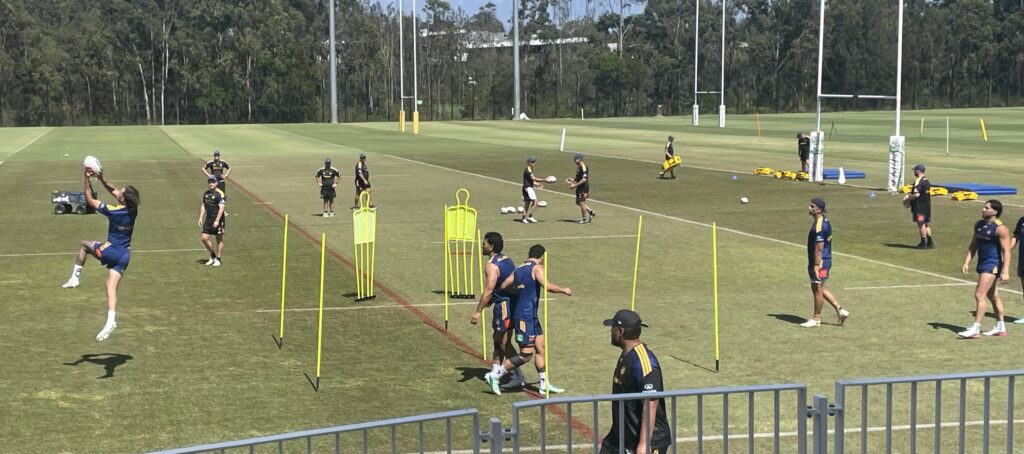
Cam Bamblett takes a high ball
Simultaneously, the forwards (who comprise the greatest number in the current group), ran core attacking shapes.
What followed was the entire group coming together for an extended period of defence skills. It developed on from the Monday and Wednesday sessions with structure and movement around the ruck, and the associated communication.
Later in the morning, the group finished up with more ball skills, then rapid fire games of touch before wrapping up with targeted extras.
Saturday
There was a genuine intensity about this session. In fact, as the players moved onto the training track, “Enter Sandman” was playing, just as it does when they run onto CommBank Stadium.
Immediately, the messaging was clear. The work was going to happen at pace, there was an expectation of fast and smooth transitions between drills, and that consequences awaited errors.
This was an extended session that was bookended by defence.
It opened with systems and communication. Split into teams of around eight a side, the focus was on the ruck and edge systems. They drilled speed in getting back into position as the markers peeled off, with an active fullback communicating to defenders.
There was also an element of contact as the attacking team asked genuine questions with the ball.
When the team transitioned into some runs, a couple of players made an error and a set of up/downs followed as a consequence.
The running was followed by unstructured touch footy in an area within the quarter. Lincoln Fletcher was very sharp during this part of the session.
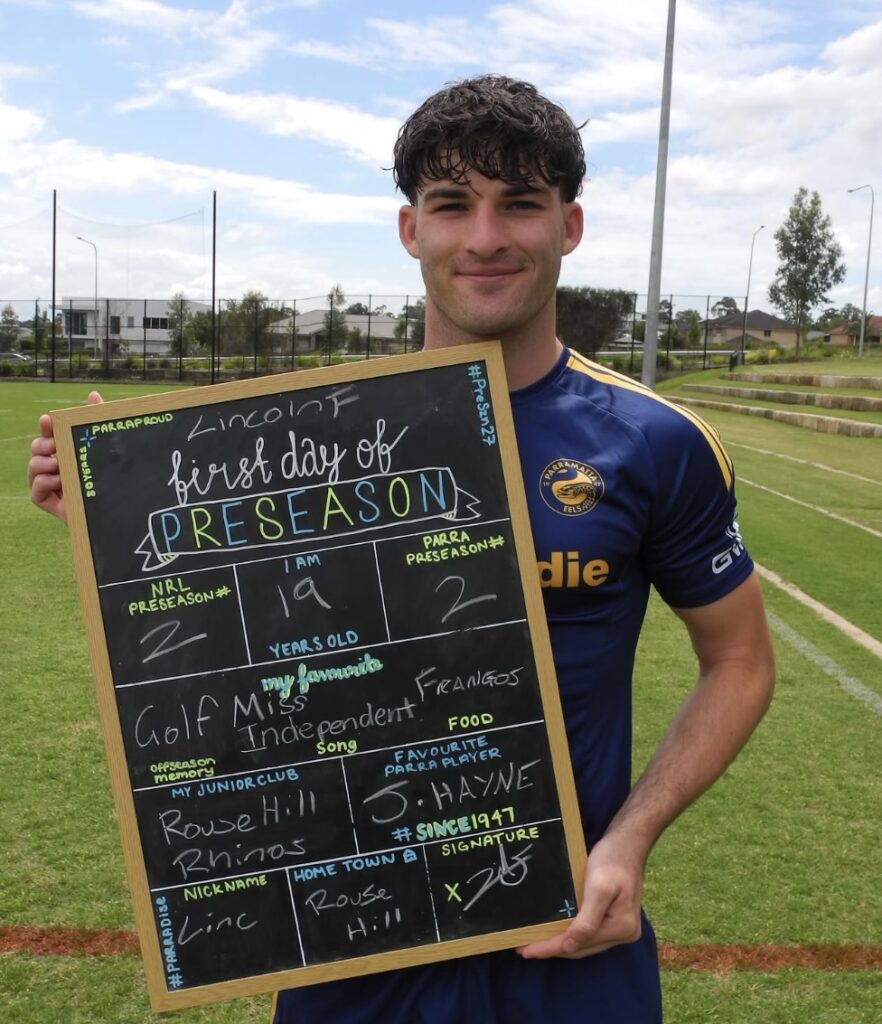
Lincoln Fletcher – image credit Eels media
Periods of serious conditioning started to become a feature of the session and once more the trio of Ryley Smith, Lincoln Fletcher and Talen Risati excelled.
However, a massive acknowledgement must go to Saxon Pryke who again sat just behind those three, and at times ran alongside them. What a motor he’s got. Of the bigger forwards, Tyrese Lokeni led the way. He went so close to a debut at the end of the season, and the young middle looks like pushing his claims for an early shot in 27 during the preseason.
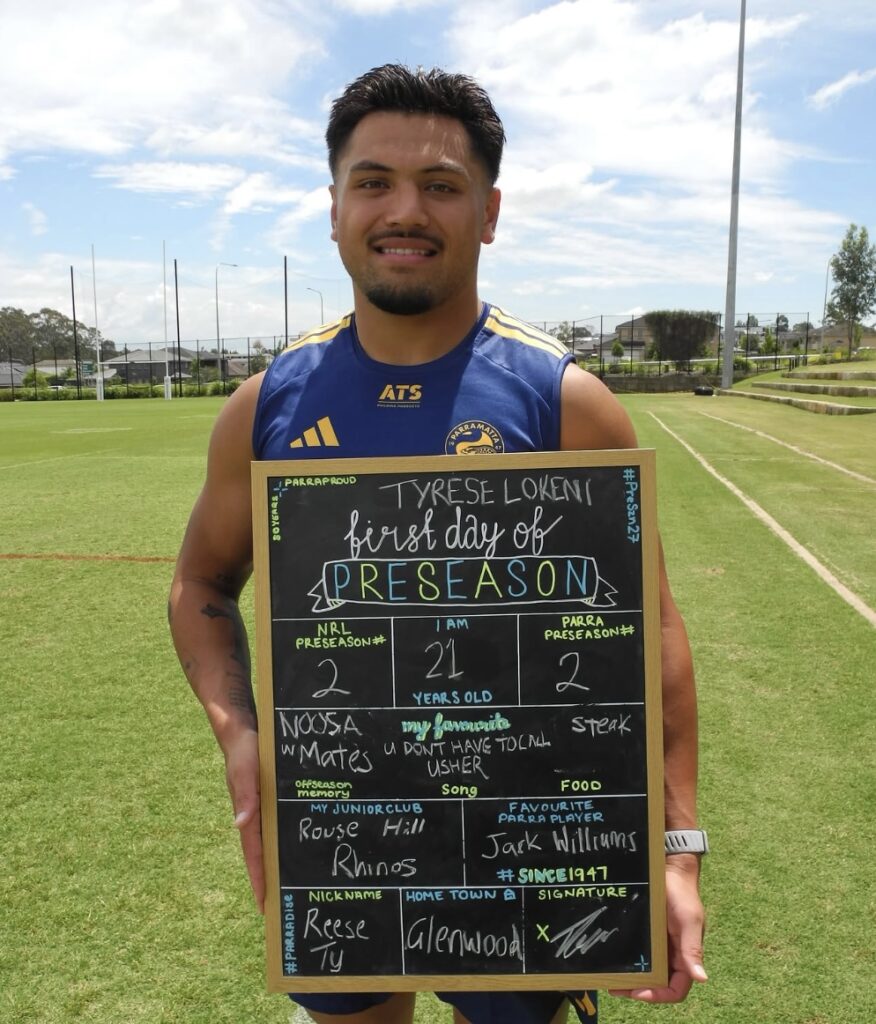
Tyrese Lokeni – image credit Eels media
In between the conditioning, the skills work continued with induced fatigue. Rapid fire draw and pass, and ball movement with shape were next on the agenda, before the group were put under the eye of Nathan Brown.
It’s not my place to give away the names of certain drills, or to go into the specifics, but this was a fun one to watch as I could hear all of Brown’s messaging.
Essentially, this was an opposed attacking drill, with a numbers advantage to the attacking group. The focus was on the players getting themselves quickly into the best position when such an advantage presents itself.
I noted some good skills and decision making by Ryley Smith, Talen Risati and Samuel Polley. Sometimes that involved holding the ball and going themselves, playing what was in front of them.
There was a coaching moment where Brown had a message for those in the role of defenders. It was delivered Nathan Brown style after he wanted more opposition from a defender.
“Fellas, I don’t coach defence, but if a bloke beats you, you turn and chase. Because I can tell you, the coach (Ryles) likes that…”. Again, reinforcing that if aspect wasn’t good enough, even if it wasn’t the goal of the drill, that it would be noted.
Next on the agenda was rapid fire taking the ball forward with support, and defending against it. More messaging, “nothing half arsed, be genuine with the ball.”
More conditioning runs, interspersed with ball skills, was next on the agenda as the kilometres were pumped into the legs. As the players transitioned to the location of the next drill, the messaging about the transitions continued.
“We don’t f…..g stop!”
Although there had been hydration stoppages during the session, eventually a major refuel and hydration break was taken, but there was another purpose. It was time to put the jerseys on for an extended period of defence technique drills. Yes, as mentioned earlier, the session would be bookended by defence.
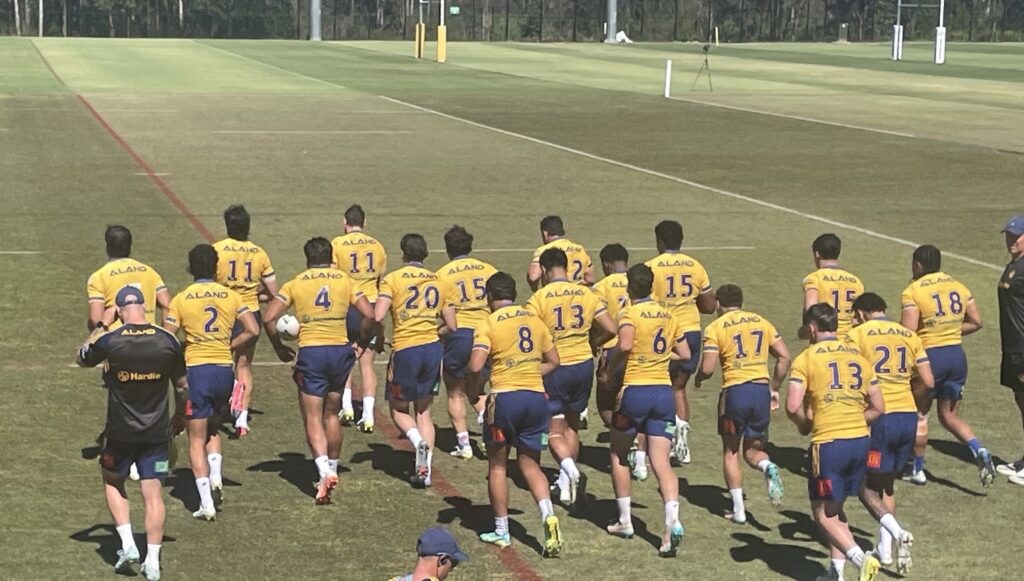
Jerseys on and ready for tackling drills
The squad had been told exactly how much time they had to refuel and get the jerseys on, and with the jerseys as tight as they are, it meant having to organise assistance in getting the jerseys on. A couple of time reminders ensured that everybody was ready to go when the signal came to move.
Unfortunately this defensive technique work was undertaken on the far field. So though I could see what was transpiring, I couldn’t hear any messaging from Mark Russell or Jason Ryles.
It began with the players paired up for one on one tackling of player carrying a football. This was repetitive so it quickly became tackling under fatigue.
Next up was two on one tackles, winning dominance and controlling the tackle. This was followed by one on one tackles winning dominance, scaffolded through to taking the attacker down to the turf, then into winning dominance over a player taken down to the turf.
Session done.
New Zealand PDRL Visit
I didn’t include this in my Wednesday report, but that day the NZ PDRL (Physical Disability Rugby League) squad watched Eels training and toured the Kellyville facility.
Though it hasn’t received the same exposure, the PDRL World Cup is also being staged alongside the Men’s, Women’s and Wheelchair tournaments. England are the reigning champions, and the previous World Cup was covered in a wonderful documentary by Adam Hills.
However, England have not qualified for today’s final which pits New Zealand against Australia.
I’ve include this story about the New Zealand team for context about the impressive standard of their code. Please note that the clip is a mix of Maori and English with subtitles and footage of play. Shout out to Carl, who is a PDRL referee from New Zealand and was one of the touring group visitors, for talking with me about PDRL across the ditch.
Mike Rush & Gianni
Our new Eels CEO, Mike Rush, has wasted little time in familiarising himself with the players and staff.
After Wednesday’s introductions, Mike was also present at the Friday and Saturday sessions. In fact, he made a point of watching some of the Jersey Flegg preseason training on Saturday morning. That wasn’t surprising given his background in prioritising pathways development.
A thank you also to Mike for spending time with a group of us, including Gianni (Giannino) Giusti and his son Joel on Friday.
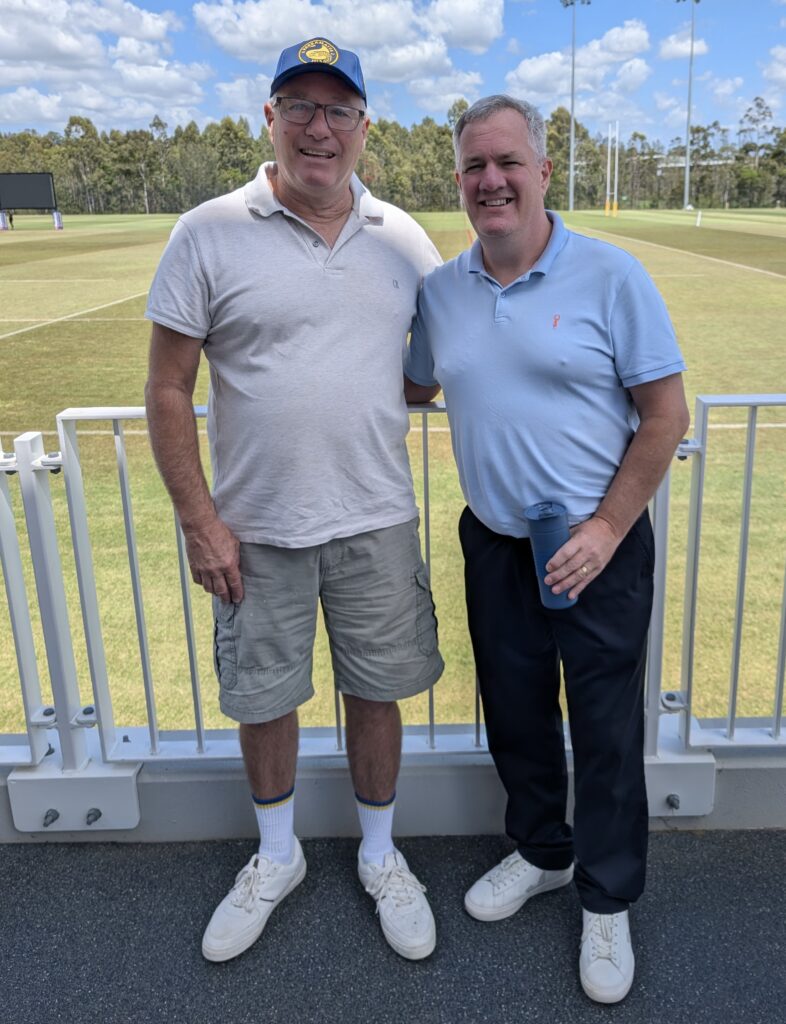
Gianni and Mike
For anyone unaware of Gianni, he’s a passionate Eels supporter who has been a part of the TCT community since we launched. Unfortunately Gianni was recently diagnosed with a rapidly advancing MND.
We are supporting the Giusti family in their fundraising for MND Australia. Please note, Gianni and his family are generously raising these funds for MND Australia, not for themselves.
If you’d like to get behind them, here is the link to the official MND Australia page for their fundraising.
Eels forever
Sixties


Thanks Craig for your insights about training, has the level of training and intensity gone to a higher level than last year as anyone who follows the game closely new we were terribly off the pace last year TIA
Thanks Sixties. It all sounds very promising for 2027, with a lot of positivity in the club. I hope the fan base can pick up on that 🙄. We underestimate the hard work the guys do unseen by most.
Are they likely to be training around 21-24 December as I will be in Parra and would love to get to Kellyville?. Understand if they aren’t though.
As ever, an invaluable insight into the club operation. I’m in awe of the commitment and energy involved, and very grateful.
What you do make clear is the commitment and sacrifice of the young men who seek a place in the NRL; of those throwing themselves into these exercises only a few will make it into even the $140,000 a year most junior ranks; several will have their dreams ended in injuries that will affect them for the rest of their lives.
I do get riled by “supporters” who sneer at an individual player who.might have made a mistake or not quite come up to the mark – the poorest performer at yesterday’s training has shown more sporting ability, commitment and courage than I ever possessed.
A couple of requests – do we know what happened to Will Latu? He hasn’t played for what seems like months but has never been listed in the injured columns.
Secondly, any information you can give us on the recent recruits below NRL level will be greatly appreciated. The Cup level performance last year was deeply disappointing – I think we had 50 put on us in the season’s last game. The contribution of Nathan Cayless to the club and to New Zealand rugby league was outstanding but it’s probably a good thing that he’s moved on; we need to be better at Cup level.