
Hey Parra fans, This week my still optimistic yet growingly cynical, data-driven curiosity is taking readers on a numerical journey that attempts to heal my frustrations, challenge my biases and decode my fan fatigue regarding the season thus far. To do so, I will be diving into responsibly sourced statistical data, which just so happens to combine a few of my favourite things: Parra, numbers and trying to make sense of the nonsensical.

Preface
While numbers rarely tell the whole story, they do help identify patterns of behaviour that are far more difficult to discredit than observations alone. That’s why I believe they’re one of the best places to start when searching for answers to most of life’s problems, whether I am looking at my budget, my health, my work schedule or in this instance my football team. Even if the evidence doesn’t support how I’m feeling; I respect that the harshest realities in life are almost always data driven.
Data-driven beliefs aside, I think it’s important to transparently preface my data sources and their potential limitations before I take you down the rabbit hole. Because I understand and respect that while numbers always tell a story; in any self-serving analysis, any patterns identified are ultimately subjective and at the end of the day: correlation no matter how significant does not unequivocally establish causation in most instances.
Data source: In a decision that was more of a time-factor than a preference; I chose to use the original source in: official NRL Match Centres on NRL.com. The match centres detail: line-ups, adjudicators, overall possession, and broad play-by-play statistics, such as: tries, goals, errors, penalties, six-agains, interchanges and injuries.
Limitations: Publicly available NRL data does not consistently include red-zone decisions, attacking-20 or possession percentage increments. Also the NRL Match Centre separately records “Inside 10 Metres” infringements. Some of those may also produce a set restart, so the ruck-infringement column is the clearest consistently published six-again measure, but it may not represent every audible six-again call made during a match. Hence some potentially valuable measures had to be grouped into categorical variables, such as completion rates, errors, and penalties. Lastly, while it pains me to acknowledge it; because I only analysed Parra games, the small sample sizes make it difficult to argue to any meaningful evidence of inconsistency and biases.
On that note, let the decoding of my biases and fan fatigue begin. As always, I hope you find it insightful and engaging; and I look forward to your views and perspectives in the comments, whether they are similar, dissimilar, or indifferent.
CHALLENGING BIASES AND CYNICISM: PERCEPTIONS AND OPINIONS Vs. DATA AND EVIDENCE
Every struggling football club eventually reaches a point where the search for answers becomes a flaming ball of whose to blame. Between the news papers, social media, television and fan forums; those conversations are becoming increasingly dominant and hard to escape.
Depending on who you watch, what you read and where your social media algorithm takes you; it feels like there is an overwhelming multitude of opinions all pointing to different reasons why the Eels have failed to meet expectations in 2026. Yet despite the passionate intent, and subjective certainty with which these views are expressed, they often rely more on perceptions and opinions rather than data and credible evidence. This season I am as guilty of this as any fan; I am not one to chime into debates on social media; though I am fairly certain I drive my family and colleagues bonkers with my strong subjective one-eyed views in conversation at times. This year in particular I have felt frustration, disappointment, and confusion that feels heavier on my heart and soul than they have in previous seasons. I have also felt new levels of discontent towards the referees, the judiciary, the NRL and on occasion the teams on-field game-day performance. Though my overall headspace sits very strongly in the “multiple injuries + inexperienced squad = no lollies” rationale; I often deflect to blaming the ref, the rules and the opposition; I am only human after all.
So, a few weeks ago after a post match emotional meltdown that included far too many swear words, Double Jacks and junk food; I had a self-reflective revelation. While I am so sure my feelings are valid; What if in reality I am searching for answers in the wrong place? Furthermore, rather than immediately jumping to “who is to blame” after every heartbreaking loss, perhaps I should first ask: what does the available data show once all my beliefs and biases are stripped away? Since then, I have spent whatever spare time I can find analysing official publicly available data from every Parramatta match thus far; analysing every stat available from penalty counts to completion rates; from questionable 6-agains to self inflicted sin bins. Looking not only at what role the officiators play, but also how effectively the Eels have converted opportunities into sustained pressure and performance.
My main objective was to test my perceptions and opinions against the available evidence and see whether they could rationally be upheld under scrutiny. The findings show that while some of my internal narratives are somewhat supported (injuries), other more accusatory narratives (officiating bias), become increasingly harder to defend against the data. More importantly, the analysis points towards a recurring pattern that may better explain why a team capable of producing impressive victories one week has too often struggled to reproduce them the next.
The numbers don’t tell us everything, but they do help us ask better questions; and sometimes, that’s where the most valuable insights begin.
Injuries: The Obvious Explanation
Any honest assessment of Parra’s season has to begin with the injury toll. It’s the explanation most supporters instinctively turn to; and with good reason. Few clubs have experienced the level of disruption the Eels have endured in 2026; with more than 100 games lost to injury and no opportunity to consistently field their best 17, stability has been almost impossible to achieve.
The result has been a season of constant reshuffling, with stabilising seniors and promising juniors being consistently sidelined for lengthy periods; making developing strategies difficult to embed and emerging plays and combinations being broken apart before they have had the opportunity to develop. In rugby league; or any team environment for that matter; cohesion isn’t built overnight; it is achieved through repetition; which over-time develops into trust in one another’s core capabilities; that in-turn enhances each players ability to instinctively predict one another’s next move.
When injuries continually force personnel changes, those relationships are disrupted; game plans that should be strategic become reactive, with coaches simply trying to field the strongest team available each week rather than being able to build long-term combinations. Understandably confidence is also affected, because constant change will inevitably impact hesitation, uncertainty and a greater tendency to misread the play.
There is little doubt that injuries have played a major role in Parra’s inconsistent performances this season and they do provide important context for many of the issues supporters have witnessed each week. However, they don’t fully explain why individual matches have been won or lost. Injuries help explain why execution may deteriorate, but they don’t directly measure how it deteriorates on the field. That’s where the analysis begins to shift.
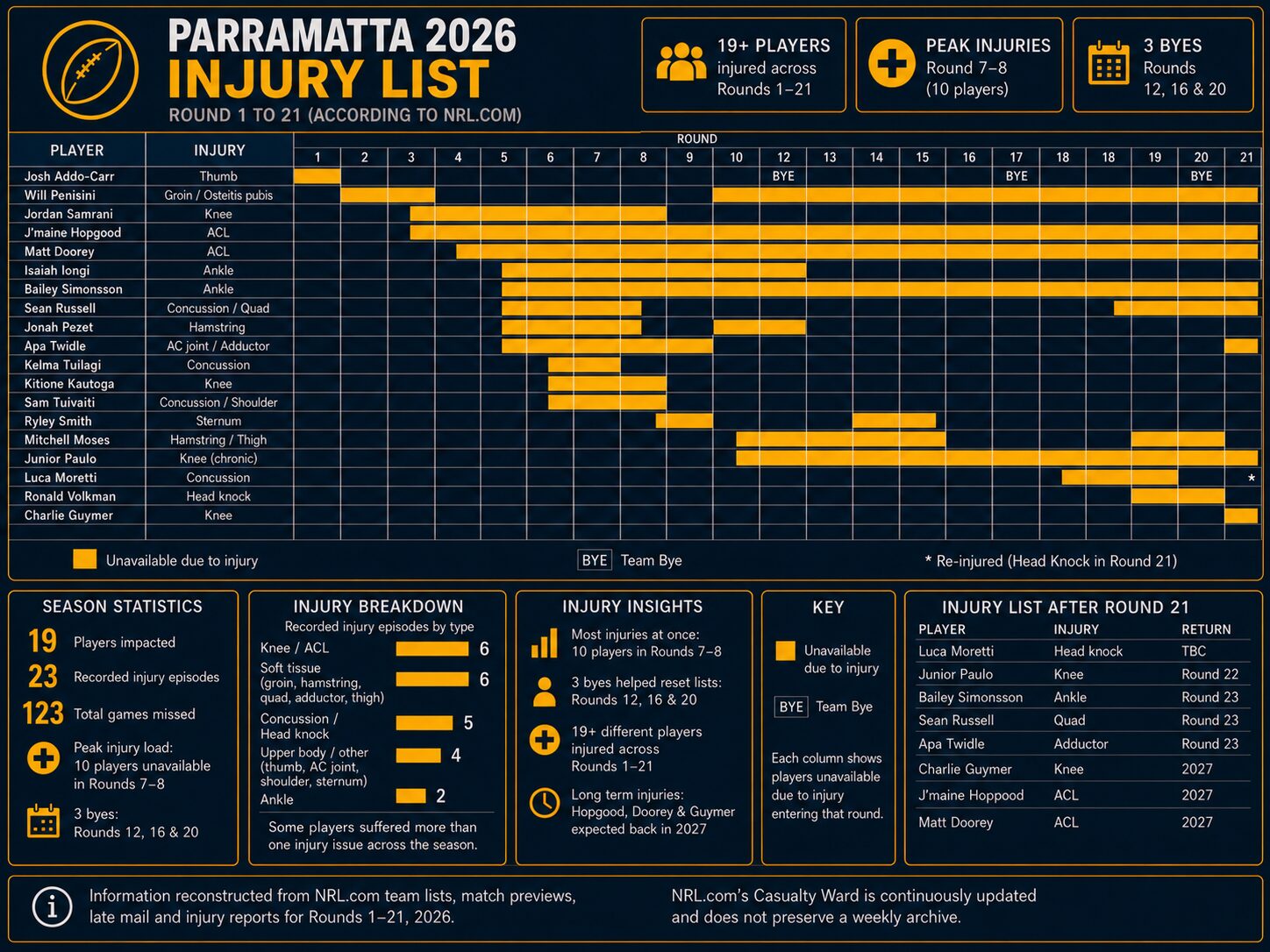
Injury overview: Created by the author using data from the NRL, decoded through PowerBI and illustrated using Canva Premium
Referee Bias: The Emotional Explanation
If injuries provide the obvious explanation for Parra’s season, officiating has arguably been the most emotional one. So why are so many supporters, including me, regularly convinced the referees have also cost Parramatta games?
Spend five minutes scrolling after almost any Eels defeat and you’ll find no shortage of frustration directed at the officials. Missed forward passes, contentious six-agains, controversial obstruction rulings, overwrought bunker interventions and perceived inconsistencies have all fuelled the belief that Parramatta has regularly been on the wrong end of crucial decisions.
To be fair, those frustrations aren’t unique to Eels supporters, every fan base can point to moments where officiating has influenced momentum or altered the complexion of a game. Rugby league is a fast, complex sport officiated by humans making split-second decisions, and perfection will never be a realistic expectation for human behaviour. That being said, isolated decisions and season-long trends are two very different things. Rather than relying on memorable moments, I wanted to examine whether the available data supported the broader claim that Parramatta had been consistently disadvantaged by officiating.
To do that, I compiled the penalty and six-again counts from every Parra match thus far before comparing them against referee appointments and match outcomes. The results were not what I expected. Across the season so far, the Eels actually have a positive penalty differential and a positive six-again differential. In simple terms, the Eels generally received more penalties and more six-agains than their opponents. That finding doesn’t prove every decision was correct, nor does it suggest supporters should simply ignore poor officiating when it occurs. A single incorrect decision at a critical moment can still influence the outcome of a match. However, when viewed as a whole, the evidence becomes much harder to reconcile with the narrative in my mind that my club has been consistently getting a raw deal from the referees and officiators.
I also examined each referee’s appointments throughout the season to determine whether any meaningful patterns emerged. Initially, there appeared to be some interesting trends with the Eels strongest performances occurring under certain officials, while other officials oversaw multiple defeats. However, once those results were placed into context, the patterns quickly became less convincing. Most referees officiated only one to three Parra matches, making the sample sizes far too small to draw reliable conclusions. The quality of opposition varied significantly, home and away conditions differed, and injuries continued to reshape the team’s performance regardless of who held the whistle.
Perhaps the most telling observation was this: Parra frequently enjoyed favourable penalty and six-again counts in games they still lost; and won games where the penalty count against them was considerable. So as much as I want it to be true, if officiating really were the club’s primary problem, we would expect to see more of the opposite. This isn’t intended to dismiss legitimate criticism of officiating. Consistency remains one of the game’s greatest challenges, and there is still value in analysing referee performance, accountability and decision-making. However, based on the evidence available, officiating appears to be more of a distraction than a defining cause of Parramatta’s season.
A side-Note on the Bunker
While the data does not suggest Parra has been systematically disadvantaged by officiating, that shouldn’t be mistaken for an endorsement of the current system. The Bunker continues to face legitimate criticism across the competition, not because it consistently favours one team over another, but because it often struggles to apply the same interpretation consistently. Similar incidents can produce different outcomes from one week to the next, intervention thresholds can appear unclear, and explanations for contentious decisions are often limited or only provided after the fact.
The result is a system that may achieve a high overall level of accuracy, yet still generate low public confidence because the small number of errors that do occur across officiating types often occur in clusters during pivotal moments of a game.
After examining injuries, refereeing and the Bunker, a clearer picture emerges. Injuries have made Parra’s season harder by disrupting combinations, cohesion and team stability. The refereeing data tells a different story: despite supporter perceptions, Parra has generally received more penalties and ruck six-agains than its opponents. While officiating and Bunker consistency remain legitimate concerns, neither adequately explains the Eels’ ladder position.
These are genuine issues the NRL should continue to address. However, based on the available evidence, they do not appear to adequately explain Parra’s position on the ladder. The data points more convincingly towards player lead factors than officiating as the defining factor in the Eels’ season.
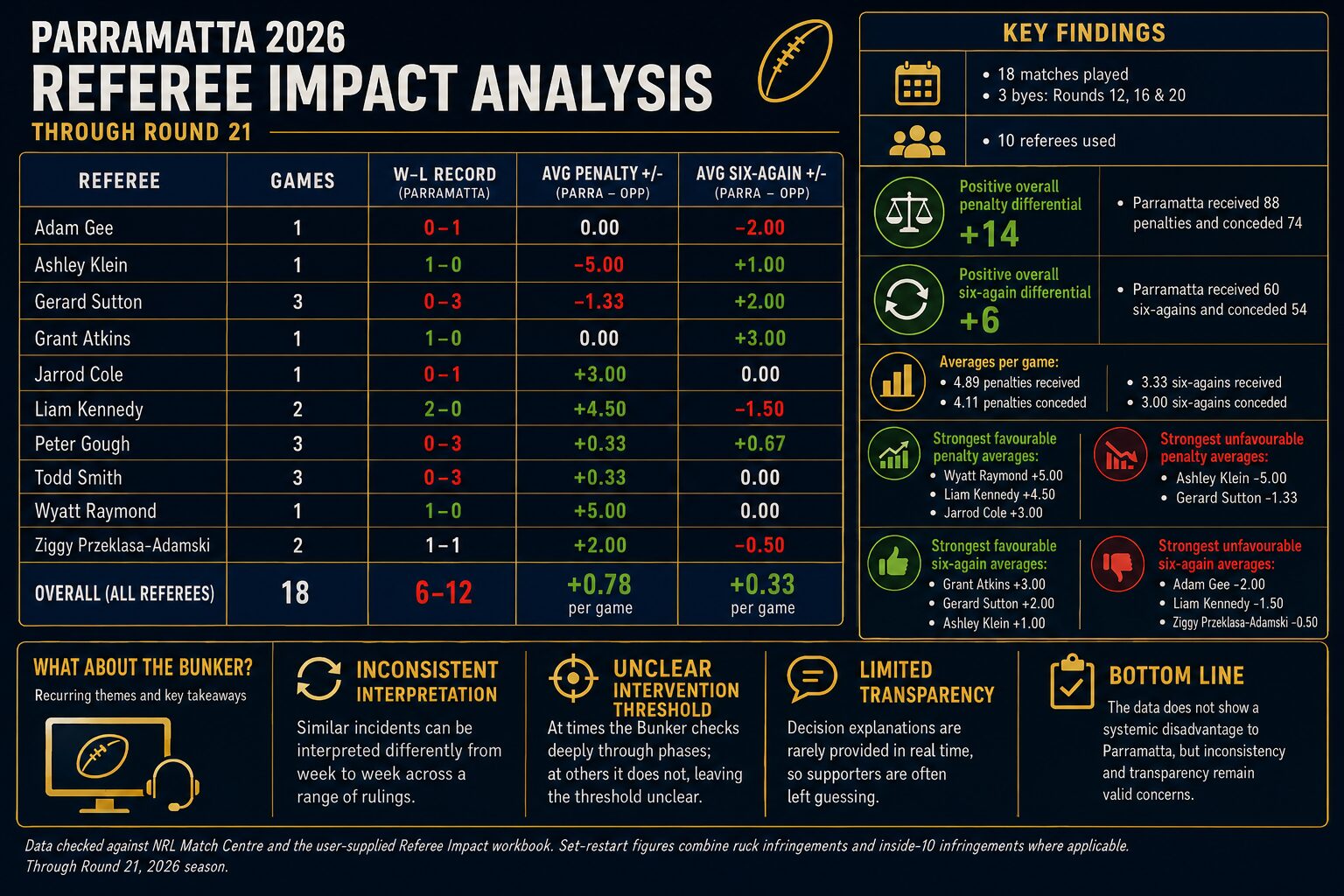
It’s Official: Ashley Klein hates us! But the overall results are surprisingly in the green. Created by the author using data from the NRL, decoded through PowerBI and illustrated using Canva Premium
Execution: The Self-Reflection Explanation
If injuries only explain part of Parra’s struggles, and the officiating data does not support the idea of a systematic disadvantage, then the uncomfortable question becomes harder to avoid: what is actually costing the Eels games? For mine, the data points to one player driven factor: Execution.
By execution, I mean the team’s ability to turn possession into pressure, pressure into chances, and chances into points. That sounds simple, but watching Parra this season, it has often felt like the Eels have done enough good work to earn opportunities, only to let too many of them slip away.
The completion numbers are the clearest starting point. In wins, Parra have completed about 82.7% of their sets. In losses, that drops to about 72.1%. That gap is especially significant because incomplete sets do more than end an attacking opportunity; they cost field position, reduce attacking opportunities, ease pressure on the opposition and force the Eels back into repeated defence sets.
That is where the errors start to matter so much. Dropped balls, loose passes and unnecessary mistakes do not just look frustrating in the moment; they change the rhythm of the game. Instead of building pressure, Parramatta gives the ball back and invites the opposition to dictate terms.
That pattern has shown up too often: promising field position becomes an early handover, a chance to apply pressure disappears, and the opposition gets a release valve before the Eels can really make them uncomfortable.
The flow usually looks something like this:
- Poor completions lead to errors
- Errors prevent sustained pressure
- Lost pressure turns into missed attacking chances
- Missed chances increase defensive fatigue
- Fatigue creates scoreboard pressure
- Scoreboard pressure encourages more forced plays and more errors.
That last one is what has frustrated me the most; when the team falls behind, the instinct seems to be to chase the game erratically with no obvious method to the madness. Passes get forced, sets get rushed, and the team starts trying to win the game back in single plays rather than earning it back through sustained pressure and practiced strategies.
That does not mean effort is the issue; the effort is almost always there, but the execution is not clean enough for long enough to consistently make a difference to the scoreboard. Poor completions and repeated defensive sets eventually wear any team down no matter how much effort is present. Because when fatigue kicks in, line speed drops, communication gets harder, tackle efficiency suffers and decisions become more reactive; that’s human nature.
So, while injuries have clearly made the season harder, and while officiating will always create moments of frustration, the data keeps pointing me back to execution as the main on-field constraint. Parra has not lacked opportunities; too often, it has failed to maximise them.
The positive, if I am searching for one, is that execution is controllable. Injuries cannot always be prevented, and refereeing will never be perfect, but completion rates, errors, attacking efficiency and decision-making under pressure can always improve.
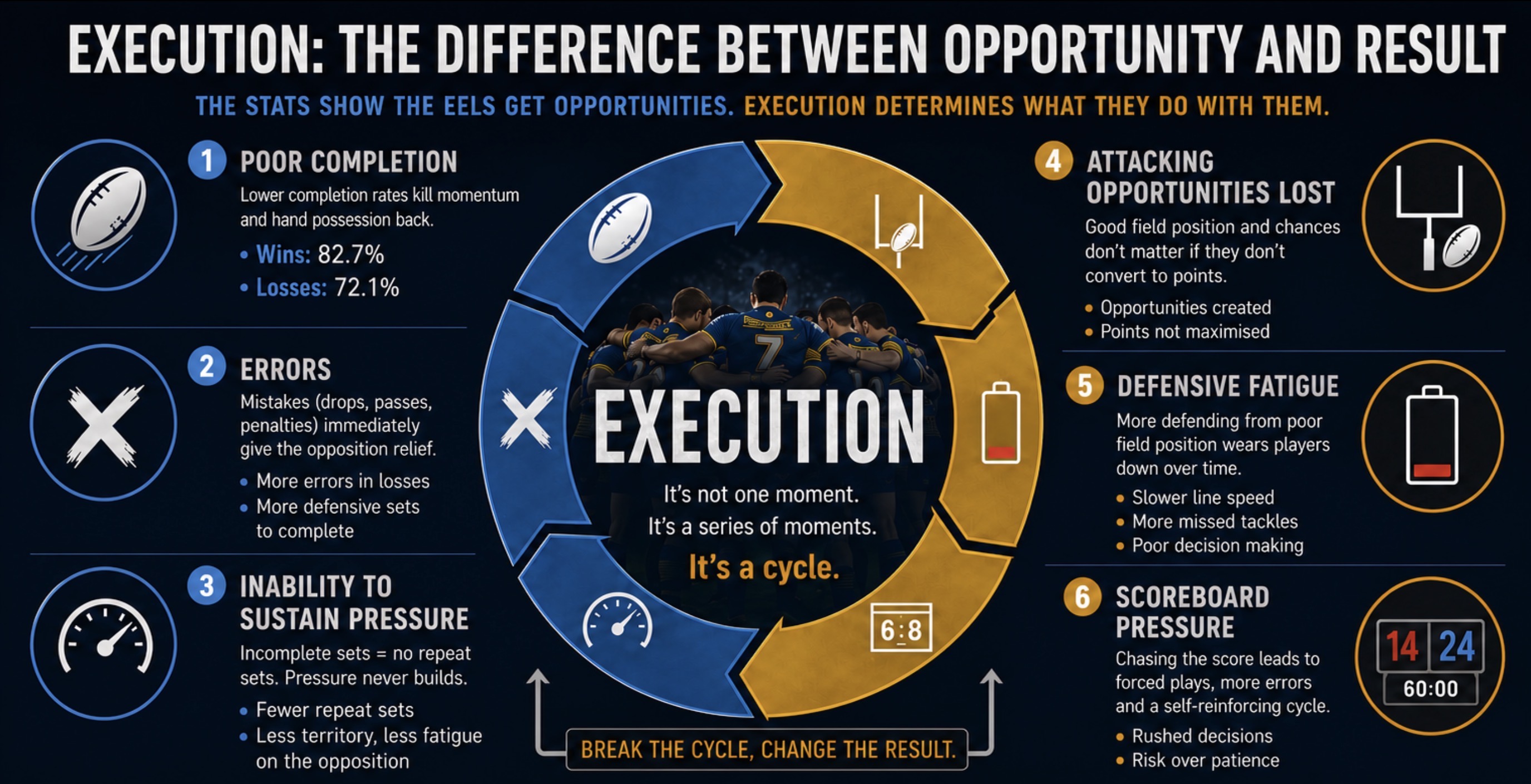
Execution Breakdown: Created by the author using data from the NRL, decoded through PowerBI and illustrated using Canva Premium
Credit Where Credit’s Due: An Indirect but Relevant Finding
In this data driven search for answers I stumbled across a positive stat for Parra that’s gone largely unnoticed. The Eels judiciary record provides some solid evidence of improved discipline. Across 2024 and 2025, the Eels experienced a relatively significant suspension burden, losing 10 matches through judiciary sanctions in 2024 and a further 12 in 2025. However, the pattern has changed considerably in 2026.
In this data driven search for answers I stumbled across a positive stat for Parra that’s gone largely unnoticed. The Eels judiciary record provides some solid evidence of improved discipline. Across 2024 and 2025, the Eels experienced a relatively significant suspension burden, losing 10 matches through judiciary sanctions in 2024 and a further 12 in 2025. However, the pattern has changed considerably in 2026.
Although they have 11 judiciary appearances this season, almost all have resulted in financial penalties rather than players being removed from the field in subsequent rounds. Only one player has been suspended, (Round 1, minute 1, J’maine Hopgood) costing the club a single match and we all know that was bollocks. This represents a substantial improvement on the previous two seasons and suggests that most offences have occurred at the lower end of the severity scale.
Fines are never ideal, and repeated Grade 1 charges should not simply be dismissed. However, from a team-performance perspective, the reduction in suspension matches is important. Availability matters, particularly during a season already affected by injuries and changes to the playing group. Keeping players eligible for selection allows combinations to develop, reduces further disruption and gives the coaching staff greater continuity.
The figures therefore point to a more encouraging trend. The Eels may still have areas of discipline to address, but they have significantly reduced the number and severity of incidents resulting in suspension. Compared with the 22 matches lost across 2024 and 2025, losing only one player for one match in 2026 represents meaningful progress.
The Golden Point: The Evidence Based Reality
After stripping away the emotion, testing my assumptions and following the numbers wherever they led me, the evidence is clear, even if it is not particularly comfortable:
- Parramatta’s injury toll is real, significant and undeniably disruptive. However, they are not the sole cause of the symptoms we have witnessed.
- Officiating remains an imperfect and occasionally infuriating part of rugby league. Yet the broader data does not support my perception that Parramatta has been systematically disadvantaged. The referees may occasionally aggravate the condition, but they are not the primary diagnosis.
- The strongest and most consistent indicator is execution. When the team consistently completes their sets, they win; when they don’t, they lose. Errors cost possession, pressure fails to become points, and defensive fatigue leads to rushed decisions.
- Effort is hard to question when players are constantly defending errors and chasing deficits. But effort without precision is inefficient. The team often create chances, only to surrender them before they can be capitalised with points.
- The dramatic reduction of judiciary appearances and adverse outcomes shows that behavioural patterns can change. It is a small but measurable sign that discipline can be corrected when standards, coaching and accountability align.
The Eels do not require a miracle, a refereeing conspiracy to be exposed, or every injured player to return simultaneously. They require cleaner completions, fewer unforced errors, calmer decisions under scoreboard pressure and the discipline to construct victories one set at a time. Injuries explain why that challenge has been harder. Officiating explains some moments of frustration. Execution explains the results more consistently than either.
That may not satisfy the emotional part of me that would still prefer to blame the referee, the Bunker, the injury gods or anyone other than the players wearing blue and gold. But the purpose of this exercise was not to validate my frustration, it was to test it, and the numbers have done exactly that. The findings have not removed the disappointment, but they have redirected it. They have replaced a search for villains with a clearer understanding of the problem; and importantly provided a number of variables that show genuine light at the end of this dark tunnel I am currently wallowing in.
Because the same data that exposes Parra’s failures also identifies the pathway forward: protect possession, sustain pressure, execute opportunities and allow effort to finally translate into results. The data diagnostics are in; the issue is execution, the treatment is repetition, discipline and composure; and despite everything this season has thrown at the club and the fans, the data indicates the prognosis is not terminal.
Roly-Poly


Great stuff. What fabulous research. We’ve all lamented the “dumb mistakes” and you just validated our feelings. Dropped ball on the first tackle. Play the ball mistakes on the first tackle etc. Momentum killers.
Thanks McFersie, it was definitely an interesting process of self reflection and reality. The early tackle errors are a killer. Actually that would be a stat and a half to break down. Lost opportunities early in sets. I reckon it would be pretty telling.
Great work Roly. Apprciate the time and effort that would go into that, vs these off the top of the head ranty comments, like what is below…. 😛
All valid stuff. Hard to do with the NRL.com stats. Its an area the game could really do with a lot of improvement on. Fox Sports publically available stats are worse (in terms of variety – they’re generally more accurate than NRL.com) though i am fortunate enough to still have access to some of their back of house match stats which are more versitile and usable for forming opinions.
My gripe with the “injury crisis” excuse (for want of a better word), is that it can be just that – an excuse. i. e. pardening the team for poor performance. But it’s not just on the field, but off it.
There are various ways injury can impact a team but the two main ways are quantity or quality. If the Storm were missing Grant, Hughes and Munster for an extended period, it is far more impactful than if they were missing one of those three, plus, say, Chan, Blore, Meaney MacDonald etc. Yes thery’re is a tipping point where the volume can cause greater harm… But we don’t have a Hughes, Grant and Munster. We barely have 1 in that group.
Who have the Eels key long term injuries been this year? Hopgood, Penisini, Simmonson. Doorey. And yes there have been others that missed a handful of weeks here and there to add to the impact of the long term injuries.
Those players listed – the “key” long term injuries, they shouldn’t dereail a season. In a quality squad, Hopgood is a solid contributor, and Penisni, Doorey and Bailey are interchangeable parts of a squad who should be playing when form warrants or as injury cover themselves.
We should be able to survive their ommission. Yes on a given week if there are a few other minor injuries, the totality of the situation might mean you have to take the L. But the fact that we start the season with an incomplete roster and the fact that it is not a strong roster, THAT continues to be the pure most undeniable underlying issue, and cause, of the results and ladder position.
I know some people had bold aspirations for this year. I never thought this was a Top 8 squad – unless the Pezet signing (which i was happy to try in light of the stuffing up of the roster) blew all expectations. This, to me, was always a squad that was going to finish in the 11-15 range, and despite the injuries, that is where we are going to land. Why? Because outside 2 or 3 players, the mediocirty of the remainder of the squad (be it aging vets, journeymen, or youth just starting out), makes them all pretty interhcangable. So even though injuries come and go, your expectations for the next man up never really change.
And just on the ref stats. If people want to complain that Gough is biased against us, they have to be willing to say Liam Kennedy is bias toward us. You can’t have it one way.
Agree with much of this.
At the end of the day we don’t set ourselves up for success and that’s my main gripe. These stats show the symptoms of the ineffective approach taken by this management. How we haven’t turned over the hof and recruitment is beyond me. People have to be respojsinlr for this shit show with the roster; it doesn’t happen by itself. Ryles complained recently about options being difficult to work through, well someone is responsible for that are they not. Why do we trust them to do better next time around?
More specific to performance, I still think we concede to many metres per set, have shit kick chase, shit wrestle and poor execution/skills base with our players. Clearly Ryles identified that before coming in but we haven’t been able to improve dramatically given the players on the roster. At the end of the day I have faith in the coaches but they can’t consistency outcoach poor roster quality. The club needs to give them the tools to work with.
As for the suggestion of Richardson – he is a terrible option. Another Tigers discard whose options and general disposition/ dealings led to Galvin walking out as well as Luai exercising option to leave. Now douehi is unhappy – a consequence of Richardson poor calls and roster management. He won at souths over a decade ago. The media leaks during g his tenure at tigers was diabolical. His public comments around the Galvin saga were shameful and meant tigers seemed to lose all leverage to negotiate with dogs. Our current hof is from tigers. We don’t need to go bargain hunting for another former tigers hof. Our s and c coach is from spooner knights. Aswell as improving the roster the club needs to get the best people it can into the coaching and front office roles
100% on Richardson. He’s faield miserably at the Tigers to get control of the football ops.
Thanks Ron, You raise some great points. The statistics show the on-field symptoms, but the underlying issue is that the club has not consistently set the football program up for success. Roster construction, recruitment and retention decisions do not happen in isolation, and there must be accountability for leaving the coaches with limited and difficult options. It is reasonable to ask why the same decision-makers should automatically be trusted to fix the problems they helped create.
On the field, the metres conceded, kick chase, wrestle and basic execution remain major concerns. I have faith in Ryles and the coaching staff, but even good coaches cannot continually overcome a roster lacking sufficient quality, balance and depth. The club must give them better tools.
I also understand your concerns about Richardson. Parramatta should not be selecting people because they are familiar, available or inexpensive. Whether it is the Head of Football, recruitment, strength and conditioning or coaching support, the priority must be attracting the strongest available candidates with current evidence of success—not continuing to recycle people from struggling systems.
Thanks BA, All fair points, particularly around the limitations of the publicly available statistics. I also agree that injuries have amplified Parramatta’s problems rather than created them. The bigger issue remains an incomplete roster lacking enough genuine top-end quality and meaningful depth, which is why the standard often changes very little when the next man comes in. On that basis, an 11th–15th finish was probably always more realistic than the top eight.
And your referee point is spot on. If negative numbers are accepted as evidence that Gough is biased against us, the same logic must mean Kennedy is biased in our favour. Otherwise, we are measuring confirmation bias rather than officiating.
I like the ref illustration, now compare that to the Warriors with a +42 penalties rating, also I think Gutho and Moses have been getting offside with all the officials for more than a few seasons – with Williams as captain I credit his calm demeanor with any positive penalty stat.
Good effort
Can the next chart be on recruitment, I would like to see a comparison between the eels and the other clubs – I suspect we are lacking in this area
Thanks Bob. Wow, the Warriors’ +42 differential certainly provides valuable context and is worth examining more closely. I didn’t have time to look into all the clubs because the NRL only provide the stats in the individual match centres and going into every game would be a big job. It would be interesting to compare though knowing that stat from Warriors.
Your point about captaincy is also interesting. I am a massive Moses fan; but in saying that Williams’ calm approach may be helpful for Parra’s relationship with officials.
I did do a piece about a month ago that looked at some aspects of recruitment, retention and total player value from an organisational angle. Looking at player gains and losses, roster vacancies, experience, value and performance across clubs may be a valuable extension on that piece. Leave it with me.
Thanks Roly,
Informative and thoughtful as always. As discussed previously I enjoy reading data analysis and interpretation. As you have pointed out there are severe limitations in the data sets available for you to use which is such a shame. That’s because for someone like myself who did a lot of strategic analysis this set of stats is really just the beginning to ask for a whole lot more data to analyse and drill down into. I’d really love to see stats around timings of six agains/ penalties, field position at the time, groupings of them etc etc, respective ladder positions in relation to each to give a much greater insight to inform the analysis. As you mention this sort of data can put real information behind the subjective analysis.
Of course the key question then is the why, why are the stats like that and as you note the cause/correlation question never has a simple linear analysis answer. This is the harder part where interpretation of the data can really diverge dependent on who is looking at it. I once completed an assessment based on large volume of data. All of my colleagues said it was great and they could see the analytical line from the data to my judgements. Then an experienced data analyst went through it as a final sense check and said in his view I was only half right. He then went through the data sets with me and showed me where he would put different emphasis on parts and why. I amended my assessment based on that discussion and it was way better, and more beneficial for decision makers because of it.
The other thing is that too many of us look for the one thing to explain why something like our season is happening. Inevitably it is a combination of things, some maybe more determining factors than others but most always not in isolation to other factors. So once all the factors are identified we can assess which is having the greatest impact, what is the easiest to remedy etc etc.
I would hope with all the data the Eels should have the club would be doing a much greater level of analysis around our performances than we can with the limited publicly available sets.
I could go down the path of lies, damned lies and statistics or the quality of data collection and input but that is probably a whole other post.
Thanks again for an enjoyable, thought provoking read Roly. Always look forward to seeing when your posts come up.
Thanks Namrebo, you’ve captured exactly why the publicly available data feels more like a starting point than a complete answer. Timing, field position, scoreline, repeated infringements and opponent quality would add far greater context and help distinguish meaningful patterns from raw totals. I reckon the timing of six agains towards the end of halves in particular would be an interesting stat; as it sometimes feels like the refs are deliberately balancing things out.
Your example about the experienced data analyst is a familiar tale and a reminder that critical reflection is so important. I had a similar situation when writing my legal research thesis. It was graded very high but got ripped to pieces quite validly under peer review. But I guess that’s the great thing about law; there is rarely a static answer; so many views can be right all at once. These examples are also an important reminder that sound analysis requires challenge, alternative interpretation and a willingness to revise conclusions. There is rarely one isolated cause behind a season like this; the real task is identifying how the factors interact, which have the greatest impact and which are most within the club’s control to address.
I would certainly hope the club are undertaking a much deeper analysis with the internal data available to them. And yes, data quality, collection methods and “lies, damned lies and statistics” could easily become another article entirely. I think watered down data to hide flaws (I.e. impacts of rule changes & their correlation with injuries) is a wide spread issue across professional sport.
Thanks again for your support and insights.
Well done on this article – it provides food for thought and some evidentiary basis for conclusions (noting the limitations flagged at the outset).
Better than most journos in nrl and opens up a lot more questions while disabusing fans of the easy cop out re: injures and refs
Ron,
So on the money when saying the analysis is better than most journos! Sick of journos making things up. Couple of weeks back Brent Read was pulled up on NRL360 and asked how good a source of some info was. He gave a sheepish grin and said it was from a source it was just Read speculating. Really poor journalism because he never flagged at the outset it was just his speculations.
#was = wasn’t
Damn auto spell/word thingy.
Thanks Ron, I really appreciate that. Too much of the same bland reporting in our game I reckon so I like to try and do something different that’s relevant and not really being covered for whatever reason. Plus I always wanted to be a sports journalist as a kid so I am getting to fulfil a dream somewhat.
My main aim with this one was to move beyond the easy explanations and use the available evidence to test whether injuries and refereeing genuinely account for the season we’ve had. The data has limitations, but it still raises more useful questions than simply accepting the most convenient narrative. I wanted to know if I was being a sook and it turns out I was. Self awareness/reflection is an often forgotten element of EQ which is as important as IQ nowadays I reckon.
Roly your articles always serve two purposes for me.
It leaves me more informed and also reaffirms to me what a simple somewhat unintelligent man I am.
You seem a little too enlightened for this club, perhaps there is a nook at a coffee shoppe out at Bondi with your name on it ?
Haha, you’re far from unintelligent Spark. I just have too much curiosity, too many spreadsheets and apparently not enough hobbies outside of my beloved Eels. I work with a lot of Bondi types and that’s enough time in that world for me. Besides, Bondi would never tolerate this much Parramatta content or my country NSW accent. Thanks for the support.
It’s good to see some numerical evidence of what we have all thought to be true – that Parra are losing because of errors, lack of footy smarts and foresight, lack of patience, and lack of support play. As you suggest, that’s actually a good thing as it means we are in control of our own success. We have seen some sprouts of a good team this season, but these generally die off as quickly as they come about. We need to be much more professional in our approach to games, but out the errors and play to the game plan. Do this, and we can definitely be a consistent top 8 team. From there, anything is possible.
Thanks Longfin, Great points, that’s how I also see it. The frustrating part is that the flashes are there, but they are undone by errors, poor decisions, impatience and a lack of support around the ball. The positive is that these are largely controllable areas. If the team can become more disciplined, professional and consistent in executing the game plan, there is enough ability in the side to become a regular top-eight team; and from there, as you say, anything is possible.
You’ve either got the talent or you don’t. We don’t.
Fair call Jimmy, For a novel like wordsmith, I also love a bit of minimalism. Your thoughts may just be the simplest and hardest truth. Coaching can improve structure, effort and execution, but it cannot consistently compensate for a roster lacking enough genuine quality. Until the talent level improves, the ceiling remains limited. Thanks for reading.
Tks Roly. Yes, execution…without you having to hire a couple of analysts, drilling further into execution, the ‘5 Whys?’ concept, would be exhausting in a one week time limit. Your output is gold standard from the perspective of a bloke whose attention span got lost somewhere in a couple of ICU bouts. Something tells me that some tackling-based data, efficiency, set metres, play the ball speeds etc may be relevant.
Thanks BDon, that means a great deal. There is a lot of groundwork that goes into my TCT contributions, and they mean a lot to me; so it’s good to know that it is coming across as such.
Excellent idea about applying the “5 Whys” to execution; that could quickly become an article in itself for sure. I am a little haunted by the 5W technique due to a group assignment during my undergrad days; but it is a really useful tool and would definitely work well. Off the top of my head, Tackling efficiency, metres conceded per set, play-the-ball speed, passing precision and defensive line speed would all help identify why the visible errors keep occurring, rather than merely confirming that they do occur. There may very well be another article hiding in that data. If I end up getting it off the ground I will credit you for the idea.
The group work thing is a study in people and teams, we have just experienced it again through our granddaughter, the stories really make you blink, like how and where do those attitudes and behaviours come from…10 Why’s? In Eels/NRL world I can think of a good example still bubbling away now across the Torres Strait.