
Hey Parra Fans, TCT Golden Point is back after a short hiatus. This week’s TCTGP looks at the emerging player-led cultural shift taking place in Australian Rugby League, and whether broader system-wide change is needed for that movement to reach its full potential. It celebrates the progress already underway while examining the role administrators, clubs, players and fans all play in shaping the game’s cultural evolution. Ultimately, it is a whole-system responsibility. As always, I hope you find it insightful and engaging and I look forward to your views whether similar, dissimilar or indifferent.

STRONGER TOGETHER: SUPPORTING EMERGING CHANGE WITH A WHOLE SYSTEM CULTURAL SHIFT
Rugby league culture has always exuded traditional notions of masculinity and toughness; with courage, sacrifice, physical endurance and tribalism remaining consistently central to the games appeal throughout each iteration of its lifespan. But as each season comes and goes, it is becoming increasingly apparent that Australian rugby league is undergoing a long-awaited, player-led paradigm shift. A shift that is peeling back the deeply entrenched layers of our games cultural blueprint; by prioritising wellbeing, inclusivity and ethics over the age old win-at-all-costs, play-through-the-pain, be-a-man and don’t-ask-uncomfortable-questions cultural norms.
Most significantly, this slow and steady cultural shift is happening for the right reasons, in that rather than trying to erase the courage strength and physical endurance we all love, this movement is seemingly re-evaluating and redefining the perceived characteristics, beliefs and perceptions of what constitutes courage, strength, physical endurance and tribalism in the modern game.
This is evident not only in the rise of present and past players speaking from experience on topics that for the most part have always been taboo, but in the way the wider rugby league community are prioritising unity and empathy while exhibiting a visible willingness to listen, support and walk along side those who are confident enough to speak, advocate and share their stories.
But if this cultural shift is going to stick, it needs more than fleeting attention and reactive action. It needs more than people listening to retrospective experiences, learning from harm after the fact, or waiting for change to be forced by litigation. It requires a proactive whole-system shift. We are all responsible to some degree, and we all play a role in shaping the game’s values, reputation and long-term viability. But what role does each party play in making this a reality? This article explores this question and hypothesises what a whole system cultural shift might look like in theory and practice.
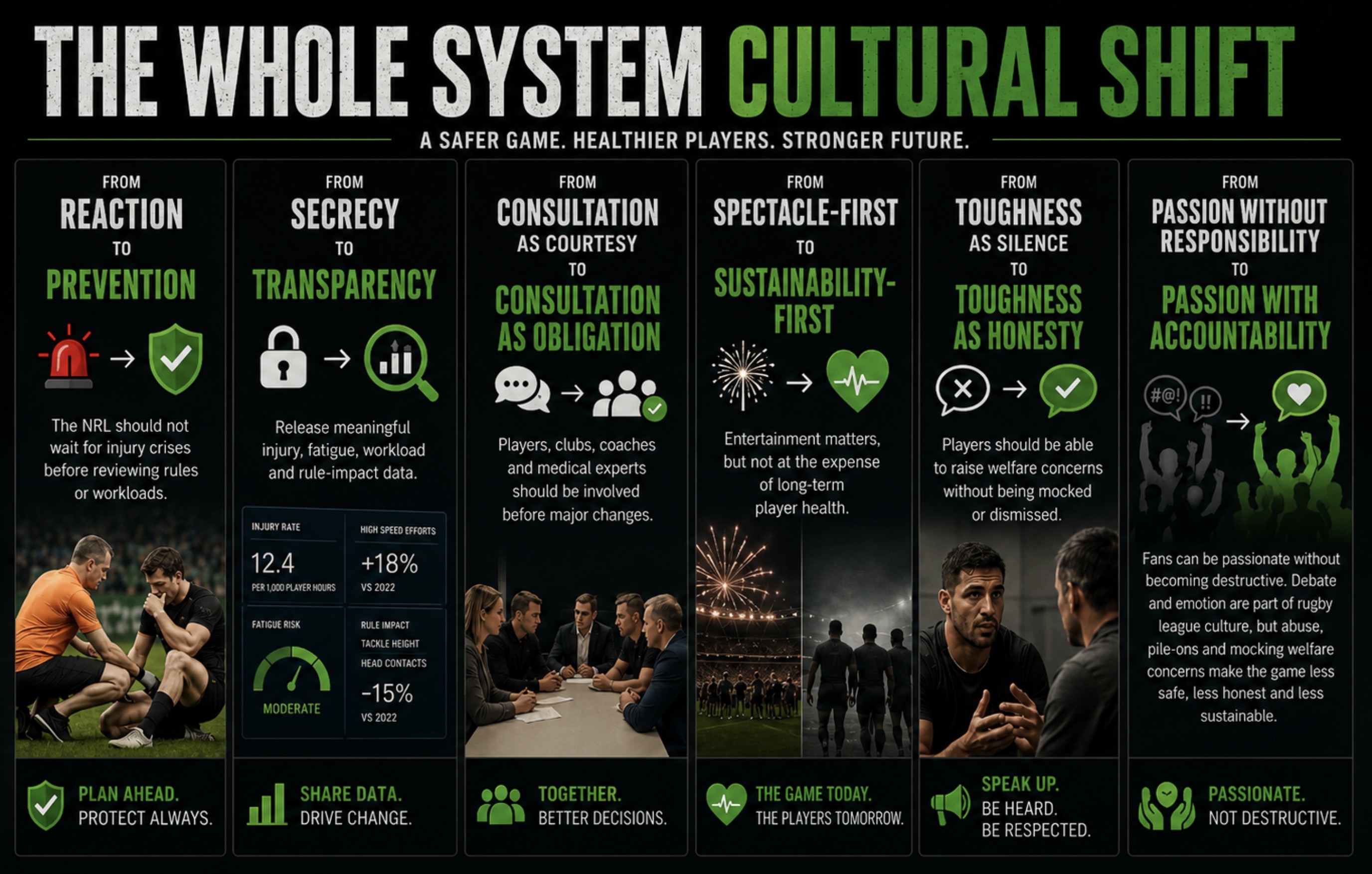
Created by the Author in Canva Premium using her own words.
NRL/ARLC – Ambition Without Dismissiveness & Trust as a Measure of Growth
The administration cannot celebrate cultural change among players while leaving its own systems anchored in reactive crisis management. If rugby league is moving from silence to honesty, then the NRL/ARLC must also move from reassurance to evidence, from consultation after the fact to responsibility built into everyday design. Ambition is not the problem. Dismissiveness is. The next phase of growth should not only be judged by commercial expansion, but by whether the governing body has earned enough trust for players, clubs, medical experts and fans to believe concerns will be heard before harm becomes unavoidable.
It’s time for the administration to shift their own entrenched cultural blueprint to better align with the majority of the Rugby League community and acknowledge that:
- the reactive nature of current protocols and mechanisms are no longer adequate or acceptable;
the same care shown in moments of crisis needs to be proactively built into the game’s everyday systems as obligatory measures that are monitored at administrative level; - while record income, bigger broadcast deals and new markets have value, financial viability does not eradicate cultural fragility;
- corporate ambition becomes hazardous when it ignores the people affected by its core business and that genuine growth is measured by more than revenue alone;
- the real test for success lies not in revenue or crowd figures; it lies in whether the game can build and maintain a culture where players feel safe enough to speak before they reach breaking point and not just retrospectively;
- administrative-led compassion should be an omnipresent expectation whenever and wherever required, and not just when someone’s story becomes public, emotional or impossible to ignore.
This is not an argument against ambition, it is an argument for disciplined, compassionate and measurable ambition. A game can be commercially strong and culturally fragile at the same time, and a code that wants to grow cannot afford to treat trust as a soft metric. Trust from a cultural perspective should be viewed as non-tangible infrastructure, that allows players to speak, clubs to improve, fans to believe, and the game to expand without losing sight of the people who carry it. If the NRL/ARLC wants to lead a stronger future, then trust must become one of its clearest measures of growth and cultural change.
The RLPA: Protection, Process and Accountability
The Rugby League Players Association is a fundamental and valuable part of the modern game.
At its best, the RLPA gives players something they have not always had: a collective voice. It pushes for safer working conditions, better consultation, greater transparency, improved wellbeing support, education pathways, transition programs and long-term protections for players whose bodies and minds carry the cost of the sport long after the final whistle.
Rugby league is built on sacrifice, but sacrifice should never be confused with silence. Players deserve a representative body that asks uncomfortable questions about workload, fatigue, injury data, rule changes, mental health, retirement support and the long-term consequences of the game’s physical demands. In that space, the RLPA’s advocacy is not only appropriate, it is essential.
But strong advocacy also needs clear boundaries. Supporting players universally should not mean defending every action unconditionally. There is an important difference between protecting a player’s rights and arguing that a player should be protected from all consequences. If a player breaches a contract, seriously damages trust, or breaks the law, accountability may be necessary. The role of the RLPA should be to ensure the process is fair, the facts are properly tested, the penalty is proportionate and the player is supported as a person.
That is not anti-player or pro administration, it is mature advocacy that supports balanced and ethical cultural change. The game should never return to a culture where players are disposable assets, expected to absorb harm without question. But nor should player advocacy drift into the idea that talent, profile or employment status places someone beyond reasonable accountability.
The best version of the RLPA is not one that opposes consequence. It is one that insists consequence is lawful, transparent, consistent and humane. That is where its value lies: protecting players from avoidable harm, giving them a genuine voice, and making sure that when accountability is required, it is delivered with fairness rather than force.
The Clubs: Minimum Standards, Measured Action and the Culture Gap
The RLPA’s latest Players’ Pulse is a good measure for where the game is excelling and underperforming at club level, but it should not be treated as a simple ranking exercise or annual talking point, but rather as a workplace health check for the elite game.
What it appears to show is that some clubs are operating with stronger resources, better support systems and healthier internal environments than others. In a salary-capped competition, we often talk about fairness through roster balance. But fairness is also shaped by what surrounds the roster: coaching trust, medical care, wellbeing support, appropriate facilities, recovery management, psychological safety and the quality of daily communication. These are not soft extras, they are cultural infrastructure.
Over a long season, those differences can influence whether players feel safe speaking up, how well they recover, how connected they feel to the club, and how consistently standards are maintained. In that sense, club culture and on-field performance are not separate issues. They feed into each other.
The Eels performed extremely well in the player perceptions poll finishing second in overall industry performance in both the NRL & NRLW space.The concern is not that every club should look identical, Clubs should have different identities, philosophies and ways of operating. The concern is whether every contracted player, regardless of jersey, is guaranteed a clear minimum standard of support.
That is where the Players’ Pulse should become more than feedback. If the report identifies flaws in club environments, the next question should be: who is responsible for ensuring those flaws are addressed? The RLPA has created a valuable benchmark. But the NRL and ARLC should be leading a transparent, code-wide improvement framework that requires clubs to respond to poor results with measurable action, timeframes and follow-up assessment.Player anonymity must of course be protected and Club identity does not always need to be publicly exposed. But minimum standards should not be optional, private or dependent on whether an individual club chooses to improve.
Because club culture is not a values poster on a wall, it is what players experience every day. And in an elite competition, inconsistent support systems can eventually become inconsistent performance systems too.
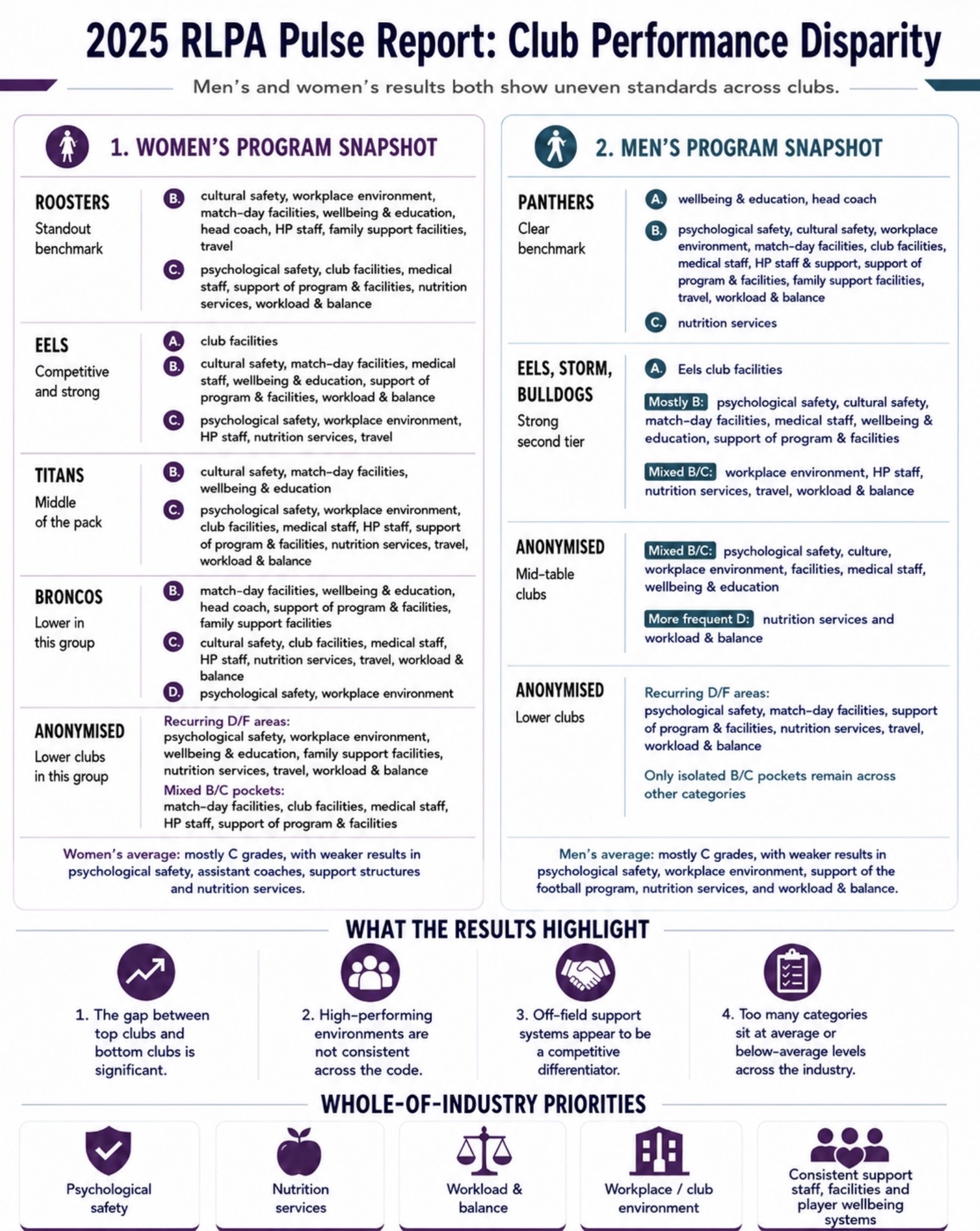 Created by the Author in Canva Premium using her own words.
The Players: Speak, Support, Listen and Own the Moment
Players are central to this cultural shift because they are not just employees of the game; they are its heartbeat, its product, its role models and, increasingly, its conscience. The most encouraging part of the current movement is that more players appear willing to speak honestly about pressure, welfare, identity, sexuality, injury, mental health, addiction, abuse and other experiences of life inside professional rugby league. That should be celebrated, but player-led progress cannot only mean speaking up when systems fail them. It also has to mean supporting each other earlier, listening when concerns are raised, owning poor choices when they occur, and understanding that privilege, profile and pressure all carry responsibility.
This is where the message becomes more balanced. Players should absolutely feel safe enough to speak before they reach breaking point. They should be supported when they are struggling, protected when they raise legitimate welfare concerns, and listened to when they identify flaws in the system. But support should not be confused with immunity. Respecting players as people also means expecting them to take ownership of their behaviour, their platforms, their relationships and the consequences that can follow when trust is breached. Enjoying your 20s should not require public self-destruction, and a phone should not become the easiest way to turn one bad decision into a permanent headline.
The strongest version of player culture is not silent, reckless or untouchable. It is honest, connected, accountable and mature enough to understand that freedom and responsibility have to grow together. Players deserve systems that protect them from avoidable harm, but the game also needs players who protect each other, protect the jersey, protect the trust of fans and protect their own futures. That is the cultural shift worth backing: speak when something is wrong, support those who do, listen before things escalate, own mistakes when they happen, and remember that the best years of your life do not need to be lived, judged or ruined through a screen.
The Fans – Passion with Accountability & Tribalism with Respect
Fans are not passive observers in rugby league’s cultural shift, they are part of the ecosystem. They create the noise, the tribalism, the loyalty, the humour, the pressure and the emotional force that make the game feel alive. That passion should never be sanitised out of rugby league. The game needs rivalry, disagreement and edge. But passion becomes corrosive when it loses accountability, and tribalism becomes destructive when it stops seeing players, coaches, officials, administrators and other supporters as people.
A healthier rugby league culture does not require fans to agree with every decision, protect every player from criticism or pretend poor performances do not matter. Supporters should be able to challenge the status quo using the appropriate channels in a proportionate manner. But this should not be viewed as permission to act without morality and lead with cruelty simply because someone’s views are different to your own. Personal beliefs are a human right, but they should not be interpreted as permission to dehumanise anyone inside or outside of the game.
The modern fan has more influence than ever before, because social media has turned every supporter into a commentator, publisher and amplifier. That can be powerful when it builds community, highlights legitimate concerns and gives fans a voice. But it can also escalate conflict, spread misinformation, pile onto individuals and make the game feel more hostile than passionate. The cultural question is no longer just what fans feel; it is what they do with that feeling.
True supporter culture should lift the game without poisoning it. Fans can be passionate without being abusive, tribal without being cruel, critical without being destructive, and loyal without becoming blind. The strongest rugby league communities are not the ones that never argue; they are the ones that know where the line is. If players, clubs and administrators are being asked to evolve, fans are part of that responsibility too. The game’s culture is not only built in boardrooms, dressing rooms or media conferences. It is built in stadiums, group chats, comment sections, podcasts, fan pages and family lounge rooms every week.
Rugby league will always be emotional, that is part of its power. But the next stage of cultural maturity requires fans to understand their impact. The game does not need less passion; it needs passion with accountability. It does not need less tribalism; it needs tribalism with respect. When supporters use their voice to challenge, connect and protect the game rather than tear people down, they become part of the solution, not just the soundtrack around it.
Final Thoughts
Supporting a genuine cultural shift in rugby league does not mean stripping the game of its grit, tribalism, intensity or competitive edge. It means committing to proactive change and improved systems that are both measurable and adaptable enough to protect those qualities without using them as excuses for silence, denial or poor decision-making. That is the cultural shift rugby league needs at all levels of our game (fans included): not from tough to soft, but from defensive to accountable; and not from entertainment to caution, but from spectacle at any cost to a game strong enough to protect its own future.
See you at the game on Saturday
Roly-Poly


Great read, thank you. I think more will come re player welfare re the relentless six-again rule.- will be interesting to see injury stats at the end of the season. Go the Eels
Hi Gaby, I agree, player welfare and the impact of rule changes are going to continue to be pressing issues until they are meaningfully addressed. I believe by the end of the season no amount of watered down data will be able to mask the reality and the issues will need to be acknowledged. Go the Eels. Thanks for reading and for the support.
Thoughtful and interesting commentary, superbly presented.
Thanks McFersie, it was an interesting article to research and write. I genuinely appreciate the positive feedback.