
Hey Parra Fans,
This TCT Golden Point examines Phoenix Crossland’s hip-drop tackle and Nathan Cleary’s injury as more than a single disciplinary incident. It considers the event through a broader player-welfare lens, recognising the need for accountability and proportionate consequences while also asking what the game can learn from the systems surrounding injury management, tackle technique and the prevention of adverse outcomes.
The intention is not to agitate or manufacture villains, but to ask some difficult questions in a measured way. More than anything, I’m interested to see how TCT readers respond. I expect there will be a wide range of views, and I’m particularly curious to see which parts of the discussion resonate, which do not, and where readers draw the line on questions of responsibility, risk, and player welfare.
I have tried to approach the more subjective elements with care, balancing my own views against existing protocols, available evidence and competing perspectives rather than presenting any of them as settled conclusions. The aim is to encourage discussion rather than prescribe an answer.

TCT GOLDEN POINT – FIT TO PLAY AND FIT FOR PURPOSE: BALANCING COURAGE CULTURE, PLAYER WELFARE, AND PROPORTIONATE RESPONSIBILITY
Every rugby league season is ultimately remembered through a collection of defining moments. Some are the ones we hope to keep: breakthrough performances, unlikely victories, debutants announcing themselves, old rivalries producing something extraordinary and communities finding another reason to celebrate together. Others are the moments we would happily erase. Serious injuries, controversy, disappointment and those occasions when something happens on a football field that suddenly makes the result seem remarkably unimportant.
The 2026 season has given us plenty of both. It has also been a reminder that, for all the tribalism rugby league thrives on, that tribalism can soften remarkably quickly when the situation calls for it. We spend most of the year defending our colours, arguing over referees, players and clubs, and finding increasingly creative reasons why the opposition is wrong. But every so often the game produces a moment that cuts straight through all of that and reminds us that the people wearing those jerseys are human beings.
Watching Nathan Cleary seriously injured at Accor Stadium on Sunday was one of those moments. Whatever colours you wear, watching a player in that much pain is horrible. Seeing his teammates gather around him, the concern etched across the faces of those nearby and then learning the extent of the damage only reinforced that feeling. In that moment, it didn’t feel like we were watching Nathan Cleary the superstar halfback, premiership winner or representative footballer. We were watching somebody’s son, sibling and partner being stretchered from a football field after suffering a devastating injury; it’s a situation no decent human being would wish upon another.
Perhaps that is also why what followed became so emotionally charged. When an injury is confronting, there is an understandable desire to identify the moment that caused it and the person responsible. Phoenix Crossland made an illegal tackle. The judiciary has dealt with that conduct, and accountability for his technique is an entirely legitimate part of this discussion. But accountability and explanation are not necessarily the same thing.
If one of the defining moments of 2026 is going to prompt a serious conversation about player welfare, then that conversation should be broad enough to examine more than the final few seconds in which the injury occurred. It should also ask what happened before the tackle, what risks were already known, how decisions were made around an injured player taking the field, and whether the structures of the modern game are doing enough to protect the people who play.
Establishing Accountability Without Inventing Intent
Before broadening this discussion, one issue can be settled. Phoenix Crossland’s tackle was illegal. He pleaded guilty to dangerous contact and the NRL Judiciary suspended him for four matches, a penalty that rules him out of Sunday’s grand final and, if selected for New Zealand, the three World Cup pool matches. Crossland accepted that he got the tackle wrong, and the game’s disciplinary process has now imposed a consequence for it.
Accountability provides a much firmer starting point than speculation about intent. An illegal tackle and a deliberate attempt to seriously injure another player are not the same proposition. Crossland’s initial contact was around Cleary’s waist before the tackle developed into the dangerous rotation and drop that caused the injury. At the judiciary, Crossland acknowledged that his execution was wrong but maintained that he had not intended to hurt Cleary. Importantly, the NRL’s own case did not depend upon malicious intent. Its counsel accepted the tackle was accidental while arguing that Crossland had failed to exercise sufficient care, that the technique presented a high risk of injury and that the eventual injury to Cleary should be taken into account when determining the penalty.
Contact sport routinely asks disciplinary systems to judge actions that occur at speed, under fatigue and in fractions of a second. Intent may be relevant in some cases, but it is not necessary for conduct to be careless or dangerous. A player can make a genuine error of technique, have no desire to injure an opponent and still be properly held responsible for the action he chose to execute. Those ideas are not contradictory, therefore the judiciary was able to hold Crossland accountable without constructing a motive that the available evidence did not establish. Supporters should be capable of making the same distinction. Criticism of the tackle is justified, but urning that criticism into certainty about Crossland’s character, motives or desire to cause harm is a different step entirely.
Punishing the Act or the Outcome?
There is, however, another proportionality question sitting alongside intent: how much should the eventual severity of an injury influence the punishment for the illegal act that preceded it?
The seriousness of an injury is understandably relevant when assessing dangerous conduct. A tackle producing catastrophic harm will inevitably attract greater scrutiny than one from which the ball carrier immediately gets back to his feet. But outcome and culpability are not necessarily the same thing. Two players can execute broadly comparable prohibited techniques and produce dramatically different medical consequences because of biomechanics, circumstance or vulnerabilities that may not be known to the tackler.
That distinction is particularly relevant here because the NRL expressly argued that Cleary’s eventual injury should form part of Crossland’s punishment. Crossland’s defence, by contrast, sought a two-to-three-match suspension and relied on factors including the speed of the incident, his remorse and good character. The judiciary ultimately imposed the four matches sought by the NRL.
The comparison with Victor Radley only days earlier makes the question difficult to ignore. Radley was penalised and placed on report for a hip-drop tackle on Herbie Farnworth in the Roosters’ preliminary final, before receiving a Grade 1 Dangerous Contact charge and a $3,000 early-plea fine. The NRL’s own judiciary report records that charge as a third-and-subsequent offence. Crossland’s tackle was instead referred directly to the judiciary and ultimately resulted in four matches.
Those cases are not direct precedents, as they were formally dealt with through different pathways and the Match Review Committee plainly assessed Crossland’s conduct as warranting direct referral rather than an ordinary Grade 1 charge. I am not saying Radley receiving a lesser sanction means Crossland automatically deserved one too, but a disparity that significant does invite a legitimate question about what exactly is being punished.
The NRL’s ordinary judiciary framework expressly takes a player’s offence record into account when determining penalties for graded dangerous-contact charges. Radley’s latest matter sat in the third-and-subsequent category yet remained a monetary penalty; Crossland’s direct referral removed his matter from that ordinary penalty table and allowed the panel to determine an appropriate suspension, with the NRL specifically urging it to consider the severity of Cleary’s eventual injury.
That does not establish that Crossland’s four-match suspension was wrong. It does, however, raise a worthwhile question not only about judiciary consistency, but about proportionality in assessment: to what extent should a disciplinary system punish the dangerousness of the conduct itself, and to what extent should it punish the medical outcome that happens to follow? This becomes even more complicated where a player entered the contest with a known physical injury. Crossland plainly bears responsibility for the illegal tackle he performed, but if the severity of the resulting injury is going to materially aggravate his punishment, it is reasonable to ask how confidently the game can separate the consequences attributable to the illegal technique from any pre-existing vulnerability or other contributing circumstance.
This is not an argument that injury should be irrelevant. It is an argument for keeping conduct, causation and outcome conceptually distinct when determining what proportionate accountability should look like.
What emerged after the incident also reinforces why those distinctions matter. Crossland contacted Nathan and Ivan Cleary to apologise and, according to his evidence, Nathan accepted that the incident had not been intentional and eventually asked him to stop apologising. Crossland also spoke openly about how heavily the incident, and its aftermath had affected him, while his defence tendered abusive social-media messages directed at him in the days following the tackle.
None of that changes what happened to Cleary, nor does remorse erase responsibility. An apology is not a defence to an illegal tackle, just as the absence of malicious intent does not make dangerous technique permissible. It does, however, remind us that disciplinary accountability does not require the dehumanisation of the player who committed the offence.
There is a broader player-welfare principle at play here
Rugby league cannot credibly argue for greater awareness of psychological safety and mental wellbeing while simultaneously treating every serious on-field mistake as evidence of moral failing. Players must be accountable for dangerous actions, sometimes through significant suspensions, while still being afforded proportionate criticism and the opportunity to learn from them. Accountability should identify what went wrong, impose an appropriate consequence and reduce the likelihood of repetition; aggressive assassination of a players character is not required to achieve any of those things.
Nathan deserves every ounce of sympathy that has come his way, his injury was horrific and his rehabilitation will be significant; and Crossland has now been held accountable for the tackle through the judiciary process. Both players can still be deserving of welfare and humanity without requiring us to choose one over the other.
The four-match suspension therefore closes one part of this conversation. What it does not do is answer every question raised by Nathan Cleary’s injury. The more useful discussion from here is whether identifying responsibility for the final illegal act should also mark the end of our curiosity about everything that placed Nathan Cleary in that moment in the first place. If player welfare is genuinely the objective, the next question should be what the game can learn from the environment surrounding the incident.
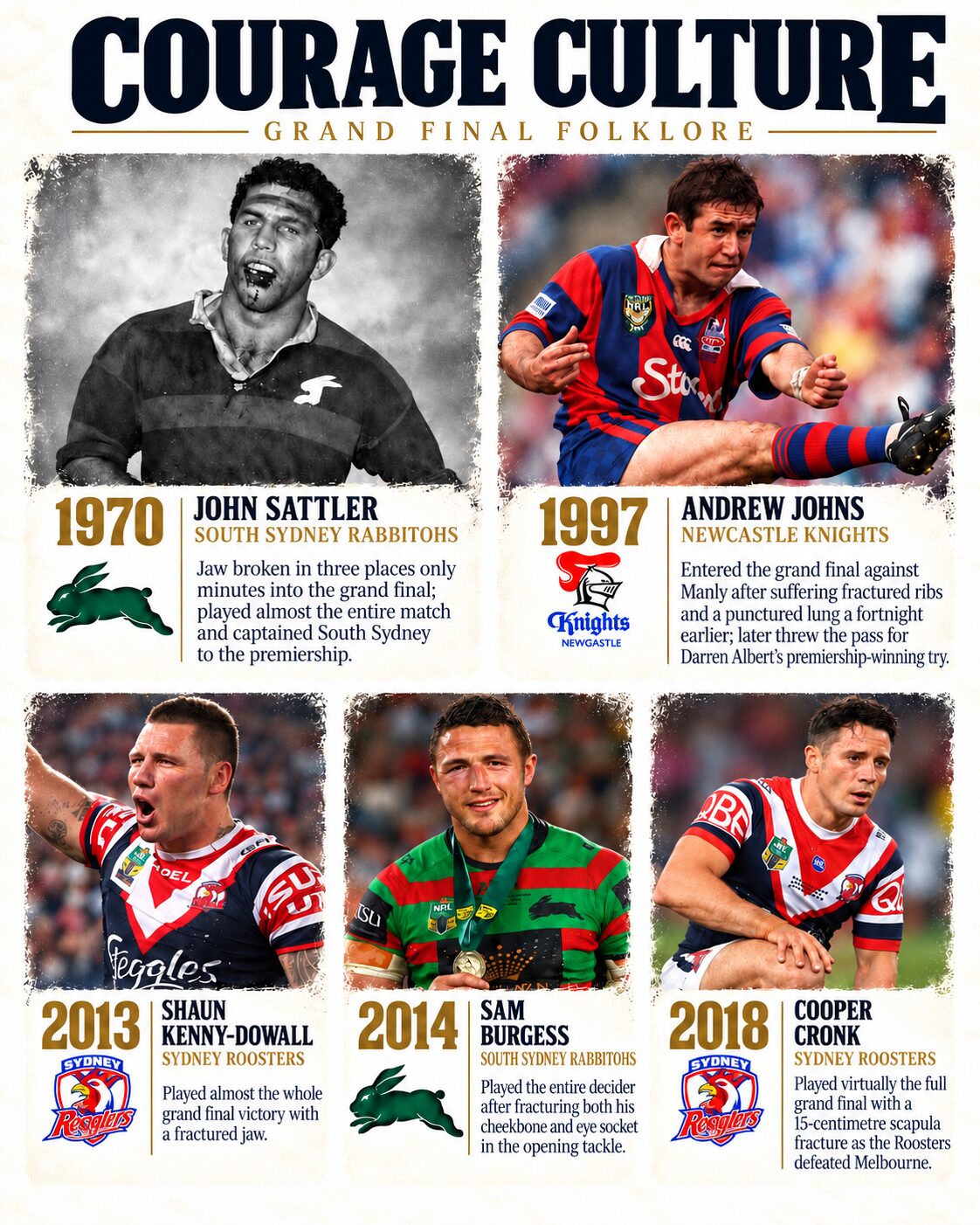
Courage Culture – Woven into the fabric of the game. Image and Information Source: NRL, SSFC Rabbitohs. Graphic created by the Author using Canva Premium
When Courage Becomes Risk Management
In rugby league, it is impossible to talk seriously about player welfare without confronting one of the game’s most deeply embedded values: toughness. Rugby league has always celebrated players who play through pain, and I don’t think we should rewrite that history as though the culture has contributed nothing positive. Some of rugby league’s most enduring grand final stories are remembered precisely because players endured injuries that most of us struggle to comprehend. Not dissimilarly, most fans and clubs will have many a story of players who battled through the pain barrier for the love of the game.
Throughout history across different eras and rulesets, we have seen the same underlying story woven through the identity of the game; courage, resilience, sacrifice and an extraordinary willingness to put the team ahead of personal discomfort.
These stories deserve their place in the game’s history and to an extent the present. They helped shape what rugby league understands courage to look like, and I don’t particularly care for a version of our game in which sacrifice, resilience or the desire to be there for your teammates are treated as character flaws. Nathan Cleary desperately wanting to play in a preliminary final therefore requires very little explanation. Elite athletes generally do not reach that level by developing an ordinary relationship with pain, risk or competitive opportunity.
But there is an important distinction between admiring courage and relying upon courage as a risk-control measure. Rugby Leagues foundations were built in eras when first-grade footballers worked ordinary jobs during the week, trained around those commitments and played within an unregulated environment far less sophisticated than the one surrounding the modern NRL. The game is now a fully professional workplace supported by world-class medical, training and injury-management systems. The culture of toughness has survived that transformation, but the resources and responsibilities surrounding it have changed enormously.
That creates a tension professional sport has not entirely resolved. We still admire the athlete who says, I’m playing; we still celebrate the teammate who refuses to stand down and we still respect those who believe discomfort and pain are something to manage rather than something that halts them from running out onto the field. But those same qualities can complicate the ideas that an injured athlete’s willingness to play, represents completely unconstrained choice. A professional footballer may genuinely and emphatically want to play while also operating inside an environment in which availability, toughness and playing through discomfort are valued occupational traits. Those pressures do not necessarily need to be explicit expectations to influence how an individual perceives risk, nor should a willingness to conform to them become a measure of a player’s commitment to the team or the game.
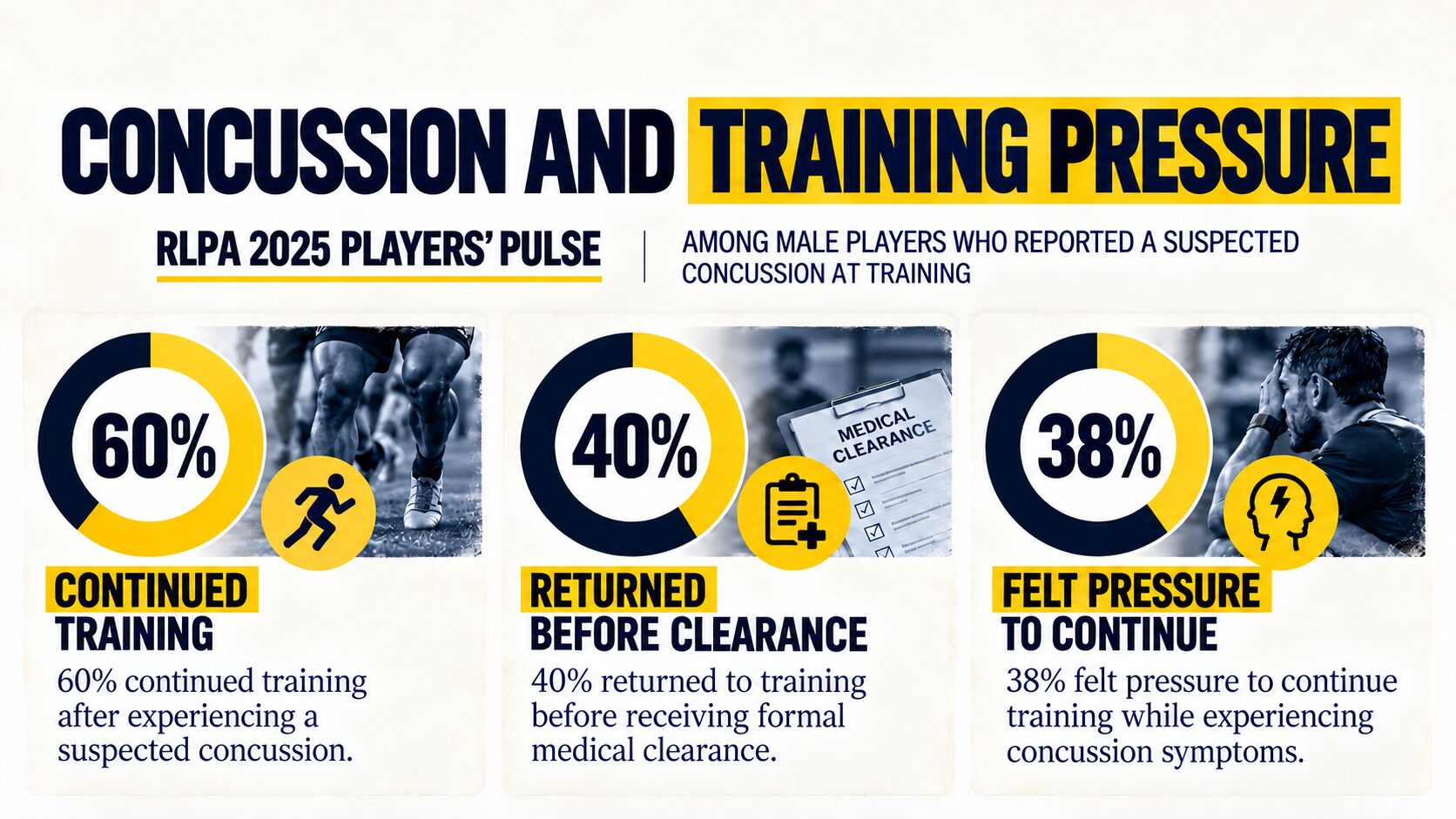
RLPA Concussion Data – Source: 2025 RLPA Player Pulse Report – Graphic created by the Author using Canva Premium
The RLPA’s 2025 Players’ Pulse findings need to be considered carefully because they relate specifically to players experiencing suspected concussion in training. They cannot simply be generalised to every injury, and they tell us nothing about what occurred inside Penrith’s medical room with Nathan Cleary. They are, however, relevant to the broader discussion about how cultural pressure can become a secondary factor in player-led risk assessment.
It is important that athletes have a meaningful voice in decisions concerning their own bodies; but autonomy and organisational responsibility are not mutually exclusive. A well-designed welfare system should actually anticipate that highly competitive athletes may be willing to accept considerably more risk than the people responsible for their health should necessarily permit. Good risk management does not depend upon eliminating courage from rugby league, nor should it diminish player agency in decisions concerning their own bodies. It asks something more nuanced: whether the systems around them are strong enough to preserve that agency while recognising that competitive desire, cultural expectations and major-match stakes can affect how risk is assessed.
That is where courage begins to intersect with risk management and where the conversation becomes bigger than rugby league’s traditional language of toughness, courage and playing through pain.
When Player Welfare Becomes a Workplace Safety Question
Professional sporting clubs are obviously not ordinary workplaces, but professional athletes are still workers and the organisations employing them still make decisions about health, safety and exposure to risk. That does not mean every football injury becomes a workplace safety breach, but it does mean the principles sitting behind workplace health and safety provide a useful lens through which to examine what happened.
Under the Work Health and Safety Act 2011 (NSW), the primary duty of care sits with the person conducting a business or undertaking to ensure, so far as is reasonably practicable, the health and safety of workers. Importantly, that duty is not limited to reacting once somebody gets hurt. It includes maintaining safe systems of work and monitoring the health of workers and workplace conditions for the purpose of preventing injury or illness.
That matters here because this was not a situation where Nathan Cleary arrived at the ground uninjured and an unforeseeable problem emerged. Penrith already knew he was carrying a significant injury, that we now know was a fracture that would itself require surgery.
Section 18 of the WHS Act is particularly relevant conceptually because it explains what “reasonably practicable” means when managing risk. It asks what is known about a hazard or risk, how likely harm is to occur, how serious the potential harm may be and what options are available to eliminate or minimise that risk. Good risk management, is not simply about asking whether somebody can perform a task. It also asks what is known about the risk of allowing them to perform it and what reasonably available alternatives exist.
Applied hypothetically to professional sport, that creates a more interesting question than simply asking whether Nathan was medically cleared. What did Penrith know about the fracture? What risks of deterioration or further injury had been identified? What controls were put around him? What alternatives were considered? And how did the importance of a preliminary final factor into the decision?
“Nathan wanted to play” tells us something important about Nathan’s autonomy. On its own, though, it does not tell us whether he should have played. At some point, an athlete’s personal willingness to accept risk becomes an organisational decision that the risk is acceptable. Nathan did not simply decide to walk onto the field independently. His injury had already affected his preparation and training. Medical professionals, coaches and high-performance staff were involved in assessing and managing his condition, and ultimately the club deemed him fit to play and permitted him to participate.
It would be unreasonable to draw any conclusions to what actually occurred without the requisite clearances and qualifications to access and assess the medical information Penrith held, the specialist advice provided, the risks that were discussed, the treatment undertaken or the controls put around Nathan’s participation. Retrospective knowledge after an adverse outcome can also make decisions concerning safety appear far more obvious than they may have been beforehand. Though while a lack of access and expertise is a respectful reason to refrain from pointing fingers, it is not a reason to declare the underlying decision-making process beyond examination.
There is also an important distinction between worker choice and organisational responsibility. Section 28 of the WHS Act places duties on workers to take reasonable care of their own health and safety. In Nathan’s case, that principle is relevant only to his agency in decisions concerning his known injury and willingness to participate. It should not be confused with responsibility for the tackle that ultimately injured him. Crossland’s responsibility arose separately from his own conduct on the field: executing a tackle within the rules and without unnecessarily exposing another player to harm. The point is that different people can hold different responsibilities for different risks within the same event.
On that note, Section 16 of the WHS Act prescribes a principle that I think is particularly useful here: workplace safety duties do not necessarily belong to only one person or business at a time. More than one person or business can have responsibility for the same matter according to what each has the capacity to influence or control. Those responsibilities do not need to be equal or interchangeable for more than one to exist. And this is where an important distinction needs to be made: shared responsibility does not mean equal responsibility.
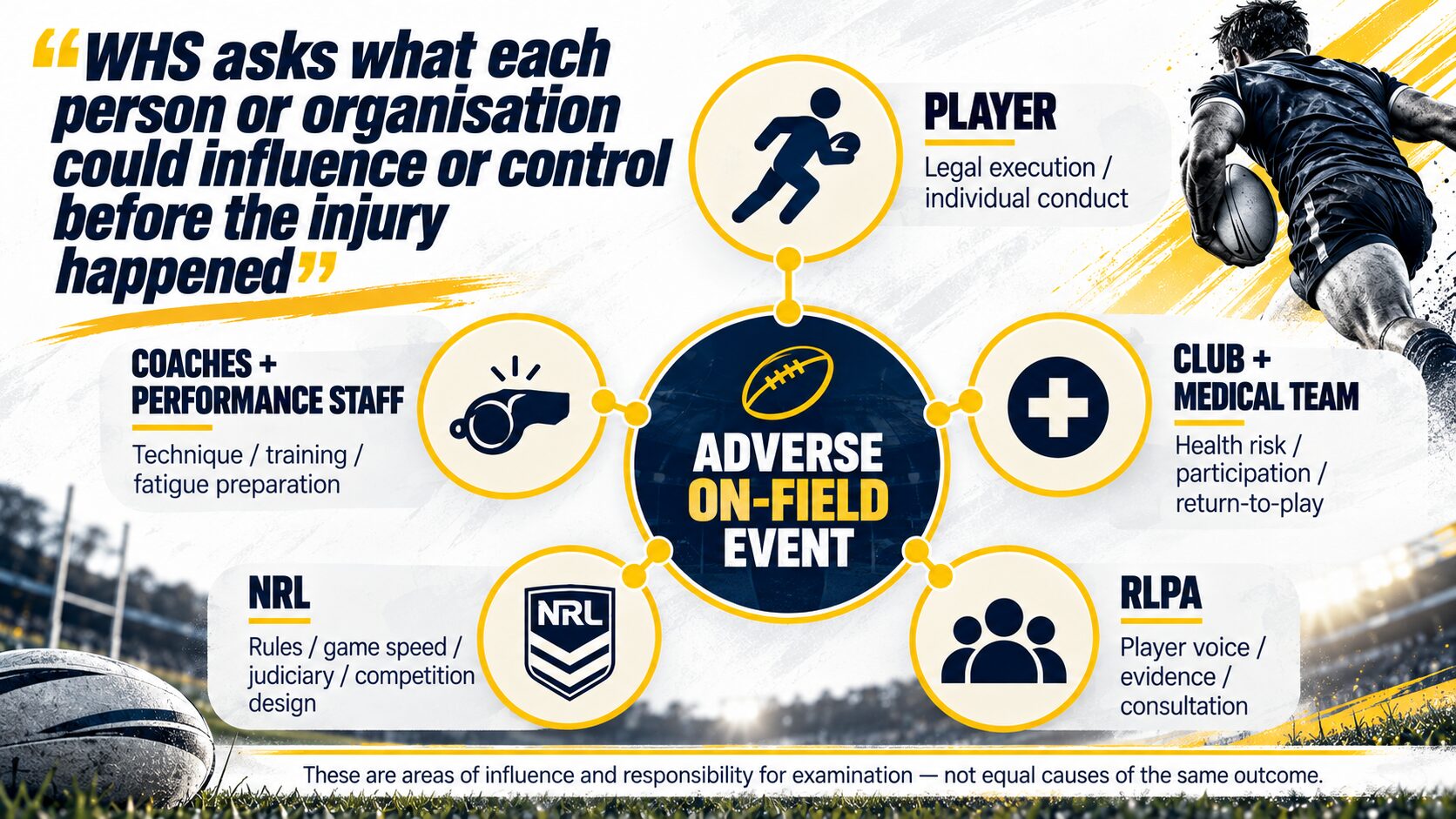
WHS areas of influence and responsibility – Source: Work Health & Safety Act. 2011 (NSW) – Graphic – Concept: RASCI Framework of shared responsibility (Sheehan/E&Y) – Graphic created by the author using Canva Premium
This is where my nerdy brain inevitably wanders towards a RASCI model but I will just brush over its relevance this time as this article is already at risk of looking like a formal assignment.
In most high-risk organisations, an incident involving serious harm would rarely result in the frontline worker being identified as the only relevant participant, simply because they performed the final act. We would ask who was Responsible, who was Accountable, who provided Support, who should have been Consulted, and who needed to be Informed; and those roles would of course differ depending on the particular risk being examined.
For the tackle itself, Crossland remains responsible for executing a legal technique. Coaches and performance staff influence how that technique is taught, practised and maintained under fatigue. Clubs control training environments and systems. Medical teams manage individual health risks and return-to-play decisions. Players retain agency and responsibilities concerning their own health and conduct. The NRL establishes the rules, judiciary framework and broader physical parameters within which the game is played. The RLPA provides player voice, evidence and consultation about the demands those systems place upon them.
Those responsibilities plainly are not equal, nor are they interchangeable. Penrith did not make Phoenix Crossland execute an illegal tackle. The NRL did not make him perform it. Nathan Cleary’s decision to play did not cause Crossland’s technique to fail. Crossland remains responsible for the act he performed, and the judiciary has imposed the consequence attached to it.
But recognising that does not require us to pretend everybody else suddenly ceased to have any capacity to influence other elements of the risk surrounding the event; and that to me, is where RASCI thinking becomes useful. It prevents us from confusing the person closest to an adverse outcome with the entirety of the system surrounding it. It also allows responsibility to remain proportionate: one person may carry primary responsibility for an action, while others hold entirely different responsibilities for the conditions, decisions or controls sitting around the action.
This is not about distributing blame until everybody receives a share. It is about understanding where influence actually existed; and if player welfare is the objective, that matters. A disciplinary system is designed to determine what happened and impose consequences where rules were breached. A risk-management system should go further and ask what could reasonably be learned, changed or controlled to reduce the likelihood of another adverse outcome.
None of this legal mumbo jumbo nor my favoured analysis acronyms conclude anything definitively. What the WHS lens does provide is a different way of asking the difficult questions associated with effective critical reflection in organisational practice. Rather than beginning with who do we blame now that somebody has been hurt?, risk management asks whether the organisations and its people had the capacity to identify, influence or minimise risk before the adverse event occurred.
That becomes particularly useful when we look beyond the individual players and towards the environment in which they are being asked to perform.
The Speed of the Modern Game
I wrote earlier this season about the distinction between inherent, avoidable and systemic risks rugby league players face. I won’t retrace that argument here, but what happened on Sunday is almost an uncomfortable case study in why the distinction matters.
The possibility of injury in a collision sport is an inherent risk. The hip-drop mechanism itself is an avoidable risk, which is precisely why the NRL prohibits it and why the judiciary has now sanctioned Crossland for executing it. But surrounding both is the concern I raised then about systemic risk: more specifically, the conditions created by the way the modern game is designed, played and managed.
I reckon this is important to revisit because identifying an avoidable risk does not make every surrounding systemic question disappear. Crossland getting his technique wrong can be true at exactly the same time as the NRL needing to ask whether increased speed, continuous play and cumulative fatigue are changing the circumstances in which defenders are being asked to make those tackles.
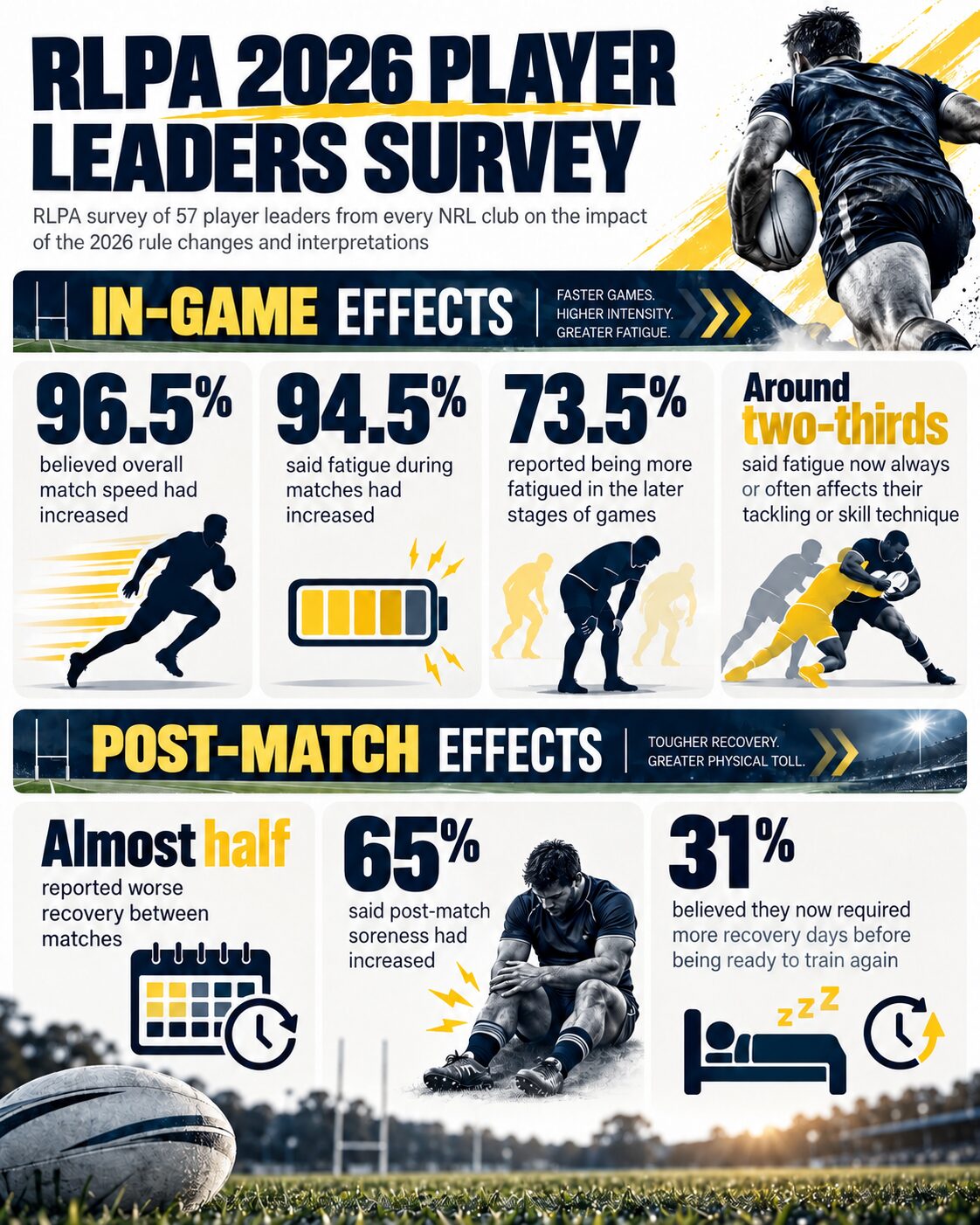
Is Spectacle being Prioritised over Safety? – Source RLPA Player Leadership Survey May 2026) – Graphics created by the Author using Canva Premium
As the RLPA Player Leader Survey results show, the physical demands of the modern game have changed. None of this proves the rule changes caused Crossland’s tackle, but it does make the broader risk-management question difficult to dismiss. When the people actually playing the game are consistently reporting greater speed, greater fatigue, impaired technique and reduced recovery, those factors become more than perceptions about spectacle; they become relevant evidence about the physical environment the NRL has deliberately created. Punishing the avoidable risk after it occurs is necessary. Asking whether the system is increasing the likelihood of that risk occurring again is prevention.
The NRL deliberately changed its rules to create a faster, more continuous game. The six-again era increased ruck speed, reduced stoppages and placed greater physical demands on players, particularly through repeated defensive efforts and acceleration under fatigue. That does not mean “V’landys ball caused Phoenix Crossland to hip drop Nathan Cleary”, but it does raise a valid question about whether the environment the NRL has deliberately engineered has changed the risk profile of the game. A game that demands faster play-the-balls, fewer stoppages, long passages of continuous football and athletes accelerating into defensive lines while fighting for every possible post-contact metre, while simultaneously expecting fatigued defenders to retreat, reset, stop that momentum and do so using an increasingly restricted set of safe techniques, creates an inherently contradictory framework for safe and sustainable entertainment.
Instead of asking why hip-drop tackles continue to occur regularly, should we not instead be asking “Have we changed the speed and physical demands of rugby league faster than we have changed the techniques required to defend it safely?” If the game deliberately creates more speed, more fatigue and more desperate defensive situations, then its investigation into dangerous tackles should not necessarily begin and end with the individual who gets the technique wrong.
The Case for Greater Fit-to-Play Accountability
We all have that friend who writes social texts like they are drafting a contract. I am fairly certain I am that friend to some people. On Monday, however, I received the following from a friend in the legal profession after asking a very simple question: “What did you think of yesterday’s final?”
“The Cleary incident raises legitimate questions about who decides an injured player is fit to participate, what risks are considered and how much influence the importance of the match or the player’s own determination should have.”
It was not something I had particularly considered while watching the game, but the comment stayed with me. It may not be the most obvious or popular way of looking at what happened, but I thought it was a perspective worth examining.
The NRL has already demonstrated through its concussion protocols that it can establish whole-of-game safeguards around return-to-play decisions. Concussion is obviously different from a fracture or other musculoskeletal injury, but the governance principle is still relevant: in some circumstances, the consequences of getting a decision wrong justify minimum safeguards beyond individual clinical discretion. That raises a reasonable question about whether significant non-concussion injuries warrant greater consistency too.
Sports-medicine assessment frameworks regarded as best-practice industry measures are already used within professional rugby league. Models such as the Strategic Assessment of Risk and Risk Tolerance (StARRT) framework recognise that return-to-play decisions are more complex than simply declaring an athlete “fit” or “unfit”. StARRT considers the condition of the injured tissue, the physical demands of participation and contextual factors capable of influencing risk tolerance. More injury-specific tools also exist. The Fredericson classification, for example, uses MRI findings to grade bone stress injuries and can assist in assessing injury severity and likely return-to-sport timeframes.
Together, these approaches show that contemporary sports medicine is already moving towards more structured and evidence-informed return-to-play decision-making. But there remains an important distinction between a clinical decision-making tool and a regulatory framework. Neither StARRT nor an injury-specific classification such as Fredericson was designed to prescribe a universal, regulated threshold for fitness to play.
While my review of the literature was necessarily limited, I could not identify an equivalent competition-wide, standardised return-to-play protocol for bone stress injuries comparable to those now used for concussion. That distinction is important in itself: the clinical tools exist to support individual decision-making, but the evidence base for converting them into a mandatory regulatory model appears far less established. The more realistic first step may therefore be a Fit-to-Play accountability framework — leaving individual clinical decisions with appropriately qualified practitioners while building greater consistency around process, documentation, specialist involvement and the circumstances in which additional review may be warranted.
There is also a longer-term reason to keep asking these questions. Not every player leaves rugby league with the same financial resources, career opportunities or capacity to manage the physical consequences of professional sport. A marquee player and a fringe first-grader can both leave the game carrying chronic injury while having very different abilities to fund treatment, rehabilitation or periods of reduced employment. Post-career medical and support programs are important, but by their nature they operate downstream, after injury or cumulative harm has already occurred. Better return-to-play decision-making sits further upstream. It would be too strong to suggest that greater Fit-to-Play oversight would necessarily reduce future medical or redress costs, but reducing preventable harm during a player’s career should logically form part of any sustainable approach to supporting players after football.
The immediate objective therefore does not need to be another mandatory protocol. It may simply be better evidence, greater consistency and clearer accountability around significant return-to-play decisions. The game may not yet be ready to regulate injuries beyond concussion, but at some point it should be ready to critically examine how those decisions are made. Not only because of what they mean for the player taking the field today, because some of those consequences may follow them long after they leave it.
The Golden Point
The easiest answer is one player. A serious injury occurs, we identify the action immediately preceding it, punish the person responsible and move on. Phoenix Crossland made an illegal tackle, Nathan Cleary suffered a catastrophic injury and the judiciary imposed a four-match suspension. Nothing in this piece changes or diminishes that accountability. But if player welfare is genuinely about prevention, the examination cannot end with the final illegal act.
Crossland’s responsibility for his tackle is distinct from Penrith’s responsibility for managing a known injury, Nathan’s agency in wanting to play, and the NRL’s responsibility for the rules and physical environment in which the game is played. Those responsibilities are neither equal nor interchangeable, and examining one does not dilute another. The point is not to redistribute blame; it is to understand where different people and systems had the capacity to influence risk.
That requires rugby league to be capable of holding more than one idea at once. We can punish dangerous technique while still asking whether fatigue, training and the speed of the modern game are making safe execution harder. We can respect an athlete’s autonomy while recognising that wanting desperately to play is not, by itself, a risk assessment. We can celebrate toughness without allowing courage to become a substitute for sound medical and organisational decision-making.
The Cleary-Crossland incident does not prove that Penrith’s medical processes failed, that the NRL’s rules caused Crossland’s tackle or that a more regulated Fit-to-Play protocol would have prevented what happened. Those conclusions would go well beyond the available evidence. What it does provide is a reason to keep asking whether the systems surrounding players are evolving as quickly as the physical demands being placed upon them.
The judiciary can determine what Crossland did wrong and what consequence should follow, but punishment answers only one part of an adverse event. Prevention requires the game to examine what happened before it, what surrounded it and what can reasonably be learned from it afterwards.
Roly-Poly


Tks Roly. Well done! Andrew Johns often fills in blanks for me, why a particular play succeeded or failed, some minor happening that when he explains it, it is not minor, and Rugby League for a few moments is like chess, then you remember all the other stuff. After the Cleary tackle, Johns asked ‘why does this keep happening?’, for once he didn’t fill in the blank for me. I’d be surprised if he couldn’t answer his own question but I reckon it may have something to do with his reluctance to publicly drill into a not so simple issue. Calling the intricacies of the plays is his expertise. Reading your piece would only confirm that for him.
You touch on one aspect that is not well documented.. what are the techniques to avoid that final damaging impact to the lower legs? What is each club doing in training for avoidance? Is ‘just don’t do it’ a practical solution? ( I think this list could go on a bit).
I recall Junior Paulo was among the first players to be whistled for a hip drop around 3 or 4 years back. I distinctly recall he actually swung his weight to the side of the tackle but still got pinged, probably because they were looking for examples to highlight and he did slide down. So what is the technique?
Thanks BDon. I remember in the commentary John’s asking: “why does this keep happening?” For me, that is one of the bigger questions sitting behind the piece.
I’m probably reluctant to go too far into the technical side of exactly how a player should execute that tackle because that is well outside my expertise. Where I am more interested is in the environment in which those tackles are now occurring. If the game is faster, players are more fatigued, defensive lines are under greater pressure and decisions have to be made in increasingly compressed periods of time, then surely maintaining perfect technique becomes more difficult as fatigue accumulates.
That doesn’t excuse an illegal tackle or remove the individual player’s responsibility, but it does make me question whether “why does this keep happening?” can be answered solely by looking at the tackler. If the same type of dangerous outcome continues to recur despite penalties, suspensions and education, perhaps the game also needs to examine whether the conditions it has created are making technical breakdown more likely.
Your Junior Paulo example is interesting in that context too. There is probably a worthwhile separate discussion around what players are actually being coached to do, but the question I’m most interested in is whether even good technique becomes harder to consistently execute when the game deliberately prioritises greater speed and fatigue.
They will never get rid of the hip drop tackle. They would have to ban all tackles below the waist. No different to the high tackle, impossible to eradicate.
I think that’s a fair point, Mick. I don’t think complete eradication is realistic either — much like the high tackle, there will always be occasions where technique breaks down in a fast, physical and unpredictable game.
For me, though, that makes the “why does this keep happening?” question even more important. If we know we can’t eliminate the risk entirely, then the focus should also be on reducing the conditions that make those breakdowns more likely. That’s where I think the increasing speed of the game and accumulated fatigue deserve more attention.
Players still have responsibility for their tackling technique, absolutely. But if fatigue makes good technique harder to execute consistently, particularly late in games or during repeated high-intensity defensive efforts, then suspending the individual player only addresses one part of the problem.
We may never get hip drops to zero. The more useful question might be whether the game is doing everything reasonably possible to reduce how often they occur.
The underlying issue has never been addressed, adequately or at all. It’s the issue that PagL doesn’t want addressed.
I think that’s where my thinking lands too, Brett. The individual tackle gets examined in enormous detail, but the broader conditions that may be contributing to these incidents receive far less attention.
For me, the underlying issue is the speed the game is now played at and the fatigue that comes with it. If players are being asked to repeatedly make high-speed defensive decisions while increasingly fatigued, then it seems reasonable to ask whether technical breakdown becomes more likely as a consequence.
That doesn’t absolve the tackler of responsibility, but if we keep dealing with each incident as an isolated act without seriously examining the environment in which they keep occurring, we probably shouldn’t be surprised when the same problem comes back again.
Whether the administration wants that conversation is another question, but I think it’s one the game needs to have.
Absolutely it’s the speed of the game now. Gus has been banging on about this for years, the game has been sped up to the point where it’s virtually unplayable now. Injuries, penalties, sin bins & suspensions are now just a cost of doing business for players and clubs. They know it’s going to happen eventually, they just margin for it rather than try to avoid it, because there is no avoiding it. Even Nathan Cleary’s injury, the Panthers just shrugged their shoulders and moved on. The problem is that it’s the speed of the game that has driven the rapid growth of the game now, and that’s why PVL doesn’t want this addressed, because it’ll kill the golden goose, and as a RL fan I kinda get that. I love the success our game is now enjoying, it feels like it’s finally fulfilling some of its immense potential, but at the same time it also feels like it’s going to ultimately consume itself like a snake eating its own tail. PVL openly admitted in his interview on Mark Bouris’ podcast that the game has a target play the ball speed, 3.5sec, that referees are expected to maintain as much as possible, failure to do so will result in losing their jobs. So, we get where we are now. Cleary’s injury won’t be the last, or the worst. It’s only a matter of time before a player fractures his femur in one of these tackles. The only solution I can see is banning all tackles around the legs. Which will result in more high tackles and concussions from teammates clashing heads trying to tackle in the same spot. The snake is halfway up its tail !!!!
Hip drops started occurring when the “six again”, ruled came in. The game sped up, faster play the balls, have led to players hitting gaps ( in between players) and getting half way through , the late reaction due to fatigue and lazy techniques causes the players to grab the player late. This causes the tacklers body momentum, once contact is initiated, to swing around the players body, gravity then takes over. That causes the ” hip drop “. Either slow the game down, or address front on tackling techniques which reopens head high debate. Let’s just play Austag ?
And therein lies the conundrum for the game. They have proven that a faster game is a more watchable and exciting game for the masses, so they structure the playing conditions to achieve that outcome, but it comes with a price. Front on defensive tackles are virtually impossible to consistently execute, because as you have pointed out, ball runners are shooting for gaps to land on the stomach, so the laws of physics virtually ensure that defenders are in danger of committing a hip drop in virtually every tackle. It then becomes a lottery. I don’t know the game goes from here.