
Watching our game against Manly felt like one of those conversations where you’re nodding along one minute, then shaking your head the next.
There was a bit of everything, agreement with what we were doing, frustration when we drifted, and genuine confusion about how it all unravelled.

The first half, though, gave you something to buy into. Our sets of six had purpose, they weren’t just completions for the sake of it, they were building pressure. We were finding space through the middle and around the ruck, asking questions of their line without overcomplicating things.
Even trailing 7–6, it didn’t feel like we were behind in the game itself. If anything, it felt like we had the momentum and a clear, simple plan that was working.

The Eels looked on track in the first half
From the couch, it looked like a side playing within itself, direct, patient, and composed. The kind of performance where you trust that if you just keep turning up, the result will follow. Especially against a Manly side that’s made a habit of starting fast but fading, it felt like we were right where we needed to be at halftime.
But then came that moment just before the break and in hindsight, it said a lot. We drifted away from what was working, chasing something a bit flashier, a bit riskier. Instead of sticking to the simple blueprint, we started pushing passes that didn’t need to be thrown, looking for rewards that weren’t really there.
That shift carried straight into the second half. The patience disappeared, and with it went our control of the game. Errors crept in, our energy dropped, and suddenly Manly had all the ball.
That 20-minute stretch after halftime told the story. Possession swung heavily their way, fatigue set in, and from there, the game slipped beyond reach. Individuals made basic defensive errors that became more frequent as fatigue increased.
In the end, it wasn’t just about what Manly did, it was about how we moved away from what had us in a winning position. A game that felt controlled and winnable at halftime turned into one that got away, largely because we stopped trusting the approach that got us there in the first place.

Mr Gough
Thinking back over the game, you can’t really avoid talking about the officiating, it felt like part of the same story. I’ve made my views on Mr Gough pretty clear before, so there’s no need to go over old ground, but there was a strange parallel between how the match was refereed and how we played it.
At its heart, rugby league is a simple game. Or at least it used to feel that way. You’d imagine 10–15 years ago it was a cleaner job to officiate; fewer interpretations, less grey area.
These days, though, it feels like the rulebook is constantly shifting, and not necessarily in ways that make things clearer. Take the “disruptor” interpretation which, if I’m being honest, I’m not entirely sure what it is anymore, and I doubt I’m alone in that.
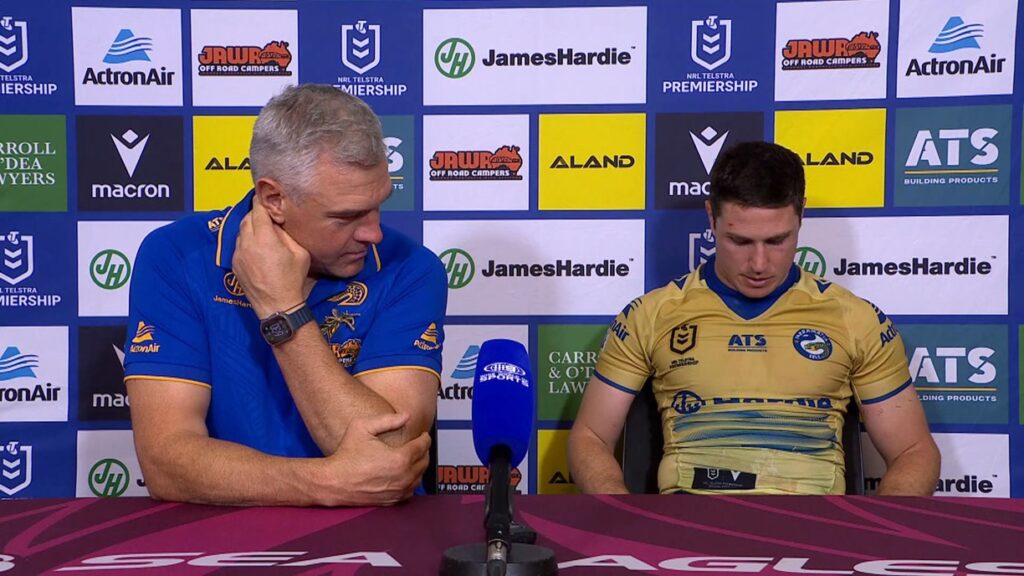
Ryles and Moses give their takes after the game
And that’s where the comparison kicks in. Just like we drifted away from our plan on Sunday, referees are being asked to adjust on the run to interpretations that seem to evolve week to week. Some handle that better than others.
The top officials adapt, stay consistent, and keep control. Others, you get the sense they’re trying so hard to nail the newer, more complex rulings that the basics start to slip, things like forward passes, which should be the bread and butter.
So while I do find myself frustrated every time Mr Gough is in charge, there’s also a bit of perspective there. It’s a tough job that seems to be getting tougher, especially when the parameters keep changing. When they are focusing so heavily on getting the complicated calls right, it’s easy for the simple ones to get lost and that’s not entirely on the individual.
That said, while officials might be dealing with moving goalposts, our Eels do not have that excuse.
We can’t control the refereeing, but we can control how we play and more importantly, how we respond. When we lose focus, when we shift away from what works, it doesn’t just affect one player, it ripples through the whole side. One error, one lapse in discipline, and suddenly the system breaks down.
If there’s a lesson in both the officiating and our performance, it’s the same one: keep it simple, stay consistent, and trust the fundamentals. Because the moment you move away from that, whether you’re holding the whistle or the ball, things start to unravel pretty quickly.
Parra Proud
Shelley


Getting the basics right and not overly complicating the game are integral to playing winning football. Look at what was achieved against the Dogs as an example, then have a look at the results and completion rates in the games on either side of it. Travel north-south, minimise mistakes are the building blocks for every game.