
Hey Parra Fans, Welcome to this week’s TCT Golden Point. The better late than never edition. This week we are looking at that epic win, the generational impact of loathing Manly, and how a pre-smartphone theory provides clarity to the stop-start season that is 2026. As always, I hope you find it insightful and engaging.

First and Foremost
Today we pause to remember those who served, those who fell, and those who returned carrying burdens unseen. Anzac Day is more than ceremony; it is a reminder that courage, sacrifice and mateship are values forged in adversity and carried through generations. It asks us to reflect on those whose service shaped far more than history, they helped secure the freedoms and privileges we too often take for granted.
During Anzac Round, football rightly and willingly takes its place behind something far greater. Before rivalry, before results, we honour service, sacrifice and the enduring spirit of mateship, values woven into Australian identity and echoed in the collective spirit of rugby league.
For a moment, the game becomes secondary, and remembrance takes its rightful place. We remember them, honour them, and remain grateful for their legacy.
Lest We Forget
Emotional Reset – Hope Restored – Consistency Pending
The win against the Bulldogs meant more than two points; it was an emotional reset that restored fan belief and reconnected the team with its identity. For those who attended, the atmosphere felt like a rare mix of desperation, defiance and belief that only a true rivalry can generate. Every defensive set felt more intense than the last, every momentum swing heavier, and every big play seemed to pull the crowd deeper into the contest. There was a raw, old-school energy to it; the kind where I didn’t feel like I was just watching a big win, I felt like I was part of it. The excitement built with every big play, the emotion slowly transitioned from shock to relief and into joy, and for a few hours the burden of recent weeks gave way to something far nicer: hope.
Now that my excitement has settled, I am in a phase more akin to cautiously optimistic. Big wins, especially in games where stakes and emotions are high, can blur reality and fast-track confidence without addressing underlying issues. The challenge for Parra this week is turning that belief and form we saw against the Bulldogs into something consistent and measurable. How the team start (composed or frantic) will say a lot about where they really are and will dictate how the game unfolds.
Rivalry games tend to accelerate everything: intensity, decision-making, and emotional investment. This can lead to big games and wins, but it can also increase the risk of teams overplaying the point, rushing execution in attack, and suffering lapses in defensive discipline, leading to the game-plan unravelling under the pressure.
What must carry over from last week is: holistic effort, defensive intent, and commitment to the job positionally and as a team
What must improve is: execution under fatigue, discipline in key moments, and attacking cohesion.
Because Intense rivalries can win moments and matches, but consistency wins premierships and builds legacies.
Here We Go Again – Inherited Disdain
Speaking of intense rivalries and legacies: Does it get any bigger than the Manly Warringah Sea Eagles? While my children feel more hatred for the Storm, Panthers and Doggies (despite my best efforts), the answer for mine is still a firm: NO! It doesn’t get any bigger and nothing will ever top it.
The beauty of Manly-hatred apart from its widespread popularity, is that the rationale of said hater/supporter will differ depending on the haters primary team:
- For some, its their dodgy administrative tactics: “If they can’t beat you they will buy your best players”
- For others, it’s the subjective perception of preferential treatment: “Other clubs fry while Manly fly by”
- For many it’s socioculturally demographical: “Fibro’s v Silvertails / The Battlers v The Establishment”
- For most Parra fans, its “All of the Above”, and most importantly because “it’s just absurd enough to be enjoyable.” Why else would it be used to sell beer?
For me personally there is an extra layer of complicated, because half of my family are die-hard Parra fans and the other half are steadfast North Sydney Bears. Hence my loathing of Manly is a passionate and proud consequence of my ancestry that is built upon the ultra-complex foundations of multi-generational inherited disdain.
All-in-all I learned very early on in life that sustaining love and respect from my family beyond being “Industrious, humble and moral” came down to four inherent and instinctive obligations:
- Loathe Manly at all costs
- Question the integrity of their administration
- Mock their beachfront privilege
- Be suspicious of their recruitment activities, especially if they are spotted lurking in Western Sydney.
Footnote: It does not escape me that these obligations are neither humble nor moral, but they do require considerable industriousness. But in the spirit of “Manly hates you too!” I choose to honour my multi-generational inherited disdain.
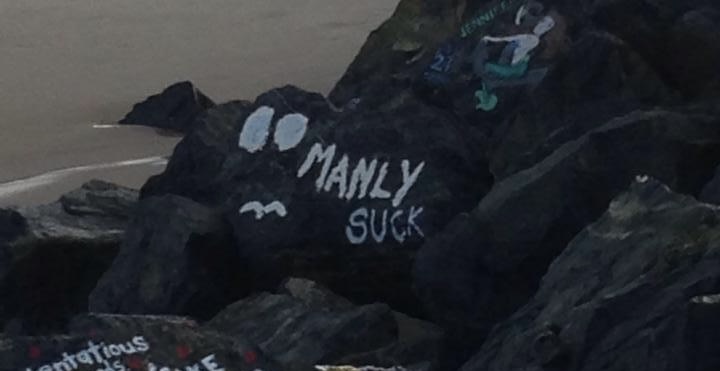
It’s set in stone
The Theoretical and Practical Drivers of Team Development
The season so far has felt stop-start, with injuries and changing combinations repeatedly disrupting cohesion and resetting progress. Yet beneath the fluctuating form, there have been glimpses of clarity and connection that suggest a side building toward something greater. Viewed from a theoretical perspective, it starts to look less like a team drifting without direction and more like one moving (sometimes messily) through the natural stages of team development.
Tuckman’s Model breaks down team development into five universal stages: forming, storming, norming, performing and adjourning. While more commonly applied in corporate settings, its theories translate strongly to performance in a sports team setting, particularly for a side like Parramatta who are navigating change and pressure in real time. Paired with collective efficacy; the shared belief in the system, each other and the group’s capacity to succeed; it helps explain how teams develop, and whether that development accelerates or stalls. Because the more a team trusts the plan and one another, the less they hesitate, and that belief can be the difference between a team surviving and genuinely competing.
It might sound like I’m whistling in the wind again with my books in tow, but hear me out. Because when you map Tuckman’s theory, and collective efficacy behavioural factors against Parra’s form and results, the whole season starts to make a lot more sense, even for skeptics.
Forming – Early Season (Rounds 1–2) – Low but Building Collective Efficacy
Forming is driven by uncertainty and poor cohesion. The heavy Round 1 loss exposed a side still searching for identity, combinations and rhythm, while the Round 2 win over Brisbane showed promise without yet delivering fluency. Effort was present, but cohesion was still developing; the team looked moderately functional rather than polished, instinctive and intuitive.
From a collective efficacy perspective, belief at Forming stage is more individual than shared. Players largely trust their own roles, but not yet the system or each other, which helps explain the sense of effort without full alignment. A team still building the trust and cohesion required for consistent performance.
- Psychologically: Players are cautious and approval-seeking, thinking more than reacting, which slows instinctive play.
- Physically: Effort is high, but inefficient, extra movement and overcompensation due to uncertainty in positioning.
- Behaviourally: “Stick to my job” mindset, limited communication, low-risk play, minimal on-field direction.
- Sociologically: Relationships are polite but superficial, combinations exist on paper, not yet built on trust or shared understanding.
Storming – The Rough Patch (Rounds 3–6) Threatened Collective Efficacy
Storming is where friction replaces early optimism. Despite a strong Round 3 performance, inconsistency soon crept in and rounds 4-6 saw a steady decline in performance. Defensive lapses, concentration errors and visible frustration, contributed to overall underperformance, as injuries put the remaining squad under pressure. The adverse causation of many injuries and media/fan scrutiny only intensified that strain, disrupting combinations and leaving the side at times caught between overthinking and under-executing.
Storming is where collective efficacy is either diminished or strengthened. Poor results and disruption won’t just affect tactics; they will challenge the teams shared belief in their ability to succeed. With that in mind, round 3-6 feels less like failure and more like a team working through tension and towards cohesion.
- Psychologically: Frustration and self-doubt creep in & players begin questioning roles, decisions, and systems.
- Physically: Fatigue compounds errors, defensive lapses and missed tackles increase as pressure builds.
- Behaviourally: Visible frustration, overcalling, overplaying, or individuals trying to “fix” things themselves.
- Sociologically: Tension rises, blame (internal or external), media noise, fan angst, and injuries disrupt cohesion, role clarity, and trust.
Norming – Reset & Clarity (Round 7 [Reality] + Round 8-10 [Hope]) Rebuilding Collective Efficacy
Norming begins when clarity replaces confusion, and for mine the teams Round 7 response signalled the commencement of that shift. After weeks of inconsistency, the team simplified its approach: clearer roles, more direct structures, and improved communication across the park. Instead of overplaying, they trusted the system.
The key change was alignment. Players looked more decisive, more connected, and more willing to trust both their role and each other. This is the essence of norming: not perfection, but shared understanding. The noise quietens, standards stabilise, and the team begins to move as one rather than as individuals. Clarity of roles and improved communication restores trust, not just in the plan, but in each other’s ability to execute it.
The Round 7 reset was a textbook collective efficacy moment. Simpler structures = less doubt. Clear roles = faster decisions. As soon as players trust the system, they stop second-guessing and performance lifts.
- Psychologically: Confidence stabilises; players trust their role and stop overthinking.
- Physically: Movement becomes more efficient, better spacing, timing, and reduced wasted effort.
- Behaviourally: Communication improves, clearer calls, better alignment, and disciplined execution of structure.
- Sociologically: Trust builds, combinations strengthen, shared standards emerge, and accountability becomes collective.
Performing – What They’re Capable Of (Round 11 & beyond) – Optimum Collective Efficacy
The Eels haven’t played at this level since the tail end of last season, though last week gave us some unmistakable glimpses of what might be possible. When they hit performing mode, their game becomes fast, instinctive, and difficult to defend, attack flows naturally, and decision-making becomes automatic rather than forced. This is where effort meets clarity, not just working hard, but working in-sync.
The challenge is no longer capability, it’s sustainability. High performing teams don’t just find this level; they hold onto it. Collective efficacy is strong, stable, and self-reinforcing. The glimpses of fast, instinctive footy are exactly that. Players aren’t thinking “what if this doesn’t work?” they are playing with the assumption that it will. That belief is what turns structure into flow.
- Psychologically: Clarity and belief, players operate instinctively with high confidence and composure.
- Physically: Peak efficiency, speed, timing, and execution align; energy is directed, not wasted.
- Behaviourally: Cohesive, adaptive play, systems are executed fluidly, with the ability to adjust in real time.
- Sociologically: Strong identity trust, connection, and shared purpose drive consistent, high-level performance.
Adjourning — The Final Stage – A discussion for September – Reflective Collective Efficacy
Adjourning is the often-overlooked fifth stage. In a rugby league context, this typically aligns with the end of a season, or fingers crossed, a finals campaign. Adjourning would involve reviewing the season: What worked, what didn’t, and how the team evolved, while also managing player departures, new signings, and resetting for the following year.
Importantly, adjourning isn’t just an ending, it’s a bridge to the next forming stage. The quality of reflection, learning, and closure here often determines how quickly a team can reconnect, rebuild cohesion, and accelerate back through the early stages the following season. And on that note, let’s shelve this stage in anticipation of a positive reflective discussion in September.
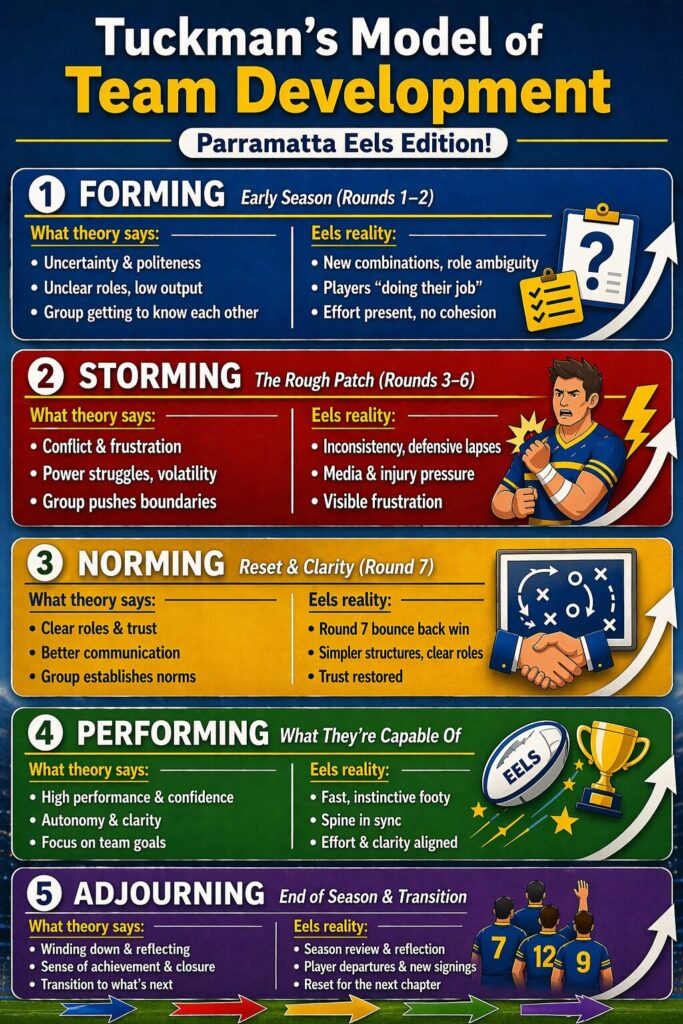
Adapted from Bruce Tuckman’s Model of Team Development
Final Thought
One important nuance often missed in Tuckman’s Model is that team development isn’t a straight line, it’s more of a loop. Teams don’t simply move from forming to storming to norming to performing and stay there. They progress, regress, and often revisit earlier stages when disrupted by injuries, changing combinations, fatigue, tactical shifts or confidence shocks. This is where collective efficacy matters most. When disruption hits, shared belief gets tested; when recovery begins, that same belief accelerates restored cohesion. The stronger the trust in the system and in each other, the shorter the loop.
The opening rounds reflected forming, the rough patch looked like storming, Round 7 hinted at norming, and injuries or selection changes could trigger regressions back into storming before cohesion can rebuild. That isn’t failure; that’s development under pressure. High-performing teams aren’t immune to failures, they recognise disruption early, restore clarity quickly, and cycle back toward cohesion faster.
Against the Bulldogs, the team showed what performing looks like, the challenge now is consistency. If they can continue to hold onto the structure and simplicity that underpinned the round 7 reset, they won’t just compete in games, they’ll start to control them.
So, on that note, bring on Sunday; though you won’t see me there. My multi-generational inherited disdain does not permit me to step on tarnished soil or fund the enemy under any circumstances. It is what it is.
Roly-Poly Parra


Good post.. also so many variables. Will the ref put whistle away next game? Or in the following game?
The other big variable is eels major players are above 30 so consistency is likely going to not be possible on their ageing bodies. We saw Jnr play well, and no surprise the whole team followed.
Ideally the eels need to sign a marquee or experienced prop in his prime for 2027 to support Jnr, otherwise consistency may never come.. can’t expect spine & backline to thrive in games we have no go forward. Fix / bolster that area (middle) and I think consistency will follow. Big Jr is a great player, just too old to play every week like he did against the dogs.
Thanks Muz, I appreciate your support and perspective.
There are indeed so many variables, some consistency would be nice. I originally mentioned Gough but then thought I would see how Sunday plays out before I rip in as redemption is also a possibility.
A marquee forward and junior off the bench would be optimal. Its less about his play nowadays and more about the impact of his presence/influence.
Excellent analysis.
Thank you, I appreciate the support. I am really stoked with how this one came together. As late as about 11pm, I wasn’t sure it would; but then like the team last week, this morning everything suddenly clicked. It’s a bit of a mixed bag but now that I fixed the typos and formatting errors it flows well. I am officially banning myself from pre-coffee early morning uploads.
My parents were Souths supporters. Didn’t care who I followed just not Manly. For me the hatred comes from the way back in the day they seem to get a way with heaps more stuff. My dad use to hate them player stealing, I hated when they found guilty of breaching the cap for 5 consecutive years but didn’t lose any points only a fine.
The development theory is a clever bit on the season. I can also think of teams that I have been a part of in work and in sport that went through stages like this. My hockey team always has a big win the loses to the worst team too.
Hi MiriaEel73,
Thanks for your insights.
The reasoning behind the salary cap decision was really bizarre for mine. NRL: “They broke the cap for 5 years but they aren’t breaking it now so never mind just pay a fine and all is forgiven”.
For me in general it’s “all of the above”. If I had to pick one thing it would be the Steven Dank stuff. Cronulla are still haunted and he was only there for 5 months. He was at Manly for 5 years and nobody mentions it.
Two very bizarre but highly relevant examples.
With the Team theory, I love that you were able to connect it to teams you are in. It’s a great reflective tool I find. I can connect Tuckmans stages in one way or another to most of the teams I have worked in. It’s such a transferable model across professions, industries and life.
I feel I can connect the stages to my performance as a parent too weirdly (me being the manager and the kids my team). Some weeks I feel like a combo of Maude Flanders and Mary Poppins and other weeks I feel like Rosanne Connor meets Peg Bundy. It’s a vicious loop really.
Thanks Roly,
I always enjoy the different perspective you bring. Just makes me think about things in a different way which is always a good thing.
That said, revisiting Tuckman’s model brought back some nightmares of various team meetings and training courses from my time in the public sector. No wonder we drank a bit back then!
The Manly thing is almost visceral isn’t it. The old question who do you support answered by team X and whoever is playing Manly.
I’ve mentioned before that my time supporting the Eels started as a young tracker around the 1976 GF. Lots of blue and gold ribbons on car aerials. My old man explained to me there was a footy GF on and the blue and gold was for the Eels. I asked what the other team colours were. Luckily for me I liked blue and gold more than maroon and white or I could’ve ended up a Manly supporter to my eternal shame!